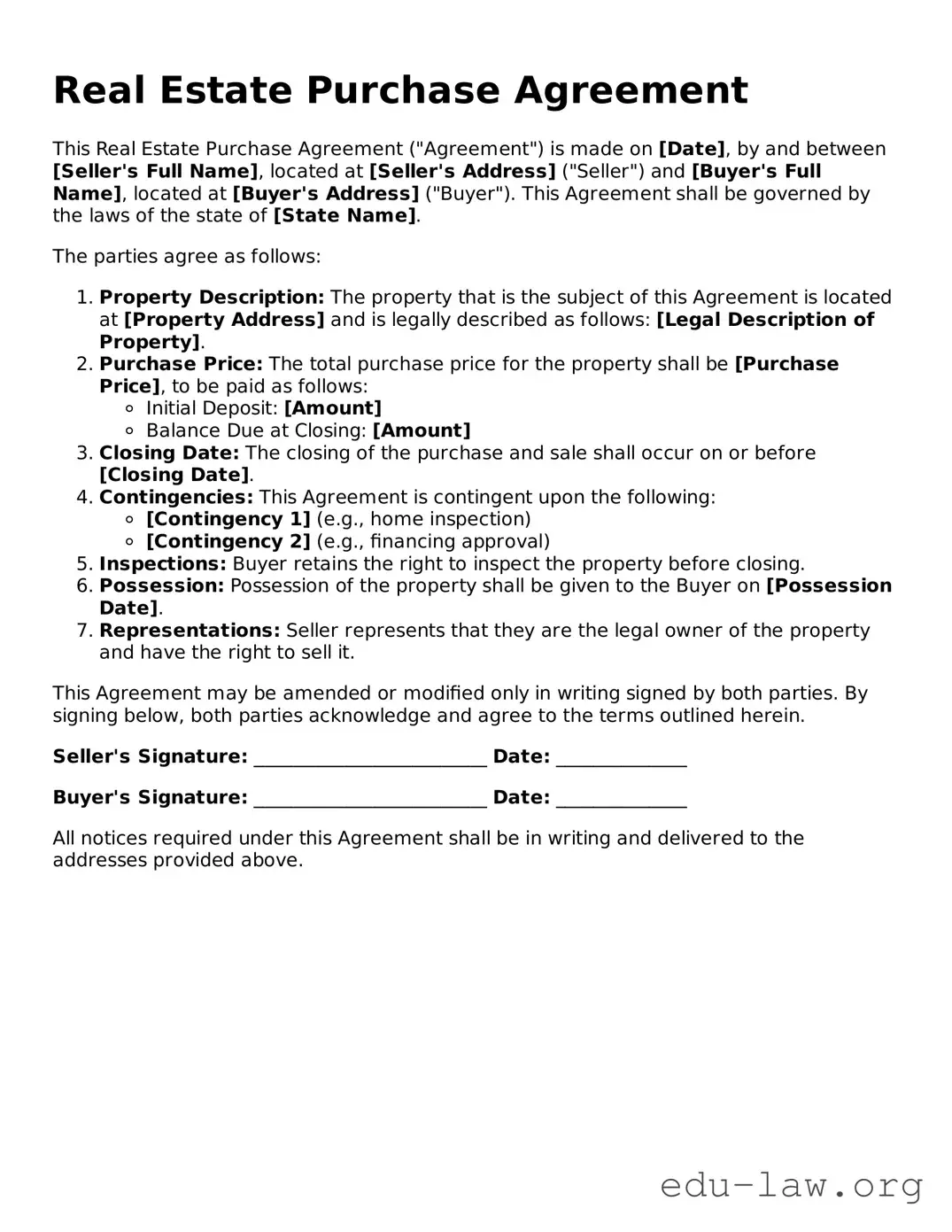
The Real Estate Purchase Agreement (REPA) plays a crucial role in the property transaction process, serving as a binding contract between the buyer and seller. It outlines essential details such as the purchase price, financing terms, and the property’s legal description, ensuring that both parties understand their obligations. In addition, the agreement specifies contingencies that must be met before the sale can proceed, such as home inspections or financing approvals. It also addresses key dates, including the closing date and any deadlines for inspections or earnest money payments. By clearly delineating the rights and responsibilities of each party, the REPA minimizes misunderstandings and potential disputes, fostering a smoother transaction experience. This comprehensive document not only helps to protect buyers and sellers but also establishes the groundwork for a successful transfer of property ownership.
Real Estate Purchase Agreement
This Real Estate Purchase Agreement ("Agreement") is made on [Date], by and between [Seller's Full Name], located at [Seller's Address] ("Seller") and [Buyer's Full Name], located at [Buyer's Address] ("Buyer"). This Agreement shall be governed by the laws of the state of [State Name].
The parties agree as follows:
This Agreement may be amended or modified only in writing signed by both parties. By signing below, both parties acknowledge and agree to the terms outlined herein.
Seller's Signature: _________________________ Date: ______________
Buyer's Signature: _________________________ Date: ______________
All notices required under this Agreement shall be in writing and delivered to the addresses provided above.
| Fact Name | Details |
|---|---|
| Definition | A Real Estate Purchase Agreement is a contract to buy and sell property. |
| Purpose | This agreement outlines the terms and conditions of a real estate transaction. |
| Common Elements | It typically includes buyer and seller information, property description, price, and closing date. |
| Variation by State | Forms may differ by state; local laws govern specific requirements. |
| Escrow Instructions | Often, the agreement includes instructions for the escrow process. |
| Contingencies | Buyers can include contingencies, such as home inspections or financing conditions. |
| Negotiable Terms | Many terms within the agreement are negotiable between the parties. |
| Governing Law | Each state has its governing law; for example, California follows the California Civil Code. |
After completing the Real Estate Purchase Agreement form, the next step involves submitting it to the relevant parties for review and negotiation. The form sets the foundation for the transaction, allowing both buyers and sellers to agree on the terms before proceeding further.
What is a Real Estate Purchase Agreement?
A Real Estate Purchase Agreement is a legally binding document between a buyer and a seller. It outlines the terms and conditions related to the sale of real estate. This includes details such as the purchase price, the closing date, and any contingencies needed to finalize the sale. It's essential for protecting both parties' interests during the transaction.
What are the key components of a Real Estate Purchase Agreement?
The key components typically include the names and contact information of both parties, a detailed description of the property, the agreed-upon purchase price, payment details, and closing date. Additionally, it may outline contingencies such as financing, inspections, and appraisal conditions. Each of these elements plays a vital role in ensuring clarity throughout the process.
Why is it important to have a Real Estate Purchase Agreement?
This agreement serves as a formal record of the terms agreed upon by both parties. It helps to prevent disputes by clearly outlining each party's responsibilities and expectations. Without this document, misunderstandings can arise, and one party may not fulfill their obligations, leading to potential legal issues down the line.
Can a Real Estate Purchase Agreement be modified?
Yes, a Real Estate Purchase Agreement can be modified, but any changes must be documented in writing and signed by both parties. Common reasons for modifications might include changes to the closing date or adjustments to the purchase price. These changes help ensure that both parties remain satisfied with the agreement as circumstances evolve.
What happens if one party breaches the Real Estate Purchase Agreement?
If one party fails to fulfill their obligations under the agreement, it is considered a breach. The non-breaching party typically has the right to seek legal remedies. These can include specific performance, where the court orders the breaching party to complete the transaction, or monetary damages for any losses suffered because of the breach.
Is a Real Estate Purchase Agreement the same as a lease agreement?
No, a Real Estate Purchase Agreement and a lease agreement are not the same. A purchase agreement is designed for the sale of property, while a lease agreement pertains to renting or leasing property for a specific period. The key difference lies in ownership transfer; a purchase agreement aims to convey ownership, whereas a lease retains ownership with the landlord.
Do I need a lawyer to draft a Real Estate Purchase Agreement?
While it is possible to find templates online or complete the agreement without legal assistance, consulting a lawyer is advisable. A lawyer can help ensure that the agreement accurately reflects your intentions and complies with local laws. They can also assist in negotiating terms, which may provide additional protection for both parties.
What should I do after signing a Real Estate Purchase Agreement?
Once you have signed the agreement, it becomes legally binding. Both parties should keep copies for their records. It is important to follow through with the outlined contingencies, such as obtaining financing or completing inspecitons. Additionally, actively communicating with the other party can help ensure a smooth closing process.
Incomplete Information: Failing to provide all necessary details can lead to misunderstandings. Many buyers forget to include their legal names or miss essential contact information, which can complicate communication.
Incorrect Property Description: When describing the property, precision is crucial. Some people inadvertently provide an inaccurate address or omit necessary identifying details, which might create disputes later.
Missing Signatures: A common oversight is neglecting to sign the document. All parties involved in the agreement need to provide their signatures. An unsigned agreement lacks legal validity.
Not Specifying Contingencies: Buyers should clearly outline any contingencies, such as inspections or financing. Omitting these can cause problems if certain conditions aren’t met before the sale.
Ignoring Deadlines: Every agreement has critical dates that must be adhered to, including offers and responses. Forgetting these deadlines can lead to a missed opportunity or unfavorable terms.
Incorrect Earnest Money Details: This part of the agreement signifies commitment. Failing to state the amount or providing misleading information about how it will be handled can create issues during the transaction.
When completing a Real Estate Purchase Agreement, attention to detail is key. Avoiding these common mistakes can pave the way for a smoother transaction and minimize potential legal disputes.
When entering into a real estate transaction, the Real Estate Purchase Agreement is often accompanied by several important documents. These documents help clarify the terms of the transaction, protect the interests of the parties involved, and ensure a smooth closing process. Here are five common documents you might encounter:
Together, these documents and the Real Estate Purchase Agreement form a comprehensive framework for your real estate transaction. Familiarity with each document will help ensure that you navigate the process confidently and securely.
The Real Estate Purchase Agreement is akin to the Lease Agreement. Both documents outline the terms of occupancy and payment for a property; however, while a Purchase Agreement involves the transfer of ownership, a Lease Agreement outlines rental terms between a tenant and landlord. Both agreements must detail critical factors such as the duration of the arrangement, payment amounts, and responsibilities of each party.
A similar document is the Listing Agreement, which is used when a property owner hires a real estate agent to sell their home. This agreement governs the relationship between the seller and the agent, detailing commissions and marketing strategies. While a Purchase Agreement focuses on the transfer of ownership, the Listing Agreement lays the groundwork for bringing a buyer to the table.
The Addendum is another related document. An addendum is used to modify or add to an existing Purchase Agreement without drafting a completely new contract. This flexibility allows for necessary changes, such as home inspection contingencies or financing adjustments, while preserving the main terms of the original contract.
Option Agreements also share similarities with the Purchase Agreement. An Option Agreement grants a potential buyer the right to purchase a property at a specified price within a set time frame. This creates a commitment from the seller while allowing the buyer the ability to evaluate the property without immediate financial obligation.
The Purchase and Sale Agreement is closely linked to the Real Estate Purchase Agreement. Although they may use different terminology in various regions, both serve the same purpose: documenting the agreement between buyer and seller regarding property transfer. Both forms outline the price, property details, and conditions of sale.
Another document that resembles the Purchase Agreement is the Joint Venture Agreement. If multiple parties collaborate to purchase a piece of real estate, a Joint Venture Agreement outlines each party’s contributions and shares in the property. This document is crucial for clarity and trust between co-investors.
The Mortgage Agreement is another important document, as it authorizes a lender to secure a loan with the property being purchased. While it focuses on the loan terms and conditions, it often accompanies the Purchase Agreement since the buyer usually requires financing to complete the purchase.
Lastly, a Seller’s Disclosure Agreement often pairs with a Real Estate Purchase Agreement. This document provides the buyer with necessary information about the property’s condition, including any known issues or legal guidelines impacting the sale. Transparency is essential in real estate transactions, making this disclosure vital for informed decision-making by the buyer.
When filling out the Real Estate Purchase Agreement form, it's crucial to approach it with care and attention to detail. Here are some essential dos and don'ts to keep in mind:
By adhering to these guidelines, you can avoid common pitfalls and streamline the process for all parties involved.
The Real Estate Purchase Agreement (RPA) is a vital document in property transactions. However, many people hold misconceptions about it. Below are nine common misunderstandings regarding this form:
While the RPA provides a framework, certain aspects must be tailored to fit specific properties or situations. Customization ensures in-depth compliance with local laws.
Signing the agreement indicates acceptance of the terms but does not finalize the sale. The agreement may still depend on contingencies and other conditions being met.
Both the buyer and the seller must sign the document for it to be legally binding. The agreement outlines mutual obligations.
While the price is essential, the RPA also includes contingencies, closing dates, and other terms that define the entire transaction.
Verbal agreements can lead to misunderstandings and are often unenforceable. All agreements should be included in writing within the RPA.
Changes may occur with mutual consent from both parties. Any amendments should be documented formally to ensure clarity.
The RPA primarily reflects the interests of the buyer. Sellers should have their attorneys review the document to ensure their rights are protected.
While it’s possible, working with a qualified agent or attorney can prevent errors or omissions that may arise in this complex document.
The RPA is critical in commercial and vacant land transactions too. Each type of real estate transaction benefits from a carefully drafted RPA.
Filling out and using a Real Estate Purchase Agreement can feel overwhelming. However, understanding the key elements can make the process smoother. Here are some important takeaways to consider:
By paying attention to these key points, you can navigate the Real Estate Purchase Agreement with greater confidence. It's important to ensure that all parties are clear about their rights and obligations in order to avoid potential disputes later on.
Passport Renewal Perth - Be aware that images in the finalized passport may not be photo-realistic due to printing requirements.
Owner Finance Agreement - Sellers can potentially receive a steady stream of income over the life of the loan through owner financing.