In the realm of real estate transactions, confidentiality plays a crucial role in maintaining trust and protecting sensitive information. A Real Estate Non-Disclosure Agreement (NDA) serves as a vital tool in this process, ensuring that all parties involved agree to keep certain information private. This form typically outlines the specific details that must remain confidential, such as financial data, property valuations, and proprietary business strategies. By clearly defining what constitutes confidential information, the NDA helps prevent unauthorized disclosures that could potentially harm any party’s interests. Additionally, the document often includes terms regarding the duration of the confidentiality obligation and the consequences of any breaches. Understanding the importance of this agreement can empower individuals and businesses alike to navigate the complexities of real estate dealings with greater confidence and security.
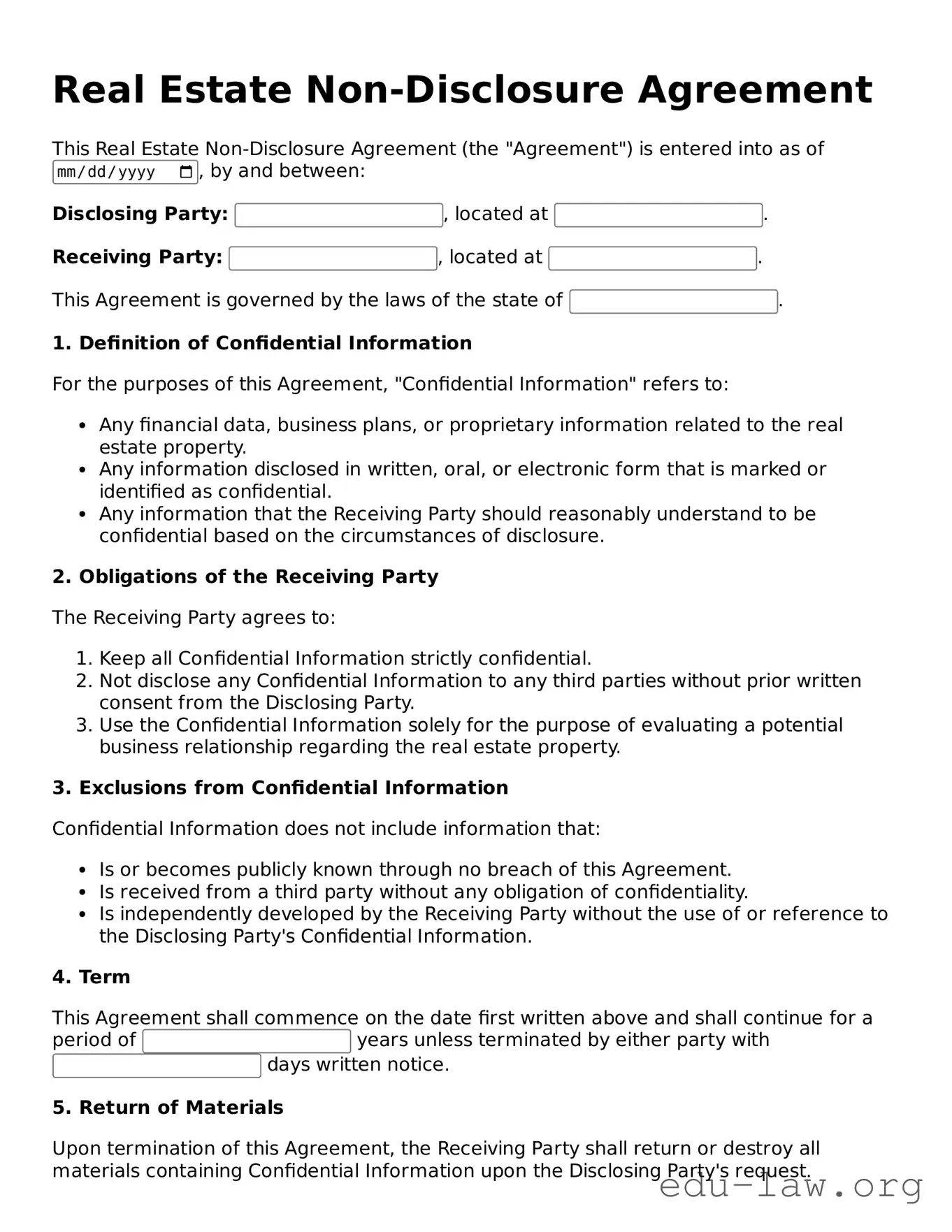
Real Estate Non-Disclosure Agreement
This Real Estate Non-Disclosure Agreement (the "Agreement") is entered into as of , by and between:
Disclosing Party: , located at .
Receiving Party: , located at .
This Agreement is governed by the laws of the state of .
1. Definition of Confidential Information
For the purposes of this Agreement, "Confidential Information" refers to:
2. Obligations of the Receiving Party
The Receiving Party agrees to:
3. Exclusions from Confidential Information
Confidential Information does not include information that:
4. Term
This Agreement shall commence on the date first written above and shall continue for a period of years unless terminated by either party with days written notice.
5. Return of Materials
Upon termination of this Agreement, the Receiving Party shall return or destroy all materials containing Confidential Information upon the Disclosing Party's request.
6. No License
Nothing in this Agreement grants the Receiving Party any rights in or to the Disclosing Party's Confidential Information, except as expressly set forth herein.
7. Governing Law
This Agreement shall be governed by and construed in accordance with the laws of the state of .
IN WITNESS WHEREOF, the parties hereto have executed this Non-Disclosure Agreement as of the date first above written.
Disclosing Party Signature: ___________________________
Receiving Party Signature: ___________________________
| Fact Name | Description |
|---|---|
| Purpose | A Real Estate Non-Disclosure Agreement (NDA) protects sensitive information shared during real estate transactions. |
| Parties Involved | The agreement typically involves a seller and a buyer, or a landlord and a tenant, ensuring confidentiality between them. |
| Governing Law (California) | In California, the NDA is governed by California Civil Code Section 1624, which outlines the requirements for enforceability. |
| Governing Law (New York) | In New York, the NDA is subject to New York General Obligations Law, which provides the framework for confidentiality agreements. |
Completing the Real Estate Non-Disclosure Agreement (NDA) form is an essential step in ensuring confidentiality during real estate transactions. By following the steps outlined below, you can accurately fill out the form and protect sensitive information.
What is a Real Estate Non-Disclosure Agreement?
A Real Estate Non-Disclosure Agreement (NDA) is a legal document designed to protect sensitive information exchanged between parties involved in a real estate transaction. It ensures that confidential details, such as financial data, property information, and negotiation strategies, remain private and are not disclosed to unauthorized individuals or entities.
Who typically uses a Real Estate Non-Disclosure Agreement?
This agreement is commonly used by real estate agents, brokers, buyers, sellers, and investors. Whenever parties are discussing the sale or purchase of a property, or when they are evaluating investment opportunities, an NDA helps safeguard proprietary information that could impact negotiations or market value.
What information is protected under a Real Estate Non-Disclosure Agreement?
The NDA protects any confidential information shared during the negotiation process. This can include, but is not limited to, financial records, property valuations, marketing strategies, and any unique terms discussed that are not meant for public knowledge. The goal is to keep all sensitive information secure.
How long does the confidentiality obligation last?
The duration of the confidentiality obligation is typically specified in the NDA itself. It can vary based on the needs of the parties involved. Common terms range from a few years to indefinitely, depending on the nature of the information and the agreement between the parties.
What happens if someone breaches the agreement?
If a party breaches the NDA, the affected party may pursue legal action for damages. This can include seeking monetary compensation for any losses incurred due to the disclosure of confidential information. Additionally, the breaching party may be subject to injunctions to prevent further disclosure.
Can a Real Estate Non-Disclosure Agreement be modified?
Yes, a Real Estate Non-Disclosure Agreement can be modified. Any changes must be agreed upon by all parties involved and documented in writing. It is essential to ensure that all modifications are clear and legally binding to avoid future disputes.
Is a Real Estate Non-Disclosure Agreement legally binding?
Yes, a properly executed Real Estate Non-Disclosure Agreement is legally binding. For it to be enforceable, it should be signed by all parties involved and include clear terms regarding the confidential information and the obligations of each party. It is advisable to consult with a legal professional to ensure that the agreement meets all necessary legal requirements.
Do I need a lawyer to create a Real Estate Non-Disclosure Agreement?
While it is possible to draft an NDA without legal assistance, consulting with a lawyer is highly recommended. A legal professional can help tailor the agreement to meet specific needs, ensure compliance with state laws, and provide guidance on best practices for protecting confidential information.
Failing to provide complete information. When filling out the Real Estate Non-Disclosure Agreement (NDA), it is crucial to include all necessary details. Omitting information can lead to misunderstandings or disputes later on.
Not understanding the terms of confidentiality. People often overlook the specific terms outlined in the NDA. It is important to read and comprehend what information is considered confidential and how it should be handled.
Using vague language. Clarity is essential in legal documents. If terms or conditions are not clearly defined, it may create confusion regarding what is protected under the agreement.
Neglecting to sign and date the agreement. A common mistake is failing to sign and date the NDA. Without signatures, the agreement may not be legally binding, which can compromise the intended protections.
When engaging in real estate transactions, several important forms and documents often accompany the Real Estate Non-Disclosure Agreement (NDA). Each of these documents serves a unique purpose, helping to protect the interests of all parties involved. Below is a list of some commonly used forms that may be relevant.
Understanding these documents is essential for anyone involved in a real estate transaction. Each one plays a vital role in ensuring that the process runs smoothly and that all parties are protected. Familiarity with these forms can lead to a more confident and informed experience.
A Confidentiality Agreement, often used in business contexts, shares similarities with a Real Estate Non-Disclosure Agreement (NDA). Both documents aim to protect sensitive information from being disclosed to unauthorized parties. In a Confidentiality Agreement, parties agree to keep certain information private, which can include trade secrets, financial data, or proprietary processes. Just like a Real Estate NDA, it outlines the scope of confidential information, the obligations of the parties involved, and the duration of confidentiality. The focus remains on safeguarding information that, if leaked, could harm one or both parties.
An Employment Non-Disclosure Agreement is another document that closely resembles a Real Estate NDA. This agreement is commonly used when an employee has access to confidential company information. Similar to a Real Estate NDA, it restricts the employee from sharing sensitive information with outside parties. The agreement typically specifies what constitutes confidential information, the responsibilities of the employee, and the consequences of breach. Both documents serve the purpose of protecting proprietary information, albeit in different contexts.
A License Agreement can bear similarities to a Real Estate NDA, particularly when it involves the sharing of proprietary information related to property use or development. In a License Agreement, one party grants another the right to use certain intellectual property, often requiring the licensee to maintain confidentiality regarding that information. Both documents protect sensitive information from unauthorized disclosure. The License Agreement may specify what information is confidential and the obligations of the licensee, mirroring the protections found in a Real Estate NDA.
Lastly, a Partnership Agreement may also be similar to a Real Estate NDA, especially when partners are involved in real estate transactions. This document outlines the terms of the partnership, including the handling of confidential information. Both agreements emphasize the importance of confidentiality in maintaining trust and protecting the interests of the parties involved. A Partnership Agreement typically includes clauses regarding the confidentiality of business dealings, similar to those found in a Real Estate NDA, ensuring that sensitive information remains secure throughout the partnership.
When filling out a Real Estate Non-Disclosure Agreement (NDA), it’s essential to approach the process with care. Here are ten important guidelines to follow.
Real estate transactions often involve sensitive information, and the Real Estate Non-Disclosure Agreement (NDA) is designed to protect that information. However, several misconceptions about this form can lead to confusion. Here are five common misconceptions:
This is not true. Non-Disclosure Agreements can be useful in any real estate deal, regardless of size. Even smaller transactions can involve confidential information that needs protection.
While an NDA restricts sharing certain information, it does not prevent all communication. You can still discuss the property with relevant parties, such as your attorney or financial advisor, as long as they are also bound by confidentiality.
Both buyers and sellers can benefit from NDAs. Sellers may want to protect their financial information or proprietary business practices, while buyers may need to safeguard their investment strategies.
This is a misconception. NDAs can vary significantly in terms of scope, duration, and specific clauses. It’s important to tailor the agreement to fit the unique circumstances of the transaction.
Not necessarily. Many NDAs include a specific time frame during which the confidentiality obligations apply. Once that period expires, the parties may be free to share the information without repercussions.
Understanding these misconceptions can help individuals navigate the complexities of real estate transactions more effectively. By recognizing the true purpose and limitations of a Non-Disclosure Agreement, parties can better protect their interests.
When dealing with a Real Estate Non-Disclosure Agreement (NDA), it's essential to understand its purpose and how to use it effectively. Here are some key takeaways to consider:
Understanding these key points can help you navigate the complexities of real estate transactions while safeguarding your sensitive information.