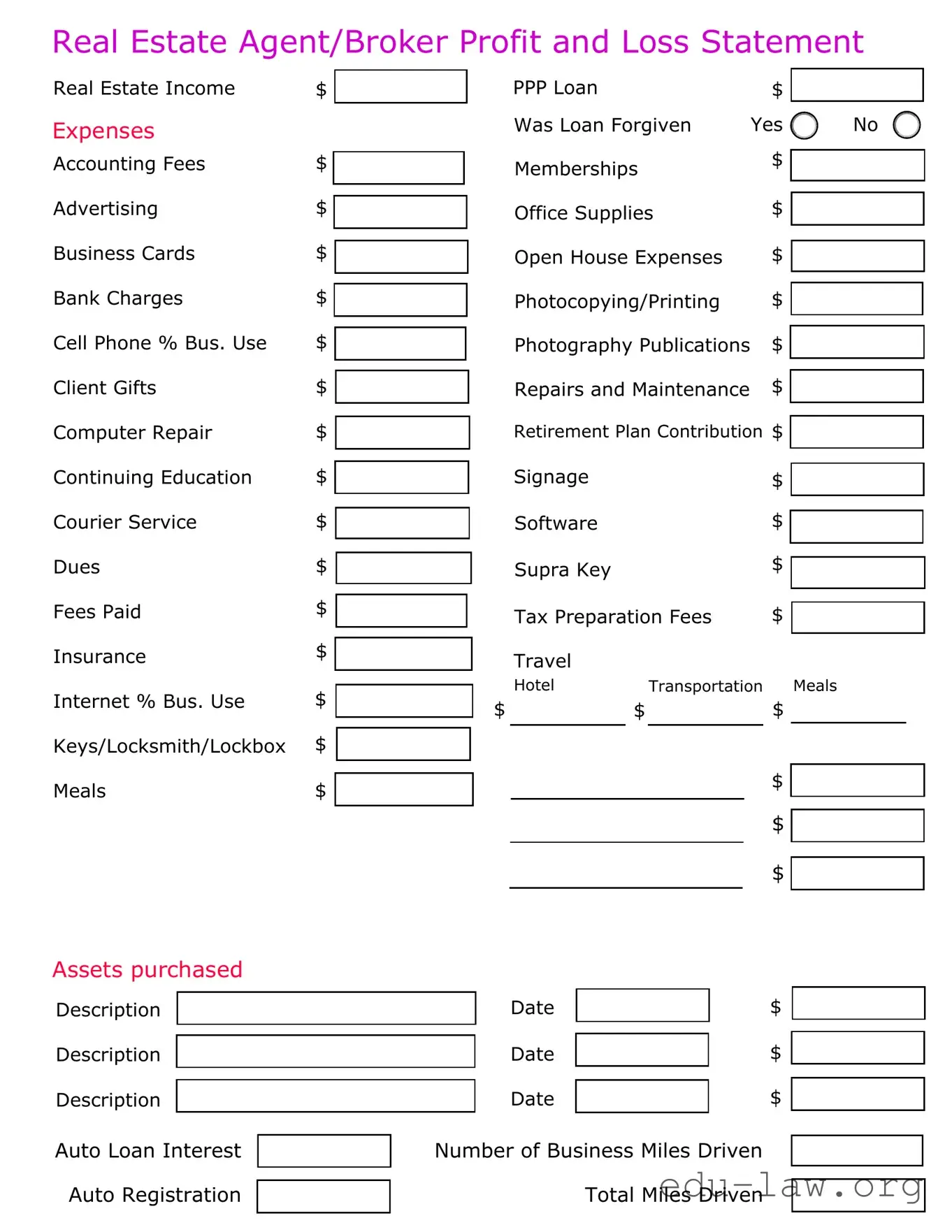
The Real Estate Agent Profit form serves as a vital tool for agents and brokers to assess their financial performance over a specified period. This comprehensive document includes a detailed Profit and Loss Statement that outlines various income sources and expenses incurred in the course of conducting real estate business. Income may derive from commissions, referrals, or other real estate-related activities, while expenses encompass a wide range of operational costs. These costs can include accounting fees, advertising, and business cards, as well as ongoing expenses such as cell phone usage, insurance, and travel. The form also allows for the inclusion of specific items like client gifts and educational expenses, which are essential for professional development. Furthermore, it captures information regarding assets purchased, auto-related costs, and business mileage, providing a complete picture of the financial landscape. By systematically documenting these elements, real estate professionals can better understand their profitability, prepare for tax obligations, and make informed decisions about future investments.

Real Estate Agent/Broker Profit and Loss Statement
Real Estate Income $
Expenses
Accounting Fees |
$ |
Advertising |
$ |
Business Cards |
$ |
Bank Charges |
$ |
Cell Phone % Bus. Use |
$ |
Client Gifts |
$ |
Computer Repair |
$ |
Continuing Education |
$ |
Courier Service |
$ |
Dues |
$ |
Fees Paid |
$ |
Insurance |
$ |
Internet % Bus. Use |
$ |
Keys/Locksmith/Lockbox |
$ |
Meals |
$ |
PPP Loan |
|
$ |
|
|
Was Loan Forgiven |
Yes |
No |
||
Memberships |
|
$ |
|
|
|
|
|||
|
|
|
|
|
Office Supplies |
$ |
|
|
|
|
|
|||
Open House Expenses |
$ |
|
|
|
|
|
|||
Photocopying/Printing |
$ |
|
|
|
|
|
|||
Photography Publications |
$ |
|
|
|
|
|
|||
Repairs and Maintenance |
$ |
|
|
|
|
|
|||
|
|
|||
Retirement Plan Contribution $ |
|
|||
Signage |
|
$ |
|
|
|
|
|
||
|
|
|
||
Software |
|
$ |
|
|
|
|
|
||
|
|
|
||
Supra Key |
|
$ |
|
|
|
|
|
||
|
|
|
||
|
|
|
|
|
Tax Preparation Fees |
$ |
|
|
|
|
|
|||
|
|
|||
Travel |
|
|
|
|
|
|
|
|
|
Hotel |
Transportation |
Meals |
||
$$$
$
$
$
Assets purchased
Description
Description
Description
Auto Loan Interest
Auto Registration
Date |
|
$ |
|
|
|
Date |
|
$ |
|
|
|
Date |
|
$ |
Number of Business Miles Driven
Total Miles Driven
| Fact Name | Detail |
|---|---|
| Form Purpose | This form is designed to help real estate agents and brokers calculate their profit and loss from their business activities. |
| Income Section | Agents report their total real estate income, which includes commissions and other revenue sources. |
| Expense Categories | Expenses are categorized into various types, such as advertising, office supplies, and continuing education. |
| PPP Loan Information | The form includes a section to indicate whether a Paycheck Protection Program (PPP) loan was received and if it was forgiven. |
| Tax Preparation Fees | Agents can list their expenses for tax preparation, which is important for accurate reporting. |
| Business Use Percentage | For certain expenses like cell phone and internet, agents must indicate the percentage used for business purposes. |
| Asset Reporting | Agents must report assets purchased, including vehicles, along with related expenses like auto loan interest. |
| Governing Laws | This form is governed by state-specific real estate laws and regulations, which may vary by location. |
| Business Mileage Tracking | Agents should track business miles driven, as this can significantly impact their tax deductions. |
Completing the Real Estate Agent Profit form requires careful attention to detail. Accurate reporting of income and expenses will provide a clearer picture of your financial standing. Follow these steps to fill out the form correctly.
After completing the form, review all entries for accuracy. Ensure that the income and expenses are correctly totaled. This will help in assessing your financial performance effectively.
What is the Real Estate Agent Profit form used for?
The Real Estate Agent Profit form is designed to help real estate agents and brokers track their income and expenses. By organizing this information, agents can gain insights into their profitability, prepare for tax season, and make informed business decisions. It serves as a comprehensive profit and loss statement, detailing various sources of income and types of expenses associated with running a real estate business.
What types of income should I report on the form?
On the Real Estate Agent Profit form, you should report all income related to your real estate activities. This includes commissions from sales, fees for services, and any other earnings directly linked to your work as an agent or broker. Be sure to keep accurate records of these income sources to ensure your financial reporting is precise.
What expenses can I deduct on the form?
You can deduct a wide range of business-related expenses on the form. Common deductions include accounting fees, advertising costs, cell phone expenses, and office supplies. Additionally, expenses related to continuing education, meals with clients, and travel for business purposes can also be deducted. Always keep receipts and documentation for these expenses to support your claims.
How do I determine the percentage of personal versus business use for expenses?
To determine the percentage of personal versus business use for expenses like your cell phone and internet, keep a log of your usage. For example, if you use your cell phone for business 70% of the time, you can deduct 70% of your monthly bill as a business expense. This method applies to any mixed-use expense, ensuring you only deduct the portion that is relevant to your real estate activities.
What should I do if I received a PPP loan?
If you received a Paycheck Protection Program (PPP) loan, you must indicate whether the loan was forgiven on the form. If it was forgiven, it may not be considered taxable income, but you should consult a tax professional for guidance on how it impacts your overall financial reporting and tax obligations.
How can I track my business miles effectively?
To track your business miles, maintain a detailed log that records the date, destination, purpose of the trip, and total miles driven. Many agents find it helpful to use a mileage tracking app or a simple spreadsheet. At the end of the year, you can total your business miles to report on the Real Estate Agent Profit form. This documentation is essential for claiming mileage deductions on your taxes.
Inaccurate Income Reporting: Some individuals may underestimate or overestimate their real estate income. It's essential to report all sources of income accurately to reflect true profitability.
Neglecting to Include All Expenses: Many agents forget to list all relevant expenses. This can include costs like advertising, office supplies, and continuing education, which can significantly impact the profit calculation.
Improper Categorization of Expenses: Misclassifying expenses can lead to confusion. For example, mixing personal and business expenses can skew the financial picture.
Ignoring Percentage-Based Expenses: Some costs, such as cell phone and internet usage, are often partially business-related. Failing to calculate the correct percentage can lead to inaccurate expense reporting.
Omitting Depreciation: Not accounting for depreciation on assets, like computers and vehicles, can misrepresent the financial status. It’s important to factor in how these assets lose value over time.
Failure to Document Mileage: Agents should keep accurate records of business miles driven. Not doing so can result in missed deductions, affecting the overall profit.
Neglecting to Update Information: Some agents might use outdated figures from previous years. Regularly updating the form ensures that it reflects the current financial situation.
Not Seeking Professional Help: Many people attempt to fill out the form without consulting a financial advisor or accountant. Professional guidance can help identify potential errors and maximize deductions.
When working in real estate, several forms and documents complement the Real Estate Agent Profit form. Each of these documents plays a crucial role in managing finances, maintaining compliance, and tracking important information. Below is a list of commonly used forms that can assist real estate agents in their operations.
Having these forms readily available can streamline operations and ensure that all necessary information is documented correctly. By utilizing these documents, real estate agents can manage their business more effectively and maintain a clear understanding of their financial situation.
The Real Estate Agent Profit form shares similarities with a Profit and Loss Statement. This document provides a comprehensive overview of income and expenses over a specific period. Just like the Profit form, a Profit and Loss Statement helps agents and brokers assess their financial performance, identify trends, and make informed business decisions. Both documents categorize income and expenses, allowing for a clear understanding of profitability and areas where costs can be reduced.
Another document that resembles the Real Estate Agent Profit form is the Income Statement. An Income Statement also details revenues and expenses, but it is typically used by businesses of all types, not just real estate professionals. This document helps in evaluating the overall financial health of a business. Similar to the Profit form, it provides a snapshot of earnings and expenditures, helping agents understand their financial standing and plan for future growth.
The Cash Flow Statement is yet another document that aligns with the Real Estate Agent Profit form. This statement focuses on the inflow and outflow of cash within a business over a specific time frame. Like the Profit form, it is crucial for understanding liquidity and ensuring that there are sufficient funds to cover expenses. Both documents serve as vital tools for financial management, enabling agents to maintain a healthy cash position while managing their operations effectively.
The Budget is a planning document that shares common ground with the Real Estate Agent Profit form. While the Profit form records actual income and expenses, a budget projects expected financial performance for a future period. Both documents require careful consideration of income sources and potential costs, allowing agents to set realistic financial goals. By comparing actual results to the budget, agents can identify variances and adjust their strategies accordingly.
The Expense Report is another document that is similar to the Real Estate Agent Profit form. This report itemizes business-related expenses incurred over a specific period, often submitted for reimbursement. Like the Profit form, it categorizes expenses and provides a detailed account of spending. Both documents help agents keep track of their financial activities and ensure that they are accurately reporting their costs for tax purposes.
Lastly, the Tax Return form is comparable to the Real Estate Agent Profit form. Tax Returns summarize income, expenses, and tax liabilities for a given year. While the Profit form is used for internal financial assessment, the Tax Return is submitted to the IRS for compliance. Both documents require accurate record-keeping and provide insights into an agent's financial situation. They play a crucial role in ensuring that all income is reported and that eligible deductions are claimed.
When filling out the Real Estate Agent Profit form, it's important to approach the process with care. Here are some helpful guidelines to consider:
There are several misconceptions about the Real Estate Agent Profit form that can lead to confusion. Understanding these misconceptions is essential for accurate financial reporting and effective business management.
This is not true. The Real Estate Agent Profit form is designed for agents and brokers of all sizes. Whether you are an independent agent or part of a larger brokerage, this form helps track income and expenses.
This misconception can lead to significant issues. Proper documentation is required for all expenses reported on the form. Receipts and records must be kept to substantiate claims during tax filings.
While tax reporting is a key function, the form also serves as a valuable tool for assessing the overall financial health of a real estate business. It provides insights into profitability and areas that may need improvement.
This is misleading. The form encompasses a wide range of expenses, including marketing costs, office supplies, and professional fees. All relevant costs that support the business operations should be included for a comprehensive view of profitability.
Filling out the Real Estate Agent Profit form can be a straightforward process if you keep a few key points in mind. Here are some essential takeaways to help you navigate this important document:
By following these takeaways, you can fill out the Real Estate Agent Profit form more effectively and ensure that you have a solid understanding of your financial standing in the real estate industry.