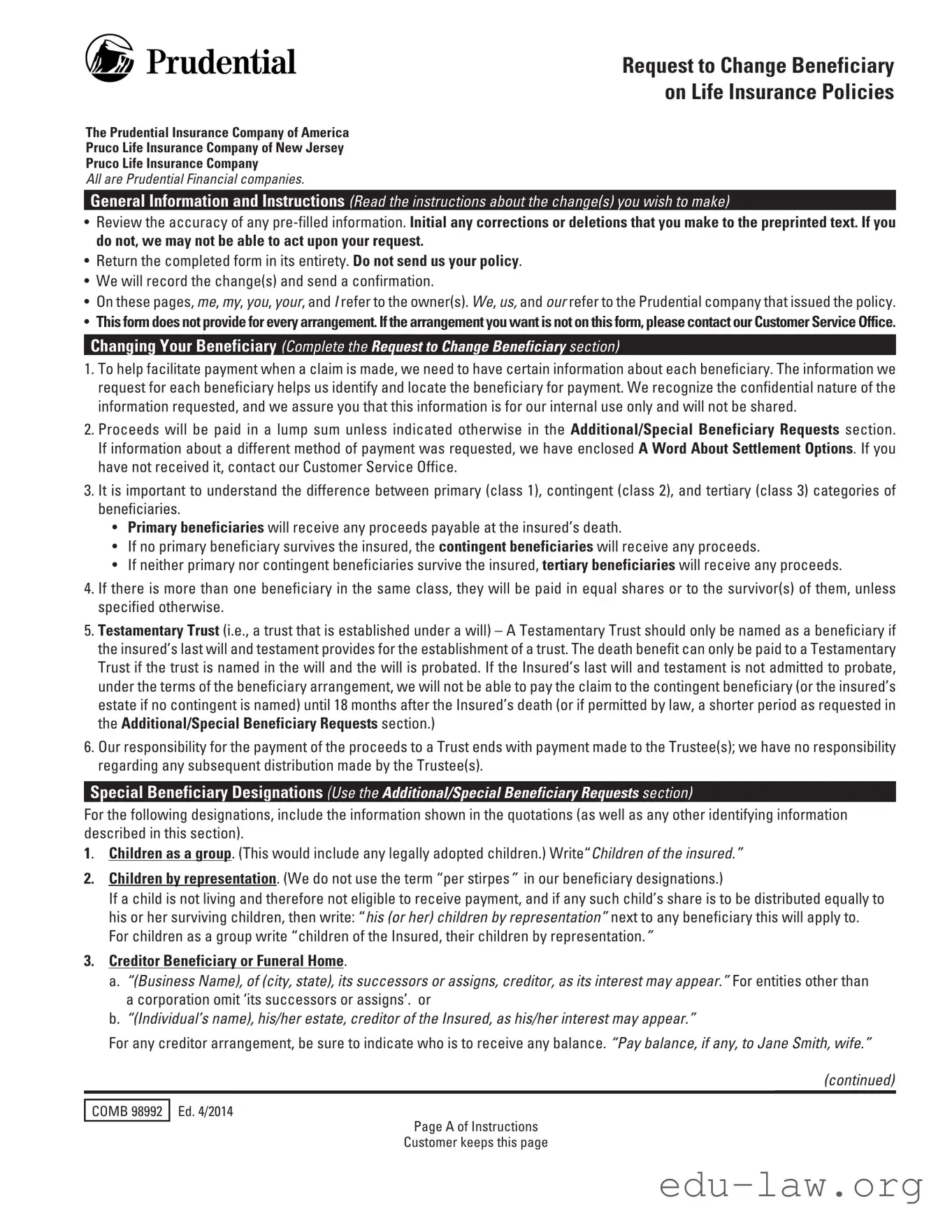
When it comes to ensuring that your loved ones are taken care of after your passing, the Prudential Change Beneficiary form plays a crucial role. This document allows you to designate who will receive the benefits from your life insurance policy, ensuring that your wishes are honored. The form covers a variety of essential aspects, including the need to review and confirm any pre-filled information, as well as the importance of specifying primary, contingent, and tertiary beneficiaries. Each category serves a distinct purpose, guiding the distribution of proceeds in the event of your death. You will find instructions on how to include various types of beneficiaries, from individuals to trusts, and even creditor arrangements. Additionally, the form offers special designations and payment options, allowing you to tailor your choices according to your unique circumstances. By carefully completing this form, you can provide peace of mind, knowing that your intentions regarding your life insurance benefits will be respected and executed as you intended.

Request to Change Beneficiary on Life Insurance Policies
The Prudential Insurance Company of America
Pruco Life Insurance Company of New Jersey
Pruco Life Insurance Company
All are Prudential Financial companies.
General Information and Instructions (Read the instructions about the change(s) you wish to make)
•Review the accuracy of any
•Return the completed form in its entirety. Do not send us your policy.
•We will record the change(s) and send a confirmation.
•On these pages, me, my, you, your, and I refer to the owner(s). We, us, and our refer to the Prudential company that issued the policy.
•This form does not provide for every arrangement. If the arrangement you want is not on this form, please contact our Customer Service Office.
Changing Your Beneficiary (Complete the Request to Change Beneficiary section)
1.To help facilitate payment when a claim is made, we need to have certain information about each beneficiary. The information we request for each beneficiary helps us identify and locate the beneficiary for payment. We recognize the confidential nature of the information requested, and we assure you that this information is for our internal use only and will not be shared.
2.Proceeds will be paid in a lump sum unless indicated otherwise in the Additional/Special Beneficiary Requests section. If information about a different method of payment was requested, we have enclosed A Word About Settlement Options. If you have not received it, contact our Customer Service Office.
3.It is important to understand the difference between primary (class 1), contingent (class 2), and tertiary (class 3) categories of beneficiaries.
•Primary beneficiaries will receive any proceeds payable at the insured’s death.
•If no primary beneficiary survives the insured, the contingent beneficiaries will receive any proceeds.
•If neither primary nor contingent beneficiaries survive the insured, tertiary beneficiaries will receive any proceeds.
4.If there is more than one beneficiary in the same class, they will be paid in equal shares or to the survivor(s) of them, unless specified otherwise.
5.Testamentary Trust (i.e., a trust that is established under a will) – A Testamentary Trust should only be named as a beneficiary if the insured’s last will and testament provides for the establishment of a trust. The death benefit can only be paid to a Testamentary Trust if the trust is named in the will and the will is probated. If the Insured’s last will and testament is not admitted to probate, under the terms of the beneficiary arrangement, we will not be able to pay the claim to the contingent beneficiary (or the insured’s estate if no contingent is named) until 18 months after the Insured’s death (or if permitted by law, a shorter period as requested in the Additional/Special Beneficiary Requests section.)
6.Our responsibility for the payment of the proceeds to a Trust ends with payment made to the Trustee(s); we have no responsibility regarding any subsequent distribution made by the Trustee(s).
Special Beneficiary Designations (Use the Additional/Special Beneficiary Requests section)
For the following designations, include the information shown in the quotations (as well as any other identifying information described in this section).
1. Children as a group. (This would include any legally adopted children.) Write“Children of the insured.”
2.Children by representation. (We do not use the term “per stirpes” in our beneficiary designations.)
If a child is not living and therefore not eligible to receive payment, and if any such child’s share is to be distributed equally to his or her surviving children, then write: “his (or her) children by representation” next to any beneficiary this will apply to.
For children as a group write “children of the Insured, their children by representation.”
3. Creditor Beneficiary or Funeral Home.
a.“(Business Name), of (city, state), its successors or assigns, creditor, as its interest may appear.” For entities other than a corporation omit ‘its successors or assigns’. or
b.“(Individual’s name), his/her estate, creditor of the Insured, as his/her interest may appear.”
For any creditor arrangement, be sure to indicate who is to receive any balance. “Pay balance, if any, to Jane Smith, wife.”
(continued)
COMB 98992
Ed. 4/2014
Page A of Instructions
Customer keeps this page

Special Beneficiary Designations (Use the Additional/Special Beneficiary Requests section) (continued)
4. Dollars and Balance Arrangements. Note: Only one dollar amount can be shown.
•“Pay $80,000, or the proceeds, if less, to Jane Doe, wife, and the balance, if any, to John Doe, son.”
5. Percentages and Fractions.
•Percentage arrangement: “Pay 75% to Jane Doe, wife, and 25% to John Doe, son.”
•Fraction arrangement: “Pay ¾ to Jane Doe, wife, and ¼ to John Doe, son.”
In the examples above, if Jane Doe is not living when the insured dies, her share will not be payable to John Doe. If you want that share to be paid to the other beneficiary (or to someone else), then write:
“Pay 75% to Jane Doe, wife, if living, otherwise to John Doe, son; and 25% to John Doe, son, if living, otherwise Jane Doe, wife.”
6.Short Term Survivorship Provision.
If this provision is chosen, any beneficiary who dies after the insured (but within the period of days you specify) will be considered to have died before the insured. The specified period (from 1 to 30 days) must be indicated, as follows: “Include Short Term Survivorship Provision of (1 to 30) days.”
For Kentucky Residents – Additional Information Regarding the Beneficiary Change
The State of Kentucky prohibits a beneficiary from collecting benefits under an insurance policy if convicted of taking the life of the decedent or of certain felonies involving abuse, neglect or financial exploitation of the decedent resulting in a loss to the decedent of more than $300 in financial or other resources, or both.
The forfeiture will not occur if:
•The insurance policy was executed prior to January 1, 2012.
•The felony was committed prior to January 1, 2012.
•The decedent, knowing of that person’s conviction, reaffirms that person’s right to receive the policy benefits by executing a new policy, or requesting a beneficiary change on an existing policy, which names that person as a beneficiary.
If a forfeiture occurs, and there are no other beneficiaries, the forfeited interest shall be paid to the State for deposit into the elder and vulnerable adult victims trust fund.
Important Notice – Civil Union Act
If your state has enacted a Civil Union Act or similar legislation, which provides that parties treat civil unions and marriages equally in all aspects, we are providing this notice to confirm that we comply with all states Civil Union Acts or similar legislation.
COMB 98992
Ed. 4/2014
Page B of Instructions
Customer keeps this page

Request to Change Beneficiary on Life Insurance Policies
Please print using blue or black ink. |
Initial any corrections or deletions that you make to the preprinted text. |
About Your Policy
You can use this form to make changes to more than one policy as long as each policy insures the same person(s) and has the same owner, and you are requesting the same changes for each policy.
Policy number(s) (eight or nine characters)
_______________________ _______________________ _______________________ _______________________
Name of insured (first, middle initial, last name)
Name of joint insured, if any (first, middle initial, last name)
Has your mailing address, telephone number(s), or
Complete this section only if you are requesting a permanent change in your mailing address, have a new telephone number(s), or
Full address
Telephone number: Home |
|
Mobile (Cell) |
Mailing Instructions
Unless otherwise indicated in this section, confirmation of the change(s) will be mailed to the owner at the address in our records.
Name of Recipient of confirmation (first, middle initial, last name)
Full address
Request to Change Beneficiary (This revokes all prior beneficiary designations)
All beneficiaries need to be restated even if they are not being changed. For example, if you are changing only the contingent beneficiary, you must restate the primary beneficiary. If more space is needed for additional beneficiaries, use the Additional/Special Beneficiary Requests section.
A. To name individual beneficiary(ies), complete the following:
Primary |
Contingent |
Name (first, middle initial, last name)
Tertiary
Relationship to insured |
|
Date of birth |
|
Soc. Sec. no. |
|
|
|||||
Full address |
|
|
|
|
|
|
|
|
|||
Telephone number: Home |
|
|
Mobile (Cell) |
|
|
|
|
||||
|
|
|
|
|
|
|
|
||||
Primary |
Contingent |
Name (first, middle initial, last name)
Tertiary
Relationship to insured |
|
Date of birth |
|
Soc. Sec. no. |
|
|
|||||
Full address |
|
|
|
|
|
|
|
|
|||
Telephone number: Home |
|
|
Mobile (Cell) |
|
|
|
|
||||
|
|
|
|
|
|
|
|
||||
Primary |
Contingent |
Name (first, middle initial, last name)
Relationship to insured
Full address
Tertiary
Date of birth |
|
Soc. Sec. no. |
Telephone number: Home |
|
Mobile (Cell) |
|
|
||
|
|
|
|
|
||
|
|
|
|
|
|
|
COMB 98992
Ed. 4/2014 |
Page 1 of 3 |
(continued) |
|
Return this page to Prudential

Initial any corrections or deletions that you make to the preprinted text.
Request to Change Beneficiary (continued)
B. To name a trustee under a living
Primary |
Contingent |
Name of current trustee(s)
Tertiary
Date of trust agreement |
|
/ |
/ |
|
Trust is (check one) Irrevocable Revocable |
|||||||||
Name of trust |
|
|
|
|
|
|
|
|
|
|
|
|||
Full address |
|
|
|
|
|
|
|
|
|
|
||||
Telephone # |
|
|
|
|
|
|
||||||||
Trust taxpayer identification # |
|
|
|
|
|
|
|
|
|
|
||||
Note: Whenever possible, include confirmation of the trust information by providing a copy of those pages of the trust documentation that show the name of the trust, name(s) of the trustee(s) and date of the trust.
C. To name a trust that will be established under the Insured’s Last Will and Testament (i.e. Testamentary Trust), check one of the following:
Primary
Contingent
Tertiary
Note: You may wish to consult legal counsel before choosing this arrangement. Only choose this arrangement if the insured’s will provides for the establishment of a trust. Trusts that are established prior to the insured’s death are not testamentary trusts. To name a trust that has already been established as a beneficiary, complete B above. Please refer to #5 in the Changing Your Beneficiary section on Page A of Instructions for additional information.
D. To name the insured’s estate as your sole beneficiary, check the following:
The insured’s estate. If choosing the insured’s estate, no other beneficiary can be selected.
E. To name a business/organization, complete the following:
Primary |
|
Contingent |
Tertiary |
|||||
Name of business/organization |
|
|
|
|
|
|||
Full address |
|
|
|
|
|
|
|
|
Telephone # |
|
|
|
|
|
|
||
Employer taxpayer identification # |
|
|
|
|
|
|||
Type of business/organization |
Corporation |
|
Limited Liability Company |
Name of sole proprietor (if applicable)
Partnership
Other
Sole Proprietorship
Additional/Special Beneficiary Requests
Use this section to name an additional beneficiary, a class or group not shown in the Request to Change Beneficiary section, or to select a payment option for your beneficiary.
For each additional individual beneficiary or member of a class or group (i.e. Children of the Insured), please provide the class (primary, contingent, tertiary), their full name, relationship to the insured, date of birth, social security number, address, home and/or mobile (cell) telephone number(s) and
COMB 98992
Ed. 4/2014Page 2 of 3
Return this page to Prudential

Initial any corrections or deletions that you make to the preprinted text.
Signature(s)/Signature Requirements (Always complete)
Your request cannot be processed without the correct signature(s), date, and applicable documentation.
•For individual policyowner(s), the person (or persons if there are joint owners) that owns the policy must sign.
•For corporations, an authorized officer must sign. Be sure to include the title of the officer and the company name.
•If president – no additional requirements
•If vice president – for policies over $1,000,000, provide a Corporate Secretary’s statement reflecting the vice president’s authority to sign
•If any other officer – provide a corporate resolution
•For limited liability companies (LLC), a copy of the document that identifies who is authorized to act on behalf of the LLC (e.g. operating agreement) must be submitted. The individual(s) authorized to act should sign and include his/her title and the company name.
•For partnerships (LP, LLP, and LLLP), the form should be signed by at least two general partners, followed by the title “general partner” after each signature. If the company only has one general partner, then the sole general partner should sign followed by the title “sole general partner”. Also, include the company name.
•For sole proprietorships, submit the signature of the owner, followed by “doing business as (company name), a sole proprietorship.“
•For trusts, the trustee(s) must sign and include the title “trustee” after their signature. The name of the trust must also be indicated in the space provided for Business/Trust name. All trustees must sign unless the trust itself or state law provides otherwise.
•A holder of a power of attorney for the policyowner must sign the form and include the title
•For guardian (conservator) of the estate - sign as “guardian of the estate of (name of ward)”. A copy of the guardianship papers must also be submitted. Depending on the rights granted by the guardianship papers or the state, a court order authorizing the change may also be required.
•For a policy containing a limitation of rights, the person or entity in whose favor the rights have been limited must also sign.
By signing this form, I:
•certify that I am authorized to sign this form,
•certify that the change(s) being requested are not subject to, or in conflict with, any prior agreement, legal proceeding, or court/administrative order, which restrict, limit, or otherwise prohibit such change(s), including, but not limited to divorce or bankruptcy proceedings,
•authorize all request(s) made on this form, both preprinted and handwritten, which are subject to the terms and conditions of the policy,
•request a waiver of any policy provision that requires me to send Prudential the policy for endorsement of the change(s),
•certify that the policy(ies) is/are in my possession and that no other person has any claim or interest in it/them, except for a collateral assignee under any assignment now on record with Prudential,
•certify that if the owner is a corporation or partnership, that it is not under receivership, trusteeship, or conservatorship, and/or has not been dissolved, and if a partnership, that no notice of disassociation has been filed by any partner, and
•understand that any endorsement that Prudential may issue will conform to its rules and practices.
X
Current owner’s signatureDate signed month/day/year
X
Current joint owner’s signature(s) (if applicable) |
|
Date signed month/day/year |
|
|
|
Signer’s title (for business/trust owned only) |
|
Business/Trust name (if applicable) |
For Massachusetts residents only
State law requires that a disinterested adult, who is not a party to the policy, witness any request to change the beneficiary arrangement. Your Prudential representative may sign as a witness.
X
Witness’ signature (Massachusetts only)
COMB 98992
Ed. 4/2014Page 3 of 3
Return this page to Prudential
| Fact Name | Details |
|---|---|
| Purpose of Form | This form is used to request a change of beneficiary on life insurance policies issued by Prudential companies. |
| Beneficiary Categories | Beneficiaries can be designated as primary, contingent, or tertiary, affecting the order of payment upon the insured's death. |
| Payment Method | Proceeds are typically paid in a lump sum unless specified otherwise in the Additional/Special Beneficiary Requests section. |
| Trustee Designation | A Testamentary Trust can only be named if the insured's will provides for its establishment and the will is probated. |
| Kentucky Law | In Kentucky, a beneficiary convicted of certain felonies may forfeit their right to benefits under the policy. |
| Massachusetts Requirement | Massachusetts law mandates that a disinterested adult witness any request to change the beneficiary arrangement. |
| Submission Instructions | The completed form must be returned in its entirety; do not send the policy document itself. |
Filling out the Prudential Change Beneficiary form is an important step in ensuring your wishes are honored regarding your life insurance policy. Once you complete the form, it should be returned to Prudential for processing. They will update their records and send you a confirmation of the changes made.
What is the purpose of the Prudential Change Beneficiary form?
The Prudential Change Beneficiary form is used to update or change the designated beneficiaries on life insurance policies issued by Prudential Financial companies. This form allows policy owners to specify who will receive the death benefits upon the insured's passing. It is essential to ensure that the information is accurate and up-to-date to facilitate the smooth payment of benefits when a claim is made.
How do I complete the Prudential Change Beneficiary form?
To complete the form, carefully review any pre-filled information and make necessary corrections by initialing them. Fill out the Request to Change Beneficiary section, providing details for each beneficiary, including their names, relationships to the insured, and contact information. Be sure to restate all beneficiaries, even if they are not changing, and submit the entire completed form without sending the policy itself.
What types of beneficiaries can I designate on the form?
You can designate primary, contingent, and tertiary beneficiaries. Primary beneficiaries are first in line to receive benefits, while contingent beneficiaries will receive benefits if no primary beneficiary survives the insured. Tertiary beneficiaries are next in line if neither primary nor contingent beneficiaries are alive at the time of the insured's death.
What happens if I have multiple beneficiaries in the same class?
If there are multiple beneficiaries within the same class, they will typically receive equal shares of the proceeds unless you specify otherwise. For example, if you name two primary beneficiaries, they will share the benefits equally unless you indicate a different arrangement.
Can I name a trust as a beneficiary?
Yes, you can name a trust as a beneficiary. However, it is important to ensure that the trust is either a living trust that is already in existence or a testamentary trust established under the insured’s last will and testament. If you choose a testamentary trust, the will must be probated for the trust to receive the death benefit.
What if I want to specify different payment arrangements for beneficiaries?
The form allows for various payment arrangements. You can designate specific dollar amounts, percentages, or fractions to be paid to different beneficiaries. For example, you might specify that one beneficiary receives a certain amount while the remaining balance goes to another beneficiary. Be clear in your instructions to avoid confusion.
How will I know if my beneficiary change has been processed?
After Prudential processes your request, they will send you a confirmation of the changes made. It is important to ensure that your mailing address is current to receive this confirmation. If you do not receive confirmation within a reasonable timeframe, you should contact Prudential’s Customer Service Office for assistance.
Are there any special considerations for residents of Kentucky?
Yes, Kentucky law prohibits a beneficiary from collecting benefits if they have been convicted of certain crimes related to the decedent. This includes crimes that result in financial exploitation or abuse. If such a forfeiture occurs and there are no other beneficiaries, the forfeited interest will be paid to the state for deposit into a trust fund for vulnerable adult victims.
What signature requirements must I meet to submit the form?
The form must be signed by the policy owner(s), and specific requirements apply depending on the ownership structure. For corporations, partnerships, and trusts, additional documentation may be required. Ensure that all necessary signatures are obtained, as the request cannot be processed without them.
Neglecting to Review Pre-filled Information: Many individuals fail to verify the accuracy of the pre-filled details on the form. This oversight can lead to incorrect beneficiary designations.
Not Initialing Corrections: If any corrections or deletions are made to the preprinted text, it is crucial to initial those changes. Without initials, the request may not be processed.
Omitting Beneficiary Information: Some people forget to provide necessary details for each beneficiary. The form requires specific information to identify and locate beneficiaries effectively.
Failing to Restate All Beneficiaries: When changing only one beneficiary, it is essential to restate all existing beneficiaries. Omitting a beneficiary could invalidate the entire request.
Ignoring Payment Method Options: Individuals often overlook the section regarding payment methods. If a different payment method is desired, it must be specified in the Additional/Special Beneficiary Requests section.
Misunderstanding Beneficiary Categories: Not understanding the differences between primary, contingent, and tertiary beneficiaries can lead to confusion. Each category has specific implications for payment distribution.
Failing to Include Trust Documentation: If naming a trust as a beneficiary, individuals sometimes forget to include necessary trust documentation, which can delay processing.
Not Providing Accurate Contact Information: Providing outdated or incorrect contact information can hinder communication regarding the status of the beneficiary change.
Neglecting Signature Requirements: A common mistake is failing to obtain the necessary signatures. The form requires signatures from the policy owner and, if applicable, joint owners or authorized representatives.
Overlooking State-Specific Regulations: Some individuals do not consider state-specific laws that may affect beneficiary designations. For example, certain states have laws regarding beneficiaries convicted of crimes against the insured.
When submitting the Prudential Change Beneficiary form, several other forms and documents may be necessary to ensure a smooth and efficient processing of your request. Understanding these documents can help clarify your obligations and streamline the beneficiary change process.
Being prepared with these documents can significantly expedite the processing of your beneficiary change request. Ensure that all forms are filled out accurately and completely to avoid any delays. If you have questions about specific requirements, reaching out to Prudential's customer service can provide clarity and assistance.
The Change of Beneficiary form is similar to a Will in that both documents outline the distribution of assets upon death. A Will provides instructions on how a person's assets should be managed and distributed after their passing, while the Change of Beneficiary form specifically designates who will receive the benefits from an insurance policy. Both documents require clear identification of beneficiaries and can include specific instructions regarding how assets should be divided among them.
Another document akin to the Change of Beneficiary form is a Trust Agreement. A Trust Agreement allows a person to place their assets into a trust for the benefit of designated beneficiaries. Similar to the Change of Beneficiary form, it requires precise information about the beneficiaries and how the assets should be distributed. Both documents serve to ensure that the wishes of the individual are honored after their death.
The Power of Attorney (POA) is another related document. A POA grants someone the authority to make decisions on behalf of another person, particularly regarding financial matters. While the Change of Beneficiary form focuses on specifying who will receive insurance benefits, a POA allows the designated individual to manage those benefits and other financial assets if the owner becomes incapacitated.
Life Insurance Policy documents themselves share similarities with the Change of Beneficiary form. Both require the policyholder to identify beneficiaries and outline how benefits will be distributed. The Life Insurance Policy provides the overall terms of coverage, while the Change of Beneficiary form specifically updates who will receive the death benefit, making it essential for ensuring the intended recipients are designated.
The Affidavit of Heirship serves a similar purpose in determining beneficiaries after someone's death. This document is often used when there is no Will to identify heirs and clarify how assets should be distributed. Like the Change of Beneficiary form, it requires detailed information about the deceased and their potential heirs, ensuring that the right individuals receive the intended assets.
A Declaration of Trust is another document that resembles the Change of Beneficiary form. It establishes a trust and identifies the beneficiaries who will receive the trust's assets. Both documents require clear identification of beneficiaries and can include stipulations on how and when assets are distributed, ensuring that the grantor's wishes are followed.
The Assignment of Benefits form also shares characteristics with the Change of Beneficiary form. This document allows the policyholder to assign benefits to another party, typically for medical or insurance claims. Similar to changing a beneficiary, it requires clear identification of the parties involved and outlines how benefits will be allocated.
Beneficiary Designation forms for retirement accounts, like IRAs or 401(k)s, are also similar. These forms specify who will receive the funds upon the account holder's death. Both the Change of Beneficiary form and retirement account beneficiary forms require accurate information about the beneficiaries and can include various arrangements for distribution, such as percentages or specific amounts.
The Gift Deed is another related document. A Gift Deed transfers ownership of property or assets while the giver is still alive. While the Change of Beneficiary form deals with posthumous distributions, both documents require clear identification of the recipient and can outline specific terms for the transfer of assets.
Lastly, the Last Will and Testament is closely related to the Change of Beneficiary form. Both documents serve to communicate the wishes of the deceased regarding asset distribution. While a Will covers all assets and their distribution, the Change of Beneficiary form focuses solely on life insurance policies, ensuring that the designated beneficiaries receive the intended benefits without delay.
When filling out the Prudential Change Beneficiary form, it is essential to follow certain guidelines to ensure that your request is processed smoothly. Here are six important do's and don'ts:
This is incorrect. The form allows changes to multiple policies as long as they insure the same person(s) and have the same owner. All requested changes must be the same for each policy.
It is important to restate all beneficiaries, even if they are not being changed. For instance, if only the contingent beneficiary is being updated, the primary beneficiary must still be restated on the form.
Providing accurate information for each beneficiary is essential. This helps facilitate payment when a claim is made. The requested information is kept confidential and is used solely for internal purposes.
A Testamentary Trust should only be named if the insured's will specifically provides for its establishment. If the will is not probated, the claim cannot be paid until a specified period has passed.
This is not true. If a beneficiary dies before the insured and no provisions are made for their share, that share may not be payable to other beneficiaries. Specific language must be included in the form to ensure alternate distributions are honored.
When filling out the Prudential Change Beneficiary form, consider the following key points:
By keeping these takeaways in mind, you can navigate the process more effectively and ensure that your beneficiary designations are accurate and reflect your wishes.