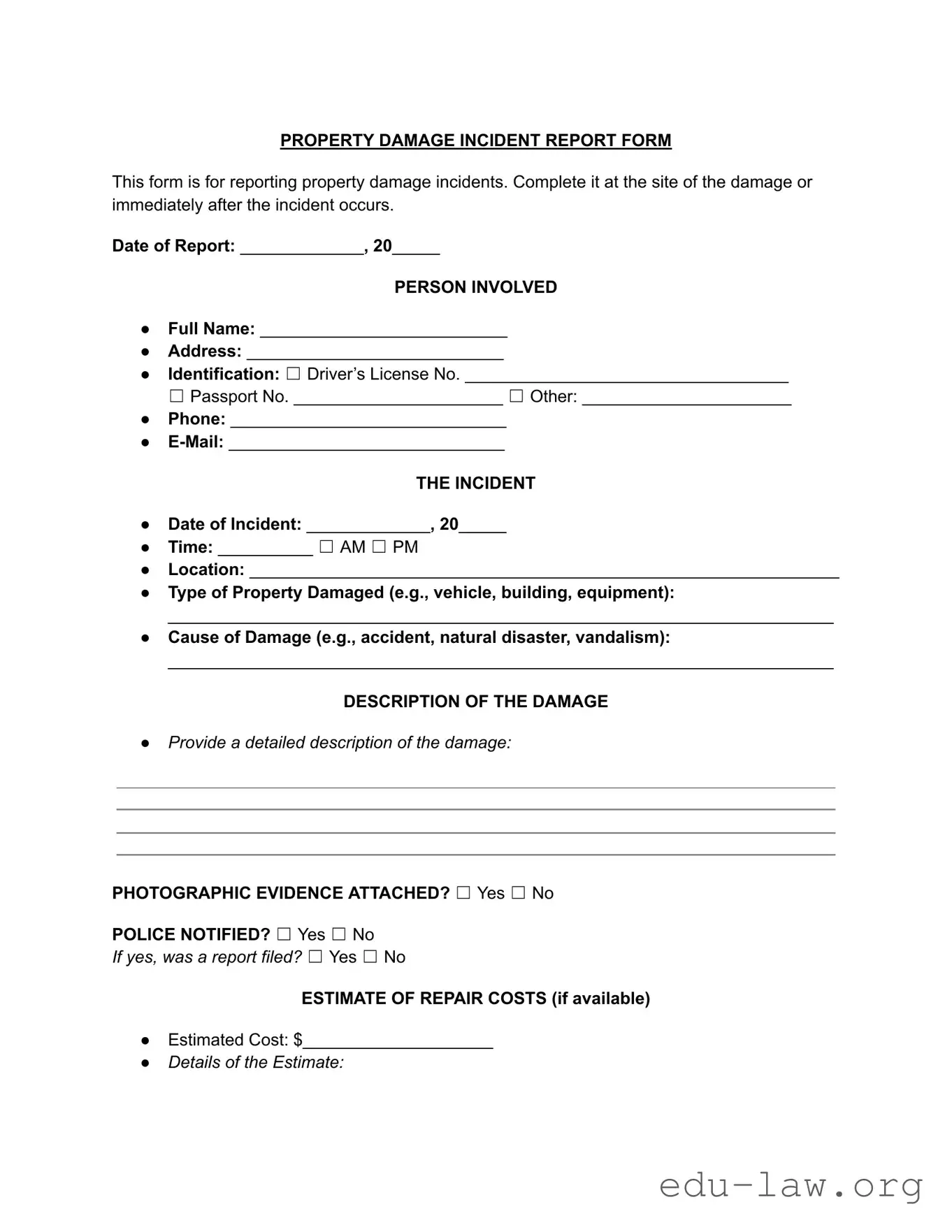
The Property Damage Incident Report form serves as a crucial tool for documenting incidents that result in damage to property, whether it be personal, commercial, or municipal. This form captures essential details such as the date, time, and location of the incident, as well as the names and contact information of those involved, including witnesses. A clear description of the circumstances surrounding the damage is vital, allowing for a comprehensive understanding of how the incident occurred. Additionally, the form often includes sections for photographs or diagrams, which can visually represent the scene and provide further context. Furthermore, it may require information about insurance coverage and any actions taken immediately following the incident. By systematically gathering this information, the form not only aids in the resolution of claims but also serves as a valuable record for future reference, helping to prevent similar occurrences and ensuring accountability among parties involved.

PROPERTY DAMAGE INCIDENT REPORT FORM
This form is for reporting property damage incidents. Complete it at the site of the damage or immediately after the incident occurs.
Date of Report: _____________, 20_____
PERSON INVOLVED
●Full Name: __________________________
●Address: ___________________________
●Identification: ☐ Driver’s License No. __________________________________
☐ Passport No. ______________________ ☐ Other: ______________________
●Phone: _____________________________
●
THE INCIDENT
●Date of Incident: _____________, 20_____
●Time: __________ ☐ AM ☐ PM
●Location: ______________________________________________________________
●Type of Property Damaged (e.g., vehicle, building, equipment):
______________________________________________________________________
●Cause of Damage (e.g., accident, natural disaster, vandalism):
______________________________________________________________________
DESCRIPTION OF THE DAMAGE
●Provide a detailed description of the damage:
PHOTOGRAPHIC EVIDENCE ATTACHED? ☐ Yes ☐ No
POLICE NOTIFIED? ☐ Yes ☐ No
If yes, was a report filed? ☐ Yes ☐ No
ESTIMATE OF REPAIR COSTS (if available)
●Estimated Cost: $____________________
●Details of the Estimate:

WITNESSES
●Were there witnesses to the incident? ☐ Yes ☐ No
●If yes, enter the witnesses’ names and contact info:
1.Full Name: ________________________
Phone: ___________________________
2.Full Name: ________________________
Phone: ___________________________
3.Full Name: ________________________
Phone: ___________________________
INSURANCE INFORMATION (if applicable)
●Insurance Provider: ________________________
●Policy Number: ___________________________
PERSON FILING REPORT
●Full Name: _____________________________
●Title/Role: ______________________________
●Signature: ______________________________
OFFICE USE ONLY
●Report received by: __________________________
●Date: _____________, 20_____
●
| Fact Name | Description |
|---|---|
| Purpose | The Property Damage Incident Report form is used to document incidents that result in property damage, ensuring that all relevant details are recorded for potential claims or legal actions. |
| Who Uses It? | This form can be utilized by property owners, tenants, insurance companies, and law enforcement agencies to provide a clear account of the damage. |
| Information Required | Typically, the form requires information such as the date of the incident, location, description of the damage, and contact information for involved parties. |
| Governing Laws | In many states, such as California, the use of this form is governed by the California Civil Code, which outlines the responsibilities of property owners and tenants regarding damage reporting. |
| Submission Process | Once completed, the form should be submitted to the relevant insurance company or local authorities, depending on the nature of the incident. |
| Importance of Accuracy | Accurate and detailed information is crucial. It can significantly impact the outcome of insurance claims and any potential legal proceedings. |
| Record Keeping | Keeping a copy of the completed form is essential for future reference and can serve as evidence if disputes arise. |
| State-Specific Variations | Some states may have specific variations of the form or additional requirements, so it is important to check local regulations. |
| Filing Deadlines | There may be deadlines for submitting the form after an incident occurs, often dictated by state laws or insurance policies. |
After obtaining the Property Damage Incident Report form, you will need to carefully fill it out to ensure that all necessary information is accurately documented. This process is essential for addressing the incident effectively and facilitating any subsequent actions that may be required.
Once you have filled out the form, it should be submitted to the appropriate party, whether that be your insurance company, a property management entity, or another relevant organization. Ensure that you keep a copy for your records.
What is a Property Damage Incident Report form?
The Property Damage Incident Report form is a document used to record details about an incident that caused damage to property. This form helps ensure that all relevant information is captured, which can be crucial for insurance claims, legal proceedings, or internal investigations. It typically includes sections for describing the incident, identifying the parties involved, and noting any witnesses.
Who should fill out the Property Damage Incident Report form?
Generally, the person who witnessed or was involved in the incident should complete the form. This could be the property owner, a tenant, or an employee, depending on the circumstances. It's important that the report is filled out as soon as possible while the details are still fresh in memory.
What information is typically required on the form?
The form usually asks for the date, time, and location of the incident. It also requires a detailed description of what happened, including the nature and extent of the damage. Personal information about the individuals involved, such as names and contact information, is also collected. If there were any witnesses, their details should be included as well.
How should I describe the incident on the form?
When describing the incident, aim for clarity and detail. Start with the basics—what happened, where it happened, and who was involved. Include any relevant circumstances leading up to the incident. Use objective language and avoid assumptions about fault. The more precise the description, the better it will serve its purpose.
What should I do if I don’t have all the information?
If you lack certain details when filling out the form, provide as much information as you can. You can indicate that some details are unknown at the time of reporting. It’s better to submit an incomplete report than to delay filing the form. You can always update it later as more information becomes available.
Where do I submit the completed Property Damage Incident Report form?
Submission guidelines can vary based on the organization or jurisdiction. Typically, you will submit the form to your supervisor, property management, or the relevant insurance company. Ensure you keep a copy for your records, as it may be needed for follow-up actions or claims.
What happens after I submit the form?
After submission, the report will be reviewed by the appropriate parties. This could include insurance adjusters, legal teams, or management personnel. They will assess the information provided to determine the next steps, which may involve investigations, repairs, or claims processing. You may be contacted for additional information if necessary.
Incomplete Information: Failing to provide all required details can lead to delays in processing the report. Ensure that every section is filled out completely.
Incorrect Dates: Entering the wrong date of the incident can create confusion. Double-check that the date matches the occurrence of the damage.
Missing Signatures: Not signing the report can render it invalid. Always sign and date the form before submission.
Neglecting to Attach Evidence: Failing to include photographs or other supporting documents can weaken your claim. Attach all relevant evidence to strengthen your case.
Using Vague Descriptions: Providing unclear or ambiguous descriptions of the damage can lead to misunderstandings. Be specific about what happened and the extent of the damage.
Not Keeping a Copy: Forgetting to keep a copy of the completed report for personal records can be a mistake. Always retain a copy for your own reference.
When dealing with property damage incidents, various forms and documents can help streamline the process of reporting and resolving issues. Each document serves a specific purpose and contributes to a comprehensive understanding of the situation. Below is a list of common forms that are often used alongside the Property Damage Incident Report form.
Having these documents on hand can significantly aid in managing property damage incidents effectively. They not only provide clarity but also ensure that all parties involved have a clear understanding of the situation and the steps needed to resolve it.
The first document that shares similarities with the Property Damage Incident Report form is the Accident Report. Like the Property Damage Incident Report, an Accident Report is designed to document incidents where damage occurs, often involving vehicles or personal injuries. Both forms capture essential details such as the date, time, and location of the incident, along with the parties involved. They serve as official records that can be referenced later for insurance claims or legal proceedings.
Another comparable document is the Incident Report used in workplace settings. This report focuses on documenting any event that disrupts normal operations, including accidents that result in property damage. Much like the Property Damage Incident Report, it requires a clear description of the incident, the individuals involved, and any immediate actions taken. Both reports aim to provide a thorough account of events for future reference and to help prevent similar incidents from occurring.
The Damage Assessment Report is another document that aligns closely with the Property Damage Incident Report. This report specifically evaluates the extent of damage caused by an incident, detailing the costs associated with repairs or replacements. While the Property Damage Incident Report outlines what happened, the Damage Assessment Report dives deeper into the financial implications. Together, they create a comprehensive understanding of the incident and its aftermath.
Additionally, the Insurance Claim Form is similar in purpose and function. When property damage occurs, individuals often need to file a claim with their insurance provider. The Insurance Claim Form requires information about the incident, similar to the Property Damage Incident Report, to substantiate the claim. Both documents work hand in hand, with the Property Damage Incident Report providing the necessary details to support the claim process.
Lastly, the Witness Statement Form bears resemblance to the Property Damage Incident Report. This document captures the accounts of individuals who witnessed the incident, providing an unbiased perspective on what transpired. While the Property Damage Incident Report focuses on the parties involved and the damage itself, the Witness Statement Form adds an additional layer of context, helping to create a clearer picture of the event. Both forms are crucial in building a comprehensive understanding of the incident for all parties involved.
When filling out the Property Damage Incident Report form, attention to detail is crucial. Here are ten important guidelines to follow:
Understanding the Property Damage Incident Report form is essential for accurate reporting and resolution of property damage. Here are ten common misconceptions about this form:
This is not true. Even minor damages should be reported. Documenting all incidents helps create a complete record.
Anyone affected by the incident, including tenants or visitors, can fill out the form. It is important for all parties involved to provide their perspective.
While timely reporting is encouraged, it is more important to provide accurate information. Take your time to gather all relevant details before submitting.
Filing the report is a step in the process, but it does not guarantee that compensation will be awarded. Each case is reviewed on its own merits.
In addition to physical damage, any emotional or psychological impact should also be noted. This helps provide a full understanding of the incident.
While it can be used for insurance claims, the form also serves to document incidents for internal records and safety improvements.
If you realize there is an error or need to add information, you can contact the appropriate office to make corrections.
While certain information is kept private, some details may be shared with relevant parties involved in the investigation or resolution of the incident.
Even if the situation seems resolved, having a formal report helps maintain a record and can assist in preventing future incidents.
By clearing up these misconceptions, individuals can better navigate the process of reporting property damage and ensure that all necessary information is documented accurately.
When filling out and using the Property Damage Incident Report form, consider the following key takeaways: