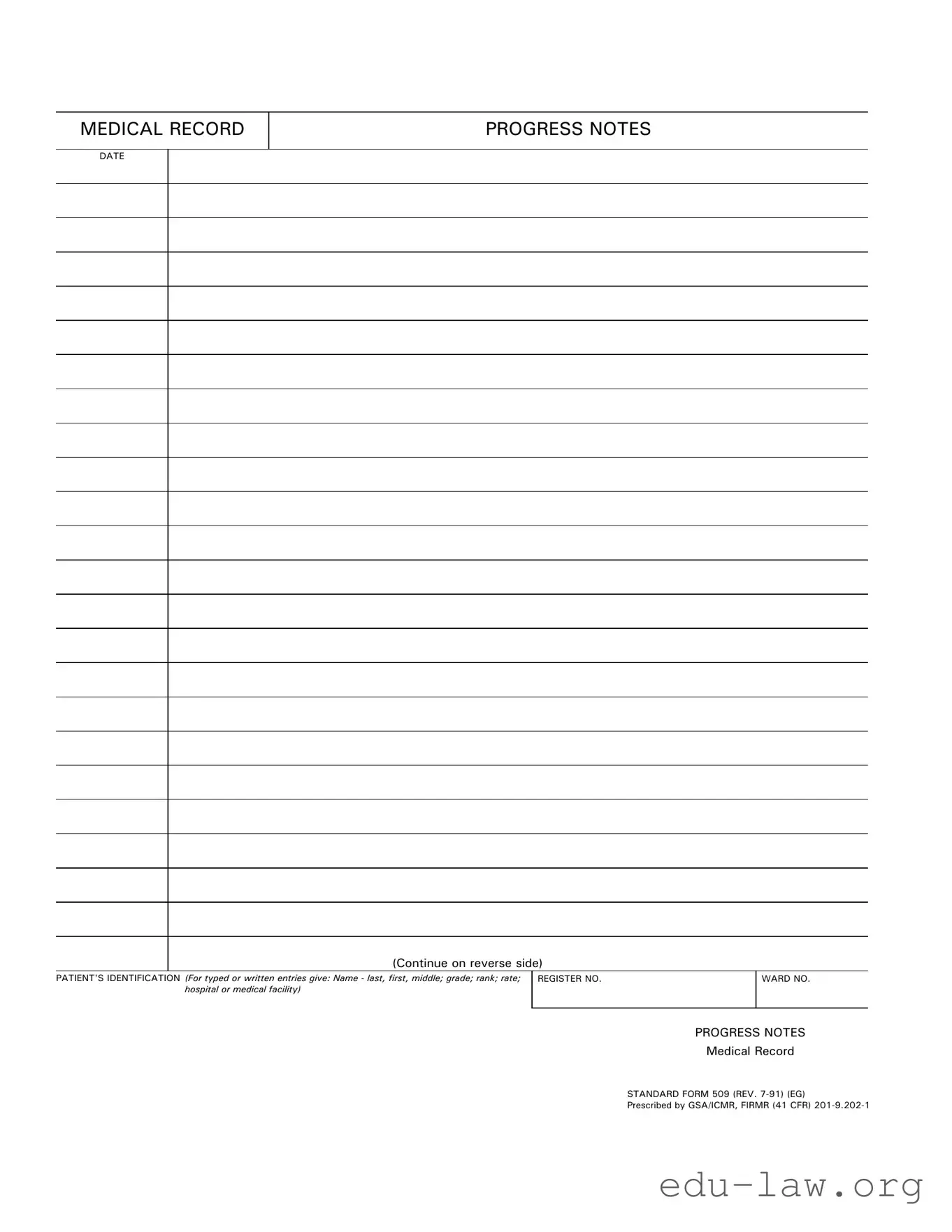
The Progress Notes form plays a crucial role in maintaining accurate and comprehensive medical records. Designed to capture essential information about a patient's ongoing care, this form facilitates communication among healthcare providers. It includes sections for the patient's identification, such as their name, grade, rank, and hospital or medical facility, ensuring that all entries are properly attributed. Each entry is dated, providing a clear timeline of the patient's treatment and progress. The standardized format, identified as Standard Form 509, has been prescribed to ensure consistency and reliability in documentation practices across various medical settings. By using this form, healthcare professionals can effectively document observations, treatment plans, and any changes in the patient's condition, thereby enhancing the quality of care delivered. This structured approach not only aids in clinical decision-making but also serves as a legal record, safeguarding both the patient and the provider.

MEDICAL RECORD
PROGRESS NOTES
DATE
(Continue on reverse side)
PATIENT'S IDENTIFICATION (For typed or written entries give: Name - last, first, middle; grade; rank; rate; hospital or medical facility)
REGISTER NO. |
WARD NO. |
|
|
PROGRESS NOTES
Medical Record
STANDARD FORM 509 (REV.
Prescribed by GSA/ICMR, FIRMR (41 CFR)

PROGRESS NOTES
DATE
STANDARD FORM 509 (REV.
| Fact Name | Description |
|---|---|
| Form Title | The form is officially titled "Medical Record Progress Notes." It is used to document patient progress in medical settings. |
| Governing Law | This form is prescribed by the General Services Administration (GSA) and is governed by the Federal Information Resources Management Regulation (FIRMR) under 41 CFR 201-9.202-1. |
| Revision Date | The current version of the form is marked as "REV. 7-91," indicating it was last revised in July 1991. |
| Patient Identification | Patients must be identified by name (last, first, middle), grade, rank, rate, and the hospital or medical facility where they are receiving care. |
| Register and Ward Numbers | The form requires entries for both the patient's register number and ward number, ensuring accurate record-keeping. |
| Progress Notes Section | This section is designated for documenting the patient's ongoing treatment and any significant changes in their condition. |
| Standard Form | The Progress Notes form is categorized as Standard Form 509, which is a designation for official government forms. |
| Usage Context | Primarily used in medical facilities, this form serves as a critical component of patient medical records, facilitating continuity of care. |
| Back Side Usage | The form includes a note indicating that additional information can be continued on the reverse side, allowing for comprehensive documentation. |
Filling out the Progress Notes form requires careful attention to detail. Once completed, this document will serve as a crucial part of the patient's medical record. Follow these steps to ensure accuracy and compliance.
After completing these steps, review the form for any errors or omissions. Ensure that all required information is filled out accurately before submission.
What is the purpose of the Progress Notes form?
The Progress Notes form is designed to document a patient’s medical history, treatment, and progress over time. It serves as a vital tool for healthcare providers to track changes in a patient's condition, treatment responses, and any new developments. This ensures continuity of care and allows for informed decision-making by medical staff.
What information is required on the Progress Notes form?
When filling out the Progress Notes form, you must provide specific details. This includes the patient's full name (last, first, middle), grade, rank, rate, and the name of the hospital or medical facility. Additionally, you should include the date of the entry, the patient's identification number, and the ward number. This information helps maintain accurate records and facilitates efficient communication among healthcare providers.
How should the Progress Notes form be filled out?
The Progress Notes form can be filled out either by typing or writing. Ensure that all entries are clear and legible. Use concise language to describe the patient's condition, treatment provided, and any observations made during the visit. If necessary, continue your notes on the reverse side of the form. This allows for comprehensive documentation without overcrowding the main section.
Who is responsible for completing the Progress Notes form?
Typically, healthcare professionals involved in a patient's care are responsible for completing the Progress Notes form. This may include doctors, nurses, or other authorized personnel. Each entry should reflect the observations and actions taken by the individual completing the form, ensuring accountability and accuracy in the medical record.
What should I do if I make a mistake on the Progress Notes form?
If you make a mistake while filling out the Progress Notes form, it is important to correct it properly. Do not use correction fluid or erase the mistake. Instead, draw a single line through the error, write the correct information next to it, and initial the change. This maintains the integrity of the medical record while ensuring that the correct information is documented.
Incomplete Patient Identification: Failing to provide all necessary details, such as the patient's full name, grade, rank, and hospital or medical facility, can lead to confusion and miscommunication in the medical record.
Neglecting to Date Entries: Omitting the date on progress notes can result in a lack of chronological clarity. Each entry should clearly indicate when the observation or treatment occurred to ensure accurate tracking of the patient's progress.
Using Vague Language: Writing in ambiguous terms can hinder understanding. Clear, specific descriptions of the patient's condition and treatment are essential for effective communication among healthcare providers.
Not Following the Standard Format: Deviating from the prescribed format can lead to disorganized notes. Adhering to the structure of the Progress Notes form is crucial for maintaining consistency and clarity in medical records.
The Progress Notes form is a crucial document in the medical record-keeping process. It provides a detailed account of a patient's condition, treatment, and progress over time. However, it is often used in conjunction with several other forms and documents to ensure comprehensive patient care and accurate record-keeping. Below is a list of commonly associated forms that healthcare providers may utilize alongside the Progress Notes form.
Utilizing these forms in conjunction with the Progress Notes enhances the overall quality of patient care. Each document plays a vital role in creating a comprehensive medical record, facilitating effective communication among healthcare providers, and ultimately supporting better health outcomes for patients.
The Treatment Plan is similar to Progress Notes as both documents track a patient's care. The Treatment Plan outlines the goals and strategies for a patient's treatment, while Progress Notes document the ongoing updates and changes in the patient's condition. Both are essential for ensuring continuity of care and effective communication among healthcare providers.
Discharge Summaries also share similarities with Progress Notes. Both documents provide a comprehensive overview of a patient's treatment and progress. However, a Discharge Summary focuses on the patient's condition at the time of discharge, detailing the treatment received and any follow-up care needed. Progress Notes, on the other hand, capture real-time updates during the patient’s stay.
Care Plans serve a similar purpose to Progress Notes by detailing the specific interventions and outcomes for a patient. While Care Plans outline the overall strategy for care, Progress Notes provide the day-to-day documentation of how those strategies are being implemented and adjusted based on the patient’s response.
Referral Letters often resemble Progress Notes in their function of communicating patient information. Both documents share insights about a patient's condition and treatment history. Referral Letters, however, are directed to another healthcare provider, whereas Progress Notes are typically internal documents used by the current care team.
Assessment and Evaluation Reports are akin to Progress Notes as they both assess a patient’s condition. These reports provide a detailed analysis of a patient’s health status, while Progress Notes focus on documenting changes and updates over time. Both are critical for monitoring a patient's progress and making informed care decisions.
Medication Administration Records (MAR) are similar to Progress Notes in that they both track patient care activities. MARs specifically document the medications given to a patient, including dosages and times. Progress Notes may reference medication changes or reactions, providing a broader context for the patient’s treatment.
Incident Reports can be compared to Progress Notes as they both document significant events related to patient care. Incident Reports focus on unusual occurrences, such as accidents or errors, while Progress Notes provide ongoing documentation of a patient’s treatment and progress. Both are important for quality assurance and improving patient safety.
Intake Forms share similarities with Progress Notes in that they collect essential patient information. Intake Forms gather initial data, such as medical history and current concerns, while Progress Notes track updates and changes during treatment. Both documents are vital for understanding a patient’s needs and ensuring appropriate care.
Clinical Pathways are similar to Progress Notes as they outline the expected course of treatment for specific conditions. Clinical Pathways provide a structured approach to care, while Progress Notes document the actual patient experience and any deviations from the pathway. Both are used to improve patient outcomes and standardize care.
Patient Education Materials can also be likened to Progress Notes. Both serve to inform and guide patients regarding their health and treatment. Patient Education Materials provide essential information about conditions and treatments, while Progress Notes document the discussions and teaching that occur between healthcare providers and patients.
When filling out the Progress Notes form, it is essential to follow specific guidelines to ensure accuracy and clarity. Here are five things to keep in mind:
By adhering to these guidelines, you can help maintain the integrity of the medical record and ensure that all relevant information is communicated effectively.
Understanding the Progress Notes form is essential for accurate documentation in medical settings. However, several misconceptions can lead to confusion. Below is a list of common misunderstandings regarding this important form.
By addressing these misconceptions, healthcare providers can enhance their understanding and use of the Progress Notes form, ultimately improving patient care and documentation practices.
When filling out and using the Progress Notes form, there are several important aspects to keep in mind. Understanding these key points can help ensure that the form is used effectively and accurately.
By following these guidelines, individuals can contribute to a more organized and efficient medical record system, enhancing patient care and communication among healthcare providers.