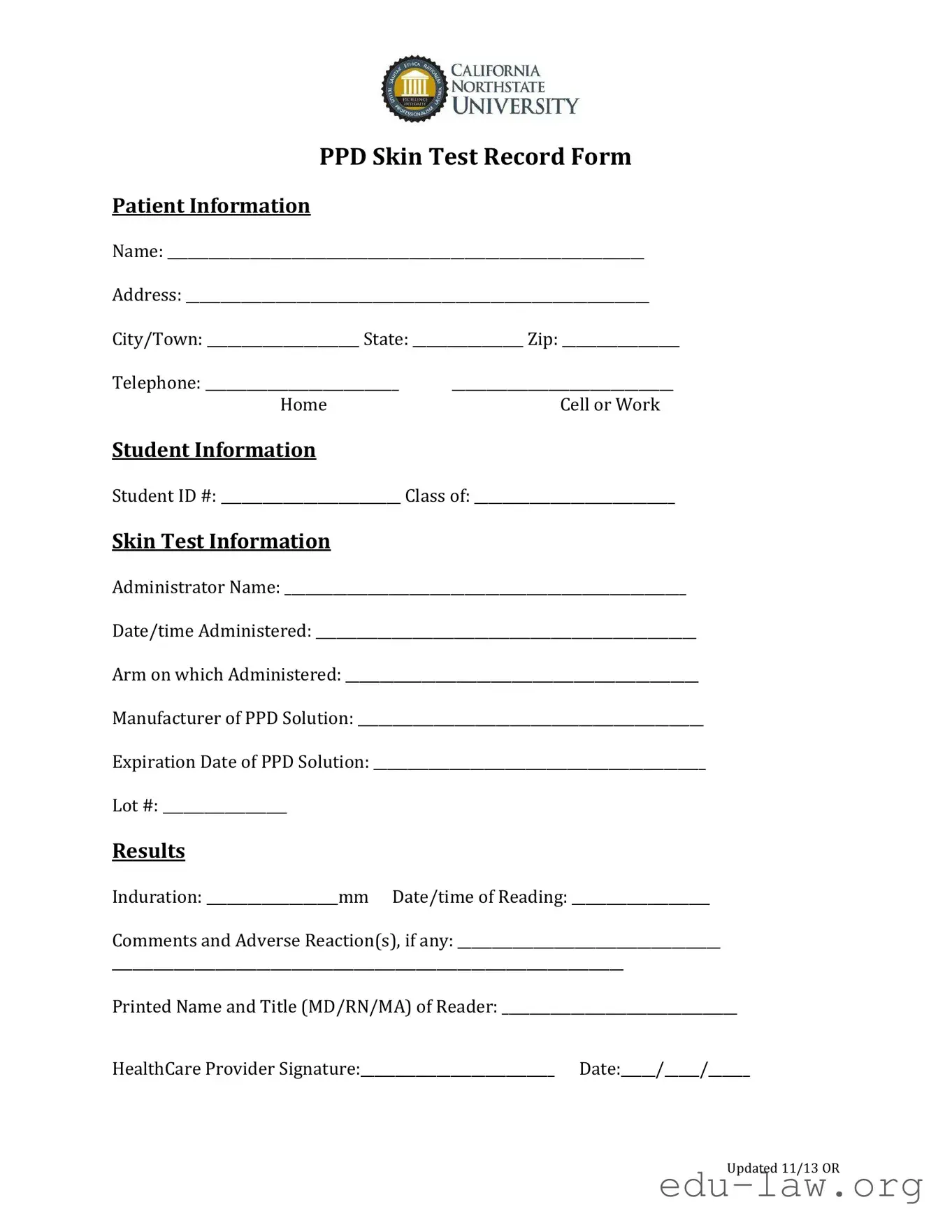
The PPD Skin Test Record Form serves as a crucial document in the assessment of tuberculosis exposure. It captures essential patient information, including the individual's name, address, and contact details, ensuring that healthcare providers can easily identify and follow up with patients. For students, a dedicated section allows for the inclusion of their student ID and class year, facilitating tracking within educational institutions. The form also details the skin test administration, recording the name of the administrator, the date and time the test was given, and the specific arm used for the injection. Important information about the PPD solution, such as its manufacturer, expiration date, and lot number, is meticulously documented to ensure the integrity of the test. The results section is vital, as it includes the measurement of induration, the date and time of reading, and space for any comments or adverse reactions that may arise. Finally, the form requires the printed name and title of the healthcare provider who interprets the results, along with their signature and the date, thereby establishing accountability and professionalism in the testing process. This comprehensive approach not only promotes accurate record-keeping but also enhances patient care by ensuring that all necessary information is readily available for future reference.

PPD SKIN TEST RECORD FORM
PATIENT INFORMATION
Name: _____________________________________________________________________
Address: ___________________________________________________________________
City/Town: ______________________ State: ________________ Zip: _________________
Telephone: ____________________________ |
________________________________ |
Home |
Cell or Work |
STUDENT INFORMATION
Student ID #: __________________________ Class of: _____________________________
SKIN TEST INFORMATION
Administrator Name: __________________________________________________________
Date/time Administered: _______________________________________________________
Arm on which Administered: ___________________________________________________
Manufacturer of PPD Solution: __________________________________________________
Expiration Date of PPD Solution: ________________________________________________
Lot #: __________________
RESULTS
Induration: ___________________mm Date/time of Reading: ____________________
Comments and Adverse Reaction(s), if any: ______________________________________
__________________________________________________________________________
Printed Name and Title (MD/RN/MA) of Reader: __________________________________
HealthCare Provider Signature:____________________________ Date:_____/_____/______
Updated 11/13 OR
| Fact Name | Details |
|---|---|
| Patient Information | The form requires comprehensive patient details, including name, address, and telephone numbers (home, cell, or work). This ensures accurate identification and communication. |
| Skin Test Information | Key data such as the administrator's name, the date and time of administration, and specifics about the PPD solution (manufacturer, expiration date, and lot number) must be documented. This information is vital for tracking and accountability. |
| Results Section | The results section captures the induration measurement in millimeters and the date/time of reading. Any comments or adverse reactions should also be noted, providing a comprehensive overview of the test outcome. |
| Governing Laws | In many states, such as California and New York, the administration and documentation of PPD tests are governed by public health laws and regulations, ensuring compliance with health standards. |
After completing the PPD Skin Test form, it will be submitted to the appropriate healthcare provider for evaluation. This process ensures that all necessary information is captured accurately for review and record-keeping.
What is the purpose of the PPD skin test?
The PPD skin test, also known as the tuberculin skin test, is used to determine if someone has been exposed to the bacteria that causes tuberculosis (TB). It helps healthcare providers identify individuals who may need further evaluation or treatment for TB infection.
How is the PPD skin test administered?
The test is administered by injecting a small amount of PPD solution just under the skin of your forearm. After the injection, a small bump will form. It’s important not to scratch or cover the area for 48 to 72 hours, as this can affect the results.
What should I expect after the test?
After the test, you will need to return to the healthcare provider to have the test site examined. This usually occurs between 48 and 72 hours after the injection. During this follow-up visit, the healthcare provider will measure any swelling at the injection site, which is known as induration.
What does the induration measurement indicate?
The size of the induration, measured in millimeters, helps determine the test result. A larger induration may indicate a positive result, suggesting possible TB exposure. However, factors such as your medical history and risk factors will also be considered in the final assessment.
Are there any side effects from the PPD skin test?
Side effects are generally mild and can include redness, swelling, or itching at the injection site. In rare cases, some individuals may experience more severe reactions. If you notice significant discomfort or any unusual symptoms, it’s important to contact your healthcare provider.
What if I have had the BCG vaccine?
If you have received the BCG vaccine, which is often given in countries with high rates of TB, the PPD skin test may still be performed. However, it may lead to a false positive result. Your healthcare provider will discuss alternative testing options, such as a blood test, if necessary.
How long is the PPD test result valid?
The results of a PPD skin test are typically valid for one year. If you need to show proof of testing for employment, school, or other requirements, be sure to check the specific guidelines, as some organizations may have different validity periods.
What should I do if I test positive?
If you receive a positive result, it does not necessarily mean you have active TB. Your healthcare provider will likely recommend further tests, such as a chest X-ray or sputum test, to determine if you have an active infection and discuss appropriate next steps for treatment if needed.
Where can I get the PPD skin test?
The PPD skin test can be administered at various locations, including clinics, hospitals, and some pharmacies. It’s advisable to contact your healthcare provider or local health department to find a convenient location and schedule an appointment.
Failing to provide complete patient information, such as name, address, or contact details, can lead to confusion and delays in processing.
Not including the student ID number for students can complicate record-keeping and verification.
Leaving out the date and time the test was administered can hinder tracking and follow-up procedures.
Incorrectly noting the arm on which the test was administered may result in misinterpretation of results.
Failing to list the manufacturer and expiration date of the PPD solution could raise questions about the test's validity.
Not recording the lot number of the PPD solution can make it difficult to trace any issues with the product.
Omitting the induration measurement can leave the results incomplete and unclear.
Not documenting the date and time of reading can lead to discrepancies in follow-up evaluations.
Failing to include comments or adverse reactions can overlook important information about the patient's response.
Not obtaining the signature of the healthcare provider or their printed name and title can render the form invalid.
The PPD Skin Test form is an essential document used to record the administration and results of a tuberculosis skin test. However, several other forms and documents often accompany it to ensure comprehensive patient care and compliance with health regulations. Below is a list of related documents that may be used alongside the PPD Skin Test form.
Utilizing these additional forms alongside the PPD Skin Test form enhances patient care and ensures that all necessary information is documented for effective health management. Proper documentation is vital for tracking patient health and ensuring compliance with healthcare standards.
The PPD Skin Test form shares similarities with the Tuberculosis (TB) Screening Questionnaire. Both documents aim to assess an individual's risk for tuberculosis exposure. The TB Screening Questionnaire gathers information about potential symptoms and risk factors, while the PPD Skin Test form records the results of the skin test itself. Each document is essential in determining whether further medical evaluation or treatment is necessary.
Another comparable document is the Vaccine Administration Record. This record is used to document the administration of vaccines, including the type of vaccine, date, and healthcare provider details. Like the PPD Skin Test form, it includes patient information and is signed by a healthcare provider. Both documents serve as official records that can be referenced for future medical care.
The Health History Form is also similar, as it collects comprehensive information about a patient's medical history. This form may include questions about past illnesses, medications, and family health history. While the PPD Skin Test form focuses specifically on tuberculosis testing, both documents contribute to a healthcare provider's understanding of a patient's overall health and potential risks.
The Consent for Treatment form is another document that bears resemblance. This form ensures that patients understand and agree to the procedures being performed, including skin tests. Both the Consent for Treatment and PPD Skin Test forms require patient information and healthcare provider signatures, highlighting the importance of informed consent in medical procedures.
The Laboratory Test Requisition form is similar in that it is used to request specific medical tests, including blood tests or cultures. This document includes patient information and the tests being ordered, much like the PPD Skin Test form details the specifics of the skin test administered. Both forms are critical for ensuring that the correct tests are performed and that results are accurately recorded.
The Medical Evaluation Form also shares commonalities with the PPD Skin Test form. This document is used to assess a patient's health status and may include physical examination findings, medical history, and any tests performed. While the PPD Skin Test form is focused solely on tuberculosis testing, both documents provide valuable insights into a patient's health and guide treatment decisions.
The Referral Form is another document that bears similarity. It is used when a healthcare provider refers a patient to a specialist or for additional testing. Like the PPD Skin Test form, the Referral Form contains patient details and the reason for the referral. Both documents facilitate communication between healthcare providers and ensure continuity of care.
Finally, the Immunization Record is comparable as it documents all vaccinations a patient has received. This form includes details such as the type of vaccine, administration date, and healthcare provider. Similar to the PPD Skin Test form, the Immunization Record serves as an official document that tracks a patient's preventive care and is vital for maintaining accurate health records.
When filling out the PPD Skin Test form, it is essential to be thorough and accurate. Below is a list of things you should and shouldn't do:
When it comes to the PPD skin test, there are several misconceptions that can lead to confusion. Understanding these can help ensure that you have the right information about this important health assessment. Here are six common misconceptions:
Being informed about these misconceptions can help you navigate the process more effectively and ensure you receive the appropriate care. Always consult with a healthcare professional for personalized advice and information.
When filling out and using the PPD Skin Test form, keep the following key points in mind: