When couples decide to enter into a postnuptial agreement, they are taking a proactive step to clarify their financial and property rights within the marriage. This legally binding document serves as a roadmap for both partners, outlining how assets and liabilities will be managed should the relationship end. The agreement begins by identifying the parties involved—typically referred to as "Husband" and "Wife"—and establishes the date of their marriage. It details the separate property of each spouse, ensuring transparency about what belongs to whom, while also defining marital property that will be subject to equitable distribution in the event of a divorce. The postnuptial agreement further addresses spousal support, specifying that neither party will be entitled to financial assistance from the other should the marriage dissolve. Additionally, it includes provisions for attorney's fees, ensuring that the prevailing party in any legal dispute can recover reasonable costs. The document emphasizes the importance of written amendments, stating that any changes must be agreed upon by both parties. Governed by the laws of a specific state, the postnuptial agreement encapsulates the entire understanding between the spouses, superseding any prior discussions or agreements. By executing this document, couples can create a sense of security and clarity, fostering a healthier dialogue about their financial future.
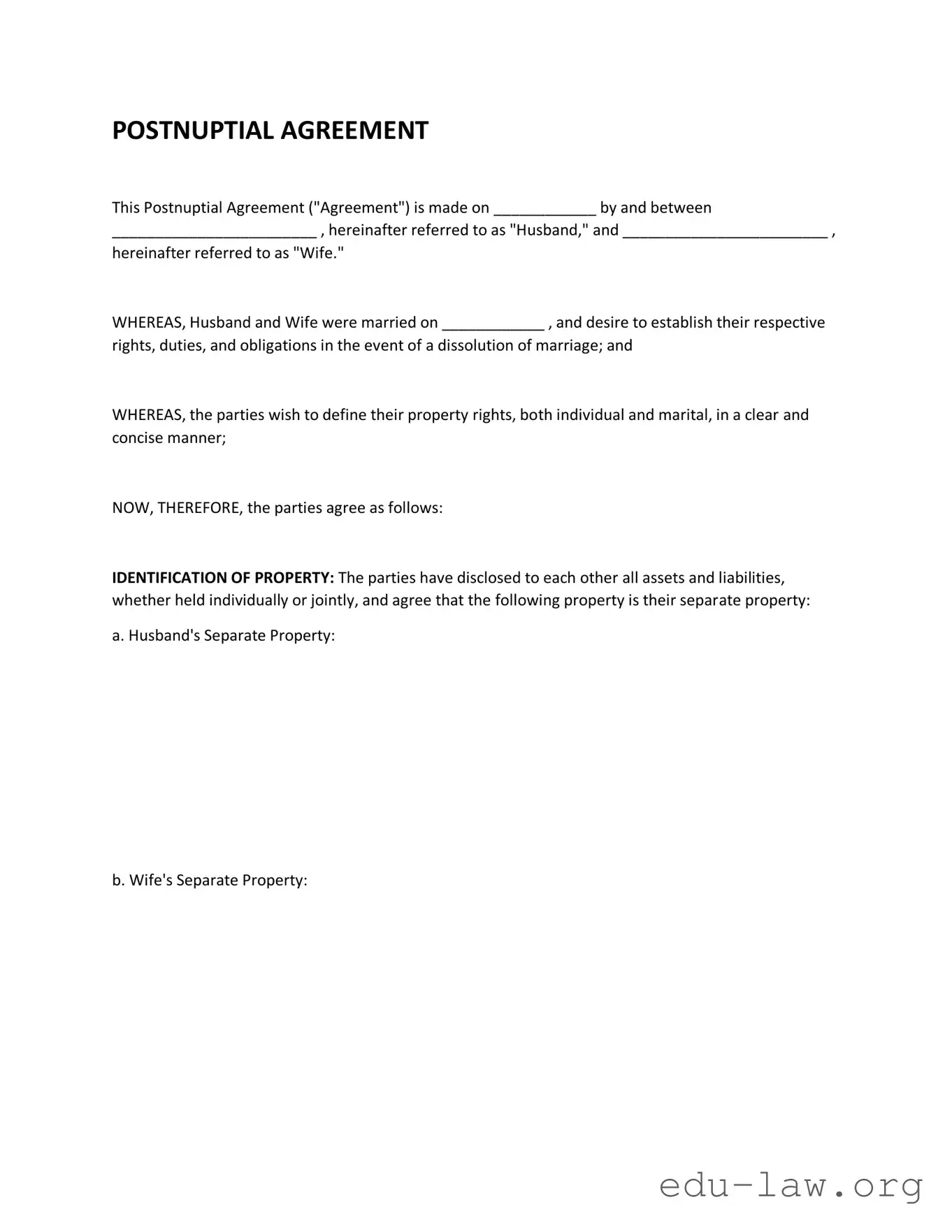
POSTNUPTIAL AGREEMENT
This Postnuptial Agreement ("Agreement") is made on ____________ by and between
________________________ , hereinafter referred to as "Husband," and ________________________ ,
hereinafter referred to as "Wife."
WHEREAS, Husband and Wife were married on ____________ , and desire to establish their respective
rights, duties, and obligations in the event of a dissolution of marriage; and
WHEREAS, the parties wish to define their property rights, both individual and marital, in a clear and concise manner;
NOW, THEREFORE, the parties agree as follows:
IDENTIFICATION OF PROPERTY: The parties have disclosed to each other all assets and liabilities, whether held individually or jointly, and agree that the following property is their separate property:
a. Husband's Separate Property:
b. Wife's Separate Property:
MARITAL PROPERTY: The parties agree that the following property is marital property and shall be subject to equitable distribution in the event of a dissolution of marriage:
DIVISION OF MARITAL PROPERTY: In the event of a dissolution of marriage, the parties agree to divide the marital property as follows:
SPOUSAL SUPPORT: The parties agree that in the event of a dissolution of marriage, neither party shall be entitled to spousal support from the other.
ATTORNEY'S FEES: In the event of any legal action related to the enforcement of this Agreement, the prevailing party shall be entitled to recover reasonable attorney's fees and costs.
AMENDMENT: This Agreement may not be amended, modified, or terminated except in writing executed by both parties.
GOVERNING LAW: This Agreement shall be governed by the laws of the State of ____________.
ENTIRE AGREEMENT: This Agreement constitutes the entire understanding between the parties and supersedes all prior negotiations, understandings, and agreements between them.
EXECUTION: This Agreement shall be executed in duplicate, and each party shall retain one original.
IN WITNESS WHEREOF, the parties have executed this Postnuptial Agreement as of the date first written above.
HUSBAND: ___________________________
________________________
WIFE: _______________________________
________________________
| Fact Name | Description |
|---|---|
| Purpose | A Postnuptial Agreement outlines the rights and responsibilities of each spouse regarding property and finances in the event of a divorce. |
| Property Identification | The agreement requires both parties to disclose their assets and liabilities, categorizing property as either separate or marital. |
| Spousal Support | Typically, the agreement states that neither spouse will be entitled to spousal support from the other in the event of a divorce. |
| Amendments | Any changes to the agreement must be made in writing and signed by both parties to be valid. |
| Governing Law | The agreement is governed by the laws of the state specified, which can vary by jurisdiction. |
Filling out the Postnuptial Agreement form is an important step in clarifying the rights and responsibilities of both parties in a marriage. The following steps will guide you through the process of completing this form accurately and effectively.
What is a Postnuptial Agreement?
A Postnuptial Agreement is a legal document created by a married couple to outline their financial rights and responsibilities. It can address issues such as the division of property, spousal support, and other matters in case of a separation or divorce. Unlike a prenuptial agreement, which is established before marriage, a postnuptial agreement is executed after the couple is already married.
Why would a couple want a Postnuptial Agreement?
There are various reasons a couple may consider a postnuptial agreement. It can provide clarity and peace of mind regarding financial matters, especially if there have been significant changes in circumstances, such as a job loss, inheritance, or a substantial increase in income. Additionally, it can help couples who want to formalize their understanding of property rights or those who wish to protect individual assets acquired during the marriage.
What should be included in a Postnuptial Agreement?
A postnuptial agreement typically includes details about the couple's separate and marital property, how that property will be divided in case of a divorce, and any agreements regarding spousal support. It’s essential for both parties to fully disclose their assets and liabilities. The agreement should also specify the governing law, meaning which state’s laws will apply to the agreement.
Is a Postnuptial Agreement legally binding?
Yes, a postnuptial agreement can be legally binding if it meets certain requirements. Both parties must voluntarily agree to the terms, and it should be in writing and signed by both spouses. Additionally, it’s advisable for each party to have independent legal counsel to ensure that their rights are protected and that they fully understand the agreement.
Can a Postnuptial Agreement be changed?
Yes, a postnuptial agreement can be amended or modified, but it must be done in writing and signed by both parties. This ensures that any changes are legally recognized and that both spouses are in agreement about the new terms. It’s important to keep the document updated, especially after significant life changes.
What happens if one spouse does not follow the Postnuptial Agreement?
If one spouse fails to adhere to the terms of the postnuptial agreement, the other spouse may seek legal recourse. This could involve filing a lawsuit to enforce the agreement. The prevailing party in such a legal action may also be entitled to recover reasonable attorney's fees and costs, as specified in the agreement.
Do both spouses need to hire attorneys for a Postnuptial Agreement?
While it’s not a legal requirement for both spouses to hire attorneys, it is highly recommended. Each spouse having their own attorney helps ensure that they fully understand the implications of the agreement and that their interests are adequately represented. This can help prevent disputes in the future and strengthen the enforceability of the agreement.
How does a Postnuptial Agreement differ from a Prenuptial Agreement?
The primary difference between a postnuptial agreement and a prenuptial agreement is the timing of when they are created. A prenuptial agreement is established before marriage, while a postnuptial agreement is executed after the couple is already married. Both serve similar purposes in defining financial rights and responsibilities, but the reasons for creating them may vary based on the couple's circumstances.
Not filling in the date: The date of the agreement is crucial. Leaving it blank can create confusion about when the agreement takes effect.
Missing signatures: Both parties must sign the agreement. Without signatures, the document may not be valid.
Inadequate property disclosure: Each party should fully disclose all assets and liabilities. Failing to do so can lead to misunderstandings and disputes later.
Ignoring state laws: Each state has its own laws regarding postnuptial agreements. Not considering these laws can affect the enforceability of the agreement.
Not reviewing the agreement: It is important to read the entire agreement before signing. Overlooking details can result in unintended consequences.
A Postnuptial Agreement is a legal document that outlines the rights and responsibilities of spouses regarding their property and financial matters in the event of a divorce or separation. While this agreement is essential for clarifying expectations, there are several other documents that may accompany it to ensure comprehensive coverage of marital assets and obligations. Below is a list of commonly used forms and documents that can complement a Postnuptial Agreement.
Each of these documents plays a vital role in ensuring that both parties understand their rights and obligations. By utilizing these forms in conjunction with a Postnuptial Agreement, couples can create a more secure and clear financial future, minimizing misunderstandings and disputes.
A Prenuptial Agreement, often referred to as a "prenup," is created before marriage. It outlines how assets and debts will be handled in the event of divorce or separation. Like a Postnuptial Agreement, it aims to protect individual property rights and clarify financial obligations. Both agreements serve to prevent disputes by establishing clear terms regarding property division and support. While a prenup is signed before marriage, a postnup is executed after the wedding, making it a useful tool for couples who wish to reassess their financial arrangements post-ceremony.
A Separation Agreement is another document similar to a Postnuptial Agreement. This agreement is typically used when a couple decides to live apart but is not yet divorced. It outlines the terms of separation, including asset division, spousal support, and child custody arrangements. Like a postnup, it aims to clarify the rights and responsibilities of each party. Both documents help to minimize conflict and provide a framework for moving forward, whether the couple reconciles or proceeds with divorce.
A Marital Settlement Agreement is executed during divorce proceedings. It details how the couple will divide their assets, debts, and responsibilities, much like a Postnuptial Agreement. This document is essential for ensuring that both parties have a mutual understanding of their financial obligations post-divorce. While a postnup is proactive, a marital settlement agreement is often reactive, addressing issues that arise from the dissolution of the marriage.
A Cohabitation Agreement is designed for couples who live together but are not married. This agreement outlines how property and debts will be handled during the relationship and in the event of a breakup. Similar to a Postnuptial Agreement, it clarifies each partner's rights and responsibilities. Both documents aim to protect individual interests and provide clear guidelines, ensuring that both parties understand their financial positions.
An Estate Plan includes various documents that dictate how an individual's assets will be distributed upon death. While a Postnuptial Agreement focuses on property division during marriage or separation, an estate plan addresses the distribution of assets after death. Both documents require clear communication and understanding between parties, emphasizing the importance of legal agreements in managing financial matters effectively.
A Financial Power of Attorney grants one person the authority to make financial decisions on behalf of another. This document is similar to a Postnuptial Agreement in that it establishes clear guidelines for financial management. Both documents help ensure that the interests of the parties are protected, particularly in situations where one partner may be unable to manage their financial affairs due to incapacity or other reasons. Clarity and mutual agreement are essential in both cases.
When filling out the Postnuptial Agreement form, consider the following guidelines:
Understanding postnuptial agreements can be challenging, and several misconceptions often arise. Here are five common myths about the Postnuptial Agreement form, along with clarifications:
By addressing these misconceptions, couples can better understand the value of a postnuptial agreement and how it can serve their needs. Communication and clarity are key to a healthy relationship.
Filling out and using a Postnuptial Agreement can be a straightforward process if you keep a few key points in mind. Here are some important takeaways:
By following these takeaways, you can create a Postnuptial Agreement that meets your needs and provides clarity for both parties.