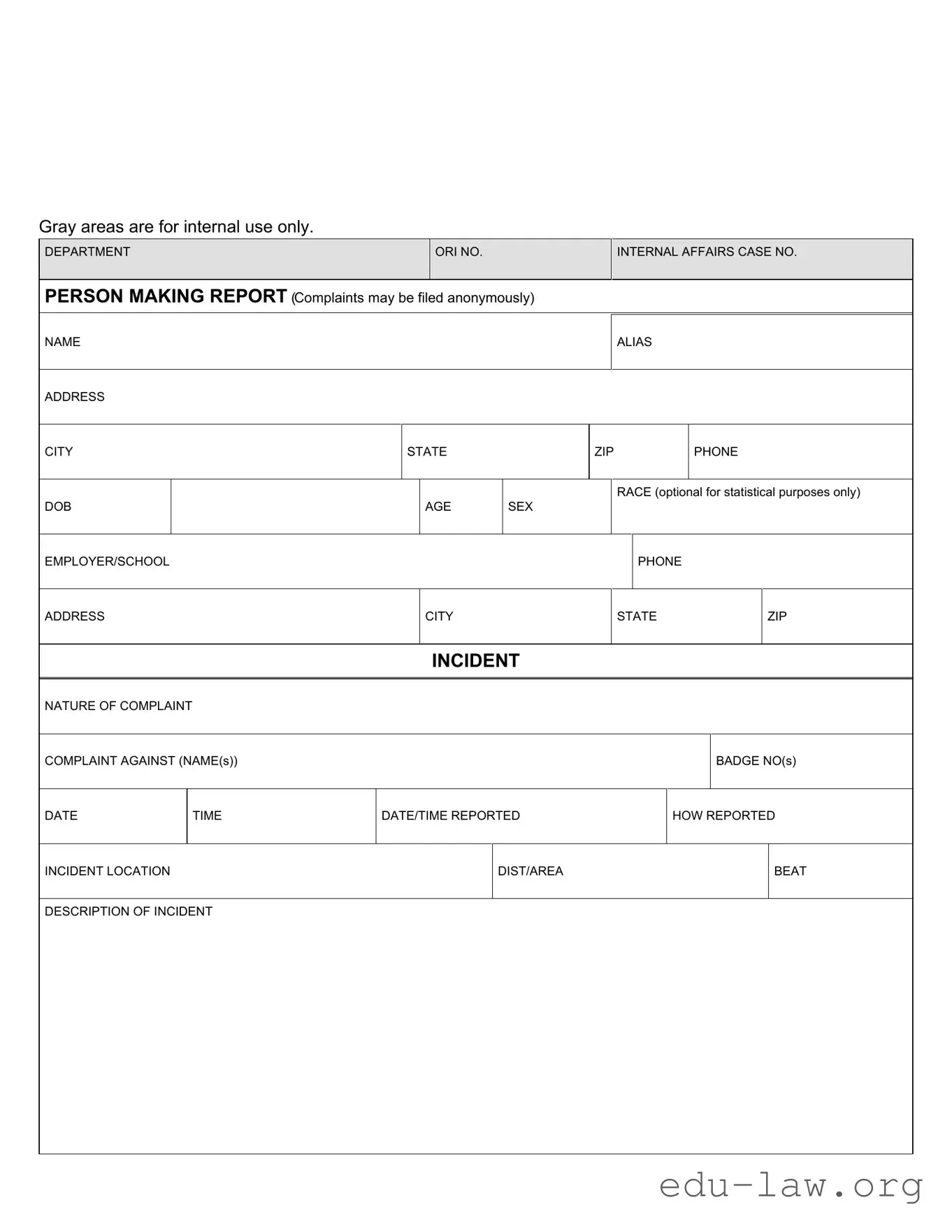
The Police Report form is a vital tool for documenting incidents and complaints within law enforcement agencies. It serves as a structured way for individuals to communicate their experiences, whether they choose to identify themselves or remain anonymous. The form collects essential information about the person making the report, including their name, contact details, and demographic information, which can be used for statistical purposes. It also outlines the nature of the complaint, specifying the individuals involved, such as officers or departments, along with their badge numbers. Key details like the date, time, and location of the incident are captured, ensuring a comprehensive account of what transpired. Furthermore, the form allows for a description of any injuries sustained and includes a section for medical treatment details. Each report is assigned a unique case number for tracking purposes, and it concludes with spaces for the complainant's signature and any additional comments. This organized approach not only facilitates internal investigations but also promotes transparency and accountability within law enforcement agencies.

Gray areas are for internal use only.
DEPARTMENT
ORI NO.
INTERNAL AFFAIRS CASE NO.
PERSON MAKING REPORT (Complaints may be filed anonymously)
NAME
ALIAS
ADDRESS
CITY
DOB
STATE |
|
ZIP |
|
PHONE |
||
|
|
|
|
|
|
|
|
|
|
|
|
RACE (optional for statistical purposes only) |
|
|
AGE |
SEX |
|
|
|
|
|
|
|
|
|
|
|
EMPLOYER/SCHOOL
PHONE
ADDRESS
CITY
STATE
ZIP
INCIDENT
NATURE OF COMPLAINT
COMPLAINT AGAINST (NAME(s))
BADGE NO(s)
DATE
TIME
DATE/TIME REPORTED
HOW REPORTED
INCIDENT LOCATION |
DIST/AREA |
BEAT |
|
|
|
DESCRIPTION OF INCIDENT |
|
|

DESCRIPTION OF ANY INJURIES
PLACE OF |
DOCTOR’S |
DATE OF |
|
TREATMENT |
NAME |
TREATMENT |
|
|
|
|
|
SIGNATURE OF COMPLAINANT (Optional) |
|
|
DATE |
|
|
|
|
COMMENTS |
|
|
|
SIGNATURE
BADGE NO.
DATE RECEIVED
| Fact Name | Description |
|---|---|
| Purpose of the Form | This form is designed for individuals to report complaints against law enforcement agencies in Morris County, ensuring accountability and transparency in policing. |
| Anonymity | Individuals filing a complaint can choose to remain anonymous, allowing them to report misconduct without fear of retaliation. |
| Governing Law | The use of this form is governed by New Jersey's Attorney General Guidelines on Internal Affairs Policies and Procedures, ensuring compliance with state regulations. |
| Information Required | The form requires detailed information, including the complainant's name, the nature of the complaint, and specifics about the incident, to facilitate a thorough investigation. |
Filling out the Police Report form is an important step in documenting your concerns. After completing the form, you will submit it to the appropriate law enforcement agency for review. Here are the steps to help you fill out the form accurately:
What is the purpose of the Police Report form?
The Police Report form is designed to facilitate the filing of complaints against law enforcement personnel. It serves as a structured way for individuals to document their grievances, ensuring that all necessary information is collected for a thorough review. This form can be used by anyone, including those who wish to remain anonymous. It is applicable to any law enforcement agency within Morris County, including the Morris County Prosecutor’s Office.
Who can file a complaint using this form?
Any individual who feels they have been wronged by law enforcement can file a complaint using this form. This includes victims of misconduct, witnesses to incidents, or even individuals who wish to report an experience anonymously. The form allows for flexibility in reporting and encourages community involvement in holding law enforcement accountable.
What information is required to complete the form?
To complete the Police Report form, you will need to provide several key pieces of information. This includes your name, address, and contact details, although providing your name is optional if you choose to remain anonymous. You will also need to specify the nature of your complaint, the names and badge numbers of the officers involved, and a detailed description of the incident. Additionally, if there were any injuries, you should include information about medical treatment received.
How is the information on the form used?
The information collected on the Police Report form is utilized by the Internal Affairs division to investigate complaints against law enforcement personnel. Each report is carefully reviewed to determine the validity of the claims made. This process helps ensure accountability and transparency within the police department. It is important to provide accurate and detailed information to facilitate a thorough investigation.
Incomplete Information: One common mistake is failing to provide all required fields. Each section of the form is important for the investigation. Missing details can delay the process or lead to misunderstandings.
Ambiguous Language: Using vague or unclear descriptions can hinder the clarity of the report. It’s essential to be as specific as possible when describing the incident and any involved parties.
Incorrect Dates or Times: Providing inaccurate dates or times can create confusion about the timeline of events. Always double-check these details before submitting the form.
Omitting Witness Information: If there are witnesses to the incident, their information should be included. This can strengthen the report and provide additional perspectives on the event.
Neglecting to Sign: Failing to sign the report can result in it being considered incomplete. If anonymity is not a concern, a signature can lend credibility to the complaint.
Not Keeping a Copy: After submitting the report, it’s wise to retain a copy for personal records. This can be helpful for follow-up communications or if further action is needed.
When dealing with a police report, several other forms may also be necessary to ensure a comprehensive understanding of the situation. These documents can provide additional context and help in the investigation process. Below are some commonly used forms that accompany a police report.
Having these forms on hand can streamline the process of reporting and investigating incidents. They ensure that all necessary information is documented, aiding both law enforcement and individuals involved in the situation.
The Internal Affairs Complaint/Report Form is similar to an Incident Report. Both documents serve to document specific events or allegations, detailing the nature of the incident, the parties involved, and the context in which it occurred. An Incident Report typically focuses on the factual aspects of an event, while the Internal Affairs form emphasizes complaints against law enforcement personnel, capturing both the incident and the complainant's perspective.
Another comparable document is the Witness Statement Form. This form collects firsthand accounts from individuals who observed an event. Like the Internal Affairs form, it gathers essential details such as the witness's name, contact information, and a description of what they witnessed. However, the Witness Statement Form is primarily concerned with gathering objective observations, whereas the Internal Affairs form centers on complaints against officers.
The Complaint Form used in civil litigation is also similar. Both documents allow individuals to formally express grievances, detailing the nature of the complaint and the parties involved. While the Internal Affairs form is specific to law enforcement issues, the civil Complaint Form can address a broader range of disputes, including personal injury or contract issues, requiring different legal standards and procedures.
The Affidavit is another related document. An Affidavit is a sworn statement made under oath, often used in legal proceedings. Like the Internal Affairs form, it requires the individual to provide detailed information about an incident or allegation. However, an Affidavit is typically used in court settings, whereas the Internal Affairs form is used internally within a police department for administrative purposes.
The Statement of Facts is also akin to the Internal Affairs form. This document outlines the facts surrounding a particular incident, presenting a narrative that may be used in investigations or legal proceedings. While both documents summarize events, the Statement of Facts is generally more neutral and focused on providing an objective account, whereas the Internal Affairs form is centered on complaints and the accountability of officers.
Lastly, the Evidence Submission Form shares similarities with the Internal Affairs form. Both are used in the context of investigations, documenting information about incidents and the evidence collected. The Evidence Submission Form focuses on physical evidence related to a case, whereas the Internal Affairs form focuses on the allegations against officers, but both aim to support thorough investigations and accountability.
When filling out the Police Report form, it is crucial to approach the task with care. Here are some guidelines to help ensure accuracy and clarity.
Following these guidelines will help ensure that your report is processed efficiently and effectively. Accuracy and clarity are paramount in these situations.
Understanding the Police Report form is essential for anyone involved in filing a complaint or report. However, several misconceptions can lead to confusion. Here are ten common misunderstandings:
Anyone can file a complaint, including witnesses or individuals who may not have been directly involved in the incident.
While providing personal details can help with the investigation, it is not mandatory. Complaints can be filed anonymously.
Not every report leads to an investigation. The police department will assess the validity and seriousness of the complaint first.
Filing a report does not guarantee that disciplinary action will occur. The outcome depends on the investigation's findings.
While in-person filing is an option, reports can often be submitted online or via mail, depending on the department's policies.
While some information may be accessible to the public, certain details in internal affairs reports may be confidential.
Complaints can range from minor issues to serious allegations. Even minor complaints are taken seriously and documented.
It is not necessary to have legal representation to file a police report. Individuals can represent themselves throughout the process.
While it is best to file a report as soon as possible, there is often no strict time limit. Delays can still be accommodated.
Retaliation for filing a complaint is against the law. Departments are required to protect complainants from any form of retribution.
Filling out the Police Report form is an important step in addressing concerns regarding law enforcement conduct. Here are key takeaways to keep in mind:
Being thorough and clear in your report can significantly impact the outcome of your complaint. Take the time to ensure all information is accurate and complete.