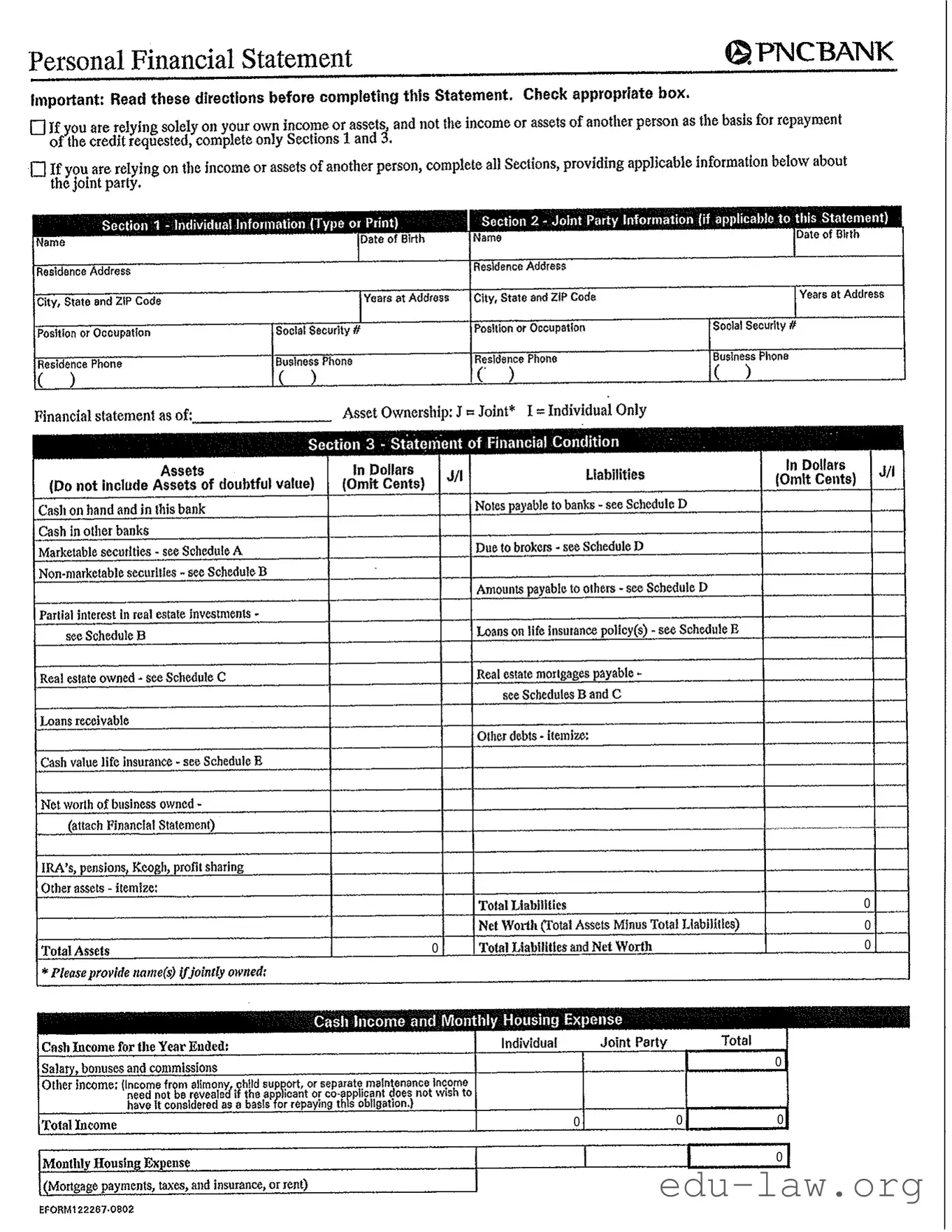
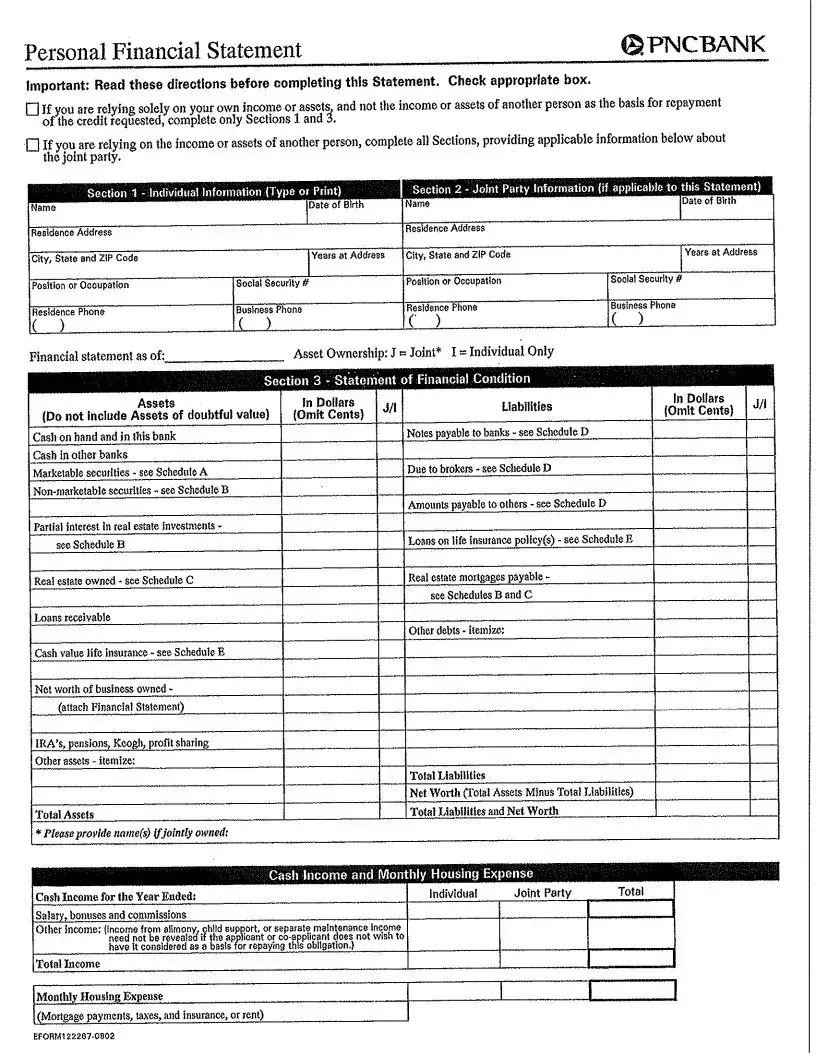
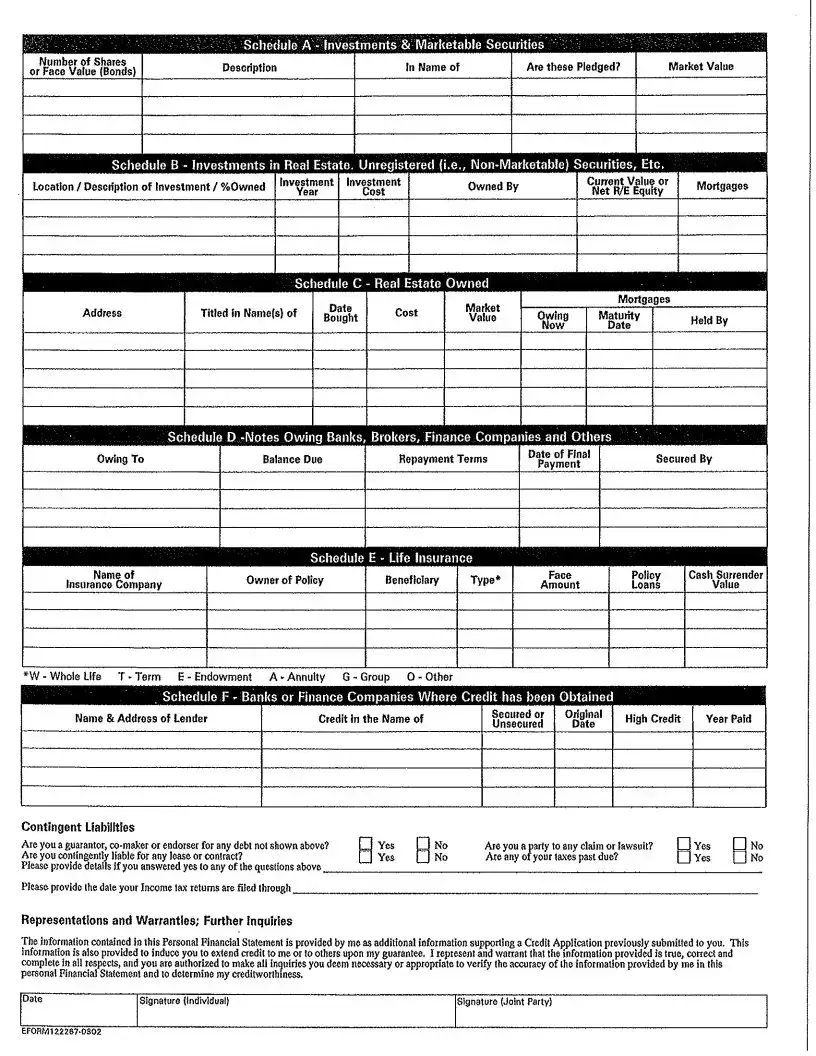
The PNC Bank Statement form serves as a crucial document for individuals seeking to present their financial standing, particularly when applying for credit. This form is structured to gather essential information regarding both individual and joint party finances, ensuring that all relevant data is captured for a comprehensive assessment. The initial sections require personal details, such as names, addresses, and occupations, while subsequent sections delve into financial specifics, including assets, liabilities, and net worth. Applicants must indicate whether they are relying solely on their own financial resources or those of another party, which determines the sections they need to complete. Furthermore, the form includes detailed schedules for assets like marketable securities and real estate, as well as liabilities owed to banks or other creditors. By meticulously filling out this form, individuals not only provide a snapshot of their financial condition but also affirm the accuracy of the information, thereby facilitating the credit evaluation process.
0
0
0 |
0 |
0
0 |
0 |
0 |
0
| Fact Name | Fact Description |
|---|---|
| Purpose | The PNC Bank Statement form is used to provide a detailed overview of an individual's financial condition, including assets and liabilities. |
| Sections | The form consists of multiple sections: Individual Information, Joint Party Information (if applicable), and a Statement of Financial Condition. |
| Asset Ownership | Applicants must indicate whether assets are owned individually or jointly, which affects the overall assessment of financial health. |
| Income Reporting | Income from various sources, including salary and other earnings, must be reported. Applicants can choose not to disclose certain income types. |
| Governing Law | The form is governed by the laws of the state where the applicant resides, which can vary significantly across the United States. |
| Verification | By signing the form, applicants authorize PNC Bank to verify the information provided and assess their creditworthiness. |
| Confidentiality | The information provided in the form is treated confidentially and is used solely for the purpose of evaluating credit applications. |
| Signature Requirement | Both the individual and any joint party must sign the form, affirming that the information is accurate and complete. |
Completing the PNC Bank Statement form requires careful attention to detail. Gather your financial information and follow these steps to ensure accuracy. Once you have filled out the form, review it for completeness before submission.
What is the purpose of the PNC Bank Statement form?
The PNC Bank Statement form is designed to provide a comprehensive overview of an individual's financial situation. It is typically used in conjunction with a credit application, allowing the bank to assess the applicant's ability to repay any credit extended. By detailing assets, liabilities, income, and expenses, the form helps the bank evaluate the financial health of the individual or joint parties involved.
Who should complete the PNC Bank Statement form?
Individuals applying for credit should complete the form. If an applicant is relying solely on their own income or assets, they need to fill out only Sections 1 and 3. However, if they are depending on the income or assets of another person, they must complete all sections, including information about the joint party. This ensures that the bank has a complete picture of all financial resources involved.
What information is required in the PNC Bank Statement form?
The form requires various details, including personal information like names, addresses, and dates of birth. It also asks for financial data such as assets, liabilities, income, and monthly housing expenses. Applicants must provide accurate figures for cash, investments, real estate, and debts. Additionally, information about any joint parties and their financial contributions may be necessary if applicable.
How should the assets and liabilities be reported on the form?
Assets should be reported in dollar amounts, omitting cents, and should include only those with verifiable value. This includes cash, investments, real estate, and any other significant assets. Liabilities should also be listed in dollar amounts and must include all debts, such as loans and mortgages. The total assets and total liabilities will be used to calculate the net worth, which is a crucial part of the financial assessment.
What happens if the information provided is inaccurate?
Providing inaccurate information on the PNC Bank Statement form can have serious consequences. If the bank discovers discrepancies, it may lead to a denial of credit or even legal repercussions. Therefore, it is essential for applicants to ensure that all information is true, correct, and complete. The form includes a statement where applicants must attest to the accuracy of the information provided, emphasizing the importance of honesty in the process.
Inaccurate Information Entry: Many individuals mistakenly provide incorrect details about their income, assets, or liabilities. It's crucial to ensure that all figures are accurate and reflect the current financial situation.
Omitting Required Sections: Some applicants fail to complete all necessary sections of the form. If you are relying on the income or assets of another person, it is essential to fill out the Joint Party Information section. Neglecting this can lead to delays or denials in the credit application process.
Not Following Instructions: Ignoring the provided directions can result in errors. The form explicitly states which sections to complete based on individual circumstances. Carefully reading and adhering to these instructions can prevent unnecessary complications.
Failure to Update Information: Some applicants use outdated financial information. It is vital to ensure that all data, including addresses, phone numbers, and financial figures, are current. Outdated information can raise red flags and hinder the approval process.
The PNC Bank Statement form is a crucial document for individuals seeking to provide a comprehensive overview of their financial situation. Alongside this form, several other documents may be required to support the application process. Below is a list of related forms and documents that are often used in conjunction with the PNC Bank Statement form, along with brief descriptions of each.
Each of these documents plays a vital role in providing a complete picture of an applicant's financial circumstances. Together, they support the assessment process and help ensure that lending decisions are made based on accurate and comprehensive information.
The Personal Financial Statement is similar to a Loan Application Form, which is commonly used by individuals seeking credit. Both documents require detailed information about the applicant's financial situation, including assets and liabilities. While the Loan Application Form may focus more on the purpose of the loan and repayment terms, it still demands a clear picture of the applicant's financial health, much like the Personal Financial Statement does. This similarity helps lenders assess the risk associated with granting credit.
Another document that resembles the Personal Financial Statement is the Credit Report. A Credit Report provides a comprehensive overview of an individual's credit history, including outstanding debts, payment history, and credit inquiries. Like the Personal Financial Statement, it plays a crucial role in determining creditworthiness. Lenders often review both documents to gain insights into an applicant's financial behavior and reliability, making them essential tools in the lending process.
The Tax Return is also akin to the Personal Financial Statement, as it offers a snapshot of an individual's income and financial status over a specific period. Tax Returns include information about earnings, deductions, and overall financial health. Lenders may request both documents to ensure that the income reported in the Personal Financial Statement aligns with what is documented in the Tax Return, providing a more accurate assessment of the applicant's financial situation.
Similarly, the Balance Sheet is a financial document that outlines an individual’s assets, liabilities, and equity at a specific point in time. Much like the Personal Financial Statement, a Balance Sheet provides a clear view of financial standing. It helps both individuals and lenders understand net worth and financial stability, making it a useful tool for evaluating credit applications and financial planning.
Lastly, the Business Financial Statement mirrors the Personal Financial Statement for business owners. This document details a business's financial performance, including revenue, expenses, and net profit. Just as the Personal Financial Statement assesses an individual's financial condition, the Business Financial Statement allows lenders to evaluate the financial health of a business seeking credit. Both documents serve to present a clear financial picture to potential creditors, aiding in the decision-making process.
When filling out the PNC Bank Statement form, it's essential to approach the task with care. Here are some important dos and don'ts to keep in mind:
By following these guidelines, you can help ensure that your PNC Bank Statement form is completed correctly and efficiently.
Understanding the PNC Bank Statement form is crucial for anyone looking to apply for credit. However, several misconceptions can lead to confusion. Here are four common misunderstandings:
By clarifying these misconceptions, individuals can better prepare their PNC Bank Statement form and ensure a smoother credit application process.
When filling out the PNC Bank Statement form, keep the following key points in mind:
Completing this form accurately is crucial for your financial application. Take your time to ensure all information is correct and thorough.