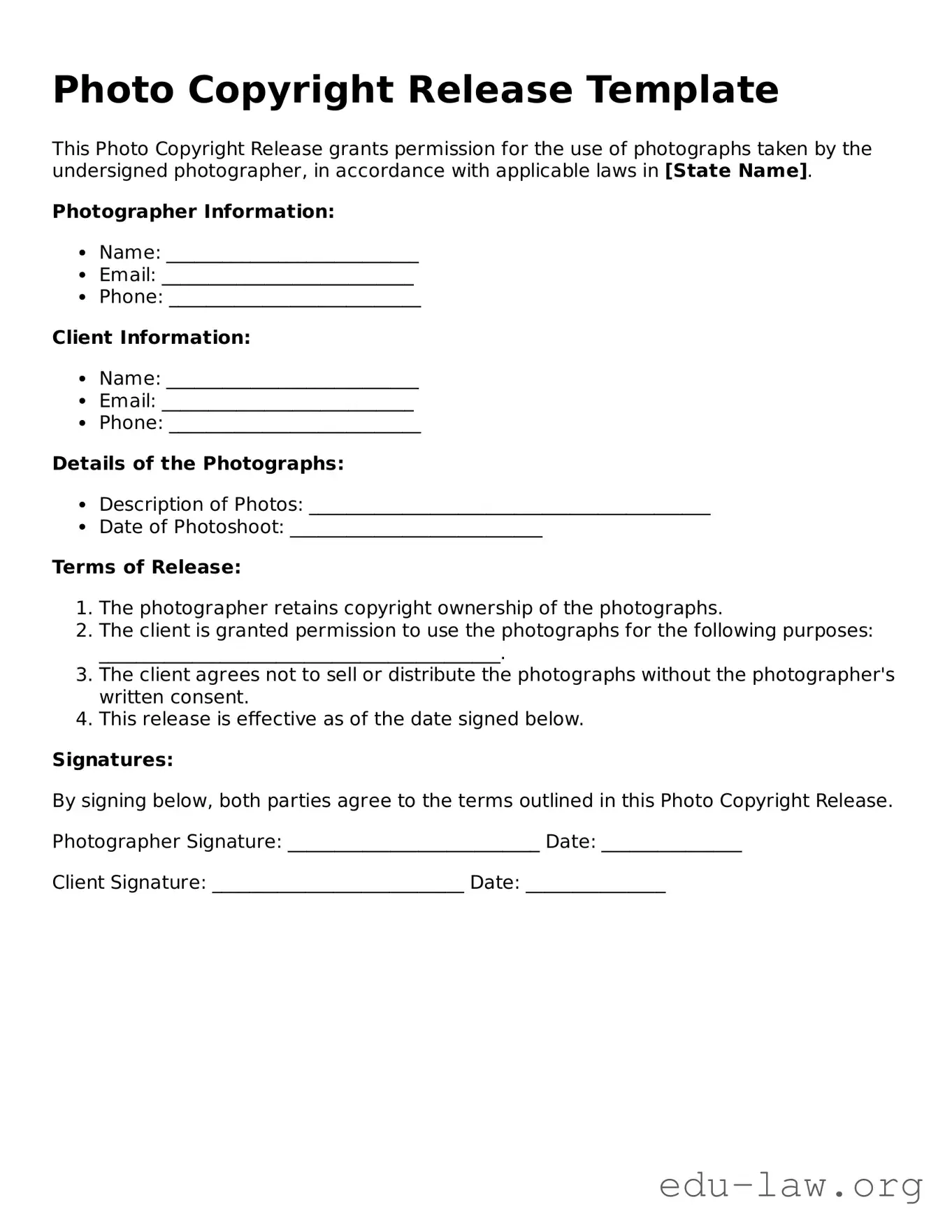
The Photo Copyright Release form serves as a crucial legal instrument in the realm of photography and visual arts. This document facilitates the transfer of rights from the photographer or creator to another party, often a client or publisher, allowing them to use the images without fear of infringing on copyright laws. Typically, the form outlines the specific rights being granted, such as reproduction, distribution, and display of the photographs. It may also specify any limitations or conditions under which the images can be used, ensuring that both parties have a clear understanding of their rights and responsibilities. By signing this form, photographers can protect their creative work while providing clients the necessary permissions to utilize the images as intended. This mutual agreement not only fosters professional relationships but also upholds the integrity of copyright law in the creative industry.
Photo Copyright Release Template
This Photo Copyright Release grants permission for the use of photographs taken by the undersigned photographer, in accordance with applicable laws in [State Name].
Photographer Information:
Client Information:
Details of the Photographs:
Terms of Release:
Signatures:
By signing below, both parties agree to the terms outlined in this Photo Copyright Release.
Photographer Signature: ___________________________ Date: _______________
Client Signature: ___________________________ Date: _______________
| Fact Name | Description |
|---|---|
| Purpose | A Photo Copyright Release form grants permission for the use of photographs, allowing the photographer or entity to use the images for specified purposes. |
| Ownership | The photographer retains ownership of the copyright unless explicitly transferred. The release allows others to use the images without infringing on copyright. |
| Consent | Individuals in the photographs must provide consent. This ensures that their likeness can be used legally and ethically. |
| State-Specific Forms | Different states may have specific requirements for photo releases. For example, California law emphasizes the need for consent when using someone's likeness for commercial purposes. |
| Limitations | The release may include limitations on how the photographs can be used, such as restricting commercial use or requiring credit to the photographer. |
| Duration | The rights granted in a Photo Copyright Release can be permanent or time-limited, depending on what is agreed upon in the form. |
| Revocation | Once signed, a Photo Copyright Release is generally binding, but in some cases, individuals may have the right to revoke consent under certain circumstances. |
Once you have the Photo Copyright Release form, it's important to complete it accurately to ensure that all necessary permissions are granted. Follow these steps carefully to fill out the form correctly.
What is a Photo Copyright Release form?
A Photo Copyright Release form is a legal document that allows the photographer to transfer copyright ownership of their images to another party. This form grants permission for the use of the photographs in various ways, such as for marketing, advertising, or personal use. It ensures that the rights of both the photographer and the individual receiving the photos are clearly defined.
When should I use a Photo Copyright Release form?
You should use a Photo Copyright Release form whenever you want to give someone permission to use your photographs for specific purposes. This could be when a client hires you for a photoshoot and wants to use the images for their business, or when you’re sharing photos with friends or family for public display. Using this form helps prevent any misunderstandings about how the photos can be used.
What information is typically included in a Photo Copyright Release form?
Typically, a Photo Copyright Release form includes details such as the names of the photographer and the individual receiving the rights, a description of the photographs, and the specific rights being granted. It may also outline any limitations on usage, such as whether the photos can be altered or used for commercial purposes. Both parties usually sign the document to acknowledge their agreement.
Is a Photo Copyright Release form legally binding?
Yes, a Photo Copyright Release form is legally binding once both parties have signed it. This means that the terms outlined in the document must be followed. However, it’s important to ensure that the form is clear and unambiguous to avoid any potential disputes in the future. If you have any concerns, consider consulting with a legal professional to ensure the form meets your needs.
Not providing complete contact information. Ensure all fields for name, address, phone number, and email are filled out accurately.
Failing to specify the purpose of the release. Clearly state how the photos will be used to avoid confusion later.
Overlooking the date of the release. Always include the date when the form is filled out to establish a timeline.
Neglecting to sign the form. A signature is necessary for the release to be valid. Without it, the form is incomplete.
Using unclear language. Be straightforward in your wording to ensure all parties understand the terms of the release.
Not keeping a copy of the signed form. Retain a copy for your records in case any disputes arise in the future.
Forgetting to include all relevant parties. If there are multiple individuals involved, ensure everyone signs the release.
Ignoring state-specific laws. Different states may have unique requirements for copyright releases, so be aware of local regulations.
When working with photography and the use of images, several documents often accompany the Photo Copyright Release form. These forms help clarify rights, responsibilities, and permissions related to the use of photographs. Here’s a brief overview of some common forms you may encounter:
Each of these forms plays a vital role in the photography process, ensuring that all parties understand their rights and obligations. Having the right documentation in place can help prevent misunderstandings and protect the interests of everyone involved.
The Photo Copyright Release form shares similarities with the Model Release form. Both documents are designed to protect the rights of individuals involved in a visual representation. A Model Release specifically grants permission for the use of a person's likeness in photographs or videos, while the Photo Copyright Release focuses on the ownership and usage rights of the images themselves. Both forms help ensure that the subjects understand how their images may be used and that the photographer or creator has the necessary permissions to avoid legal issues.
Another related document is the Property Release form. This form is used when a photographer captures images of private property. Just as the Photo Copyright Release secures the rights to the images, a Property Release ensures that the photographer has permission to use images of the property for commercial purposes. Without this document, the property owner could challenge the use of their property in the images, similar to how a subject might contest the use of their likeness in a Photo Copyright Release.
The Video Release form is also akin to the Photo Copyright Release. While the latter deals with still images, the Video Release pertains to moving images. It grants permission for the use of a person's likeness in video content. Both documents serve the same purpose of protecting the rights of the subjects and the creators, ensuring that all parties are aware of how the content will be used and distributed.
A similar document is the Music Release form. This form is used when incorporating music into visual content, such as videos or films. Just like the Photo Copyright Release, which addresses the ownership and rights of photographs, the Music Release ensures that the creator has permission to use specific music tracks. It helps avoid copyright infringement and clarifies the terms under which the music can be used, protecting both the artist and the creator.
The Licensing Agreement is another document that bears resemblance to the Photo Copyright Release. This agreement outlines the terms under which one party can use the intellectual property of another, including photographs. While the Photo Copyright Release focuses on granting permission for specific uses of images, a Licensing Agreement can cover a broader range of uses and may involve financial compensation. Both documents are essential for protecting the rights of creators and ensuring clarity in usage terms.
The Release of Liability form is similar in that it protects one party from legal claims made by another. While the Photo Copyright Release focuses on image rights, the Release of Liability is often used in situations where participants might be exposed to risks, such as during a photoshoot. Both documents aim to clarify responsibilities and protect the interests of the involved parties, ensuring that everyone understands their rights and obligations.
The Consent Form for Minors is another document that aligns with the Photo Copyright Release. When a minor is involved in a photoshoot, parental consent is required to use their likeness. This form ensures that parents or guardians grant permission for the minor's image to be used, similar to how the Photo Copyright Release secures permission from adults. Both forms help safeguard the rights of individuals, particularly those who may not be able to consent on their own.
The Creative Commons License is a document that also shares similarities with the Photo Copyright Release. This license allows creators to specify how their work can be used by others. While the Photo Copyright Release focuses on granting specific permissions for individual images, a Creative Commons License provides a broader framework for sharing and using creative works. Both documents aim to clarify the rights of creators and how their work can be utilized by others.
The Assignment of Copyright form is closely related to the Photo Copyright Release. This document is used when a creator transfers their copyright ownership to another party. While the Photo Copyright Release grants permission for use, the Assignment of Copyright formally changes ownership. Both documents are crucial for managing rights and ensuring that creators and users understand their legal standing regarding the work.
Lastly, the Non-Disclosure Agreement (NDA) can be viewed as similar in its protective nature. While the Photo Copyright Release deals with image rights, an NDA protects confidential information shared between parties. Both documents establish clear boundaries and expectations, ensuring that sensitive information or rights are not misused or disclosed without permission. They serve to foster trust and clarity in professional relationships.
When filling out a Photo Copyright Release form, it’s essential to approach the task with care. Here’s a helpful list of things to do and avoid to ensure a smooth process.
Things You Should Do:
Things You Shouldn't Do:
Completing the Photo Copyright Release form correctly is vital for protecting your rights and ensuring clarity in the use of your images. Stay organized and proactive to avoid any potential issues.
Understanding the Photo Copyright Release form is essential for photographers and subjects alike. However, several misconceptions can lead to confusion. Below is a list of common misunderstandings regarding this important document.
This is not true. A release typically allows the photographer to use the images for specific purposes, while the subject retains certain rights, depending on the terms of the release.
While commercial use often requires a release, it is also advisable for personal projects, exhibitions, or any public display of the images.
Written consent is crucial. A signed release provides clear evidence of permission, which can protect both parties in case of disputes.
Photo releases can vary significantly in terms of rights granted and limitations. It is essential to read the specific terms of each release carefully.
This is misleading. Even personal use can sometimes infringe on copyright or privacy rights if the image is shared publicly.
Even at public events, individuals may have a right to privacy. Obtaining a release can help avoid potential legal issues.
In some cases, individuals may have the right to revoke a release under specific circumstances. It’s important to check the terms of the release for any such provisions.
While photographers often take on this responsibility, it is a good practice for both parties to understand their rights and obligations regarding the use of images.
By dispelling these misconceptions, individuals can make informed decisions about their rights and responsibilities related to photo copyright releases.
Filling out and using a Photo Copyright Release form is essential for anyone involved in photography, whether as a photographer or a subject. Here are key takeaways to consider:
By following these guidelines, individuals can navigate the complexities of image rights more effectively.