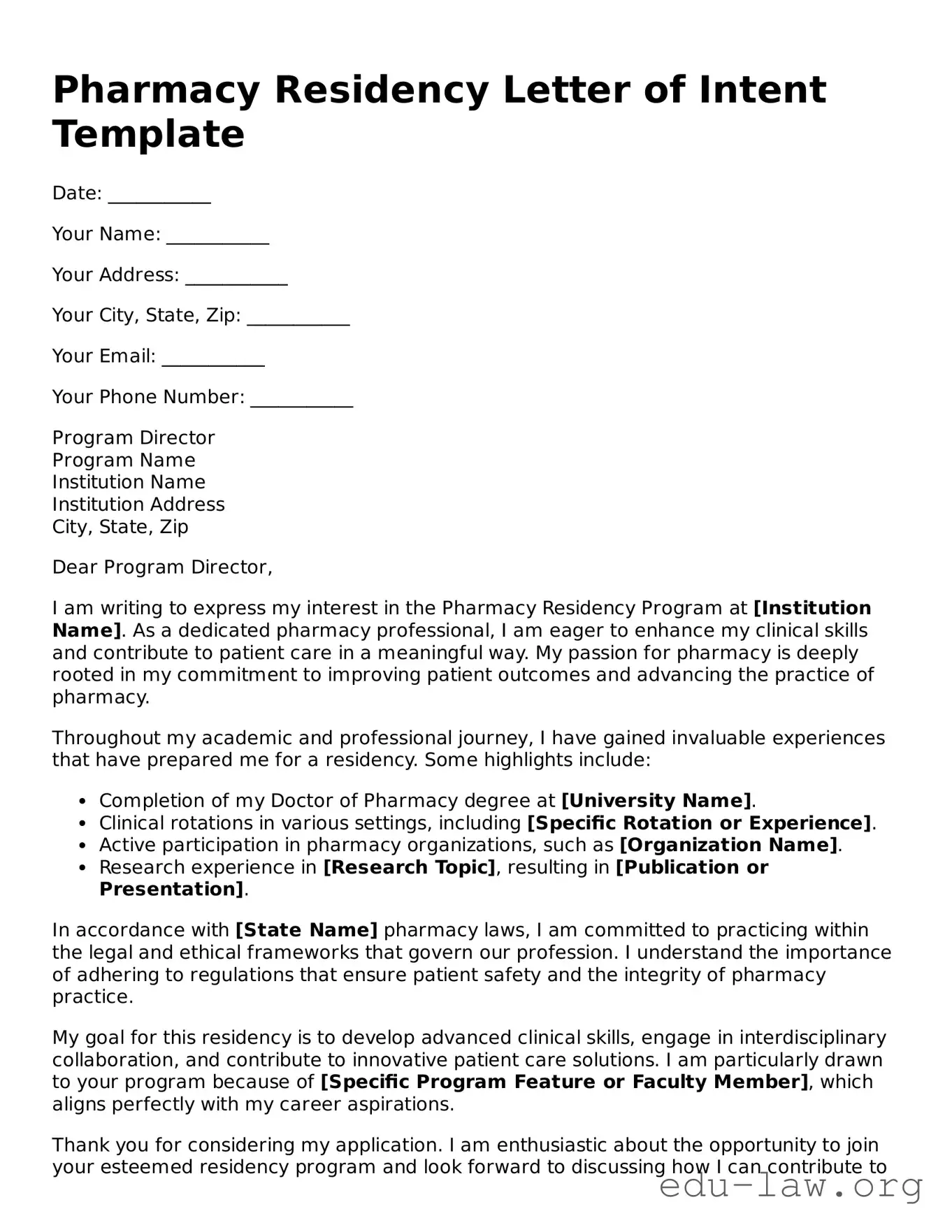
The Pharmacy Residency Letter of Intent is a crucial document for aspiring pharmacy residents, serving as a personal introduction to residency programs. This letter provides candidates the opportunity to express their motivations for pursuing a residency, outline their professional goals, and highlight relevant experiences. A well-crafted letter can set an applicant apart from others by showcasing their passion for the field and commitment to patient care. In addition to personal anecdotes, the letter should reflect an understanding of the specific residency program and how it aligns with the applicant's career aspirations. Clarity and professionalism are key, as the letter is often the first impression made on the selection committee. By thoughtfully addressing these elements, candidates can effectively communicate their qualifications and enthusiasm for the residency opportunity.
Pharmacy Residency Letter of Intent Template
Date: ___________
Your Name: ___________
Your Address: ___________
Your City, State, Zip: ___________
Your Email: ___________
Your Phone Number: ___________
Program Director
Program Name
Institution Name
Institution Address
City, State, Zip
Dear Program Director,
I am writing to express my interest in the Pharmacy Residency Program at [Institution Name]. As a dedicated pharmacy professional, I am eager to enhance my clinical skills and contribute to patient care in a meaningful way. My passion for pharmacy is deeply rooted in my commitment to improving patient outcomes and advancing the practice of pharmacy.
Throughout my academic and professional journey, I have gained invaluable experiences that have prepared me for a residency. Some highlights include:
In accordance with [State Name] pharmacy laws, I am committed to practicing within the legal and ethical frameworks that govern our profession. I understand the importance of adhering to regulations that ensure patient safety and the integrity of pharmacy practice.
My goal for this residency is to develop advanced clinical skills, engage in interdisciplinary collaboration, and contribute to innovative patient care solutions. I am particularly drawn to your program because of [Specific Program Feature or Faculty Member], which aligns perfectly with my career aspirations.
Thank you for considering my application. I am enthusiastic about the opportunity to join your esteemed residency program and look forward to discussing how I can contribute to your team.
Sincerely,
[Your Name]
| Fact Name | Description |
|---|---|
| Purpose | The Pharmacy Residency Letter of Intent is used by candidates to express their interest in a residency program. |
| Content | This letter typically includes the candidate's qualifications, experiences, and reasons for applying to the specific program. |
| Length | Most letters are one page long, allowing candidates to be concise yet informative. |
| Format | The letter should be formatted professionally, often including a header with the candidate's contact information. |
| Submission | Candidates usually submit the letter along with their application materials by a specified deadline. |
| State-Specific Forms | Some states may have specific guidelines for the letter of intent, which candidates should follow closely. |
| Governing Laws | In states like California, the Pharmacy Practice Act governs residency programs and their application processes. |
| Personalization | It is essential for candidates to personalize their letters, addressing specific faculty or program attributes. |
| Review | Before submission, candidates should have their letters reviewed by mentors or peers to ensure clarity and professionalism. |
After you have gathered all necessary information, it's time to complete the Pharmacy Residency Letter of Intent form. This form is crucial for your application process, and filling it out accurately is essential for presenting your qualifications effectively.
What is the purpose of the Pharmacy Residency Letter of Intent?
The Pharmacy Residency Letter of Intent serves as a formal introduction to the residency program you are applying for. It allows you to express your interest in the program, highlight your qualifications, and convey your career goals. This document is your opportunity to make a strong first impression, demonstrating not only your passion for pharmacy but also your commitment to the specific residency program. A well-crafted letter can set you apart from other candidates, showcasing your unique experiences and aspirations.
What should be included in the Letter of Intent?
Your Letter of Intent should include several key components. Start with a brief introduction about yourself, including your current educational status and any relevant experiences. Next, discuss your reasons for applying to the specific residency program, emphasizing what attracts you to it. Highlight your relevant skills, experiences, and accomplishments that make you a suitable candidate. Finally, conclude with a strong closing statement expressing your enthusiasm for the opportunity and your readiness to contribute to the program.
How long should the Letter of Intent be?
Typically, a Letter of Intent should be concise, ideally one page in length. This brevity ensures that your message is clear and impactful. Aim for around 300 to 500 words. Remember, admissions committees often have many applications to review, so clarity and conciseness are crucial. Use your words wisely to convey your passion and qualifications without overwhelming the reader with excessive detail.
When is the best time to submit the Letter of Intent?
Timing can be critical when it comes to submitting your Letter of Intent. Ideally, you should submit it alongside your application materials, ensuring that it reaches the admissions committee at the same time. However, if you have additional insights or accomplishments to share after your initial submission, consider sending an updated letter. Just be sure to check the specific deadlines and guidelines provided by the residency program to ensure you remain in good standing with their application process.
How can I make my Letter of Intent stand out?
Failing to follow the specific instructions provided for the letter of intent. Each program may have different requirements.
Not personalizing the letter. Generic letters do not stand out to selection committees.
Neglecting to proofread for spelling and grammatical errors. Mistakes can create a negative impression.
Writing too much or too little. Striking a balance in length is important for clarity and engagement.
Omitting relevant experiences and achievements. Highlighting unique qualifications can strengthen the application.
Using overly complex language or jargon. Clear and straightforward language is preferred.
Failing to explain why they are interested in a specific program. This shows a lack of research and commitment.
Submitting the letter late. Timeliness is crucial in the application process.
When applying for a pharmacy residency, several documents accompany the Pharmacy Residency Letter of Intent. Each document plays a critical role in presenting a comprehensive view of the applicant's qualifications and intentions. Below is a list of common forms and documents that applicants should consider including in their submissions.
Including these documents with the Pharmacy Residency Letter of Intent can significantly enhance an applicant's profile. It is essential to ensure that all materials are accurate, complete, and submitted on time to maximize the chances of acceptance into a residency program.
The Pharmacy Residency Letter of Intent is similar to a personal statement. Both documents allow applicants to express their motivations and goals related to their chosen field. A personal statement typically focuses on the applicant's background, experiences, and aspirations, providing insight into their character and commitment. Like the Letter of Intent, it serves as a platform for candidates to showcase their passion and dedication, helping them stand out in a competitive selection process.
Another document that shares similarities is the curriculum vitae (CV). While the CV outlines an applicant's professional history, education, and skills, the Letter of Intent complements this by explaining the reasons behind their career choices and future ambitions. Together, these documents create a comprehensive picture of the candidate, highlighting both their qualifications and their personal motivations for pursuing a pharmacy residency.
The Statement of Purpose is another document that closely resembles the Pharmacy Residency Letter of Intent. Both serve to articulate the applicant's objectives and the rationale for their interest in a specific program. While the Statement of Purpose may be more focused on academic goals and research interests, the Letter of Intent emphasizes the applicant's commitment to the residency program and how it aligns with their career path. This connection helps admissions committees understand the applicant's fit for the program.
Lastly, the recommendation letter also bears similarities to the Pharmacy Residency Letter of Intent. While the recommendation letter is written by someone who can vouch for the applicant's skills and character, the Letter of Intent allows the applicant to advocate for themselves. Both documents aim to provide insight into the candidate’s qualifications and suitability for the residency program. They work together to create a well-rounded view of the applicant, combining external validation with personal narrative.
When completing the Pharmacy Residency Letter of Intent form, it is crucial to approach the task thoughtfully. Here are some important guidelines to consider:
By following these guidelines, you can create a compelling Letter of Intent that effectively communicates your passion and qualifications for the pharmacy residency program.
Misconception 1: The Letter of Intent is just a formality.
Many applicants believe that the Letter of Intent holds little weight in the application process. In reality, this document is your chance to express your passion for pharmacy and your specific interest in the residency program. It can significantly influence the selection committee's perception of you.
Misconception 2: A generic letter will suffice.
Some think that a one-size-fits-all letter is acceptable. However, tailoring your Letter of Intent to the specific residency program is crucial. Highlighting why you are a good fit for that program and mentioning faculty members or specific opportunities can set you apart from other candidates.
Misconception 3: Length is more important than content.
Applicants often assume that a longer letter will impress the committee. In truth, clarity and conciseness are far more valuable. A well-structured letter that effectively communicates your goals and qualifications in a brief format will leave a stronger impression.
Misconception 4: The Letter of Intent is only about academic achievements.
While academic qualifications are important, the Letter of Intent should also reflect your personal experiences, values, and aspirations. Sharing your journey, motivations, and how they align with the residency program can create a more compelling narrative.
Filling out the Pharmacy Residency Letter of Intent form is a critical step in your application process. Here are some key takeaways to keep in mind:
By focusing on these key points, you can create a compelling Letter of Intent that enhances your residency application.