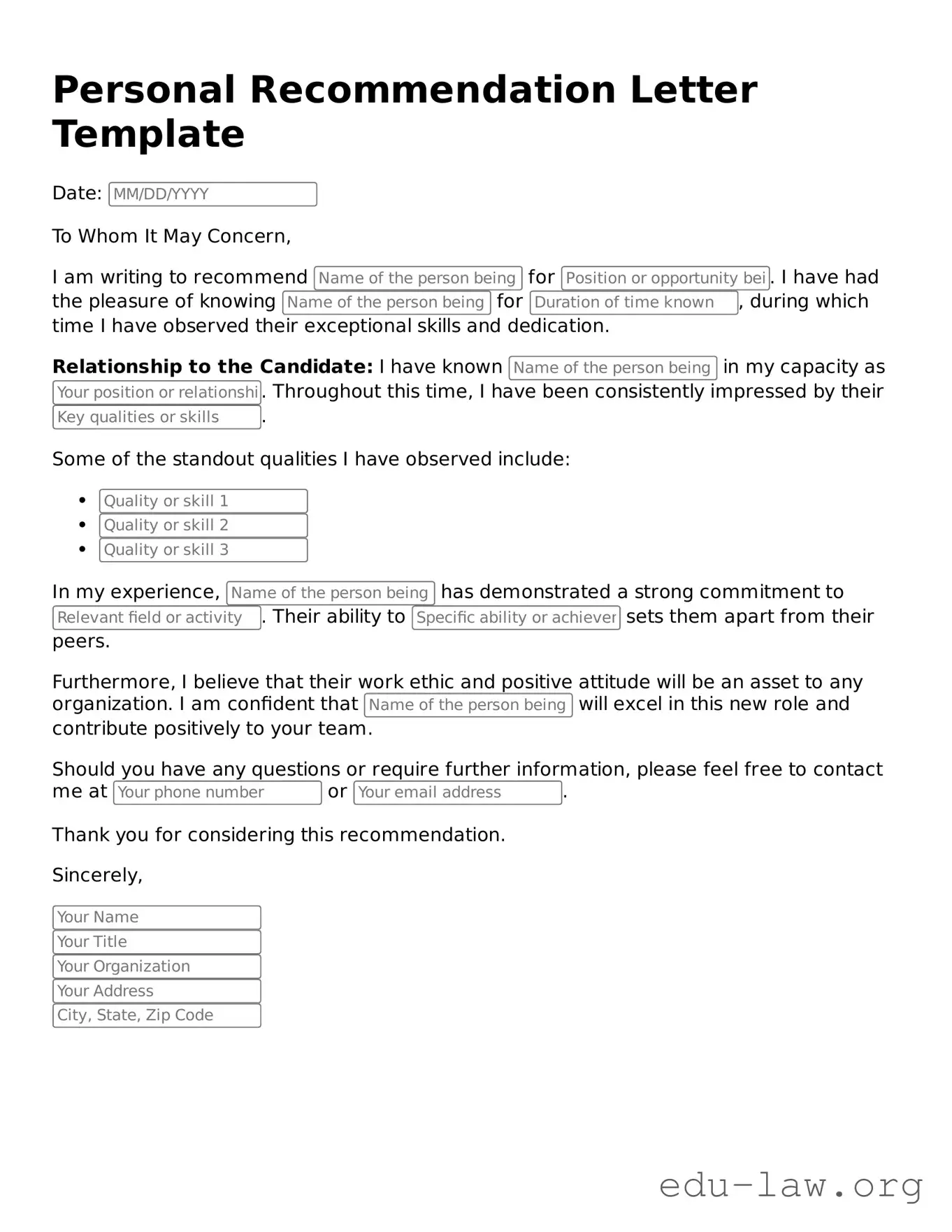
When seeking a personal recommendation letter, understanding the key components of the associated form can greatly enhance the process. This form typically serves as a structured guide for the individual providing the recommendation, ensuring that all necessary information is included. It often requests details about the relationship between the recommender and the person being recommended, highlighting specific qualities, skills, or experiences that make the individual stand out. Additionally, the form may include sections for the recommender to share personal anecdotes or examples that illustrate the candidate's strengths. By clearly outlining expectations and providing a framework, the Personal Recommendation Letter form not only facilitates a more effective writing process but also helps to present a compelling case to potential employers or educational institutions. Ultimately, a well-completed form can significantly influence the outcome of applications, making it an essential tool for both the recommender and the candidate.
Personal Recommendation Letter Template
Date:
To Whom It May Concern,
I am writing to recommend for . I have had the pleasure of knowing for , during which time I have observed their exceptional skills and dedication.
Relationship to the Candidate: I have known in my capacity as . Throughout this time, I have been consistently impressed by their .
Some of the standout qualities I have observed include:
In my experience, has demonstrated a strong commitment to . Their ability to sets them apart from their peers.
Furthermore, I believe that their work ethic and positive attitude will be an asset to any organization. I am confident that will excel in this new role and contribute positively to your team.
Should you have any questions or require further information, please feel free to contact me at or .
Thank you for considering this recommendation.
Sincerely,
| Fact Name | Details |
|---|---|
| Purpose | A Personal Recommendation Letter is used to endorse an individual's character, skills, and qualifications for a specific opportunity. |
| Format | Typically, the letter should be formatted as a formal business letter, including the date, recipient's address, and a closing signature. |
| Length | Most recommendation letters are one to two pages long, allowing enough space to provide detailed insights without being overly lengthy. |
| Content | The letter should include specific examples of the individual's achievements and strengths, making it more impactful and personalized. |
| Confidentiality | In some cases, the letter may be confidential, meaning it is submitted directly to the recipient without the applicant seeing it. |
| State-Specific Forms | Some states may have specific guidelines for recommendation letters, particularly in educational or professional settings. |
| Governing Laws | Each state may have its own laws regarding the use of recommendation letters, especially in employment or educational contexts. |
| Submission | Letters can be submitted electronically or in hard copy, depending on the requirements of the institution or organization requesting them. |
After gathering the necessary information, you can proceed to fill out the Personal Recommendation Letter form. This process requires careful attention to detail to ensure all information is accurately represented. Follow the steps below to complete the form effectively.
What is a Personal Recommendation Letter form?
A Personal Recommendation Letter form is a document used to request a letter of recommendation from an individual who can speak to a person's qualifications, character, and experiences. This form typically outlines the purpose of the recommendation and provides space for the recommender to include specific information about the individual being recommended.
Who should I ask to write my recommendation letter?
It is advisable to choose someone who knows you well and can provide a detailed and positive account of your skills and character. This could be a teacher, employer, mentor, or someone who has observed your work ethic and achievements. The recommender should be able to highlight your strengths and provide examples that support their recommendation.
What information should I provide to the recommender?
When requesting a recommendation letter, it is helpful to provide the recommender with relevant information. This may include your resume, details about the position or program you are applying for, and specific accomplishments or experiences you would like them to mention. Clear communication about deadlines and submission methods is also essential.
How long should the recommendation letter be?
Typically, a recommendation letter should be one to two pages long. It should be long enough to provide substantial information about the individual being recommended, but concise enough to maintain the reader's interest. The focus should remain on quality over quantity, ensuring that the content is relevant and impactful.
Can I see the recommendation letter before it is submitted?
It is generally considered polite to ask the recommender if you may review the letter before it is submitted. However, some recommenders may prefer to keep their letters confidential. Respecting their wishes is important, as confidentiality can sometimes enhance the authenticity of the recommendation.
What should I do if my recommender misses the deadline?
If a recommender misses the deadline for submitting the letter, it is important to follow up politely. A gentle reminder can help. If the letter is still not submitted, consider having a backup recommender in mind. It is crucial to plan ahead to avoid last-minute issues that could impact your application.
Can I use the same recommendation letter for different applications?
While it is possible to use the same recommendation letter for multiple applications, it is advisable to tailor each letter to the specific opportunity. Different programs or positions may have unique requirements or focus areas. Customizing the letter can demonstrate the recommender's understanding of the specific context and strengthen your application.
Not providing specific examples: Many people write vague statements about the individual they are recommending. Instead of saying, "They are a great team player," it’s more effective to share a specific instance where the person demonstrated teamwork.
Ignoring the guidelines: Each recommendation letter form often comes with specific instructions. Failing to follow these can lead to incomplete submissions. Always read the guidelines carefully to ensure all required sections are filled out correctly.
Using generic language: A common mistake is using phrases that could apply to anyone. Tailoring the letter to the individual’s unique qualities makes a stronger impression. Personalizing the content shows genuine support and understanding of the person’s strengths.
Neglecting to proofread: Spelling and grammar errors can undermine the credibility of the recommendation. Taking the time to review the letter for mistakes ensures that it presents the individual in the best light possible.
When applying for a job, school, or other opportunities, you might encounter the need for a Personal Recommendation Letter. This letter serves as a powerful endorsement of your skills, character, and experiences. However, it is often accompanied by other important documents that can enhance your application. Below are some commonly used forms and documents that complement the Personal Recommendation Letter.
Each of these documents plays a crucial role in presenting a well-rounded view of your qualifications. Together with the Personal Recommendation Letter, they create a compelling case for your candidacy, whether for a job, school admission, or other opportunities. Preparing these materials thoughtfully can significantly enhance your chances of success.
A personal recommendation letter shares similarities with a professional reference letter. Both documents serve the purpose of endorsing an individual’s skills, character, and accomplishments. A professional reference letter is typically written by someone who has directly observed the individual’s work performance, such as a former employer or supervisor. In contrast, a personal recommendation letter may come from friends, mentors, or community leaders who can speak to the individual’s personal qualities and character traits. Regardless of the context, both letters aim to provide insight into the individual’s capabilities and suitability for a particular opportunity.
Another document akin to a personal recommendation letter is the character reference letter. This type of letter focuses specifically on the individual's personal qualities rather than their professional achievements. Often written for legal matters, job applications, or educational opportunities, a character reference letter highlights traits such as honesty, integrity, and reliability. While a personal recommendation may encompass a broader view of the individual’s life experiences, the character reference is more focused on moral attributes and personal conduct.
A college recommendation letter is also similar to a personal recommendation letter, particularly in the context of academic applications. This document is typically written by teachers, counselors, or other educational professionals who can vouch for a student's academic performance and potential. Both types of letters emphasize the individual’s strengths and contributions, but a college recommendation letter specifically addresses the academic context, discussing the student’s achievements, work ethic, and readiness for higher education.
The scholarship recommendation letter shares similarities with a personal recommendation letter as well. This letter is often required as part of scholarship applications and aims to showcase the applicant's qualifications, achievements, and character. Just like a personal recommendation, it provides a narrative about the individual’s strengths and contributions. However, the scholarship recommendation letter is specifically tailored to highlight how the individual meets the criteria set forth by the scholarship committee, making it a focused endorsement of the applicant’s suitability for financial support.
Lastly, a letter of recommendation for employment is closely related to a personal recommendation letter. This document is typically written by a former employer or colleague who can provide insights into the individual's work ethic, skills, and contributions in a professional setting. While both letters serve to endorse an individual, the employment recommendation letter is more targeted towards job-related qualifications and experiences. It often includes specific examples of the individual’s work performance, making it a vital tool for job seekers looking to highlight their professional capabilities.
When filling out a Personal Recommendation Letter form, there are important dos and don'ts to keep in mind. Follow these guidelines to ensure your recommendation is effective and well-received.
Misconceptions about the Personal Recommendation Letter form can lead to confusion. Here are ten common misunderstandings:
Understanding these misconceptions can help individuals better navigate the process of obtaining and writing personal recommendation letters.
When it comes to filling out and using a Personal Recommendation Letter form, there are several important points to keep in mind. These takeaways can help ensure that the process is smooth and effective.
By keeping these key points in mind, you can make the most of your Personal Recommendation Letter form and secure the support you need for your future endeavors.