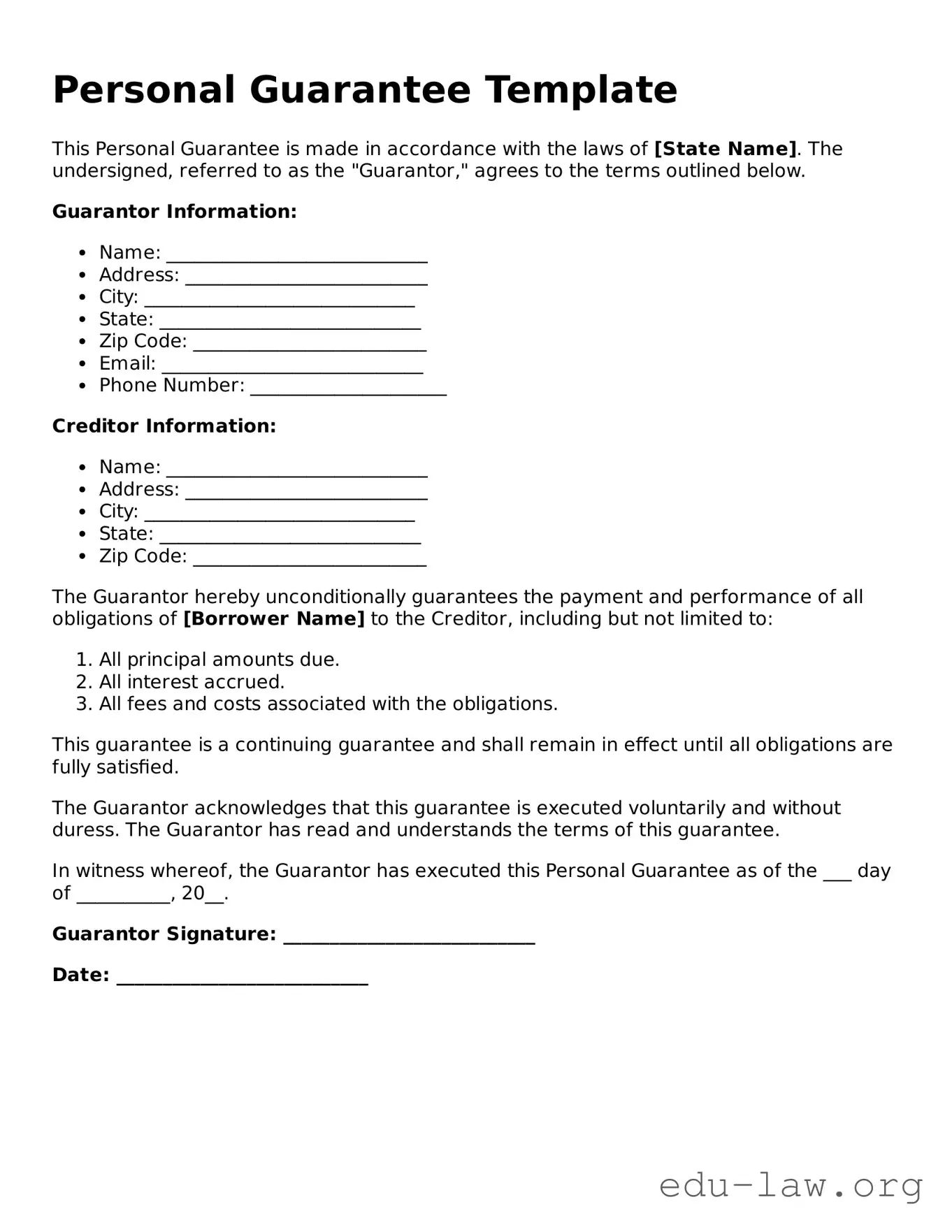
The Personal Guarantee form plays a crucial role in various business transactions, providing a layer of security for lenders and creditors. This document serves as a commitment from an individual, often a business owner or principal, to take personal responsibility for the debts or obligations of a business entity. By signing this form, the guarantor agrees to fulfill the financial obligations if the business defaults. Key aspects of the Personal Guarantee include the identification of the parties involved, the specific obligations being guaranteed, and the terms under which the guarantee is effective. It is essential to understand that this form not only protects the interests of the lender but also carries significant implications for the guarantor, potentially affecting personal credit and financial stability. As businesses seek funding or enter into contracts, the Personal Guarantee form becomes a vital tool in establishing trust and accountability in financial relationships.
Personal Guarantee Template
This Personal Guarantee is made in accordance with the laws of [State Name]. The undersigned, referred to as the "Guarantor," agrees to the terms outlined below.
Guarantor Information:
Creditor Information:
The Guarantor hereby unconditionally guarantees the payment and performance of all obligations of [Borrower Name] to the Creditor, including but not limited to:
This guarantee is a continuing guarantee and shall remain in effect until all obligations are fully satisfied.
The Guarantor acknowledges that this guarantee is executed voluntarily and without duress. The Guarantor has read and understands the terms of this guarantee.
In witness whereof, the Guarantor has executed this Personal Guarantee as of the ___ day of __________, 20__.
Guarantor Signature: ___________________________
Date: ___________________________
| Fact Name | Description |
|---|---|
| Definition | A Personal Guarantee is a legal commitment made by an individual to repay a debt or obligation if the primary borrower defaults. |
| Purpose | This form provides assurance to lenders that they can seek repayment from the guarantor, enhancing the likelihood of loan approval. |
| State-Specific Forms | Many states have their own specific Personal Guarantee forms, which may include unique requirements and language. |
| Governing Laws | The laws governing Personal Guarantees can vary by state. For example, California law may apply in California, while New York law governs in New York. |
| Enforceability | For a Personal Guarantee to be enforceable, it typically must be in writing and signed by the guarantor. |
| Risks | Signing a Personal Guarantee carries significant risk, as it can lead to personal financial liability if the borrower defaults. |
Once you have the Personal Guarantee form, you will need to complete it accurately. This form is essential for ensuring that all necessary information is provided for processing. Follow these steps carefully to fill it out correctly.
After completing these steps, review the form for any errors. Once confirmed, submit it as instructed in the accompanying guidelines.
What is a Personal Guarantee form?
A Personal Guarantee form is a document where an individual agrees to be personally responsible for a debt or obligation of a business. This means that if the business fails to meet its financial commitments, the individual who signed the guarantee can be held liable for those debts. It is commonly used in business loans and leases to provide additional security to lenders or landlords.
Who should sign a Personal Guarantee?
What are the risks of signing a Personal Guarantee?
Signing a Personal Guarantee carries significant risks. If the business defaults on its obligations, creditors can pursue the personal assets of the guarantor. This could include bank accounts, personal property, or even real estate. It’s crucial to assess the financial stability of the business and your own financial situation before agreeing to this commitment.
Can a Personal Guarantee be revoked?
Generally, a Personal Guarantee cannot be revoked unilaterally once it has been signed. However, it may be possible to negotiate a release with the creditor, especially if the business's financial situation improves or if the debt is paid off. Always consult with a legal professional for guidance on this matter.
Is a Personal Guarantee legally binding?
Yes, a Personal Guarantee is a legally binding document. Once signed, it creates an obligation for the guarantor to fulfill the terms outlined in the agreement. It’s essential to read the document carefully and understand all terms before signing, as it can have serious financial consequences.
What should I consider before signing a Personal Guarantee?
Before signing, consider the financial health of the business, your personal financial situation, and the potential impact on your personal assets. It’s wise to seek advice from a financial advisor or attorney to understand the risks and ensure you are making an informed decision.
Are there alternatives to a Personal Guarantee?
Yes, there are alternatives to a Personal Guarantee. Some businesses may offer secured loans, where collateral is provided to back the loan. Additionally, you might explore options such as co-signers or seeking loans from lenders who do not require personal guarantees. Discussing these alternatives with a financial advisor can help you find the best solution.
What happens if I default on a Personal Guarantee?
If you default on a Personal Guarantee, creditors can pursue legal action to recover the owed amount. This may include garnishing wages, seizing assets, or placing liens on property. It’s crucial to communicate with creditors if you foresee difficulties in meeting obligations to explore potential solutions.
Inaccurate Personal Information: Many individuals fail to provide their full legal name, current address, or contact information. This can lead to confusion and delays in processing.
Missing Signatures: It’s common for people to forget to sign the form. Without a signature, the guarantee is not valid, and this can create significant issues later on.
Not Reading the Terms: Some individuals rush through the form without understanding the obligations they are agreeing to. This can result in unexpected liabilities.
Incorrect Dates: Filling in the wrong date or leaving the date blank can invalidate the agreement. Always double-check the date before submitting.
Omitting Necessary Details: Certain forms require additional information, such as Social Security numbers or business details. Failing to include these can lead to rejection of the form.
Using Incorrect Terminology: Misunderstanding terms like “guarantor” or “debtor” can lead to confusion. Ensure that you understand these roles before completing the form.
Not Keeping Copies: After filling out the form, it’s vital to keep a copy for personal records. Many forget this step, which can complicate future reference.
Ignoring Instructions: Each Personal Guarantee form may have specific instructions. Ignoring these can lead to mistakes that delay the process.
Failing to Update Information: If personal circumstances change, such as a change of address or name, it’s important to update the guarantee. Many forget to do this, leading to potential complications.
A Personal Guarantee form is often accompanied by several other important documents that help clarify the terms of the agreement and protect the interests of all parties involved. Below is a list of commonly used forms and documents that may be utilized alongside the Personal Guarantee form.
Understanding these documents is crucial for anyone involved in a financial transaction that includes a Personal Guarantee. They collectively provide a comprehensive overview of the obligations and protections for both the lender and the borrower.
The Personal Guarantee form shares similarities with a Lease Agreement. Both documents serve to establish a commitment between parties. In a Lease Agreement, a tenant agrees to pay rent to a landlord, often with the landlord requiring a personal guarantee from the tenant or a third party. This ensures that financial obligations will be met, creating a safety net for the landlord, much like how a personal guarantee secures a lender's interests in a loan arrangement.
Another document akin to the Personal Guarantee is the Loan Agreement. In this case, the borrower agrees to repay a specified amount of money to a lender. Just as a personal guarantee reinforces the borrower's promise, a Loan Agreement may require collateral or a personal guarantee from a third party to mitigate the lender's risk. Both documents emphasize accountability and the assurance of repayment.
The Promissory Note is also similar to the Personal Guarantee form. A promissory note is a written promise to pay a specific amount of money at a designated time. It often includes terms that outline the consequences of default. Like a personal guarantee, it is a formal acknowledgment of a debt, ensuring that the borrower is aware of their obligations and the potential repercussions of failing to meet them.
A Corporate Resolution can be compared to the Personal Guarantee as well. This document is used by corporations to authorize specific actions, such as entering into a loan agreement. When a corporate officer signs a personal guarantee, it often follows a corporate resolution that indicates the corporation's approval. Both documents highlight the importance of formal approval and accountability in financial transactions.
The Indemnity Agreement is another document that bears resemblance to the Personal Guarantee form. In an indemnity agreement, one party agrees to compensate another for certain damages or losses. This concept parallels the personal guarantee, where an individual agrees to take responsibility for another's financial obligations. Both documents aim to protect one party from potential losses arising from the actions or inactions of another.
Similar to the Personal Guarantee is the Security Agreement. This document outlines the terms under which a borrower grants a lender a security interest in specific assets. In many cases, a personal guarantee may accompany a security agreement, providing an additional layer of assurance for the lender. Both documents work together to secure the lender's interests and mitigate risk.
The Co-Signer Agreement also aligns closely with the Personal Guarantee form. In this situation, a co-signer agrees to take on the responsibility for a loan or lease alongside the primary borrower. Much like a personal guarantee, the co-signer's commitment provides additional security for the lender or landlord, ensuring that obligations will be met even if the primary party defaults.
Lastly, the Affidavit of Support is comparable to the Personal Guarantee. This document is often used in immigration cases, where an individual pledges financial support for another person. The affiant takes on the responsibility to ensure that the sponsored individual will not become a public charge. This commitment mirrors the essence of a personal guarantee, as both documents create a binding obligation to support another party financially.
When filling out a Personal Guarantee form, it’s important to approach the task with care. Here are some guidelines to help you navigate the process effectively.
By following these guidelines, you can fill out the Personal Guarantee form with confidence and clarity. Taking the time to do it right will help protect your interests in the long run.
Understanding the Personal Guarantee form is crucial for anyone entering into a business agreement. However, several misconceptions can lead to confusion and potential pitfalls. Here are nine common misconceptions about the Personal Guarantee form, along with clarifications to help clear the air.
By debunking these misconceptions, individuals can approach the Personal Guarantee form with a clearer understanding, allowing for better decision-making in their business endeavors.
Filling out and using a Personal Guarantee form is an important step in securing financial agreements. Here are some key takeaways to consider: