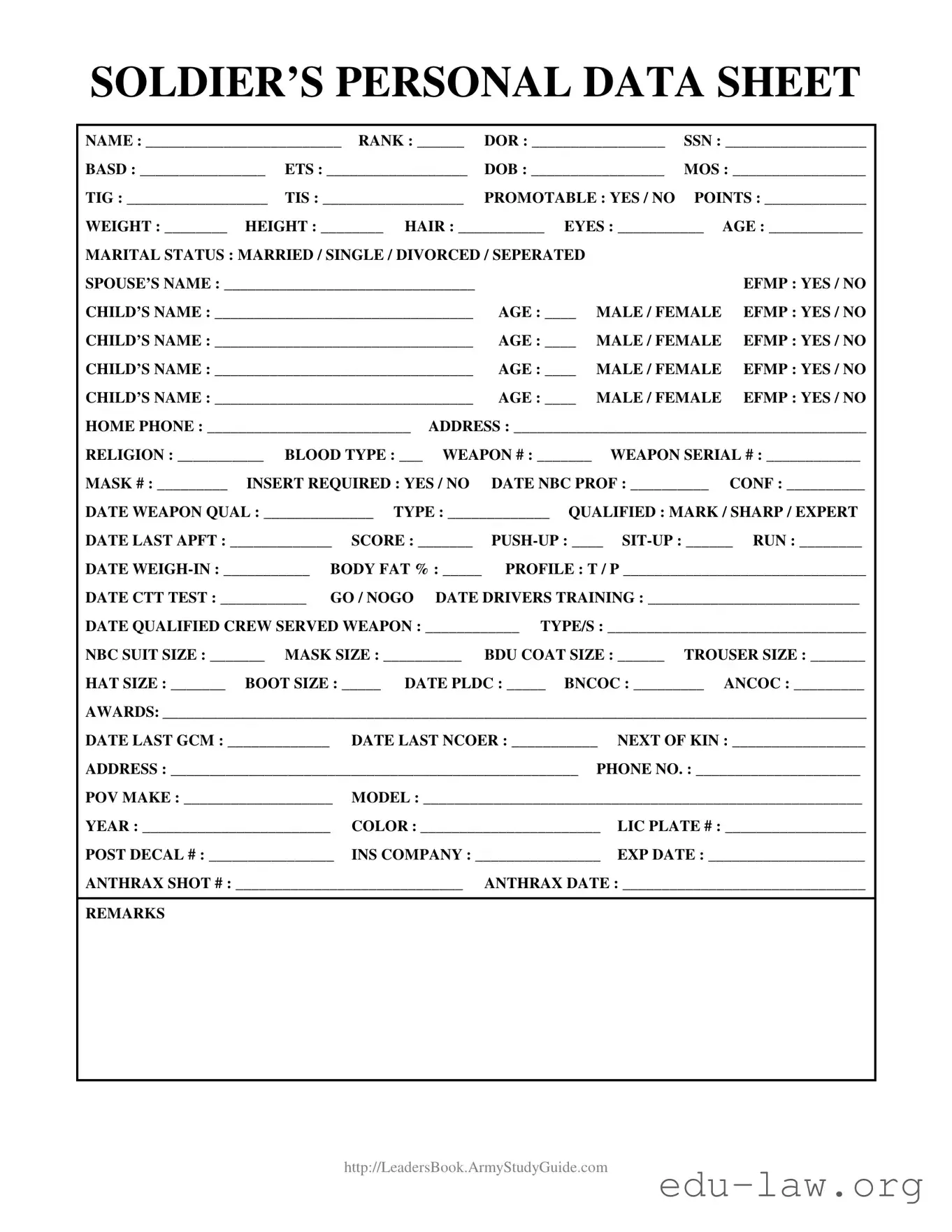
The Personal Data Sheet is an essential document for soldiers, capturing critical information that reflects their military career and personal details. This form includes basic identification data such as the soldier’s name, rank, and Social Security Number, alongside key dates like the Date of Rank and Estimated Time of Separation. It also outlines physical attributes, including height, weight, and age, as well as marital status and information about dependents. For soldiers with children, the form provides space to list each child's name, age, gender, and any special needs through the Exceptional Family Member Program (EFMP). Additionally, the sheet records vital statistics such as blood type, religion, and home address. The form also encompasses military qualifications, including weapon qualifications, physical fitness test scores, and training completion dates. Notably, it captures essential administrative details like awards, next of kin information, and vehicle details. This comprehensive overview helps ensure that all pertinent information is readily available for military personnel management and support services.

SOLDIER’S PERSONAL DATA SHEET
NAME : _________________________ RANK : ______ |
DOR : _________________ SSN : __________________ |
||
BASD : ________________ ETS : __________________ |
DOB : _________________ MOS : _________________ |
||
TIG : __________________ TIS : __________________ |
PROMOTABLE : YES / NO POINTS : _____________ |
||
WEIGHT : ________ HEIGHT : ________ HAIR : ___________ EYES : ___________ AGE : ____________ |
|||
MARITAL STATUS : MARRIED / SINGLE / DIVORCED / SEPERATED |
|
|
|
SPOUSE’S NAME : ________________________________ |
|
|
EFMP : YES / NO |
CHILD’S NAME : _________________________________ |
AGE : ____ |
MALE / FEMALE |
EFMP : YES / NO |
CHILD’S NAME : _________________________________ |
AGE : ____ |
MALE / FEMALE |
EFMP : YES / NO |
CHILD’S NAME : _________________________________ |
AGE : ____ |
MALE / FEMALE |
EFMP : YES / NO |
CHILD’S NAME : _________________________________ |
AGE : ____ |
MALE / FEMALE |
EFMP : YES / NO |
HOME PHONE : __________________________ |
ADDRESS : _____________________________________________ |
|||||||||
RELIGION : ___________ |
BLOOD TYPE : ___ |
WEAPON # : _______ |
WEAPON SERIAL # : ____________ |
|||||||
MASK # : _________ |
INSERT REQUIRED : YES / NO |
DATE NBC PROF : __________ |
CONF : __________ |
|||||||
DATE WEAPON QUAL : ______________ |
TYPE : _____________ |
QUALIFIED : MARK / SHARP / EXPERT |
||||||||
DATE LAST APFT : _____________ |
SCORE : _______ |
|||||||||
DATE |
BODY FAT % : _____ |
PROFILE : T / P _______________________________ |
||||||||
DATE CTT TEST : ___________ |
GO / NOGO |
DATE DRIVERS TRAINING : ___________________________ |
||||||||
DATE QUALIFIED CREW SERVED WEAPON : ____________ TYPE/S : _________________________________ |
||||||||||
NBC SUIT SIZE : _______ |
MASK SIZE : __________ |
BDU COAT SIZE : ______ TROUSER SIZE : _______ |
||||||||
HAT SIZE : _______ |
BOOT SIZE : _____ |
DATE PLDC : _____ |
BNCOC : _________ |
ANCOC : _________ |
||||||
AWARDS: __________________________________________________________________________________________ |
||||||||||
DATE LAST GCM : _____________ |
|
DATE LAST NCOER : ___________ |
NEXT OF KIN : _________________ |
|||||||
ADDRESS : ____________________________________________________ PHONE NO. : _____________________ |
||||||||||
POV MAKE : ___________________ |
MODEL : ________________________________________________________ |
|||||||||
YEAR : ________________________ |
|
COLOR : _______________________ |
LIC PLATE # : __________________ |
|||||||
POST DECAL # : ________________ |
INS COMPANY : ________________ |
EXP DATE : ____________________ |
||||||||
ANTHRAX SHOT # : _____________________________ |
ANTHRAX DATE : _______________________________ |
|||||||||
|
|
|
|
|
|
|
|
|
|
|
REMARKS |
|
|
|
|
|
|
|
|
|
|
http://LeadersBook.ArmyStudyGuide.com
| Fact Name | Description |
|---|---|
| Purpose | The Personal Data Sheet is designed to gather essential information about soldiers for administrative and operational purposes. |
| Identification | It includes key personal identifiers such as name, rank, and Social Security Number (SSN). |
| Military Details | Information regarding the soldier's military service, such as Date of Rank (DOR) and Military Occupational Specialty (MOS), is recorded. |
| Family Information | The form collects data about the soldier's marital status and details of dependents, including children. |
| Health and Fitness | It captures health-related information, including blood type, weight, height, and body fat percentage. |
| Training Records | Details about completed training, such as NBC (Nuclear, Biological, Chemical) training and weapon qualifications, are included. |
| Next of Kin | The form requires information about the soldier's next of kin, ensuring that emergency contacts are readily available. |
| Legal Compliance | In many states, the collection and use of personal data are governed by privacy laws, ensuring the information is handled appropriately. |
| Variability | Different branches of the military may have specific versions of the Personal Data Sheet, reflecting their unique requirements. |
| Updates | Soldiers must regularly update their Personal Data Sheet to reflect any changes in personal circumstances or military status. |
Filling out the Personal Data Sheet form is an important step in ensuring that all relevant personal information is accurately documented. This information is crucial for administrative purposes and helps maintain a comprehensive record of the soldier's details. Below are the steps to complete the form effectively.
What is the purpose of the Personal Data Sheet form?
The Personal Data Sheet form serves as a comprehensive record of a soldier's personal and professional information. It collects vital data such as name, rank, service number, physical characteristics, and family details. This information is essential for maintaining accurate personnel records, facilitating administrative processes, and ensuring that soldiers receive appropriate support and resources. Additionally, it aids in the assessment of a soldier’s qualifications and readiness for various duties and responsibilities.
Who is required to complete the Personal Data Sheet?
All active-duty soldiers are typically required to complete the Personal Data Sheet. This form is often used during initial enlistment, promotions, and periodic reviews. It is also important for soldiers who are transitioning out of the military or changing their status. Family members, particularly those with special needs, may also be documented on the form to ensure that the necessary support is available. Each soldier must ensure that the information provided is accurate and up-to-date.
How is the information on the Personal Data Sheet used?
The information collected on the Personal Data Sheet is utilized for various administrative purposes. It helps in managing personnel assignments, tracking qualifications, and ensuring compliance with military regulations. The data may also be used to provide support services to soldiers and their families, including medical care and family assistance programs. Furthermore, it plays a role in evaluating a soldier’s eligibility for promotions and special assignments.
What should I do if my information changes after submitting the Personal Data Sheet?
If there are any changes to your information after you have submitted the Personal Data Sheet, it is crucial to update the form as soon as possible. Soldiers should notify their commanding officer or the appropriate administrative office to ensure that records are kept current. This may involve filling out a new form or making amendments to the existing one. Keeping the information accurate is vital for ensuring that all personnel-related processes function smoothly and effectively.
Leaving sections blank: Ensure all required fields are filled out. Missing information can lead to delays in processing.
Incorrect Social Security Number: Double-check the SSN for accuracy. A wrong number can cause significant issues.
Not updating marital status: Make sure to select the correct status. This can affect benefits and family support.
Forgetting to list children: If you have children, include their names and ages. This is important for family-related benefits.
Incorrectly entering dates: Verify all dates, such as DOB and ETS. Mistakes can complicate your records.
Omitting contact information: Provide a current home phone number and address. This ensures you can be reached easily.
Not specifying weapon qualifications: Clearly state your qualifications and scores. This is crucial for your military record.
Neglecting to sign: Don’t forget to sign the form. An unsigned document is not valid and will be returned.
When completing a Personal Data Sheet, several other forms and documents may be necessary to provide a comprehensive overview of a soldier's personal and professional information. Here are some commonly used documents that complement the Personal Data Sheet:
Collectively, these documents help create a complete picture of a soldier's status and readiness. Keeping them organized and up-to-date is essential for smooth operations and effective management within the military structure.
The Personal Data Sheet (PDS) form shares similarities with the Employee Information Form commonly used in various workplaces. Both documents serve to collect essential personal information about individuals. The Employee Information Form typically includes sections for name, contact details, emergency contacts, and job-related data. Like the PDS, it aims to provide a comprehensive overview of the individual for administrative purposes, ensuring that employers have the necessary information to manage their workforce effectively.
Another document that resembles the Personal Data Sheet is the Military Personnel Record. This record contains detailed information about a service member’s career, including assignments, promotions, and evaluations. Similar to the PDS, the Military Personnel Record captures critical data points such as rank, dates of service, and qualifications. Both documents are essential for maintaining accurate records and facilitating personnel management within military and governmental organizations.
The Standard Form 86 (SF-86), used for security clearance applications, also shares characteristics with the PDS. The SF-86 requires individuals to provide personal information, including background history, contact details, and family information. Like the PDS, it seeks to gather comprehensive data to assess an individual’s suitability for access to classified information, highlighting the importance of thorough documentation in both military and civilian contexts.
Additionally, the Medical History Form used by healthcare providers is similar in that it collects vital personal information. This form gathers data about an individual's medical background, including allergies, medications, and family medical history. Both the Medical History Form and the PDS aim to compile essential information that can influence decision-making, whether in a medical setting or within military personnel management.
The Family Care Plan is another document that parallels the Personal Data Sheet. This plan outlines the care arrangements for service members’ dependents during deployment or absence. It includes information about the service member's family status, contact details, and emergency contacts. Both documents emphasize the importance of family considerations in the context of military service, ensuring that service members' responsibilities towards their families are clearly documented and understood.
Furthermore, the Deployment Checklist is akin to the Personal Data Sheet, as it serves to ensure that all necessary information and preparations are in place before a service member is deployed. This checklist typically includes personal details, equipment requirements, and medical readiness. Both documents aim to facilitate a smooth transition during critical periods, ensuring that all relevant information is readily available for operational success.
Lastly, the Recruitment Application Form used by various organizations is similar to the Personal Data Sheet. This form collects personal information from potential candidates, including their qualifications, work history, and personal details. Like the PDS, it serves to create a comprehensive profile of the individual, aiding in the selection and onboarding process. Both documents are crucial for ensuring that organizations have the necessary data to make informed decisions regarding personnel management.
When filling out the Personal Data Sheet form, it’s important to be careful and thorough. Here are some things you should and shouldn’t do:
Here are five common misconceptions about the Personal Data Sheet form:
Filling out the Personal Data Sheet is an important task for soldiers. Here are some key takeaways to keep in mind:
By following these guidelines, you can ensure your Personal Data Sheet is a reliable resource for both you and your command.