The Pennsylvania Transfer-on-Death Deed (TODD) serves as a valuable estate planning tool, allowing property owners to transfer real estate to designated beneficiaries upon their death without the need for probate. This form streamlines the transfer process, ensuring that the property automatically passes to the named individuals, thereby simplifying the transition of ownership. Importantly, the TODD does not impact the property owner's rights during their lifetime; they maintain full control over the property and can revoke or modify the deed at any time. To execute this deed properly, certain requirements must be met, including the need for the property owner to sign the document in the presence of a notary public. Additionally, the deed must be recorded with the county recorder of deeds to be effective. By utilizing the Transfer-on-Death Deed, Pennsylvania residents can achieve peace of mind, knowing their property will be transferred according to their wishes, while also potentially avoiding the complexities and costs associated with probate proceedings.
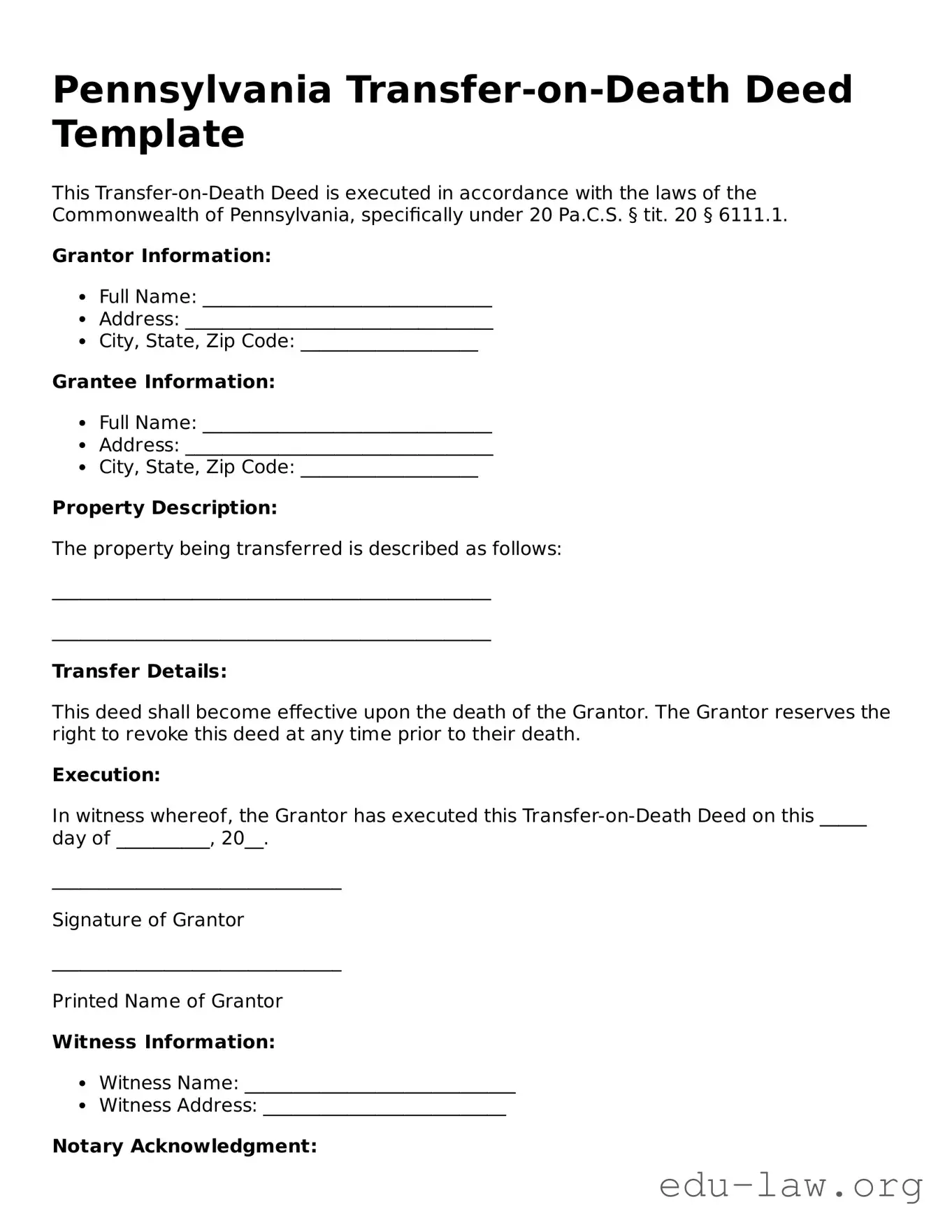
Pennsylvania Transfer-on-Death Deed Template
This Transfer-on-Death Deed is executed in accordance with the laws of the Commonwealth of Pennsylvania, specifically under 20 Pa.C.S. § tit. 20 § 6111.1.
Grantor Information:
Grantee Information:
Property Description:
The property being transferred is described as follows:
_______________________________________________
_______________________________________________
Transfer Details:
This deed shall become effective upon the death of the Grantor. The Grantor reserves the right to revoke this deed at any time prior to their death.
Execution:
In witness whereof, the Grantor has executed this Transfer-on-Death Deed on this _____ day of __________, 20__.
_______________________________
Signature of Grantor
_______________________________
Printed Name of Grantor
Witness Information:
Notary Acknowledgment:
State of Pennsylvania, County of _______________
On this _____ day of __________, 20__, before me, a notary public, personally appeared ______________________, known to me (or satisfactorily proven) to be the person whose name is subscribed to the within instrument, and acknowledged that they executed the same for the purposes therein contained.
_______________________________
Notary Public
My commission expires: ________________
| Fact Name | Details |
|---|---|
| Definition | A Transfer-on-Death Deed allows an individual to transfer real estate to a beneficiary upon their death without going through probate. |
| Governing Law | The Pennsylvania Transfer-on-Death Deed is governed by 20 Pa.C.S. § 6111.3. |
| Requirements | The deed must be in writing, signed by the owner, and recorded in the county where the property is located. |
| Revocation | The deed can be revoked at any time before the owner's death, allowing for flexibility in estate planning. |
Once you have the Pennsylvania Transfer-on-Death Deed form ready, it’s time to fill it out accurately. This form allows you to designate a beneficiary who will receive your property upon your passing, without the need for probate. Following these steps will help ensure that the form is completed correctly.
What is a Transfer-on-Death Deed in Pennsylvania?
A Transfer-on-Death Deed (TODD) is a legal document that allows a property owner in Pennsylvania to transfer real estate to a designated beneficiary upon their death. This deed enables the property owner to retain full control of the property during their lifetime. It avoids the probate process, which can be lengthy and costly, ensuring a smoother transition of ownership to the beneficiary after the owner's passing.
Who can be designated as a beneficiary in a Transfer-on-Death Deed?
In Pennsylvania, the property owner can designate one or more individuals as beneficiaries in a Transfer-on-Death Deed. Beneficiaries can be family members, friends, or even organizations. However, it is important to ensure that the chosen beneficiaries are of legal age and capable of receiving the property. Additionally, the deed should clearly outline how the property will be divided if multiple beneficiaries are named.
How does one create a Transfer-on-Death Deed?
Creating a Transfer-on-Death Deed involves filling out the appropriate form, which must include specific information such as the property owner's name, the property description, and the beneficiary's name. Once the form is completed, it must be signed by the property owner in the presence of a notary public. After notarization, the deed should be recorded with the local county recorder of deeds to ensure its validity and effectiveness. It is advisable to consult with a legal professional to ensure all requirements are met.
Can a Transfer-on-Death Deed be revoked or changed?
Yes, a Transfer-on-Death Deed can be revoked or modified at any time before the property owner's death. To revoke the deed, the property owner must execute a new deed that explicitly states the revocation or create a new Transfer-on-Death Deed that replaces the previous one. It is important to record any changes with the county recorder of deeds to maintain accurate public records. Keeping beneficiaries informed about any changes is also a considerate practice.
What happens if the beneficiary predeceases the property owner?
If a designated beneficiary passes away before the property owner, the Transfer-on-Death Deed may not automatically transfer the property to that beneficiary’s heirs. Instead, the property may revert to the estate of the original owner, or the deed may become ineffective, depending on how it is structured. To prevent complications, it is advisable to review and update the deed regularly, especially after significant life events such as the death of a beneficiary.
Inaccurate Property Description: One common mistake is failing to provide a complete and accurate description of the property. This includes not specifying the correct parcel number or legal description, which can lead to confusion or disputes in the future.
Improper Signatures: All required parties must sign the deed. Sometimes individuals forget to include the signature of a spouse or co-owner, which can invalidate the deed.
Not Notarizing the Document: The Transfer-on-Death Deed must be notarized to be legally binding. Failing to have the document notarized can result in the deed not being recognized by the county.
Missing Witnesses: Depending on local requirements, some deeds may need witnesses to be valid. Not including the necessary witnesses can lead to complications during the transfer process.
Incorrectly Naming Beneficiaries: It is crucial to accurately name beneficiaries. Mistakes in spelling or using incorrect names can cause legal issues and may prevent the intended person from receiving the property.
Failure to Record the Deed: After filling out the deed, it must be recorded with the appropriate county office. Neglecting to do this means the deed will not take effect, and the property may not transfer as intended.
Not Understanding Tax Implications: Some individuals overlook the potential tax implications of transferring property through a Transfer-on-Death Deed. It is important to understand how this may affect estate taxes or other financial considerations.
The Pennsylvania Transfer-on-Death Deed allows individuals to transfer real estate upon their death without going through probate. While this deed is essential for facilitating the transfer process, several other forms and documents are often used in conjunction with it to ensure a smooth transition of property ownership. Below is a list of these documents, along with a brief description of each.
Utilizing these forms and documents in conjunction with the Pennsylvania Transfer-on-Death Deed can help streamline the process of transferring property and ensure that the wishes of the deceased are honored. Proper planning and documentation can significantly ease the burden on loved ones during a difficult time.
The Pennsylvania Transfer-on-Death Deed (TODD) form is similar to a will in that both documents facilitate the transfer of property upon death. A will outlines the distribution of assets and can specify beneficiaries for real estate. However, unlike a will, which requires probate, a TODD allows property to pass directly to the designated beneficiary without going through the probate process, thereby simplifying the transfer and potentially reducing costs and delays for the heirs.
When filling out the Pennsylvania Transfer-on-Death Deed form, it is important to follow certain guidelines to ensure accuracy and compliance. Here are ten things to keep in mind:
By following these guidelines, you can help ensure that the Transfer-on-Death Deed is filled out correctly and legally binding.
The Pennsylvania Transfer-on-Death Deed (TODD) form is a valuable tool for estate planning, but several misconceptions surround its use. Understanding these misconceptions can help individuals make informed decisions about their property and estate. Here are nine common misunderstandings:
Many people believe the TODD is limited to real estate. In fact, it can also be used for other types of property, such as bank accounts and investment accounts, depending on how the accounts are structured.
While a TODD can help avoid probate, it does not exempt the property from estate taxes. Beneficiaries may still be responsible for taxes depending on the overall value of the estate.
Some believe that once a TODD is executed, it cannot be changed. In reality, the owner can revoke or modify the deed at any time before their death, as long as they follow the proper procedures.
This misconception suggests that all heirs must consent to the TODD. However, the owner has the sole authority to designate beneficiaries without needing approval from other family members.
While legal assistance can be beneficial, it is not strictly necessary to fill out a TODD form. Individuals can complete the form on their own, provided they understand the requirements and implications.
Many assume that only those with significant assets need a TODD. In truth, anyone who owns property and wants to simplify the transfer process after death can benefit from this deed.
Although a TODD helps avoid probate, it does not guarantee a hassle-free transfer. Disputes among beneficiaries or challenges to the deed can still arise, potentially complicating the process.
Some people think that a TODD transfers ownership as soon as it is signed. In reality, the transfer only takes effect upon the owner's death, allowing them to retain control of the property while alive.
Many confuse a TODD with a will. While both are estate planning tools, a TODD specifically addresses the transfer of property outside of probate, whereas a will covers a broader range of assets and may require probate to take effect.
By clarifying these misconceptions, individuals can better understand how the Pennsylvania Transfer-on-Death Deed form works and how it can fit into their estate planning strategy.
When filling out and using the Pennsylvania Transfer-on-Death Deed form, consider the following key takeaways: