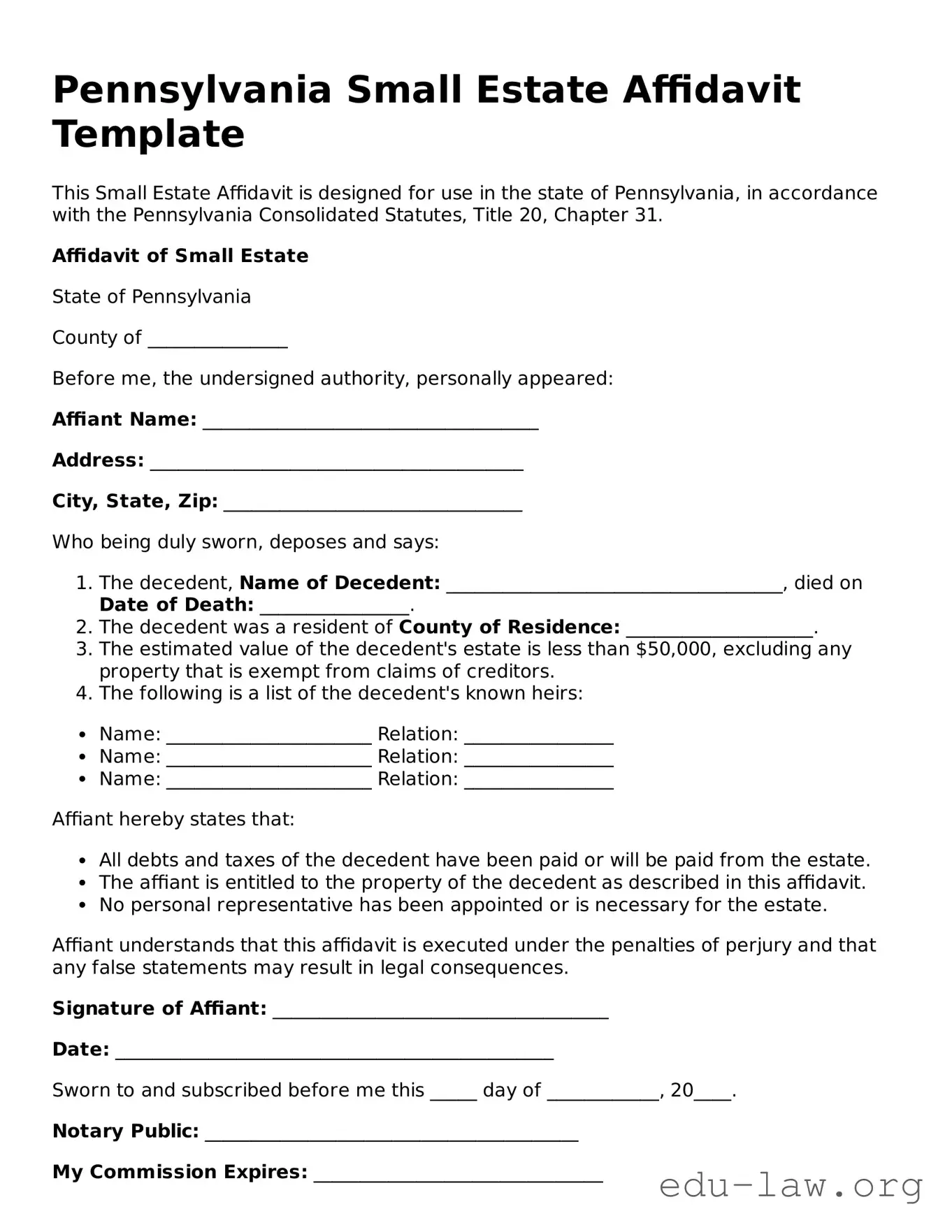
In Pennsylvania, when an individual passes away and leaves behind a small estate, the process of settling their affairs can be simplified through the use of the Small Estate Affidavit form. This form is particularly beneficial for estates that do not exceed a certain value threshold, allowing heirs to bypass the lengthy and often complicated probate process. Typically, the Small Estate Affidavit can be utilized when the total value of the decedent's assets, excluding real estate, is less than $50,000. By completing this affidavit, designated heirs can claim the deceased's assets directly from financial institutions or other entities without court intervention. The form requires the signature of the affiant, who must be an eligible heir, and it includes essential information such as the decedent’s details, the list of assets, and a declaration of the affiant’s right to inherit. This streamlined approach not only saves time but also reduces the associated costs of settling an estate, making it an invaluable tool for families dealing with the loss of a loved one.
Pennsylvania Small Estate Affidavit Template
This Small Estate Affidavit is designed for use in the state of Pennsylvania, in accordance with the Pennsylvania Consolidated Statutes, Title 20, Chapter 31.
Affidavit of Small Estate
State of Pennsylvania
County of _______________
Before me, the undersigned authority, personally appeared:
Affiant Name: ____________________________________
Address: ________________________________________
City, State, Zip: ________________________________
Who being duly sworn, deposes and says:
Affiant hereby states that:
Affiant understands that this affidavit is executed under the penalties of perjury and that any false statements may result in legal consequences.
Signature of Affiant: ____________________________________
Date: _______________________________________________
Sworn to and subscribed before me this _____ day of ____________, 20____.
Notary Public: ________________________________________
My Commission Expires: _______________________________
| Fact Name | Details |
|---|---|
| Eligibility Criteria | In Pennsylvania, the Small Estate Affidavit can be used if the total value of the estate is $50,000 or less, excluding real estate. |
| Governing Law | The Small Estate Affidavit is governed by 20 Pa.C.S. § 3101 et seq. of the Pennsylvania Consolidated Statutes. |
| Filing Process | The affidavit must be filed with the Register of Wills in the county where the decedent resided at the time of death. |
| Use of Funds | Funds can be accessed and distributed to the heirs listed in the affidavit without the need for formal probate proceedings. |
After gathering the necessary information and documents, you will be ready to complete the Pennsylvania Small Estate Affidavit form. This form is essential for settling a small estate without going through the full probate process. The following steps will guide you through filling out the form accurately.
Once you have submitted the form, you may need to wait for any necessary approvals or responses from the court or other involved parties. Ensure you keep track of any deadlines or additional requirements that may arise during this process.
What is a Pennsylvania Small Estate Affidavit?
The Pennsylvania Small Estate Affidavit is a legal document that allows individuals to settle the estate of a deceased person without going through the formal probate process. This form is particularly useful for estates that meet specific criteria, allowing heirs to access assets more quickly and with less expense.
Who is eligible to use the Small Estate Affidavit?
To be eligible, the total value of the deceased person's estate must not exceed a certain threshold, which is currently set at $50,000, excluding real estate. Additionally, the person filing the affidavit must be an heir or a beneficiary of the estate. This form is typically used when there are no disputes among heirs and the estate is relatively straightforward.
What assets can be transferred using the Small Estate Affidavit?
The Small Estate Affidavit can be used to transfer various types of assets, including bank accounts, personal property, and vehicles. However, it does not apply to real estate. If the deceased owned real property, a different process must be followed to transfer ownership.
How do I complete the Small Estate Affidavit?
To complete the Small Estate Affidavit, you will need to fill out the form with relevant information about the deceased, including their name, date of death, and a list of assets. You must also provide details about the heirs or beneficiaries. After completing the form, it must be signed in front of a notary public to be valid.
Where do I file the Small Estate Affidavit?
The Small Estate Affidavit does not need to be filed with the court. Instead, you can present the completed and notarized affidavit directly to institutions, such as banks or title companies, to claim the deceased's assets. Each institution may have its own requirements, so it’s wise to check with them beforehand.
Is there a fee associated with the Small Estate Affidavit?
There is no filing fee for the Small Estate Affidavit itself, as it is not submitted to the court. However, some institutions may charge fees for processing the transfer of assets. Additionally, if you seek legal assistance in completing the affidavit, there may be associated legal fees.
What if there are disputes among heirs?
If disputes arise among heirs regarding the distribution of assets, the Small Estate Affidavit may not be the appropriate tool. In such cases, it is advisable to pursue formal probate proceedings, where the court can resolve disagreements and ensure a fair distribution according to the law.
Can I use the Small Estate Affidavit for multiple estates?
No, the Small Estate Affidavit is specific to one estate. If you are handling multiple estates, you will need to complete a separate affidavit for each estate, provided they each meet the eligibility criteria.
What happens if the estate exceeds the Small Estate threshold?
If the estate's value exceeds the $50,000 threshold, the Small Estate Affidavit cannot be used. In this situation, the estate must go through the formal probate process, which involves filing a will (if one exists) with the court and following the necessary legal procedures to settle the estate.
How long does the process take?
The process of using a Small Estate Affidavit is generally quicker than formal probate. Once the affidavit is completed and notarized, heirs can often access the deceased's assets immediately, depending on the policies of the institutions involved. However, it is important to allow for any potential delays due to institutional requirements or other factors.
Incorrect Value Assessment: Many individuals underestimate or overestimate the total value of the estate. It’s essential to accurately assess the value of all assets to ensure compliance with Pennsylvania law.
Missing Signatures: Failing to obtain the necessary signatures can lead to delays. All required parties must sign the affidavit for it to be valid.
Omitting Debts: Some people forget to list outstanding debts. All liabilities must be disclosed, as they can affect the distribution of the estate.
Not Including All Assets: It’s common to overlook certain assets, such as personal property or bank accounts. Every asset should be accounted for to avoid complications.
Failure to Meet Eligibility Requirements: Individuals sometimes submit the affidavit without verifying eligibility. Ensure that the estate meets the criteria set by Pennsylvania law for small estates.
The Pennsylvania Small Estate Affidavit is a useful tool for settling the estates of individuals who have passed away with limited assets. When utilizing this form, several other documents may also be required to ensure a smooth process. Below is a list of common forms and documents that often accompany the Small Estate Affidavit.
Understanding these accompanying documents can help streamline the process of settling a small estate in Pennsylvania. Proper preparation ensures that all legal requirements are met and can facilitate a smoother transition for the heirs involved.
The Pennsylvania Small Estate Affidavit is similar to the Affidavit of Heirship, which is often used in situations where a deceased person did not leave a will. This document allows heirs to establish their relationship to the deceased and claim their inheritance without going through the lengthy probate process. Both forms serve to simplify the transfer of assets, but the Affidavit of Heirship is specifically focused on proving familial ties, while the Small Estate Affidavit is geared towards settling smaller estates efficiently.
Another related document is the Last Will and Testament. While the Small Estate Affidavit is used for estates that fall below a certain value threshold, a Last Will and Testament outlines a person's wishes regarding the distribution of their assets after death. The key difference lies in the presence of a will; if a valid will exists, the Small Estate Affidavit cannot be used. Both documents aim to ensure that the deceased’s wishes are respected, but they operate under different legal frameworks.
The Transfer on Death Deed (TOD) is also comparable to the Small Estate Affidavit. A TOD allows individuals to designate beneficiaries for their property, ensuring that it passes directly to those individuals upon death without going through probate. This document simplifies the transfer process, similar to the Small Estate Affidavit, but it applies specifically to real estate. Both documents help avoid the complexities of probate, but they serve different types of assets.
The Declaration of Trust is another document that shares similarities with the Small Estate Affidavit. A trust allows individuals to manage their assets during their lifetime and specify how they should be distributed upon death. While the Small Estate Affidavit is used for settling smaller estates without a trust, both documents facilitate the efficient transfer of assets and can help avoid probate, depending on how the estate is structured.
The Probate Petition is a crucial document in the estate administration process, contrasting with the Small Estate Affidavit. When an estate does not qualify for the Small Estate Affidavit, a Probate Petition is filed to initiate the formal probate process. This document requires court approval to validate a will and oversee the distribution of assets, which can be a lengthy and complex procedure. Both documents address asset distribution, but the Probate Petition involves more legal oversight.
The Affidavit of Executor is another related document. This affidavit is used by an executor to confirm their authority to act on behalf of the estate. While the Small Estate Affidavit allows heirs to claim assets directly, the Affidavit of Executor is specifically for individuals appointed in a will to manage the estate. Both documents serve to facilitate the transfer of assets, but they are used in different contexts depending on whether a will exists.
The Small Estate Affidavit also bears resemblance to the Affidavit of Debt. This document can be used to settle outstanding debts of the deceased before distributing the remaining assets to heirs. While the Small Estate Affidavit focuses on the transfer of assets to heirs, the Affidavit of Debt ensures that any debts are addressed first. Both documents work towards the orderly resolution of an estate, but they target different aspects of estate management.
Another document that is similar is the Waiver of Notice. This form is often used in probate cases to allow heirs or beneficiaries to waive their right to receive formal notice of probate proceedings. While the Small Estate Affidavit allows heirs to claim assets without going through probate, the Waiver of Notice can expedite the process for those who are aware of the proceedings and agree to waive their rights. Both documents facilitate smoother transitions in estate management.
Lastly, the Power of Attorney can be compared to the Small Estate Affidavit in terms of asset management. A Power of Attorney allows an individual to make decisions on behalf of another person, including financial matters. While the Small Estate Affidavit is used posthumously to transfer assets, a Power of Attorney is effective during a person's lifetime. Both documents empower individuals to manage assets, but they operate at different stages of life and under different circumstances.
When completing the Pennsylvania Small Estate Affidavit form, it is important to follow specific guidelines to ensure accuracy and compliance. Below is a list of actions to take and avoid.
The Pennsylvania Small Estate Affidavit is a useful tool for settling the estates of deceased individuals with limited assets. However, several misconceptions surround this form. Here are ten common misunderstandings:
This is incorrect. The limit is actually $50,000 for estates without a will and $100,000 for estates with a will.
Not true. Only certain individuals, such as heirs or beneficiaries, are eligible to file this affidavit.
This is misleading. Filing the affidavit does not guarantee immediate access to the deceased's assets; additional steps may be required.
This is a misconception. Debts must still be settled before distributing assets, even in small estate cases.
This is incorrect. Certain assets, like real estate, may require different procedures.
This is not accurate. The Small Estate Affidavit is a simpler process that bypasses formal probate.
This is false. Multiple heirs can file separate affidavits for their respective shares of the estate.
This is misleading. Only the filing party needs to agree, but it is advisable to communicate with all heirs.
This is not true. There are time limits for filing, typically within a year of the deceased's passing.
This is incorrect. Individuals can file the affidavit without an attorney, though legal advice is often beneficial.
Understanding these misconceptions is crucial for anyone considering the Small Estate Affidavit process in Pennsylvania. Taking the right steps can help ensure a smoother transition during a difficult time.
When dealing with the Pennsylvania Small Estate Affidavit form, there are several important points to keep in mind. This form can simplify the process of settling a small estate, but understanding its requirements is crucial.
By following these guidelines, you can navigate the Small Estate Affidavit process more smoothly and ensure that the estate is settled according to Pennsylvania law.