When it comes to transferring property ownership in Pennsylvania, the Quitclaim Deed form plays a pivotal role. This straightforward legal document allows one party, known as the grantor, to convey their interest in a property to another party, called the grantee, without making any guarantees about the title's validity. Unlike other types of deeds, a Quitclaim Deed does not provide warranties or assurances regarding potential claims against the property, making it a popular choice for family transfers, divorces, or situations where the parties trust one another. Understanding the essential components of this form is crucial for anyone considering a property transfer. Key elements include the names of the parties involved, a legal description of the property, and the signature of the grantor. While it may seem simple, using a Quitclaim Deed correctly can help avoid future disputes and ensure a smooth transition of ownership. Whether you’re a seasoned property owner or a first-time buyer, familiarizing yourself with the Quitclaim Deed can empower you to navigate the complexities of real estate transactions in Pennsylvania with confidence.
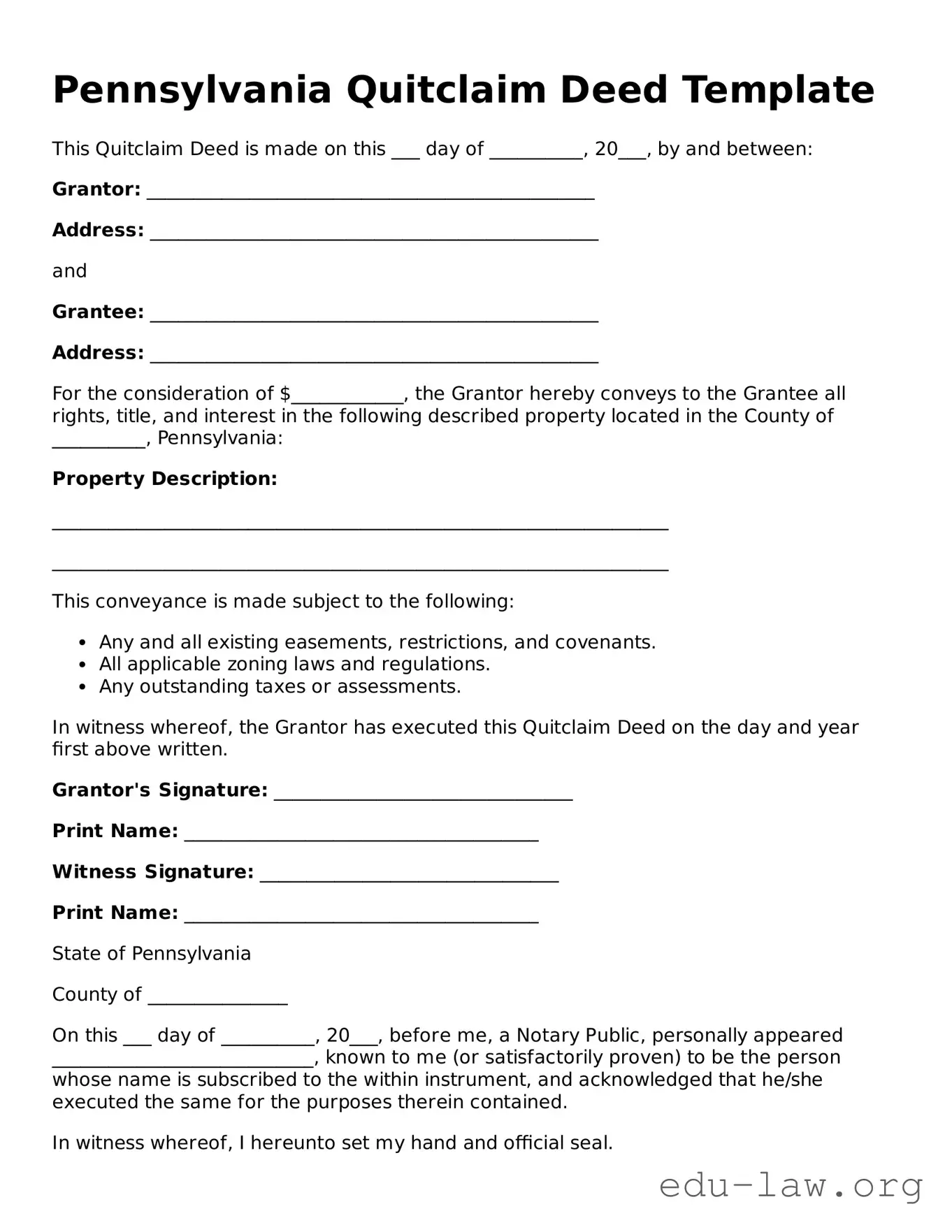
Pennsylvania Quitclaim Deed Template
This Quitclaim Deed is made on this ___ day of __________, 20___, by and between:
Grantor: ________________________________________________
Address: ________________________________________________
and
Grantee: ________________________________________________
Address: ________________________________________________
For the consideration of $____________, the Grantor hereby conveys to the Grantee all rights, title, and interest in the following described property located in the County of __________, Pennsylvania:
Property Description:
__________________________________________________________________
__________________________________________________________________
This conveyance is made subject to the following:
In witness whereof, the Grantor has executed this Quitclaim Deed on the day and year first above written.
Grantor's Signature: ________________________________
Print Name: ______________________________________
Witness Signature: ________________________________
Print Name: ______________________________________
State of Pennsylvania
County of _______________
On this ___ day of __________, 20___, before me, a Notary Public, personally appeared ____________________________, known to me (or satisfactorily proven) to be the person whose name is subscribed to the within instrument, and acknowledged that he/she executed the same for the purposes therein contained.
In witness whereof, I hereunto set my hand and official seal.
Notary Public Signature: ________________________________
My Commission Expires: ________________________________
| Fact Name | Description |
|---|---|
| Definition | A Quitclaim Deed in Pennsylvania transfers ownership interest in real property without guaranteeing the title's validity. |
| Governing Law | Quitclaim Deeds in Pennsylvania are governed by Title 21 of the Pennsylvania Consolidated Statutes. |
| Usage | This type of deed is commonly used among family members or in divorce settlements where the parties know each other. |
| Consideration | While a Quitclaim Deed can be executed without payment, it is often accompanied by nominal consideration, like $1. |
| Recording | To make the transfer official, the Quitclaim Deed must be recorded in the county where the property is located. |
After you have gathered the necessary information, you can begin filling out the Pennsylvania Quitclaim Deed form. This document will need to be completed accurately to ensure a smooth transfer of property ownership.
What is a Quitclaim Deed in Pennsylvania?
A Quitclaim Deed is a legal document used to transfer ownership of real estate from one party to another in Pennsylvania. Unlike other types of deeds, a Quitclaim Deed does not guarantee that the person transferring the property has clear title. It simply conveys whatever interest the grantor has in the property at the time of the transfer. This type of deed is often used among family members or in situations where the parties know each other well and trust that the transfer is legitimate.
How do I complete a Quitclaim Deed in Pennsylvania?
To complete a Quitclaim Deed in Pennsylvania, you will need to gather specific information, including the names of the grantor (the person transferring the property) and the grantee (the person receiving the property), a legal description of the property, and the date of the transfer. The form must be signed by the grantor in the presence of a notary public. After signing, the Quitclaim Deed should be filed with the county's Recorder of Deeds office to ensure that the transfer is officially recorded and recognized.
Are there any fees associated with filing a Quitclaim Deed in Pennsylvania?
Yes, there are fees associated with filing a Quitclaim Deed in Pennsylvania. The fees vary by county and typically include a recording fee that must be paid at the time of filing. It is advisable to check with the local Recorder of Deeds office for the exact fee schedule. Additionally, if the property is being transferred as part of a sale, there may be other costs, such as transfer taxes, that need to be considered.
Can a Quitclaim Deed be contested in Pennsylvania?
Yes, a Quitclaim Deed can be contested in Pennsylvania, but the grounds for contesting may be limited. Common reasons for contesting a Quitclaim Deed include claims of fraud, lack of capacity of the grantor at the time of signing, or failure to follow proper legal procedures during the transfer. If a dispute arises, it may be necessary to seek legal advice or resolve the matter in court to determine the validity of the deed and the rights of the parties involved.
Incomplete information: One of the most common mistakes is failing to provide all required information. This includes the names of both the grantor (the person transferring the property) and the grantee (the person receiving the property). Missing any details can lead to delays or complications.
Incorrect legal descriptions: The legal description of the property must be accurate. Many people mistakenly use informal descriptions or fail to include crucial details. A precise legal description is essential for the deed to be valid.
Not signing the document: A quitclaim deed must be signed by the grantor. Some individuals forget to sign or assume that a witness is not necessary. Without a signature, the deed cannot be executed.
Improper notarization: Many people overlook the requirement for notarization. The deed must be signed in front of a notary public to be legally binding. Failing to have the document notarized can invalidate the transfer.
Filing errors: After completing the quitclaim deed, individuals often make mistakes when filing it with the county recorder's office. This can include submitting the wrong form or not paying the required fees. Such errors can result in the deed not being recorded properly.
When dealing with property transfers in Pennsylvania, the Quitclaim Deed is often accompanied by other essential documents. Each of these forms serves a specific purpose in ensuring a smooth and legally sound transaction. Below is a list of commonly used forms that complement the Quitclaim Deed.
Each of these documents plays a vital role in the property transfer process in Pennsylvania. Properly preparing and submitting them can help avoid complications and ensure a successful transaction.
The Warranty Deed serves a similar purpose to the Quitclaim Deed, as both are used to transfer property ownership. However, the Warranty Deed provides a stronger guarantee to the buyer. When a seller uses a Warranty Deed, they assure the buyer that they hold clear title to the property and have the right to sell it. This document also protects the buyer against any future claims on the property, making it a more secure option for those looking to purchase real estate.
The Bargain and Sale Deed is another document that resembles the Quitclaim Deed in its function of transferring property. However, unlike the Quitclaim Deed, it implies that the seller has ownership of the property and the right to sell it, but it does not guarantee that the title is free of encumbrances. This type of deed is often used in transactions where the seller is willing to convey ownership but does not want to provide the extensive warranties found in a Warranty Deed.
The Special Purpose Deed, often used in specific situations such as transfers between family members or in divorce settlements, shares similarities with the Quitclaim Deed. Like the Quitclaim Deed, it typically does not provide warranties about the title. Instead, it focuses on the unique circumstances surrounding the transfer, which may include stipulations or conditions that apply only to that particular situation.
The Deed of Trust is akin to the Quitclaim Deed in that both involve the transfer of property interests. However, a Deed of Trust is primarily used in financing transactions. It involves three parties: the borrower, the lender, and a trustee. While a Quitclaim Deed merely transfers ownership, a Deed of Trust secures a loan by placing the property as collateral, ensuring that the lender has a claim to the property if the borrower defaults.
The Grant Deed is another document that operates similarly to the Quitclaim Deed, as it facilitates the transfer of property ownership. However, the Grant Deed includes certain assurances from the seller, such as the promise that they have not transferred the property to anyone else and that the property is free from undisclosed encumbrances. This offers a bit more security to the buyer compared to the straightforward nature of a Quitclaim Deed.
The Executor’s Deed is used in the context of estate administration, making it similar to the Quitclaim Deed in that it transfers property. This type of deed is executed by the executor of an estate to convey real estate to heirs or beneficiaries. While it does not guarantee a clear title, it serves to facilitate the distribution of property as per the decedent’s wishes, much like a Quitclaim Deed facilitates ownership transfer without warranties.
The Trustee’s Deed is comparable to the Quitclaim Deed in that it transfers property held in a trust. When a trustee conveys property, it is often done without the warranties typically found in other types of deeds. This document is used to ensure that the property is transferred according to the terms of the trust, similar to how a Quitclaim Deed transfers property rights without guarantees.
The Mineral Deed is another document that resembles the Quitclaim Deed, specifically in the context of transferring rights to mineral interests. This deed allows the owner of mineral rights to convey those rights to another party. Like a Quitclaim Deed, it typically does not provide warranties regarding the title, focusing instead on the specific rights being transferred rather than the property itself.
The Affidavit of Title is similar in that it addresses the ownership of property, but it does so in a different manner. This document is a sworn statement by the seller affirming their ownership and the absence of any liens or claims against the property. While it does not transfer ownership like a Quitclaim Deed, it serves to provide assurances to the buyer, making it a useful companion in property transactions.
Finally, the Lease Agreement, while primarily a rental document, has similarities to the Quitclaim Deed in that it involves the transfer of rights related to property. A lease grants a tenant the right to use and occupy a property for a specified period. While it does not transfer ownership, it establishes a legal relationship between the landlord and tenant, similar to how a Quitclaim Deed establishes a new owner’s rights to the property.
When filling out the Pennsylvania Quitclaim Deed form, it is important to follow certain guidelines to ensure the document is completed correctly. Here are five things to do and five things to avoid:
Things You Should Do:
Things You Shouldn't Do:
There are several misconceptions regarding the Pennsylvania Quitclaim Deed form. Understanding these can help clarify its purpose and implications.
This is not true. A quitclaim deed transfers whatever interest the grantor has in the property, but it does not guarantee that the grantor actually owns the property or has the right to transfer it.
While often used in family transactions, quitclaim deeds can be used in any situation where the parties agree to transfer property interests.
This is incorrect. A quitclaim deed transfers ownership of the property but does not affect any mortgage obligations. The person remains liable for the mortgage unless it is refinanced or satisfied.
In Pennsylvania, while notarization is highly recommended for validity, it is not strictly required. However, recording the deed is necessary to protect the new owner's interests.
Every property transfer, including those via quitclaim deeds, carries potential legal implications. It is important to understand these before proceeding.
This is not necessarily the case. Depending on the circumstances, a warranty deed may provide more protection for the buyer, as it guarantees clear title.
While primarily used for real estate, quitclaim deeds can also be used to transfer interests in other types of property, such as vehicles or personal property.
In reality, a quitclaim deed is relatively straightforward. However, it is still advisable to consult with a legal professional to ensure all aspects are correctly addressed.
Filling out and using the Pennsylvania Quitclaim Deed form is an important process for transferring property. Here are some key takeaways to keep in mind:
Taking these steps seriously will help ensure a smooth property transfer process in Pennsylvania.