When considering marriage, many couples in Pennsylvania find it beneficial to discuss their financial futures openly and honestly. A prenuptial agreement, often referred to as a prenup, serves as a proactive step in safeguarding individual assets and outlining financial responsibilities. This legal document allows partners to define how property will be divided in the event of a divorce or separation, protecting both parties and reducing potential conflicts. Key aspects of the Pennsylvania Prenuptial Agreement include provisions for asset distribution, debt allocation, and even spousal support arrangements. Furthermore, the agreement can address issues such as inheritance rights and financial responsibilities during the marriage. Understanding the nuances of this form is crucial, as it can help couples avoid misunderstandings and foster a sense of security as they embark on their journey together. By taking the time to draft a comprehensive prenup, couples can ensure that their unique circumstances and wishes are respected, paving the way for a more harmonious future.
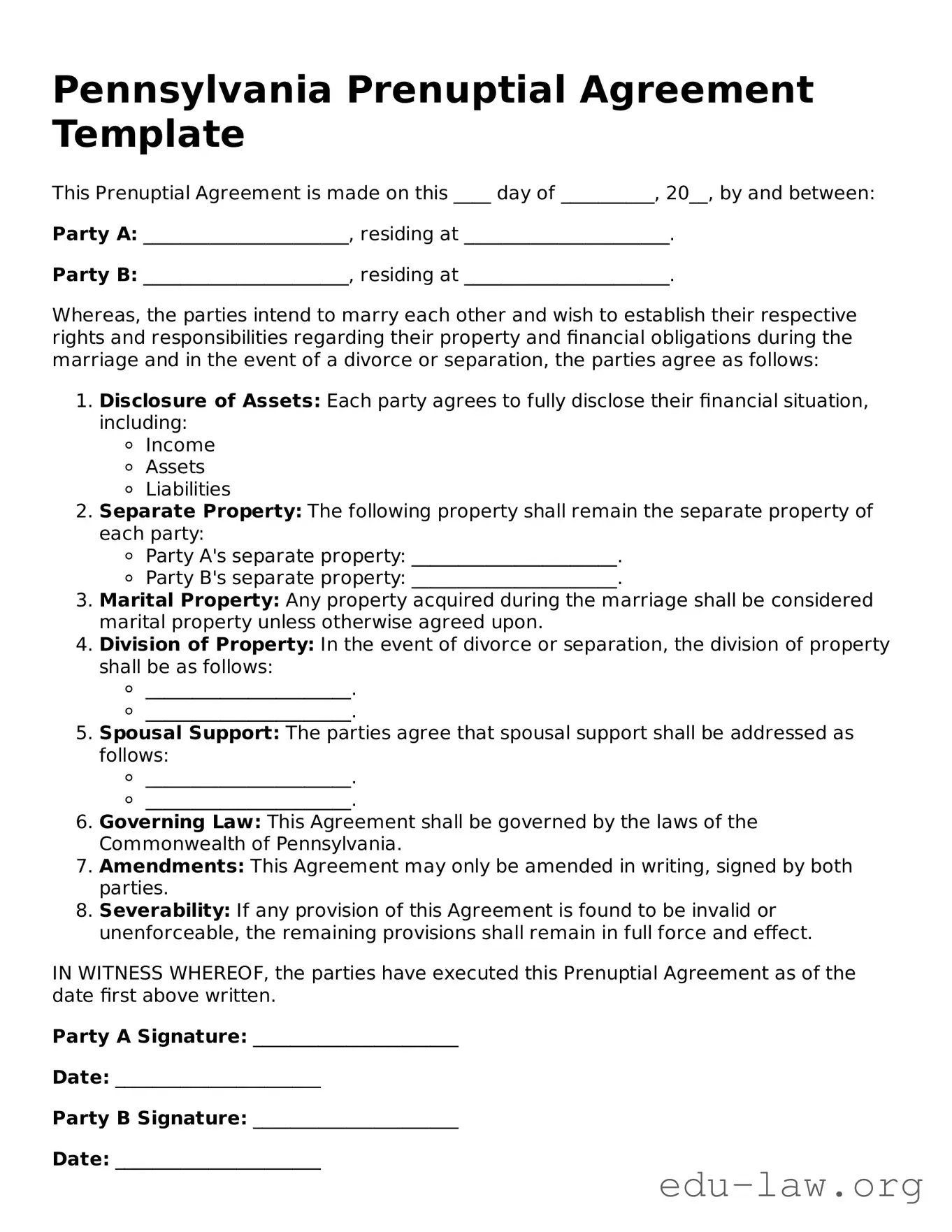
Pennsylvania Prenuptial Agreement Template
This Prenuptial Agreement is made on this ____ day of __________, 20__, by and between:
Party A: ______________________, residing at ______________________.
Party B: ______________________, residing at ______________________.
Whereas, the parties intend to marry each other and wish to establish their respective rights and responsibilities regarding their property and financial obligations during the marriage and in the event of a divorce or separation, the parties agree as follows:
IN WITNESS WHEREOF, the parties have executed this Prenuptial Agreement as of the date first above written.
Party A Signature: ______________________
Date: ______________________
Party B Signature: ______________________
Date: ______________________
Witness Signature: ______________________
Date: ______________________
| Fact Name | Description |
|---|---|
| Governing Law | The Pennsylvania Prenuptial Agreement is governed by the Pennsylvania Uniform Premarital Agreement Act. |
| Purpose | This agreement outlines the distribution of assets and financial responsibilities in the event of divorce or separation. |
| Voluntary Agreement | Both parties must enter into the agreement voluntarily, without coercion or undue influence. |
| Disclosure Requirement | Full financial disclosure is required from both parties to ensure fairness and transparency. |
| Modification | The agreement can be modified or revoked at any time, provided both parties agree to the changes in writing. |
| Enforceability | Courts in Pennsylvania will enforce the agreement as long as it is deemed fair and both parties had legal representation. |
Completing the Pennsylvania Prenuptial Agreement form requires careful attention to detail. This process ensures that both parties have a clear understanding of their rights and obligations before entering into marriage. Follow these steps to fill out the form accurately.
What is a prenuptial agreement in Pennsylvania?
A prenuptial agreement, often called a "prenup," is a legal contract between two individuals before they marry. It outlines the distribution of assets and responsibilities in the event of divorce or separation. In Pennsylvania, these agreements can cover a wide range of topics, including property division, spousal support, and debt management.
Why should I consider a prenuptial agreement?
Considering a prenuptial agreement can provide peace of mind. It helps clarify financial expectations and responsibilities, protecting both parties in the event of a divorce. Additionally, it can simplify the divorce process by pre-determining asset division and reducing potential conflicts.
What should be included in a Pennsylvania prenuptial agreement?
A comprehensive prenuptial agreement should include details about asset division, spousal support, and debt responsibilities. It may also address how future income, inheritances, and gifts will be treated. Both parties should fully disclose their financial situations to ensure fairness and transparency.
Is a prenuptial agreement enforceable in Pennsylvania?
Yes, prenuptial agreements are generally enforceable in Pennsylvania, provided they meet certain legal standards. The agreement must be in writing, signed by both parties, and executed voluntarily. It should also be fair and not unconscionable at the time of enforcement.
Can I modify a prenuptial agreement after marriage?
Yes, couples can modify a prenuptial agreement after marriage. To do so, both parties must agree to the changes, and the modifications should be documented in writing and signed. It's advisable to consult a lawyer to ensure that the revised agreement complies with Pennsylvania law.
Do I need a lawyer to create a prenuptial agreement?
While it's not legally required to have a lawyer, it is highly recommended. A lawyer can help ensure that the agreement is fair, legally sound, and tailored to your specific needs. Having independent legal advice can also prevent future challenges to the agreement's validity.
When should I start discussing a prenuptial agreement with my partner?
It's best to start discussing a prenuptial agreement well before the wedding. Open and honest communication about finances is crucial for a healthy relationship. Bringing up the topic early allows both partners to consider their options and seek legal advice without the pressure of an impending wedding.
Failing to disclose all assets and debts. Full transparency is crucial. Both parties should list their financial obligations and possessions.
Not considering future income or potential inheritance. It’s important to account for changes in financial circumstances that may arise after marriage.
Using vague language. Clarity is essential. Ambiguous terms can lead to misunderstandings and disputes later on.
Not having the agreement reviewed by legal professionals. Seeking legal advice ensures that both parties understand their rights and obligations.
Rushing the process. Taking time to carefully consider each clause can prevent future conflicts.
Not discussing the agreement openly with each other. Communication fosters trust and ensures both parties are on the same page.
Ignoring state laws. Each state has specific requirements for prenuptial agreements. Familiarity with Pennsylvania's laws is essential.
When couples in Pennsylvania consider entering into a prenuptial agreement, they often find it beneficial to utilize additional forms and documents to support their agreement. These documents can provide clarity, structure, and legal grounding to the arrangement. Below is a list of commonly used forms that may accompany a Pennsylvania Prenuptial Agreement.
Incorporating these documents alongside a prenuptial agreement can help couples establish a solid foundation for their marriage. By addressing financial and legal matters proactively, individuals can foster a sense of security and mutual understanding as they embark on their shared journey.
A Cohabitation Agreement shares similarities with a Prenuptial Agreement, particularly in its purpose of defining the rights and responsibilities of partners. This document is often utilized by couples who choose to live together without marrying. Like a prenuptial agreement, it can cover issues such as property division, financial responsibilities, and even matters regarding children. Both documents aim to clarify expectations and protect individual interests, though a cohabitation agreement is typically enacted before marriage.
A Separation Agreement is also akin to a Prenuptial Agreement, as it delineates the terms under which a couple will separate. This document can address issues such as child custody, support, and property division, much like a prenuptial agreement does for couples planning to marry. The primary difference lies in the timing; a separation agreement is often created when a couple decides to live apart, while a prenuptial agreement is established prior to marriage.
An Estate Plan, while primarily focused on the distribution of assets after death, shares some characteristics with a Prenuptial Agreement. Both documents can outline how assets will be managed and divided. In a prenuptial agreement, couples can specify what happens to their assets during marriage and in the event of divorce. An estate plan, on the other hand, focuses on what happens to those same assets after one spouse passes away. Both documents are essential for ensuring that individual wishes are respected.
A Non-Disclosure Agreement (NDA) can also be compared to a Prenuptial Agreement in terms of protecting sensitive information. While a prenuptial agreement primarily deals with financial matters, it can include clauses that safeguard personal information or business interests. Similarly, an NDA is designed to prevent one party from disclosing confidential information to outside parties. Both documents emphasize the importance of trust and confidentiality in relationships, whether they are personal or professional.
A Power of Attorney (POA) is another document that has some similarities with a Prenuptial Agreement. While a prenuptial agreement outlines financial matters and asset distribution, a POA grants one person the authority to make decisions on behalf of another in specific situations, such as medical emergencies or financial matters. Both documents involve significant trust and can be crucial in protecting individual interests, though they serve different functions within a relationship.
A Business Partnership Agreement is similar to a Prenuptial Agreement in that both documents establish clear guidelines for the management and division of assets. In a business partnership, the agreement outlines how profits and responsibilities are shared, much like a prenuptial agreement specifies how assets will be divided in the event of divorce. Both documents are essential for preventing disputes and ensuring a harmonious relationship, whether in marriage or business.
Finally, a Child Custody Agreement bears resemblance to a Prenuptial Agreement in its purpose of establishing clear expectations. While a prenuptial agreement deals with financial matters and asset division, a child custody agreement focuses on the care and upbringing of children in the event of a separation or divorce. Both documents aim to provide clarity and stability, ensuring that all parties understand their rights and responsibilities.
When filling out the Pennsylvania Prenuptial Agreement form, it is essential to approach the task with care and attention to detail. Below is a list of things to do and avoid to ensure the process goes smoothly.
When considering a prenuptial agreement in Pennsylvania, many people hold misconceptions that can lead to misunderstandings. Here are five common misconceptions about the Pennsylvania Prenuptial Agreement form:
This is a widespread belief, but prenuptial agreements can benefit anyone. They provide clarity about financial matters and protect both parties, regardless of income level.
Many view discussing a prenup as a lack of trust. However, having a clear agreement can actually strengthen a relationship by fostering open communication about finances and expectations.
This is not true. Couples can modify their prenup at any time, as long as both parties agree and the changes are documented properly.
While notarization adds an extra layer of validity, it is not the only requirement for a prenup to be enforceable. Both parties must enter the agreement voluntarily and with full disclosure of assets.
This misconception can lead to confusion. In Pennsylvania, courts prioritize the best interests of the child, and any agreements regarding custody or support must comply with state laws.
Understanding these misconceptions can help individuals make informed decisions about prenuptial agreements. It is crucial to approach this topic with clarity and care.
When considering a prenuptial agreement in Pennsylvania, it's essential to understand the key aspects of the process. Here are ten important takeaways:
By understanding these key points, couples can approach their prenuptial agreement with confidence and clarity, fostering a strong foundation for their marriage.