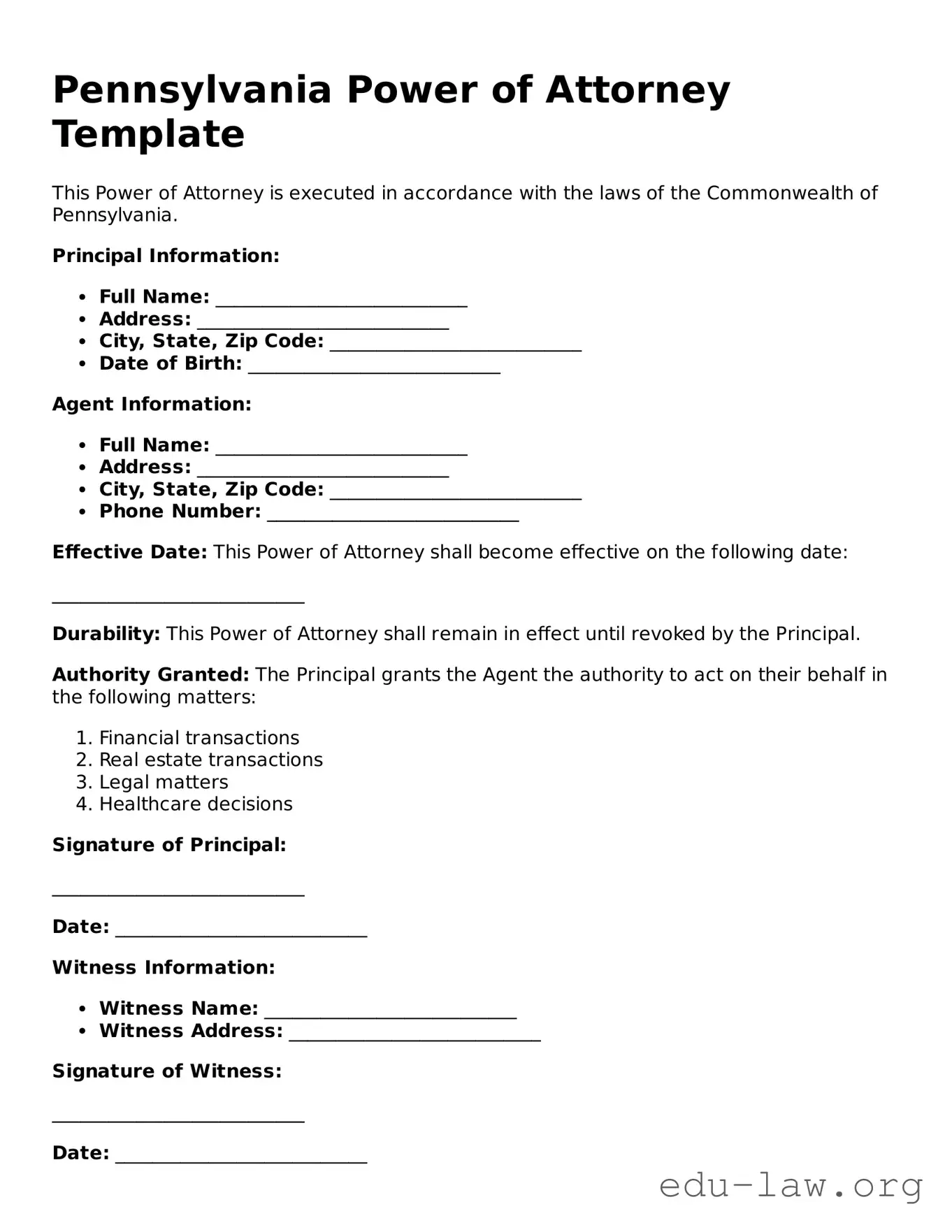
In Pennsylvania, the Power of Attorney (POA) form serves as a vital legal tool, empowering individuals to designate someone they trust to make decisions on their behalf. This form can cover a wide range of responsibilities, from managing financial matters to making healthcare choices. It's essential to understand that there are different types of POAs available, including durable and medical, each serving unique purposes. A durable Power of Attorney remains effective even if the principal becomes incapacitated, while a medical Power of Attorney specifically addresses healthcare decisions. Completing the form correctly is crucial, as it requires the principal's signature, and often the signatures of witnesses or a notary, to ensure its validity. By establishing a POA, individuals can ensure their wishes are respected and that their affairs are handled according to their preferences, providing peace of mind for both the principal and their loved ones.
Pennsylvania Power of Attorney Template
This Power of Attorney is executed in accordance with the laws of the Commonwealth of Pennsylvania.
Principal Information:
Agent Information:
Effective Date: This Power of Attorney shall become effective on the following date:
___________________________
Durability: This Power of Attorney shall remain in effect until revoked by the Principal.
Authority Granted: The Principal grants the Agent the authority to act on their behalf in the following matters:
Signature of Principal:
___________________________
Date: ___________________________
Witness Information:
Signature of Witness:
___________________________
Date: ___________________________
This document must be signed in the presence of a notary public to be valid.
| Fact Name | Description |
|---|---|
| Definition | A Power of Attorney (POA) in Pennsylvania is a legal document that allows one person to act on behalf of another in legal or financial matters. |
| Governing Law | The Pennsylvania Power of Attorney is governed by the Pennsylvania Consolidated Statutes, Title 20, Chapter 56. |
| Types of POA | There are two main types: General Power of Attorney and Limited Power of Attorney, each serving different purposes. |
| Durability | A POA can be durable, meaning it remains effective even if the principal becomes incapacitated. |
| Agent's Authority | The agent's authority can be broad or limited, depending on how the document is drafted. |
| Signing Requirements | The form must be signed by the principal and witnessed by two individuals or notarized. |
| Revocation | The principal can revoke the Power of Attorney at any time, as long as they are competent to do so. |
| Fiduciary Duty | The agent has a fiduciary duty to act in the best interest of the principal, which includes avoiding conflicts of interest. |
| Use in Healthcare | A separate document called a Healthcare Power of Attorney is often used to designate someone to make medical decisions. |
Filling out the Pennsylvania Power of Attorney form is a straightforward process. By completing this form, you designate someone to act on your behalf in financial or legal matters. Follow the steps below to ensure the form is filled out correctly.
After completing the form, keep a copy for your records. Provide copies to your agent and any relevant institutions where the Power of Attorney may be used.
What is a Power of Attorney in Pennsylvania?
A Power of Attorney (POA) in Pennsylvania is a legal document that allows an individual, known as the principal, to appoint another person, referred to as the agent or attorney-in-fact, to make decisions on their behalf. This authority can cover a wide range of matters, including financial transactions, medical decisions, and real estate dealings. The principal can specify the powers granted to the agent and can limit or expand those powers as needed. This document is particularly useful in situations where the principal may become incapacitated or unable to manage their affairs.
How do I create a Power of Attorney in Pennsylvania?
To create a valid Power of Attorney in Pennsylvania, the principal must be at least 18 years old and mentally competent. The document must be in writing and signed by the principal. It is advisable to have the POA notarized to enhance its validity and acceptance by third parties. While not legally required, having witnesses can also provide additional support. The principal should ensure that the agent understands their responsibilities and is trustworthy, as the agent will have significant authority over the principal's affairs.
Can I revoke a Power of Attorney in Pennsylvania?
Yes, a Power of Attorney can be revoked in Pennsylvania at any time, as long as the principal is still competent. To revoke a POA, the principal should create a written revocation document, which should clearly state the intent to revoke the previous Power of Attorney. It is advisable to notify the agent and any institutions or individuals who were relying on the original POA about the revocation. This ensures that the agent no longer has authority and helps prevent any confusion or misuse of power.
What happens if the principal becomes incapacitated?
If the principal becomes incapacitated, the Power of Attorney remains in effect, provided it is a durable Power of Attorney. A durable POA specifically states that the authority granted to the agent continues even if the principal is no longer able to make decisions due to mental or physical incapacity. In contrast, a non-durable POA would become ineffective if the principal loses capacity. It is essential for the principal to consider these aspects when drafting the document to ensure that their wishes are honored during periods of incapacity.
Failing to clearly identify the principal and agent. It is crucial to provide full names and addresses to avoid confusion.
Not specifying the powers granted. Some individuals leave this section vague, which can lead to misunderstandings about what the agent can do.
Omitting the date of execution. This date is important for determining when the authority begins and can affect the validity of the document.
Not signing the form in the presence of a notary public. Pennsylvania requires notarization for the Power of Attorney to be legally binding.
Neglecting to include alternate agents. If the primary agent is unavailable, having a backup can ensure that decisions can still be made.
Using outdated forms. Laws can change, so it is important to use the most current version of the Power of Attorney form.
Forgetting to discuss the arrangement with the agent. Open communication helps ensure that the agent understands their responsibilities and the principal's wishes.
Not reviewing the form for accuracy. Mistakes in names, dates, or powers can invalidate the document.
Overlooking state-specific requirements. Each state may have unique stipulations that must be followed for the form to be valid.
Failing to keep copies of the completed form. It is advisable to provide copies to the agent and keep one for personal records.
A Power of Attorney (POA) is a vital document that allows one person to make decisions on behalf of another. In Pennsylvania, several other forms and documents often accompany the Power of Attorney to ensure that all aspects of a person's financial and healthcare wishes are clearly articulated and legally binding. Below are some commonly used documents that may complement a Power of Attorney.
Incorporating these documents alongside a Power of Attorney can provide a comprehensive plan for managing both financial and healthcare decisions. It is essential to consider these additional forms to ensure that your wishes are respected and that your affairs are handled according to your preferences.
The Pennsylvania Power of Attorney form is similar to the Advance Healthcare Directive, which allows individuals to outline their healthcare preferences in case they become unable to communicate their wishes. Like the Power of Attorney, this document appoints a trusted person, often referred to as a healthcare proxy, to make medical decisions on behalf of the individual. Both documents aim to ensure that a person’s preferences are respected, whether in financial matters or healthcare situations, highlighting the importance of having clear directives in place.
Another document akin to the Power of Attorney is the Living Will. This legal document specifies an individual's wishes regarding end-of-life care and medical treatments. While the Power of Attorney grants authority to someone to make decisions on behalf of another, a Living Will directly communicates the individual's desires about medical interventions. Both documents serve to protect personal autonomy and provide guidance during critical moments when a person may not be able to express their preferences.
The Healthcare Proxy is also similar to the Pennsylvania Power of Attorney, as it designates someone to make healthcare decisions. However, it is specifically focused on medical matters, unlike the broader financial and legal powers granted by a Power of Attorney. Both documents require careful consideration in selecting the right person to act on one’s behalf, ensuring that the appointed individual understands and respects the individual's values and wishes.
The Durable Power of Attorney is another closely related document. This form allows an individual to appoint someone to manage their financial affairs, even if they become incapacitated. The key similarity lies in the durability of the authority granted; both documents remain effective even when the principal can no longer make decisions. This ensures that financial and legal matters can continue to be handled seamlessly during challenging times.
Additionally, the Guardianship Agreement shares similarities with the Power of Attorney. While a Power of Attorney is typically created while the individual is still competent, a Guardianship Agreement may come into play when someone is no longer able to make decisions for themselves. Both documents aim to protect the interests of individuals who cannot advocate for themselves, though the processes for establishing them differ significantly.
Lastly, the Trust Agreement is comparable in that it allows for the management of assets. A Trust can designate a trustee to manage an individual’s property and finances, similar to how a Power of Attorney allows someone to act on behalf of another. Both documents provide mechanisms for asset management, but a Trust often involves more complex arrangements and can serve various purposes, such as estate planning and tax benefits.
When filling out the Pennsylvania Power of Attorney form, it is essential to approach the task with care and attention to detail. Here are some important do's and don'ts to consider:
By following these guidelines, you can ensure that your Power of Attorney form is filled out correctly and effectively reflects your wishes.
Understanding the Pennsylvania Power of Attorney (POA) form is crucial for effective planning. However, several misconceptions can lead to confusion. Here are four common misconceptions:
Many people believe that all POA forms are interchangeable. In reality, Pennsylvania has specific requirements and types of POAs, including durable, medical, and limited powers of attorney. Each serves different purposes and has different legal implications.
This is not true. A POA can be effective immediately upon signing, depending on how it is drafted. It can also be set to become effective only upon the principal's incapacitation, but that is a choice made by the individual creating the document.
In Pennsylvania, a principal can revoke a POA at any time, as long as they are mentally competent. This can be done through a written notice to the agent or by creating a new POA that explicitly revokes the previous one.
This misconception can lead to serious concerns. An agent's authority is limited to what is specified in the POA document. The principal can outline specific powers, and any actions outside of those powers may not be legally binding.
When filling out and using the Pennsylvania Power of Attorney form, it is important to keep several key points in mind. This document allows you to appoint someone to make decisions on your behalf, and understanding its implications is crucial.
By following these guidelines, you can ensure that your Power of Attorney is effective and aligns with your intentions.