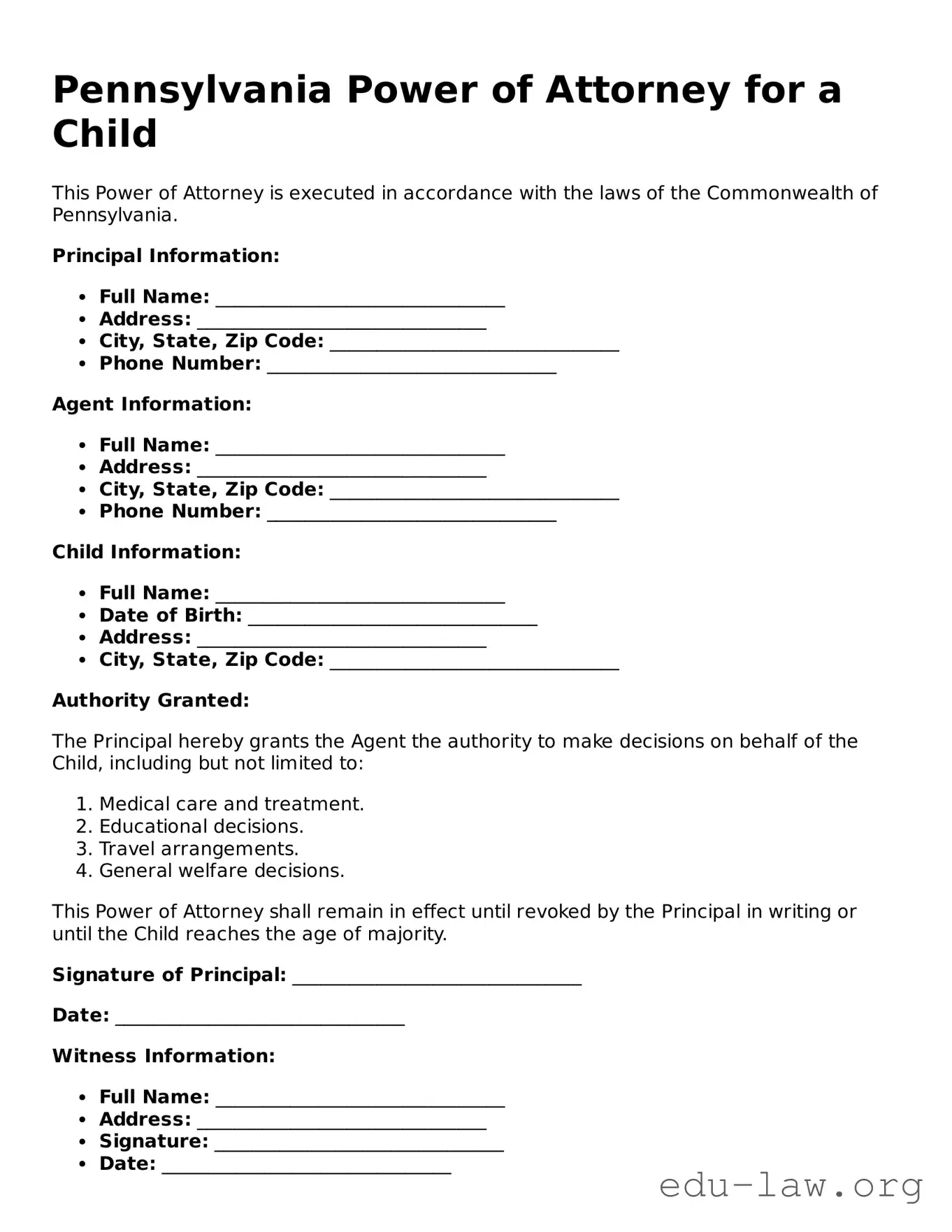
The Pennsylvania Power of Attorney for a Child form serves as a crucial legal document that enables a parent or legal guardian to designate another individual to make decisions on behalf of their child. This form is particularly useful in situations where a parent may be temporarily unavailable, such as during travel or medical emergencies. It outlines the specific powers granted to the designated individual, which may include decisions related to education, health care, and general welfare. The document requires signatures from both the parent and the designated agent, ensuring that all parties understand their roles and responsibilities. Additionally, the form may need to be notarized to enhance its legal validity. Understanding the implications of this power of attorney is essential for parents, as it provides a mechanism for ensuring that their child's needs are met even in their absence.
Pennsylvania Power of Attorney for a Child
This Power of Attorney is executed in accordance with the laws of the Commonwealth of Pennsylvania.
Principal Information:
Agent Information:
Child Information:
Authority Granted:
The Principal hereby grants the Agent the authority to make decisions on behalf of the Child, including but not limited to:
This Power of Attorney shall remain in effect until revoked by the Principal in writing or until the Child reaches the age of majority.
Signature of Principal: _______________________________
Date: _______________________________
Witness Information:
| Fact Name | Description |
|---|---|
| Definition | A Power of Attorney for a Child allows a parent or guardian to designate another person to make decisions for their child. |
| Governing Law | The form is governed by Pennsylvania Consolidated Statutes, Title 20, Chapter 56. |
| Purpose | This document is used for various reasons, such as temporary guardianship during travel or emergencies. |
| Duration | The Power of Attorney can be effective for a specific period or until revoked by the parent or guardian. |
| Signatures Required | The form must be signed by the parent or guardian granting the authority. |
| Notarization | Notarization is not required, but it can add an extra layer of validity. |
| Revocation | A parent or guardian can revoke the Power of Attorney at any time, as long as it is done in writing. |
| Limitations | The authority granted can be limited to specific decisions or general care for the child. |
| Eligibility | Only a parent or legal guardian can create a Power of Attorney for their child. |
| Important Considerations | Consider discussing the arrangement with the designated person to ensure they are willing and able to take on the responsibility. |
Filling out the Pennsylvania Power of Attorney for a Child form is a straightforward process. Once completed, this document will allow you to designate someone to make decisions on behalf of your child when you are unavailable. Follow these steps to ensure the form is filled out correctly.
What is a Pennsylvania Power of Attorney for a Child form?
The Pennsylvania Power of Attorney for a Child form is a legal document that allows a parent or guardian to designate another individual to make decisions on behalf of their child. This can include medical decisions, educational decisions, and other important matters. The form is particularly useful for parents who may be temporarily unavailable due to travel, work commitments, or other circumstances.
Who can be designated as an agent in the Power of Attorney for a Child?
Any responsible adult can be designated as an agent in the Power of Attorney for a Child. This could be a relative, family friend, or neighbor. It is essential to choose someone who is trustworthy and capable of making decisions in the best interest of the child.
How long is the Power of Attorney for a Child valid?
The Power of Attorney for a Child can be set for a specific period or can remain in effect until revoked by the parent or guardian. It is important to specify the duration in the document to avoid any confusion about the authority granted to the agent.
Is the Power of Attorney for a Child form required to be notarized?
Yes, the Pennsylvania Power of Attorney for a Child form must be signed in the presence of a notary public. This step helps to ensure the authenticity of the document and provides a level of legal protection for both the parent and the agent.
Can the Power of Attorney for a Child be revoked?
Yes, the Power of Attorney for a Child can be revoked at any time by the parent or guardian. To do this, a written notice of revocation should be provided to the agent and any relevant parties. It is advisable to keep a copy of the revocation for personal records.
What happens if the Power of Attorney for a Child is not in place?
If the Power of Attorney for a Child is not in place, a parent may face difficulties in making decisions for their child during periods of absence. Without this document, medical providers or schools may not allow someone other than the parent to make decisions or access information regarding the child. This could lead to delays in necessary care or education.
Failing to include the full names of both the child and the agent. It is crucial to provide complete names to avoid any confusion or legal issues later on.
Not specifying the duration of the power of attorney. Clearly stating the time frame helps ensure that the authority granted is understood and respected.
Neglecting to sign the document in front of a notary public. A signature without notarization may not hold up in legal situations.
Overlooking the need for witnesses. Depending on the circumstances, having one or more witnesses may be required to validate the document.
Using vague language. Clearly outlining the specific powers granted to the agent prevents misunderstandings about what the agent can and cannot do.
Failing to provide contact information for the agent. Including a phone number and address ensures that the agent can be easily reached if necessary.
Not reviewing the form for accuracy. Errors in names, dates, or other information can lead to complications and delays.
Ignoring the need for periodic updates. Life circumstances change, and it is important to revisit and revise the document as needed.
When designating someone to make decisions for a child, the Pennsylvania Power of Attorney for a Child form is often accompanied by several other important documents. Each of these documents serves a unique purpose and can help ensure that the child's needs are met effectively and legally.
Having these documents in place can provide peace of mind for parents and guardians. They ensure that the child's welfare is prioritized and that caregivers have the necessary authority to act in the child's best interests.
The Pennsylvania Power of Attorney for a Child form shares similarities with a Medical Power of Attorney. Both documents allow individuals to designate another person to make decisions on their behalf. In the case of a Medical Power of Attorney, this authority specifically pertains to healthcare decisions. Parents can appoint a trusted individual to make medical choices for their child in the event they are unable to do so. This ensures that the child receives appropriate care, even when the parent is not present, reflecting a commitment to the child's well-being.
Another document akin to the Power of Attorney for a Child is the Guardianship Agreement. This legal arrangement allows a designated individual to take on the responsibilities of a guardian for a minor. While the Power of Attorney for a Child is typically temporary and can be revoked, a Guardianship Agreement often involves a more permanent arrangement. It grants the guardian the authority to make decisions regarding the child's upbringing, education, and welfare, providing a broader scope of responsibility than the Power of Attorney.
The Custody Agreement also bears resemblance to the Pennsylvania Power of Attorney for a Child form. Custody Agreements are often established in the context of divorce or separation, determining where a child will live and who will make decisions about their upbringing. Like the Power of Attorney, these agreements are designed to protect the child's best interests. However, Custody Agreements are usually more formal and can involve court approval, whereas a Power of Attorney can be executed privately without court intervention.
Lastly, the Child Care Authorization form is another document that parallels the Power of Attorney for a Child. This form is often used by parents to authorize another individual to care for their child temporarily. Similar to the Power of Attorney, it grants specific rights and responsibilities to the caregiver, allowing them to make decisions regarding the child's daily care. However, the Child Care Authorization is generally more limited in scope and duration, focusing primarily on short-term arrangements, such as during a vacation or while the parent is away.
When filling out the Pennsylvania Power of Attorney for a Child form, it is essential to approach the task with care and attention to detail. Here are some important guidelines to follow, including things you should and shouldn't do.
By following these guidelines, you can ensure that the Power of Attorney for a Child form is filled out correctly and serves its intended purpose effectively.
Understanding the Pennsylvania Power of Attorney for a Child form is crucial for parents and guardians. However, several misconceptions can lead to confusion. Here’s a list of ten common misunderstandings:
Clearing up these misconceptions can help ensure that parents and guardians use the Power of Attorney for a Child form effectively and responsibly.
Filling out and utilizing the Pennsylvania Power of Attorney for a Child form can be straightforward if you keep a few key points in mind. Here are essential takeaways to consider: