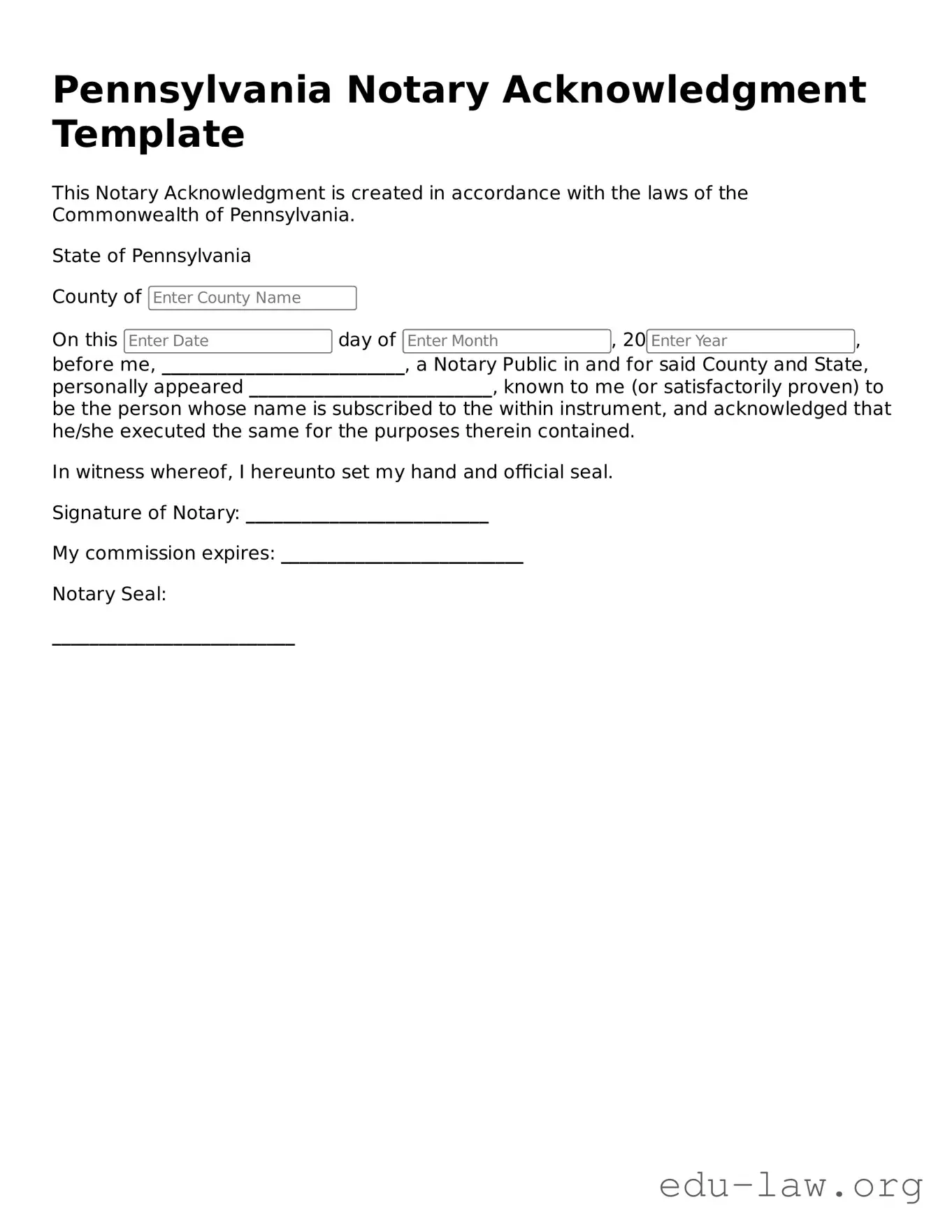
The Pennsylvania Notary Acknowledgement form plays a crucial role in the realm of legal documentation, providing a clear and reliable way to verify the identity of signers and the authenticity of their signatures. This form is essential for various transactions, including property transfers, contracts, and other legal agreements. By requiring the presence of a notary public, it ensures that the signer willingly and knowingly executes the document in question. The form typically includes key details such as the name of the signer, the date of the acknowledgment, and the notary's signature and seal, all of which contribute to its validity. Understanding how to properly complete and utilize this form is vital for individuals and businesses alike, as it helps prevent fraud and ensures that legal documents hold up in court. Whether you are a notary, a legal professional, or an individual looking to navigate the complexities of legal documentation, familiarity with the Pennsylvania Notary Acknowledgement form is indispensable.
Pennsylvania Notary Acknowledgment Template
This Notary Acknowledgment is created in accordance with the laws of the Commonwealth of Pennsylvania.
State of Pennsylvania
County of
On this day of , 20, before me, __________________________, a Notary Public in and for said County and State, personally appeared __________________________, known to me (or satisfactorily proven) to be the person whose name is subscribed to the within instrument, and acknowledged that he/she executed the same for the purposes therein contained.
In witness whereof, I hereunto set my hand and official seal.
Signature of Notary: __________________________
My commission expires: __________________________
Notary Seal:
__________________________
| Fact Name | Description |
|---|---|
| Purpose | The Pennsylvania Notary Acknowledgement form is used to verify the identity of the signer and confirm their willingness to sign a document. |
| Governing Law | This form is governed by the Pennsylvania Notary Law, specifically Title 57 of the Pennsylvania Consolidated Statutes. |
| Signature Requirement | The signer must appear in person before the notary public to complete the acknowledgment. |
| Notary's Role | The notary public is responsible for ensuring that the signer understands the document and is signing voluntarily. |
| Record Keeping | Notaries are required to maintain a record of all acknowledgments performed, including the date, type of document, and the signer's information. |
| Validity | Once properly completed, the acknowledgment form serves as legal proof that the signer has executed the document in front of a notary. |
After obtaining the Pennsylvania Notary Acknowledgement form, you are ready to fill it out accurately. Ensure you have all necessary information at hand before starting. Follow these steps to complete the form properly.
Once you have completed these steps, review the form for accuracy before submitting it as required. Make sure all information is clear and legible.
What is a Pennsylvania Notary Acknowledgement form?
The Pennsylvania Notary Acknowledgement form is a legal document that serves to confirm that a signature on a document was made voluntarily and that the signer is who they claim to be. This form is commonly used in various transactions, such as real estate deals or legal agreements, to provide assurance that the necessary parties are participating in the signing process willingly and knowingly.
Who can act as a notary in Pennsylvania?
In Pennsylvania, a notary public must be at least 18 years old, a resident of the state, and must complete the required training and examination. Notaries are appointed by the Department of State and must adhere to specific regulations to maintain their commission. They play a crucial role in verifying identities and ensuring that documents are executed properly.
How do I complete a Notary Acknowledgement form?
To complete a Notary Acknowledgement form, the signer must appear before the notary public. The signer will need to provide valid identification to confirm their identity. The notary will then fill out the form, which includes details such as the date, the signer's name, and a statement that the signer acknowledged their signature. The notary will also affix their official seal to the document.
Is a Notary Acknowledgement form required for all documents?
No, not all documents require a Notary Acknowledgement. The necessity of this form depends on the type of document and the requirements of the parties involved. For example, real estate transactions often require notarization, while other documents may not. It is important to check the specific requirements for your situation.
What is the difference between notarization and a Notary Acknowledgement?
Notarization is a broader term that encompasses various acts performed by a notary public, including taking oaths, witnessing signatures, and certifying copies of documents. A Notary Acknowledgement specifically refers to the act of confirming that a signer has willingly signed a document in the presence of a notary. Essentially, a Notary Acknowledgement is a type of notarization.
Can a Notary Acknowledgement be done remotely in Pennsylvania?
As of recent updates, Pennsylvania allows for remote notarization under specific conditions. This means that a notary can perform an acknowledgment through audio-visual technology, provided both the signer and the notary can see and hear each other in real-time. However, it is essential to follow the guidelines set forth by the state to ensure that the remote notarization is valid.
What should I do if my Notary Acknowledgement is rejected?
If a Notary Acknowledgement is rejected, it is important to understand the reason behind the rejection. Common issues may include missing information, an improper signature, or lack of identification. To resolve the issue, review the document and consult with the notary to identify what needs to be corrected. You may need to complete the acknowledgment again to ensure that it meets all requirements.
Failing to include the date of the acknowledgment. This is essential, as it indicates when the notarization took place.
Not identifying the signer clearly. It's crucial to ensure that the name matches the identification presented to the notary.
Leaving out the notary's signature. Without this, the acknowledgment is incomplete and cannot be considered valid.
Using an incorrect notary seal. The seal must be legible and contain all required information, including the notary's name and commission details.
Neglecting to fill in the jurisdiction information. This specifies where the notarization is taking place and is necessary for legal validity.
Overlooking the capacity in which the signer is acting. This detail helps clarify the authority of the signer in the document.
Not ensuring that the signer is present during the acknowledgment. The notary must witness the signature to validate the process.
Using outdated or incorrect forms. Always make sure to use the most current version of the Pennsylvania Notary Acknowledgment form.
The Pennsylvania Notary Acknowledgement form is a crucial document for verifying the identity of individuals signing various legal instruments. However, several other forms and documents often accompany it, each serving a specific purpose in the notarization process. Below is a list of commonly used forms that can enhance the effectiveness and clarity of legal transactions.
Each of these documents plays a vital role in ensuring that legal transactions are conducted smoothly and with the necessary verification. Familiarity with these forms can help individuals navigate the complexities of legal processes more effectively.
The Pennsylvania Notary Acknowledgment form is similar to the Affidavit. An affidavit is a written statement confirmed by oath or affirmation, often used as evidence in court. Like the acknowledgment form, it requires a notary public to verify the identity of the signer and to confirm that the signer understands the contents of the document. Both documents serve to provide a level of assurance regarding the authenticity of the signatures and the intent of the parties involved.
Another document that shares similarities with the Pennsylvania Notary Acknowledgment form is the Power of Attorney. This document allows one person to grant authority to another to act on their behalf in legal matters. Just as the acknowledgment form requires a notary to verify the identity of the signer, the Power of Attorney must also be notarized to ensure that the granting of authority is legitimate and that the principal fully understands the implications of the document.
The Deed is another document akin to the Pennsylvania Notary Acknowledgment form. A deed transfers ownership of real property from one party to another. For a deed to be legally binding, it must be signed and notarized. The notary's role is to confirm the identity of the parties involved and to witness the signing, similar to the acknowledgment process where the notary verifies the signer's identity and intent.
Similar to the acknowledgment form is the Certificate of Incumbency. This document is used to confirm the identity of individuals authorized to act on behalf of a corporation or other entity. Notarization is often required to add credibility to the document, ensuring that the signatures are valid and that the individuals listed are indeed authorized to represent the entity, mirroring the verification process found in the acknowledgment form.
The Will also shares characteristics with the Pennsylvania Notary Acknowledgment form. A will outlines how a person wishes to distribute their assets upon death. While not all states require notarization for a will, having it notarized can help prevent disputes and ensure that the document is valid. The notary’s role is to affirm the identity of the testator and confirm that they are signing willingly, much like in the acknowledgment process.
The Living Trust is another document that resembles the Pennsylvania Notary Acknowledgment form. A living trust allows a person to manage their assets during their lifetime and dictate how they should be distributed after death. Like the acknowledgment form, a living trust can be notarized to ensure that the signatures are valid and that the trustor understands the terms, providing an extra layer of protection against potential disputes.
Finally, the Bill of Sale is similar in nature to the Pennsylvania Notary Acknowledgment form. A bill of sale documents the transfer of ownership of personal property from one party to another. While notarization is not always required, having the document notarized can enhance its validity and provide proof that the transaction took place. The notary’s verification of the parties’ identities and their understanding of the transaction parallels the acknowledgment process.
When filling out the Pennsylvania Notary Acknowledgment form, it is essential to follow certain guidelines to ensure accuracy and compliance. Below is a list of things you should and shouldn't do during this process.
There are several misconceptions surrounding the Pennsylvania Notary Acknowledgement form. Understanding these can help individuals navigate the notary process more effectively. Here are six common misconceptions:
Understanding these misconceptions can help clarify the role of notaries and ensure a smoother process when dealing with notarized documents in Pennsylvania.
When filling out and using the Pennsylvania Notary Acknowledgement form, several important points should be considered: