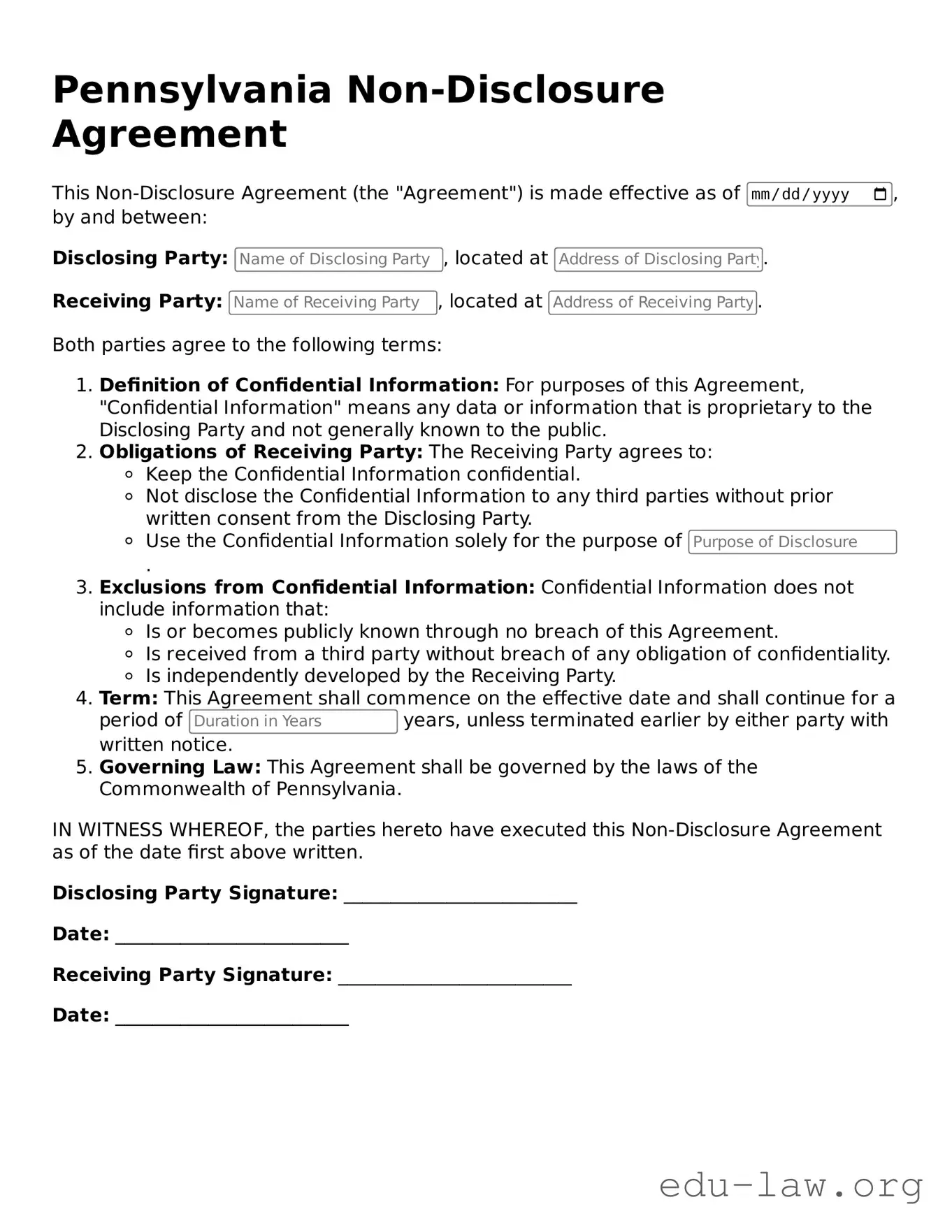
In the realm of business and professional relationships, confidentiality plays a crucial role in safeguarding sensitive information. The Pennsylvania Non-disclosure Agreement (NDA) form serves as a vital tool for individuals and organizations seeking to protect their proprietary data, trade secrets, and other confidential materials from unauthorized disclosure. This legally binding document outlines the obligations of the parties involved, ensuring that shared information remains private and secure. Key components of the NDA include definitions of what constitutes confidential information, the duration of the confidentiality obligations, and the specific circumstances under which disclosure may be permitted. Additionally, the form often addresses the consequences of breaching the agreement, which can include legal remedies and financial repercussions. By establishing clear guidelines, the Pennsylvania NDA fosters trust and collaboration between parties while minimizing the risk of information leaks that could jeopardize competitive advantage or business integrity.
Pennsylvania Non-Disclosure Agreement
This Non-Disclosure Agreement (the "Agreement") is made effective as of , by and between:
Disclosing Party: , located at .
Receiving Party: , located at .
Both parties agree to the following terms:
IN WITNESS WHEREOF, the parties hereto have executed this Non-Disclosure Agreement as of the date first above written.
Disclosing Party Signature: _________________________
Date: _________________________
Receiving Party Signature: _________________________
Date: _________________________
| Fact Name | Description |
|---|---|
| Purpose | The Pennsylvania Non-disclosure Agreement (NDA) protects confidential information shared between parties. |
| Governing Law | The NDA is governed by the laws of Pennsylvania. |
| Parties Involved | Typically, there are two parties: the disclosing party and the receiving party. |
| Confidential Information | The NDA clearly defines what constitutes confidential information. |
| Duration | NDAs can specify how long the confidentiality obligation lasts, often ranging from 1 to 5 years. |
| Permitted Disclosures | Some disclosures may be allowed, such as those required by law or court order. |
| Consequences of Breach | Breaching the NDA can lead to legal action and potential financial damages. |
| Mutual vs. Unilateral | NDAs can be mutual, where both parties share confidential information, or unilateral, where only one party discloses. |
| Signature Requirement | For the NDA to be enforceable, it must be signed by both parties. |
| Additional Clauses | Parties may include additional clauses like non-compete or non-solicitation provisions. |
After obtaining the Pennsylvania Non-disclosure Agreement form, the next step involves accurately completing the document to ensure it meets all necessary requirements. Properly filling out the form helps protect sensitive information and establishes clear expectations between the parties involved.
What is a Pennsylvania Non-disclosure Agreement (NDA)?
A Pennsylvania Non-disclosure Agreement is a legal document that protects confidential information shared between parties. It ensures that sensitive information, such as business plans, trade secrets, or proprietary data, remains private and is not disclosed to unauthorized individuals or entities.
Who typically uses a Non-disclosure Agreement in Pennsylvania?
NDAs are commonly used by businesses, entrepreneurs, and individuals who need to share confidential information with potential partners, employees, or contractors. They help create a secure environment for collaboration while safeguarding sensitive information.
What information can be protected under an NDA?
Any information that is considered confidential can be protected under an NDA. This may include business strategies, customer lists, financial data, marketing plans, or any other proprietary information that a party wishes to keep secret.
How long does the confidentiality obligation last?
The duration of confidentiality obligations can vary. Typically, NDAs specify a time frame, often ranging from one to five years. However, some information may remain confidential indefinitely, especially if it qualifies as a trade secret.
What happens if someone breaches the NDA?
If a party breaches the NDA, the other party may seek legal remedies. This can include monetary damages, injunctive relief, or specific performance. The exact consequences will depend on the terms outlined in the agreement and the nature of the breach.
Do I need a lawyer to create a Non-disclosure Agreement?
While it is not mandatory to have a lawyer draft an NDA, it is highly recommended. A legal professional can ensure that the agreement is comprehensive, enforceable, and tailored to meet your specific needs.
Can an NDA be modified after it is signed?
Yes, an NDA can be modified if both parties agree to the changes. It is essential to document any amendments in writing and have both parties sign the modified agreement to ensure clarity and enforceability.
Are verbal agreements enforceable in Pennsylvania?
Verbal agreements can be enforceable, but they are often difficult to prove. It is always best to have a written NDA to clearly outline the terms and expectations, reducing the risk of misunderstandings or disputes.
What should I include in a Non-disclosure Agreement?
A comprehensive NDA should include definitions of confidential information, the obligations of both parties, the duration of confidentiality, and any exclusions from confidentiality. It may also include dispute resolution procedures and governing law provisions.
Is there a standard form for a Pennsylvania Non-disclosure Agreement?
While there is no official standard form, many templates are available online. However, it is crucial to customize any template to fit your specific situation and ensure it complies with Pennsylvania law.
Inaccurate Identification of Parties: Individuals often fail to clearly identify all parties involved in the agreement. This can lead to confusion about who is bound by the terms of the NDA.
Vague Definitions of Confidential Information: A common mistake is not providing a precise definition of what constitutes confidential information. This lack of clarity can result in disputes later on.
Omitting Duration of Confidentiality: Many people neglect to specify how long the confidentiality obligations will last. Without a defined time frame, the NDA may be unenforceable.
Failure to Include Permitted Disclosures: Some individuals overlook the need to outline situations in which disclosure of confidential information is allowed. This omission can lead to unintended breaches.
Not Considering Governing Law: It is crucial to identify which state's laws will govern the agreement. Many people forget this step, which can complicate enforcement.
Neglecting to Seek Legal Advice: Finally, individuals often fill out the NDA without consulting a legal professional. This can result in poorly drafted agreements that do not adequately protect their interests.
When entering into a Pennsylvania Non-disclosure Agreement (NDA), several other documents may be helpful to ensure that all parties are protected and informed. Below is a list of common forms and documents that often accompany an NDA.
These documents can help clarify relationships and protect interests when confidential information is shared. Having them in place can make future dealings smoother and more secure.
A confidentiality agreement, often used interchangeably with a non-disclosure agreement (NDA), serves a similar purpose. Both documents protect sensitive information shared between parties. A confidentiality agreement may be broader in scope, covering various types of confidential information beyond trade secrets. It establishes a duty to keep information private and outlines the consequences for breaches. Like an NDA, it is commonly used in business relationships, employment settings, and collaborations.
A non-compete agreement restricts an individual from engaging in certain competitive activities after leaving a job or business. While it focuses on competition, it often includes clauses that protect confidential information. Both documents aim to safeguard a company’s interests. However, a non-compete agreement emphasizes the prevention of competition, while an NDA primarily focuses on confidentiality and the handling of sensitive information.
A non-solicitation agreement prevents an individual from soliciting clients or employees of a business after leaving. This document complements an NDA by ensuring that confidential client lists and business strategies remain protected. Both agreements are designed to maintain the integrity of a business’s operations. While the NDA deals with information confidentiality, the non-solicitation agreement specifically addresses the relationships a business has built.
A proprietary information agreement is another document similar to an NDA. It specifically protects proprietary information, which can include trade secrets, formulas, and processes unique to a business. Like an NDA, it requires the receiving party to keep this information confidential. The key difference lies in the specificity of what is considered proprietary, whereas an NDA may cover a broader range of confidential information.
An employment agreement often contains confidentiality clauses that align closely with those found in NDAs. This document outlines the terms of employment, including job responsibilities, compensation, and the handling of confidential information. By incorporating confidentiality provisions, the employment agreement ensures that employees understand their obligation to protect sensitive information they may encounter during their tenure. Both documents work together to create a secure environment for business operations.
When filling out the Pennsylvania Non-disclosure Agreement form, it is essential to follow certain guidelines to ensure the document is completed correctly. Here is a list of things you should and shouldn't do:
Following these guidelines will help protect your interests and ensure that the Non-disclosure Agreement is legally binding and effective.
Non-disclosure agreements (NDAs) are important legal tools used to protect sensitive information. However, there are several misconceptions about these agreements, particularly in Pennsylvania. Understanding the truth behind these misconceptions can help individuals and businesses navigate their use more effectively.
Many believe that only large corporations need NDAs. In reality, any individual or small business that shares confidential information can benefit from an NDA.
While employees often sign NDAs, they are also used in various situations, such as partnerships, vendor agreements, and client relationships.
Though enforcement can be challenging, NDAs are legally binding documents. If properly drafted, they can be enforced in court.
Not all NDAs are created equal. They should be tailored to fit the specific needs of the parties involved and the type of information being protected.
NDAs do not prevent all discussions about work. They only restrict the sharing of specific confidential information.
While trade secrets are a common reason for NDAs, they can also protect other sensitive information, such as business strategies or client lists.
Most NDAs have a specified duration. After this period, the obligations to keep the information confidential may no longer apply.
Many people think NDAs are set in stone. However, terms can often be negotiated to better suit the needs of both parties.
NDAs can protect both written and verbal information. It’s essential to specify the types of information covered in the agreement.
Violating an NDA can lead to serious consequences, including legal action and financial penalties. It’s important to take these agreements seriously.
By understanding these misconceptions, individuals and businesses can better navigate the complexities of non-disclosure agreements in Pennsylvania.
When dealing with the Pennsylvania Non-disclosure Agreement (NDA), it is essential to understand its implications and proper usage. Here are six key takeaways to consider:
By keeping these points in mind, you can effectively navigate the complexities of the Pennsylvania Non-disclosure Agreement.