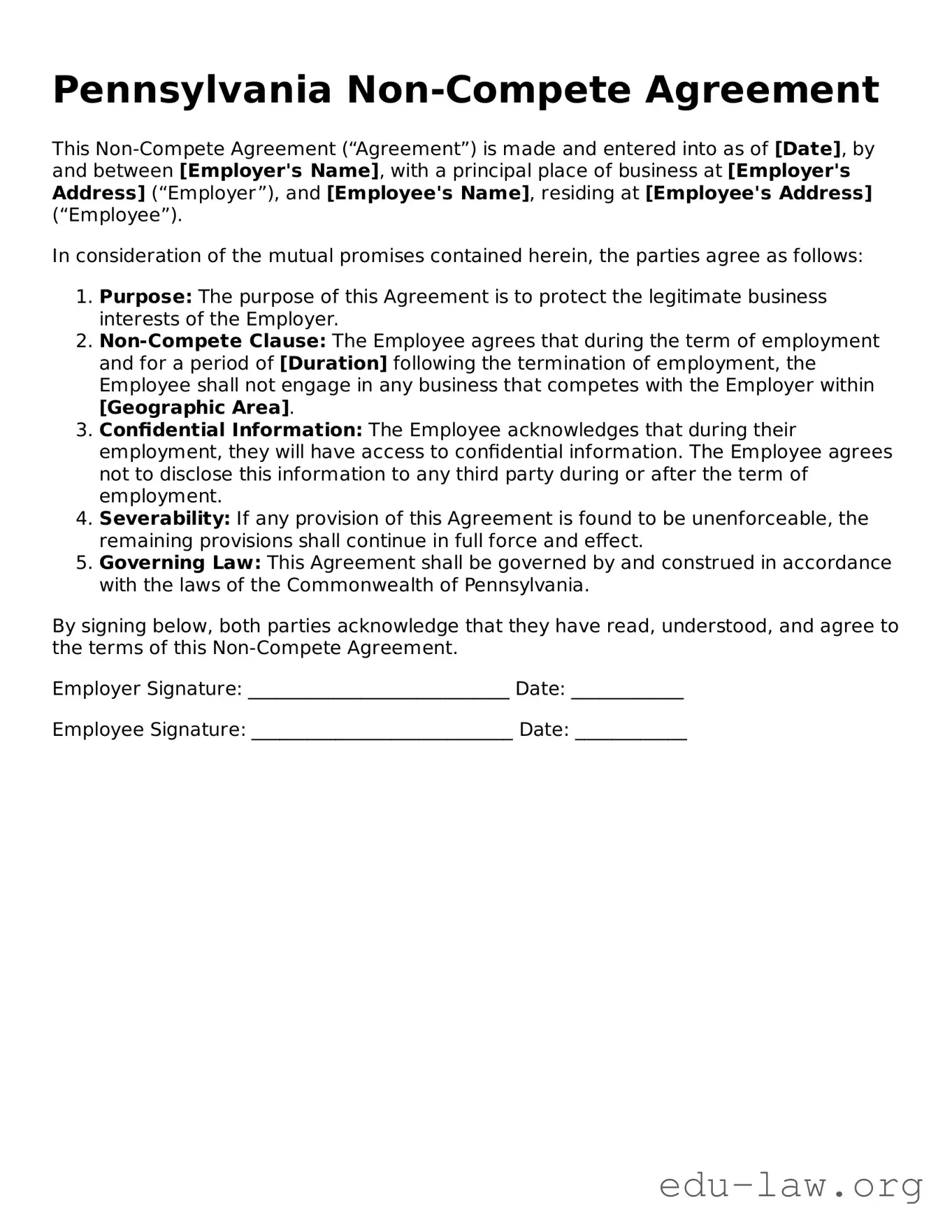
The Pennsylvania Non-compete Agreement form serves as a critical tool for employers seeking to protect their business interests while balancing the rights of employees. This agreement outlines the conditions under which an employee agrees not to engage in competitive activities after leaving their current position. Key components typically include the duration of the non-compete period, the geographical scope in which the restrictions apply, and the specific activities that are deemed competitive. By clearly defining these elements, the form aims to prevent potential harm to the employer's business, such as the loss of trade secrets or customer relationships, while also ensuring that employees understand their obligations. It is important for both parties to recognize that the enforceability of such agreements can vary, depending on factors such as reasonableness and public policy considerations. Therefore, careful attention to the drafting process is essential to create a fair and effective agreement that respects the rights of all involved.
Pennsylvania Non-Compete Agreement
This Non-Compete Agreement (“Agreement”) is made and entered into as of [Date], by and between [Employer's Name], with a principal place of business at [Employer's Address] (“Employer”), and [Employee's Name], residing at [Employee's Address] (“Employee”).
In consideration of the mutual promises contained herein, the parties agree as follows:
By signing below, both parties acknowledge that they have read, understood, and agree to the terms of this Non-Compete Agreement.
Employer Signature: ____________________________ Date: ____________
Employee Signature: ____________________________ Date: ____________
| Fact Name | Description |
|---|---|
| Definition | A non-compete agreement is a contract where an employee agrees not to enter into competition with their employer for a specified time after leaving the company. |
| Governing Law | In Pennsylvania, non-compete agreements are governed by state contract law, particularly the Restatement (Second) of Contracts. |
| Enforceability | Non-compete agreements are enforceable in Pennsylvania if they are reasonable in duration, geographic scope, and the interests they protect. |
| Reasonableness Test | The courts apply a reasonableness test to determine if the restrictions imposed by the non-compete are necessary to protect legitimate business interests. |
| Duration | Typically, a duration of six months to two years is considered reasonable, but this can vary based on the specific circumstances of the employment. |
| Geographic Scope | The geographic scope must be limited to areas where the employer does business or where the employee had significant influence. |
| Consideration | For a non-compete agreement to be valid, there must be adequate consideration, such as a job offer or a promotion. |
| Employee Rights | Employees have the right to negotiate the terms of a non-compete agreement before signing, and they should seek legal advice if unsure. |
| Legal Challenges | Non-compete agreements can be challenged in court if deemed overly restrictive or if they do not protect a legitimate business interest. |
After obtaining the Pennsylvania Non-compete Agreement form, you will need to fill it out accurately. Make sure to gather all necessary information before starting. This will help ensure a smooth process.
What is a non-compete agreement in Pennsylvania?
A non-compete agreement is a legal contract between an employer and an employee. It restricts the employee from engaging in activities that compete with the employer's business for a specified period and within a certain geographical area after leaving the job. In Pennsylvania, these agreements must be reasonable in scope to be enforceable.
Are non-compete agreements enforceable in Pennsylvania?
Yes, non-compete agreements can be enforceable in Pennsylvania, but they must meet specific criteria. The agreement must protect legitimate business interests, be reasonable in duration and geographic scope, and not impose an undue hardship on the employee. Courts often examine these factors closely before deciding on enforceability.
How long can a non-compete agreement last in Pennsylvania?
The duration of a non-compete agreement in Pennsylvania varies depending on the nature of the business and the role of the employee. Generally, a duration of six months to two years is considered reasonable. However, longer periods may be scrutinized by the courts, especially if they significantly limit an employee's ability to find work.
What geographical area can a non-compete agreement cover?
The geographical scope of a non-compete agreement should be reasonable and related to the employer's business interests. For example, if a company operates primarily in Pennsylvania, it may limit the non-compete to that state or specific regions within it. Courts will evaluate whether the geographic restriction is necessary to protect the employer's business interests.
Can I negotiate the terms of a non-compete agreement?
Yes, employees can negotiate the terms of a non-compete agreement before signing. It is advisable to discuss any concerns regarding duration, geographic scope, or specific activities that are restricted. Open communication with the employer can lead to a more favorable agreement for both parties.
What happens if I violate a non-compete agreement?
If you violate a non-compete agreement, your former employer may take legal action against you. This could include seeking an injunction to prevent you from working for a competitor or pursuing damages for any losses incurred due to the violation. It is essential to understand the terms of the agreement to avoid potential legal issues.
Can a non-compete agreement be enforced against independent contractors?
Yes, non-compete agreements can also apply to independent contractors in Pennsylvania. However, the enforceability may depend on the specific circumstances of the relationship and the terms of the agreement. Courts will assess whether the agreement is reasonable and necessary to protect the business interests of the employer.
What should I do if I believe my non-compete agreement is unfair?
If you believe your non-compete agreement is unfair or overly restrictive, consider seeking legal advice. A qualified attorney can review the agreement and help you understand your rights and options. They can also assist in negotiating more favorable terms or challenging the agreement's enforceability in court.
Are there any exceptions to non-compete agreements in Pennsylvania?
Yes, certain exceptions may apply to non-compete agreements in Pennsylvania. For instance, if an employee is terminated without cause, courts may be less likely to enforce the agreement. Additionally, if the agreement is deemed overly broad or unreasonable, it may be invalidated. Each case is unique, so legal guidance is crucial for understanding specific situations.
Failing to clearly define the scope of the agreement. A vague description can lead to misunderstandings later on.
Not specifying the geographic area covered by the non-compete. This can make the agreement unenforceable.
Omitting the duration of the non-compete period. A reasonable time frame is essential for enforceability.
Neglecting to include consideration for the agreement. Without something of value exchanged, the agreement may not hold up in court.
Using overly broad language that restricts the individual’s ability to find work. Courts often reject agreements that are too restrictive.
Not having the agreement reviewed by a legal professional. Legal advice can help ensure that the document is fair and enforceable.
Forgetting to include a severability clause. This clause allows parts of the agreement to remain valid even if other parts are struck down.
Failing to consider the state laws that may affect the agreement. Different states have varying regulations regarding non-compete clauses.
Not obtaining the employee’s signature on the agreement. A signed document is crucial for enforceability.
Overlooking the importance of clarity and simplicity in language. Using complicated terms can lead to confusion and disputes.
When entering into a Pennsylvania Non-compete Agreement, several other forms and documents may also be necessary to ensure clarity and legal compliance. Understanding these documents can help both employers and employees navigate their rights and responsibilities effectively.
Being aware of these additional documents can streamline the process of drafting and executing a Pennsylvania Non-compete Agreement. Ensuring that all parties understand their rights and obligations is crucial for maintaining a positive working relationship.
The Pennsylvania Non-compete Agreement is often compared to the Non-disclosure Agreement (NDA). Both documents aim to protect sensitive information. While a non-compete restricts an employee from working with competitors after leaving a job, an NDA focuses on preventing the sharing of confidential information during and after employment. Companies use NDAs to safeguard trade secrets, client lists, and proprietary processes, ensuring that employees do not disclose this information to outsiders.
Another similar document is the Non-solicitation Agreement. This agreement prevents an employee from soliciting clients or other employees after they leave the company. Like a non-compete, it aims to protect the business’s interests. However, while a non-compete limits where an employee can work, a non-solicitation agreement restricts specific actions, such as approaching former clients for business or recruiting former colleagues.
The Employment Agreement is also closely related to the Non-compete Agreement. This document outlines the terms and conditions of employment, including job responsibilities, salary, and benefits. Many employment agreements include non-compete clauses to ensure that employees understand their obligations regarding competition after leaving the company. This integration helps clarify expectations and protects the employer’s interests from the outset of the employment relationship.
Similar to the Non-compete Agreement is the Confidentiality Agreement. This document obligates employees to keep certain information private. While non-compete agreements restrict future employment opportunities, confidentiality agreements focus on safeguarding sensitive information during the employment period and beyond. They serve to protect intellectual property and business strategies from being disclosed to competitors.
The Severance Agreement is another document that may incorporate non-compete clauses. When an employee is laid off or terminated, a severance agreement may offer compensation in exchange for the employee agreeing not to compete with the company for a certain period. This arrangement benefits both parties: the employer protects its business interests, while the employee receives financial support during their transition.
The Partnership Agreement can also bear similarities to a Non-compete Agreement, especially in business partnerships. Partners may agree not to compete with each other during the partnership and for a specified time afterward. This ensures that partners remain committed to the business and do not take clients or resources to a competing venture, thus fostering trust and collaboration within the partnership.
The Franchise Agreement often contains non-compete clauses as well. Franchisees usually agree not to operate competing businesses during the term of the franchise and for a specified time afterward. This protects the franchisor’s brand and ensures that franchisees do not undermine the business by opening similar establishments nearby. The mutual benefit is clear: franchisees gain from the brand’s established reputation while maintaining a competitive edge.
Consulting Agreements can also resemble Non-compete Agreements. These documents often include clauses that restrict consultants from working with competitors or sharing sensitive information. This ensures that the consulting firm’s proprietary knowledge and strategies remain confidential and are not leveraged by competitors. The goal is to protect the business interests of the hiring company while allowing consultants to provide valuable insights.
Lastly, the Licensing Agreement may incorporate non-compete elements. When a company licenses its products or services to another entity, it may include clauses that prevent the licensee from creating competing products. This protects the licensor's intellectual property and market share while allowing the licensee to benefit from the established brand and product offerings.
When filling out the Pennsylvania Non-compete Agreement form, it is essential to approach the task with care. Here are five things to consider doing and avoiding.
Non-compete agreements are often misunderstood, leading to confusion among employees and employers alike. Here are four common misconceptions about the Pennsylvania Non-compete Agreement form:
Many people believe that all non-compete agreements hold up in court. However, in Pennsylvania, these agreements must meet specific criteria to be enforceable. They must be reasonable in duration, geographic scope, and the type of activity they restrict. Courts may refuse to enforce agreements that are overly broad or unfairly limit an individual's ability to work.
Another common misconception is that signing a non-compete agreement prevents you from ever working in your field. In reality, these agreements typically restrict employment for a defined period and within a specific geographic area. Once the agreed-upon time has elapsed, individuals are free to pursue employment opportunities in their field.
Some individuals think that non-compete agreements only apply to executives or highly specialized roles. In Pennsylvania, however, non-compete agreements can be applied to employees at various levels. Even entry-level positions may include these agreements, especially if the employee has access to sensitive company information.
Many employees assume that the terms of a non-compete agreement are set in stone. This is not the case. Employees have the right to negotiate the terms before signing. It is advisable to seek clarification on any points that seem unreasonable and to discuss potential modifications with the employer.
When considering a Non-compete Agreement in Pennsylvania, it’s important to understand the key aspects of filling out and using the form effectively. Here are some essential takeaways to keep in mind:
By keeping these points in mind, you can navigate the Non-compete Agreement process more effectively and protect your interests while respecting the rights of employees.