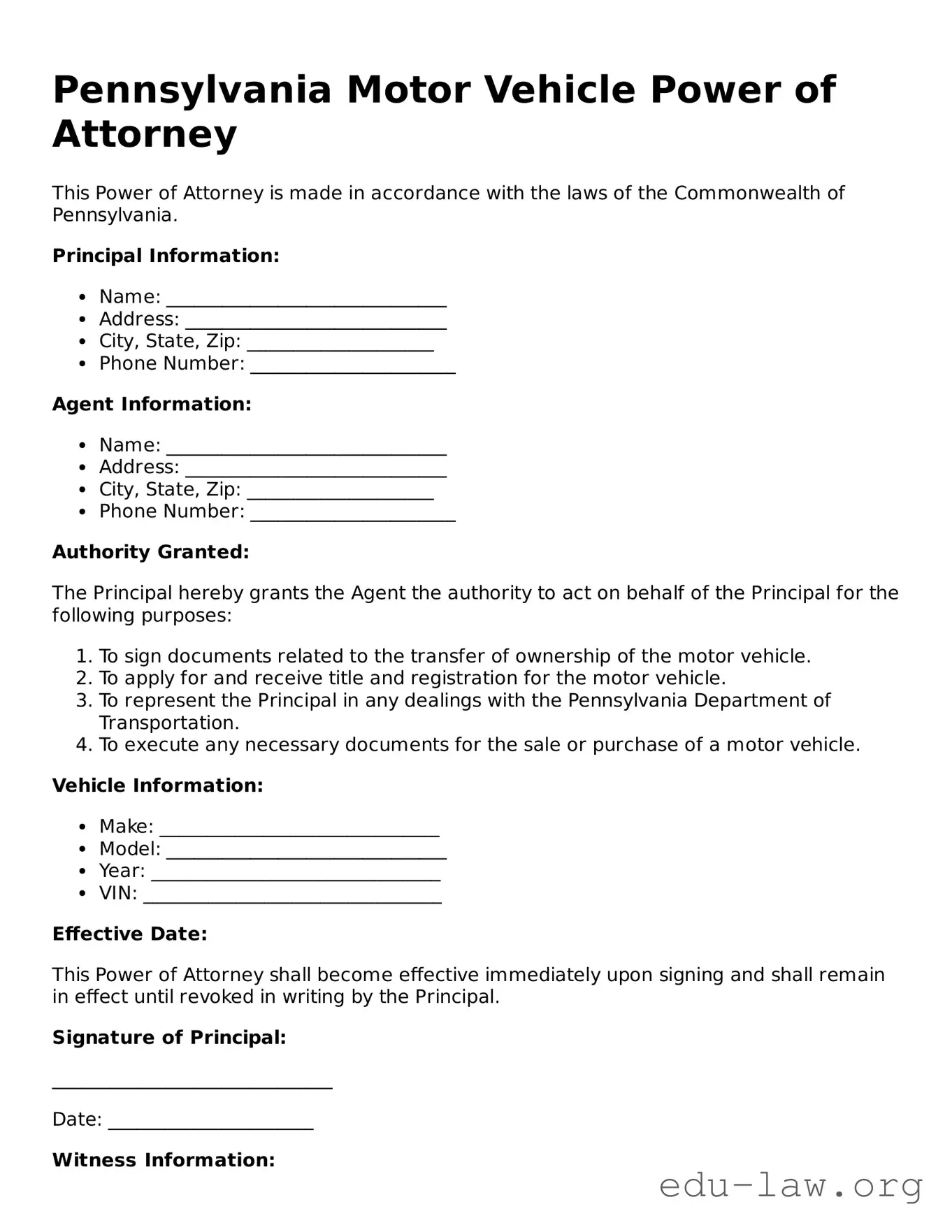
In Pennsylvania, the Motor Vehicle Power of Attorney form serves as a vital tool for individuals who wish to delegate authority regarding their motor vehicle matters to another person. This form allows a designated agent to handle various tasks on behalf of the vehicle owner, including the ability to sign documents related to the sale, transfer, or registration of a vehicle. It is particularly useful in situations where the owner may be unable to attend to these matters personally due to distance, health issues, or other commitments. By completing this form, the vehicle owner can ensure that their interests are protected while providing a trusted individual with the necessary legal authority to act on their behalf. Additionally, the form must be properly executed, including signatures from both the owner and the agent, to ensure its validity. Understanding the nuances of this form can help individuals navigate the often complex world of vehicle ownership and transactions with greater ease and confidence.
Pennsylvania Motor Vehicle Power of Attorney
This Power of Attorney is made in accordance with the laws of the Commonwealth of Pennsylvania.
Principal Information:
Agent Information:
Authority Granted:
The Principal hereby grants the Agent the authority to act on behalf of the Principal for the following purposes:
Vehicle Information:
Effective Date:
This Power of Attorney shall become effective immediately upon signing and shall remain in effect until revoked in writing by the Principal.
Signature of Principal:
______________________________
Date: ______________________
Witness Information:
Signature of Witness: ____________________________
Name of Witness: _________________________________
Date: _________________________________________
| Fact Name | Details |
|---|---|
| Purpose | The Pennsylvania Motor Vehicle Power of Attorney form allows an individual to authorize another person to act on their behalf regarding vehicle-related matters. |
| Governing Law | This form is governed by the Pennsylvania Vehicle Code, specifically Title 75 of the Pennsylvania Consolidated Statutes. |
| Usage | This form is commonly used for tasks such as transferring vehicle ownership, registering vehicles, and handling title issues. |
| Requirements | The form must be signed by the principal and notarized to be valid. It is important to ensure all information is accurate before submission. |
Filling out the Pennsylvania Motor Vehicle Power of Attorney form is a straightforward process that allows you to designate someone to handle vehicle-related matters on your behalf. Once the form is completed, it should be signed and submitted to the appropriate authority to ensure your designated agent can act in your stead.
What is a Pennsylvania Motor Vehicle Power of Attorney form?
The Pennsylvania Motor Vehicle Power of Attorney form is a legal document that allows an individual to designate another person to act on their behalf regarding motor vehicle transactions. This includes activities such as transferring vehicle ownership, registering a vehicle, or obtaining a title. The person granting the authority is referred to as the "principal," while the person receiving the authority is the "agent." This form is particularly useful when the principal cannot be present to complete these transactions themselves.
Who can be appointed as an agent in this form?
Any competent adult can be appointed as an agent in the Pennsylvania Motor Vehicle Power of Attorney form. This includes family members, friends, or professionals. It is important to choose someone trustworthy, as they will have the authority to make decisions and take actions regarding your vehicle on your behalf.
How do I complete the Motor Vehicle Power of Attorney form?
To complete the form, you need to provide basic information about yourself as the principal, including your name, address, and vehicle details. You must also fill in the agent's information. After completing the form, both you and the agent should sign it. It is advisable to have the signatures notarized to ensure the document is legally binding and recognized by the Pennsylvania Department of Transportation.
Is there a specific format for the Motor Vehicle Power of Attorney form?
Yes, the Pennsylvania Department of Transportation provides a specific format for the Motor Vehicle Power of Attorney form. It is essential to use this approved version to ensure that the document meets all legal requirements. You can typically find the form on the Pennsylvania Department of Transportation’s website or at local DMV offices.
Does the Motor Vehicle Power of Attorney need to be notarized?
While notarization is not strictly required, it is highly recommended. Notarizing the form adds an extra layer of legitimacy and can help prevent disputes regarding the authority granted. If the form is not notarized, some institutions may question its validity, which could delay or complicate transactions.
Can I revoke the Motor Vehicle Power of Attorney once it is signed?
Yes, you can revoke the Motor Vehicle Power of Attorney at any time as long as you are competent to do so. To revoke it, you should create a written notice stating your intention to revoke the authority granted to the agent. It is advisable to notify the agent and any relevant parties, such as the Pennsylvania Department of Transportation, to avoid any confusion regarding your vehicle transactions.
Not Identifying the Principal Clearly: The principal is the person granting authority. Failing to provide their full name and address can lead to confusion and potential legal issues.
Missing Signature: The form must be signed by the principal. Omitting this crucial step invalidates the document and the authority it is meant to convey.
Not Specifying the Agent: The agent is the individual authorized to act on behalf of the principal. If their name and contact information are not clearly stated, it can create problems when trying to execute the powers granted.
Failing to Define Powers Clearly: The form allows for specific powers to be granted. Vague language can lead to misunderstandings about what the agent is allowed to do, potentially resulting in unauthorized actions.
Ignoring Notarization Requirements: Depending on the situation, notarization may be required. Not having the document notarized can render it ineffective in certain circumstances.
Not Keeping Copies: After completing the form, it's essential to keep copies. Failing to do so can complicate matters if the original is lost or if disputes arise regarding the authority granted.
When dealing with vehicle transactions in Pennsylvania, the Motor Vehicle Power of Attorney form is often accompanied by several other important documents. These forms help ensure that all legal aspects of vehicle ownership and transfer are properly managed. Below are some commonly used documents that complement the Power of Attorney.
Having these documents prepared and organized can streamline the process of transferring vehicle ownership in Pennsylvania. It is always a good idea to double-check that you have everything needed to avoid any delays or complications.
The Pennsylvania Motor Vehicle Power of Attorney form is similar to the General Power of Attorney. Both documents allow individuals to appoint someone else to act on their behalf. The General Power of Attorney is broader in scope and can cover various financial and legal matters, while the Motor Vehicle Power of Attorney specifically pertains to vehicle-related transactions. This makes the latter more specialized, focusing solely on matters like title transfers and registration for motor vehicles.
Another document comparable to the Motor Vehicle Power of Attorney is the Limited Power of Attorney. Like the Motor Vehicle Power of Attorney, the Limited Power of Attorney grants specific powers to an agent, but it can cover a wider range of actions beyond just vehicle transactions. For instance, it might allow someone to manage real estate or handle financial accounts, depending on the limitations set by the principal.
The Durable Power of Attorney also shares similarities with the Motor Vehicle Power of Attorney. This document remains effective even if the principal becomes incapacitated, ensuring that the appointed agent can continue to manage the principal's affairs. While the Durable Power of Attorney can encompass a variety of legal and financial matters, the Motor Vehicle Power of Attorney is confined to vehicle-related issues, making it a more focused option.
A Vehicle Title Transfer form is another document that is closely related to the Motor Vehicle Power of Attorney. While the Motor Vehicle Power of Attorney allows someone to act on behalf of the vehicle owner, the Vehicle Title Transfer form is the actual document used to change the ownership of a vehicle. The two documents often work together, as the Power of Attorney may be necessary to complete the title transfer process.
The Bill of Sale is also relevant when discussing vehicle transactions. This document serves as proof of the sale of a vehicle and typically includes details such as the sale price and the parties involved. While the Motor Vehicle Power of Attorney authorizes someone to handle the sale on behalf of the owner, the Bill of Sale formalizes the transaction itself, making both documents essential in the vehicle selling process.
Another similar document is the Registration Application for a Vehicle. This form is used to register a vehicle with the state and often requires the signature of the owner. The Motor Vehicle Power of Attorney can be utilized to authorize another person to complete this application on behalf of the vehicle owner, streamlining the registration process when the owner cannot be present.
Finally, the Release of Liability form is relevant in the context of vehicle transactions. This document protects the seller from future liabilities associated with the vehicle after it has been sold. While the Motor Vehicle Power of Attorney facilitates the sale and transfer of ownership, the Release of Liability ensures that the seller is no longer responsible for the vehicle once the transaction is complete, providing peace of mind to both parties involved.
When filling out the Pennsylvania Motor Vehicle Power of Attorney form, it is essential to follow specific guidelines to ensure accuracy and compliance. Here is a list of things you should and shouldn't do:
The Pennsylvania Motor Vehicle Power of Attorney form is a useful tool, but several misconceptions surround it. Understanding these can help individuals navigate the process more effectively.
This is incorrect. While many people use the form to authorize someone to sell a vehicle on their behalf, it can also be used for other purposes, such as transferring ownership, registering a vehicle, or handling title issues.
In reality, anyone can fill out the Motor Vehicle Power of Attorney form. You do not need a lawyer, but it is important to ensure that all information is accurate and complete.
While notarization can add an extra layer of legitimacy, it is not a requirement for the form to be valid in Pennsylvania. However, having it notarized can help avoid disputes later on.
This is false. The person who grants the Power of Attorney can revoke it at any time, as long as they are mentally competent. A written revocation should be provided to the agent and any relevant parties.
This is not true. You can designate multiple agents to act on your behalf. However, it is essential to clarify whether they can act independently or if they must act together.
This misconception is misleading. Businesses can also use the Motor Vehicle Power of Attorney form to authorize an individual to act on their behalf regarding vehicle transactions.
When filling out and using the Pennsylvania Motor Vehicle Power of Attorney form, consider the following key takeaways: