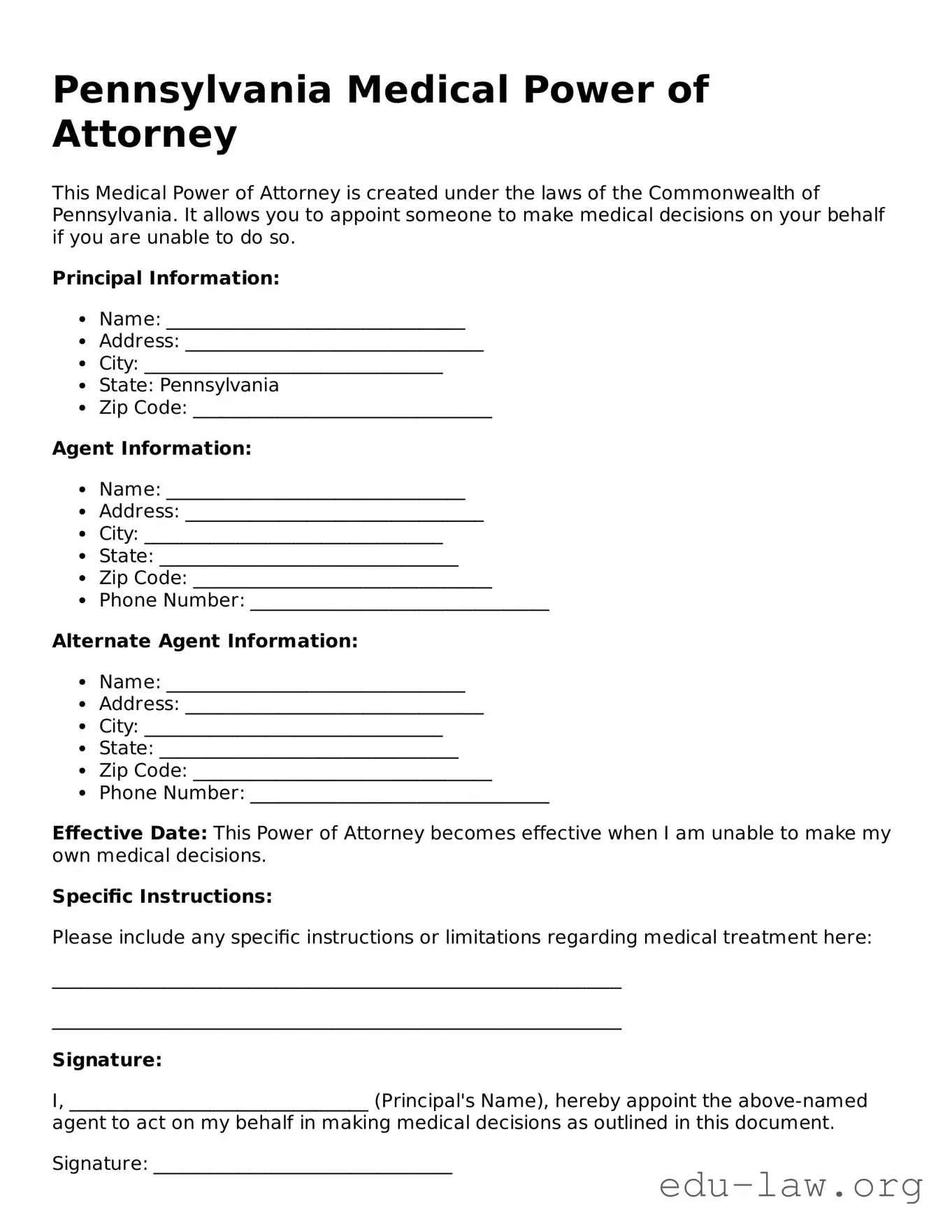
In Pennsylvania, the Medical Power of Attorney form serves as a crucial document that empowers individuals to make healthcare decisions on behalf of another person when they are unable to do so themselves. This legal tool is designed to ensure that a person's medical preferences are respected, even if they cannot communicate them due to illness or incapacity. By appointing a trusted individual, often referred to as a healthcare agent or proxy, the form provides clarity in situations where critical medical choices must be made. The document outlines the scope of authority granted to the agent, which can include decisions about treatments, surgeries, and end-of-life care. Importantly, the Pennsylvania Medical Power of Attorney also allows individuals to specify their wishes regarding organ donation and other medical interventions, ensuring that their values and preferences guide their care. Understanding the nuances of this form is essential for anyone looking to safeguard their health decisions and ensure that their voice is heard in times of medical crisis.
Pennsylvania Medical Power of Attorney
This Medical Power of Attorney is created under the laws of the Commonwealth of Pennsylvania. It allows you to appoint someone to make medical decisions on your behalf if you are unable to do so.
Principal Information:
Agent Information:
Alternate Agent Information:
Effective Date: This Power of Attorney becomes effective when I am unable to make my own medical decisions.
Specific Instructions:
Please include any specific instructions or limitations regarding medical treatment here:
_____________________________________________________________
_____________________________________________________________
Signature:
I, ________________________________ (Principal's Name), hereby appoint the above-named agent to act on my behalf in making medical decisions as outlined in this document.
Signature: ________________________________
Date: ________________________________
Witnesses:
Notarization:
State of Pennsylvania
County of ________________________________
Subscribed and sworn to before me this _____ day of ____________, 20__.
Notary Public: ________________________________
My Commission Expires: ________________________________
| Fact Name | Description |
|---|---|
| Definition | The Pennsylvania Medical Power of Attorney form allows an individual to appoint someone else to make healthcare decisions on their behalf if they become unable to do so. |
| Governing Law | This form is governed by the Pennsylvania Consolidated Statutes, specifically Title 20, Chapter 54, which outlines the laws regarding health care decisions and powers of attorney. |
| Requirements | The form must be signed by the principal (the person granting authority) and witnessed by two individuals who are not related to the principal or named in the document. |
| Revocation | The Pennsylvania Medical Power of Attorney can be revoked at any time by the principal, provided they communicate their intent clearly, either verbally or in writing. |
Filling out the Pennsylvania Medical Power of Attorney form is a straightforward process that requires careful attention to detail. Once completed, the form will allow you to designate someone to make medical decisions on your behalf in the event that you become unable to do so.
What is a Pennsylvania Medical Power of Attorney?
A Pennsylvania Medical Power of Attorney is a legal document that allows an individual, known as the principal, to designate another person, referred to as the agent, to make medical decisions on their behalf in the event they become incapacitated. This document empowers the agent to communicate with healthcare providers and make choices regarding medical treatment, ensuring that the principal's wishes are honored even when they cannot express them directly.
Who can serve as an agent in a Medical Power of Attorney?
In Pennsylvania, any competent adult can serve as an agent. This includes family members, friends, or trusted advisors. However, it is advisable to choose someone who understands your values and preferences regarding healthcare. It is also important that the chosen agent is willing to take on this responsibility and can act in your best interests during difficult times.
How does one create a Medical Power of Attorney in Pennsylvania?
Creating a Medical Power of Attorney in Pennsylvania involves several steps. First, the principal must complete a Medical Power of Attorney form, which can often be found online or obtained through legal resources. The form must be signed by the principal and witnessed by two individuals who are not related to the principal or the agent. Alternatively, the document can be notarized. Once completed, the principal should provide copies to their healthcare providers and the designated agent.
Can a Medical Power of Attorney be revoked?
Yes, a Medical Power of Attorney can be revoked at any time as long as the principal is mentally competent. To revoke the document, the principal should create a written notice stating their intent to revoke the Medical Power of Attorney. This notice should be signed and dated, and it is advisable to inform the previously designated agent and any healthcare providers of the revocation to avoid confusion.
What happens if there is no Medical Power of Attorney in place?
If an individual becomes incapacitated without a Medical Power of Attorney, medical decisions may be made by family members or, in some cases, by the court. This can lead to disagreements among family members regarding treatment options, potentially delaying necessary medical care. Having a Medical Power of Attorney in place ensures that your wishes are known and respected, providing clarity during challenging times.
Is a Medical Power of Attorney the same as a Living Will?
No, a Medical Power of Attorney and a Living Will serve different purposes. A Medical Power of Attorney designates someone to make healthcare decisions on your behalf, while a Living Will outlines your preferences for medical treatment in specific situations, such as terminal illness or irreversible coma. Both documents can work together to ensure that your healthcare wishes are honored, but they are distinct legal instruments.
Can I update my Medical Power of Attorney once it is established?
Absolutely. You can update or change your Medical Power of Attorney at any time, provided you are mentally competent. If you wish to make changes, it is best to create a new Medical Power of Attorney document that explicitly states the updates. Be sure to inform your agent and healthcare providers of the changes to ensure that your most current wishes are followed.
Failing to designate a specific agent. Many individuals overlook the importance of naming a trusted person to make medical decisions on their behalf. Without a clear designation, it can lead to confusion and potential disputes among family members.
Not discussing wishes with the chosen agent. It is crucial to have an open conversation about healthcare preferences. Without this discussion, the agent may make decisions that do not align with the individual’s values or desires.
Neglecting to sign and date the form. A common mistake is to complete the document but forget to provide a signature or date. This oversight can render the form invalid.
Not having witnesses or a notary present. Pennsylvania law requires that the Medical Power of Attorney be signed in the presence of either two witnesses or a notary. Failing to meet this requirement can invalidate the document.
Using outdated forms. Individuals sometimes use older versions of the Medical Power of Attorney form that may not comply with current legal standards. It is important to use the most recent version to ensure validity.
Overlooking the importance of backup agents. Some people only name one agent without considering a backup. If the primary agent is unavailable or unable to act, this can create complications.
Ignoring state-specific requirements. Each state has unique regulations regarding Medical Power of Attorney forms. Not adhering to Pennsylvania's specific requirements can lead to legal issues.
When preparing a Pennsylvania Medical Power of Attorney form, it is often beneficial to consider additional documents that can complement it. These documents can help ensure that your healthcare wishes are respected and provide clarity regarding your overall estate planning. Below is a list of common forms that are frequently used alongside the Medical Power of Attorney.
Considering these documents along with the Pennsylvania Medical Power of Attorney can provide a comprehensive approach to your healthcare and financial planning. Each document serves a unique purpose and can help protect your interests in various situations.
The Pennsylvania Medical Power of Attorney form is similar to a general Power of Attorney (POA) document. Both documents allow individuals to appoint someone else to make decisions on their behalf. However, while a general POA can cover a wide range of decisions, including financial and legal matters, the Medical Power of Attorney specifically focuses on health care decisions. This means that the appointed agent can make choices regarding medical treatment, end-of-life care, and other health-related issues when the principal is unable to do so.
A Living Will is another document that shares similarities with the Pennsylvania Medical Power of Attorney. Both are part of advance care planning and address health care preferences. However, a Living Will specifically outlines an individual's wishes regarding medical treatment in situations where they cannot communicate their desires, such as terminal illness or irreversible coma. In contrast, the Medical Power of Attorney designates a person to make those decisions, providing flexibility in responding to unexpected medical situations.
The Advance Directive is also akin to the Medical Power of Attorney. An Advance Directive encompasses both a Living Will and a Medical Power of Attorney, serving as a comprehensive document that guides health care decisions. This means it can include specific instructions about medical treatment preferences as well as appointing an agent to make decisions. This dual approach ensures that an individual’s wishes are respected while also having someone available to act on their behalf if needed.
Finally, the Do Not Resuscitate (DNR) order can be considered similar in purpose to the Medical Power of Attorney. A DNR order specifies a person's wishes regarding resuscitation efforts in the event of cardiac arrest. While the Medical Power of Attorney allows for broader decision-making in health care, a DNR focuses specifically on one critical aspect of medical care. Both documents are essential for ensuring that an individual’s preferences regarding medical treatment are respected, especially in critical situations.
When filling out the Pennsylvania Medical Power of Attorney form, it is essential to follow specific guidelines to ensure the document is valid and effective. Below is a list of do's and don'ts to consider:
Many individuals have misunderstandings about the Pennsylvania Medical Power of Attorney (MPOA) form. Here are five common misconceptions:
Misconception 1: The MPOA only applies when a person is terminally ill.
This is not true. The MPOA can be activated if a person is unable to make their own medical decisions, regardless of their illness's severity.
Misconception 2: A spouse automatically has the authority to make medical decisions.
While spouses often have strong legal rights, they do not automatically have the authority unless designated by an MPOA. It’s essential to complete the form to ensure your wishes are honored.
Misconception 3: The MPOA is only necessary for older adults.
Anyone, regardless of age, can benefit from having an MPOA. Accidents or sudden health issues can happen at any age, making it wise to have this document in place.
Misconception 4: Once signed, the MPOA cannot be changed.
This is incorrect. Individuals can revoke or update their MPOA at any time, as long as they are mentally competent. Regular reviews of the document are recommended.
Misconception 5: The MPOA is the same as a living will.
While both documents deal with medical decisions, they serve different purposes. The MPOA designates someone to make decisions on your behalf, while a living will outlines specific wishes regarding end-of-life care.
Filling out and using the Pennsylvania Medical Power of Attorney form can be straightforward if you keep a few essential points in mind. Here are nine key takeaways:
By keeping these takeaways in mind, you can ensure that your Medical Power of Attorney form serves your needs effectively and respects your healthcare preferences.