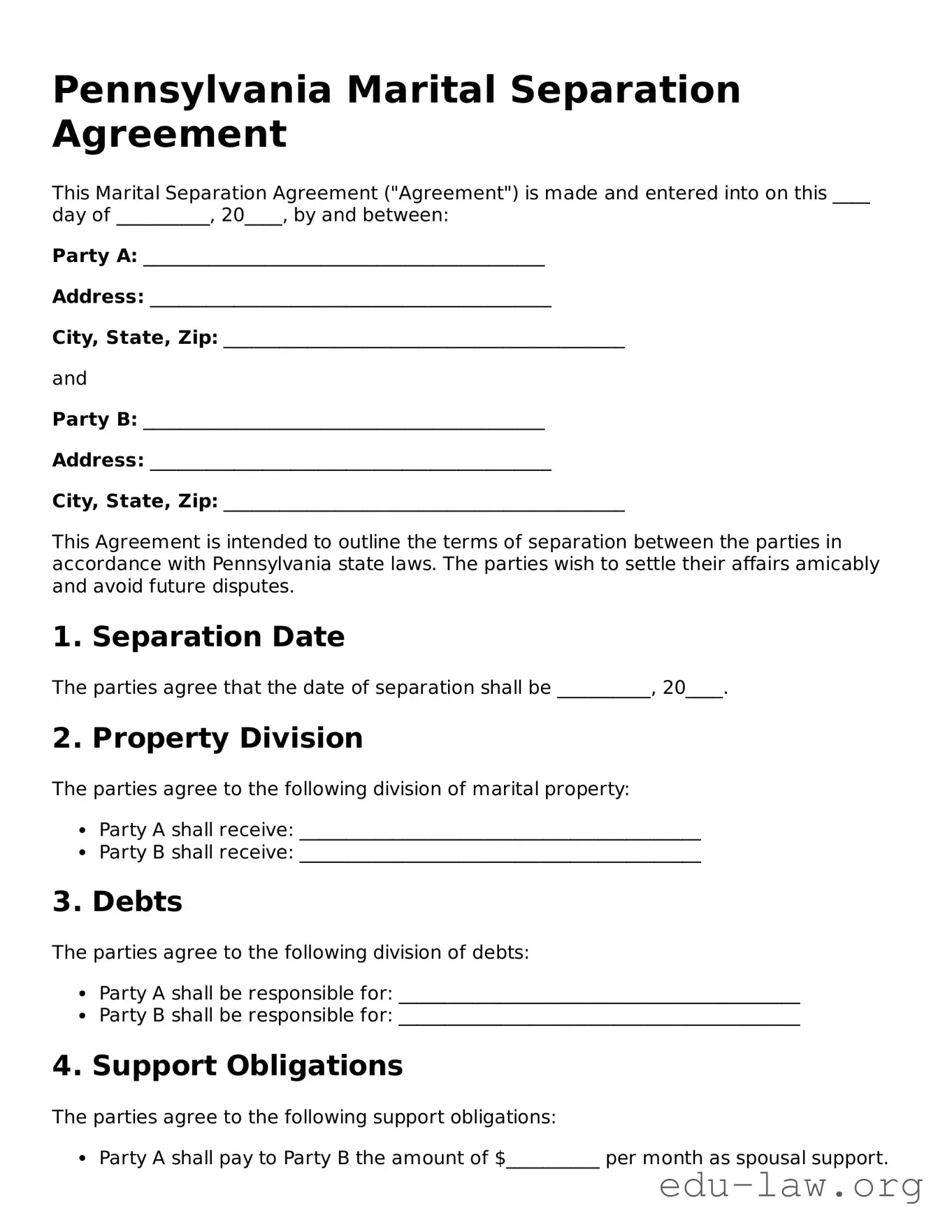
In the state of Pennsylvania, couples considering separation often find it beneficial to create a Marital Separation Agreement. This important document serves as a framework for addressing various aspects of a couple's relationship during the period of separation. It typically outlines the division of assets and debts, establishes child custody arrangements, and determines spousal support, among other considerations. By clearly delineating the responsibilities and rights of each party, the agreement aims to reduce conflict and provide clarity during a challenging time. It is essential for both parties to fully understand the implications of the terms they agree to, as this document can have lasting effects on their lives and the lives of their children. Crafting a comprehensive and fair agreement can pave the way for a smoother transition and help maintain a cooperative relationship moving forward.
Pennsylvania Marital Separation Agreement
This Marital Separation Agreement ("Agreement") is made and entered into on this ____ day of __________, 20____, by and between:
Party A: ___________________________________________
Address: ___________________________________________
City, State, Zip: ___________________________________________
and
Party B: ___________________________________________
Address: ___________________________________________
City, State, Zip: ___________________________________________
This Agreement is intended to outline the terms of separation between the parties in accordance with Pennsylvania state laws. The parties wish to settle their affairs amicably and avoid future disputes.
1. Separation Date
The parties agree that the date of separation shall be __________, 20____.
2. Property Division
The parties agree to the following division of marital property:
3. Debts
The parties agree to the following division of debts:
4. Support Obligations
The parties agree to the following support obligations:
5. Custody and Visitation
If applicable, the parties agree to the following terms regarding child custody and visitation:
6. General Provisions
This Agreement represents the entire understanding between the parties. It may only be amended in writing and signed by both parties. Each party acknowledges that they have had the opportunity to consult with legal counsel before signing this Agreement.
IN WITNESS WHEREOF, the parties have executed this Marital Separation Agreement as of the date first above written.
Party A Signature: ___________________________ Date: ____________
Party B Signature: ___________________________ Date: ____________
Witness Signature: ___________________________ Date: ____________
| Fact Name | Details |
|---|---|
| Definition | A Pennsylvania Marital Separation Agreement is a legal document that outlines the terms agreed upon by spouses who wish to live separately while remaining legally married. |
| Governing Law | This agreement is governed by the laws of the Commonwealth of Pennsylvania, specifically under Title 23 of the Pennsylvania Consolidated Statutes. |
| Purpose | The primary purpose of this agreement is to clarify the rights and responsibilities of each spouse during the separation period. |
| Key Components | Typical components include division of property, child custody arrangements, child support, and spousal support. |
| Enforceability | Once signed by both parties, the agreement is generally enforceable in court, provided it meets legal requirements. |
| Modification | The agreement can be modified if both parties consent to the changes in writing. |
| Legal Advice | It is advisable for each spouse to seek independent legal advice before signing the agreement to ensure their rights are protected. |
Filling out the Pennsylvania Marital Separation Agreement form is a critical step in the process of formalizing a separation. This document outlines the terms agreed upon by both parties regarding various aspects of their relationship, including property division, child custody, and support obligations. Once completed, this form serves as a foundation for further legal proceedings and can help clarify expectations moving forward.
What is a Pennsylvania Marital Separation Agreement?
A Pennsylvania Marital Separation Agreement is a legal document that outlines the terms and conditions under which a couple agrees to live separately while still being legally married. This agreement typically covers various aspects such as the division of assets, debts, child custody, and support arrangements. It serves as a clear framework to help both parties navigate their separation amicably and can be beneficial if divorce proceedings follow later.
Do both parties need to sign the agreement?
Yes, both parties must sign the Marital Separation Agreement for it to be legally binding. This ensures that both individuals are in agreement with the terms outlined in the document. It's important to discuss and negotiate the terms together before signing, as this will help prevent misunderstandings and disputes in the future.
Is the Marital Separation Agreement enforceable in court?
Yes, once signed, the Marital Separation Agreement is enforceable in court. If one party fails to comply with the terms of the agreement, the other party can seek legal recourse. Courts generally uphold these agreements as long as they are fair and both parties entered into them voluntarily and without coercion.
Can the terms of the agreement be modified later?
Yes, the terms of a Marital Separation Agreement can be modified if both parties agree to the changes. It is advisable to document any modifications in writing and have both parties sign the amended agreement. This helps maintain clarity and ensures that everyone is on the same page regarding the updated terms.
What happens if we reconcile after signing the agreement?
If you and your spouse reconcile after signing the Marital Separation Agreement, you can choose to revoke the agreement. It is recommended to create a new document that outlines your current arrangement, reflecting your decision to continue the marriage. This ensures that both parties have a clear understanding of their relationship moving forward.
Do I need a lawyer to draft the agreement?
While it is not legally required to have a lawyer draft the Marital Separation Agreement, it is highly recommended. A lawyer can help ensure that the agreement complies with Pennsylvania laws and adequately protects your rights. Having professional guidance can make the process smoother and provide peace of mind for both parties.
Neglecting to Include Complete Personal Information: Individuals often forget to provide full names, addresses, and other identifying details. This omission can lead to confusion or delays in processing the agreement.
Failing to Specify Property Division: Many people overlook the importance of clearly detailing how property will be divided. Without explicit terms, disputes may arise later.
Ignoring Debt Responsibilities: It is common for individuals to forget to address how debts will be handled. Leaving this out can result in one party being unfairly burdened.
Omitting Child Custody Arrangements: Parents sometimes neglect to specify custody and visitation rights. This can lead to misunderstandings and conflicts regarding the children’s living arrangements.
Not Including Child Support Details: Failing to outline child support obligations can create financial uncertainty. It is essential to agree on amounts and payment schedules.
Using Vague Language: Individuals may use ambiguous terms that can be interpreted in multiple ways. Clarity is crucial to avoid future disputes.
Forgetting to Review the Agreement: Some people rush through the process and do not take the time to review the agreement thoroughly. This can lead to overlooking critical details.
Neglecting to Seek Legal Advice: Many individuals fill out the form without consulting a legal professional. This mistake can result in misunderstandings of rights and obligations.
The Pennsylvania Marital Separation Agreement form is a crucial document for couples who wish to formalize their separation. Alongside this agreement, several other forms and documents may be necessary to ensure that all aspects of the separation are addressed comprehensively. Below is a list of additional documents that are often used in conjunction with the Marital Separation Agreement.
Each of these documents plays a vital role in ensuring that the separation process is clear and organized. They help protect the interests of both parties and provide a framework for future interactions, especially when children are involved. It is advisable to consult with a professional to ensure all necessary documents are completed accurately and appropriately.
The Pennsylvania Marital Separation Agreement is similar to a Divorce Settlement Agreement. Both documents outline the terms of the separation between spouses, including the division of assets, debts, and responsibilities regarding children. A Divorce Settlement Agreement typically becomes part of the final divorce decree, while a Marital Separation Agreement may serve as a temporary arrangement until the divorce is finalized or until the parties choose to reconcile.
Another document that shares similarities is the Child Custody Agreement. This agreement focuses specifically on the arrangements for children, detailing custody, visitation schedules, and support obligations. Like the Marital Separation Agreement, it aims to provide clarity and structure to the parties involved, ensuring that the best interests of the children are prioritized during the separation process.
The Property Settlement Agreement is also comparable. This document specifically addresses the distribution of marital property and debts between spouses. It ensures that both parties understand their rights and obligations regarding shared assets. In this sense, it functions similarly to the Marital Separation Agreement by establishing clear terms that can help prevent disputes in the future.
A Cohabitation Agreement is another related document. While typically used by unmarried couples, it outlines the rights and responsibilities of partners living together. Like a Marital Separation Agreement, it can address issues such as property division and financial obligations, providing a framework for resolving potential conflicts should the relationship end.
Lastly, a Non-Marital Separation Agreement can be considered similar. This document is used by couples who are not legally married but wish to separate their lives and finances. It covers similar topics as the Marital Separation Agreement, including asset division and support obligations, helping to ensure both parties are treated fairly during the separation process.
When filling out the Pennsylvania Marital Separation Agreement form, it’s important to approach the process carefully. Here are some dos and don’ts to keep in mind:
Misconceptions about the Pennsylvania Marital Separation Agreement can lead to confusion and misunderstandings. Here are four common misconceptions:
A marital separation agreement is not a divorce. It allows couples to live apart while outlining the terms of their separation, such as asset division and child custody. A divorce legally ends the marriage, while a separation agreement maintains the marriage but sets terms for living separately.
While a marital separation agreement can be legally binding if properly executed, it is not automatically enforceable. Both parties must agree to its terms, and it may require court approval to ensure its enforceability in the event of a dispute.
This agreement is not limited to couples with children. Any married couple can create a separation agreement to address issues such as property division, spousal support, and other financial matters, regardless of whether children are involved.
A marital separation agreement is not a permanent solution. It is a temporary arrangement that can be modified or revoked. Couples may decide to reconcile or proceed with divorce, making the separation agreement subject to change based on their circumstances.
When filling out and using the Pennsylvania Marital Separation Agreement form, consider these important points: