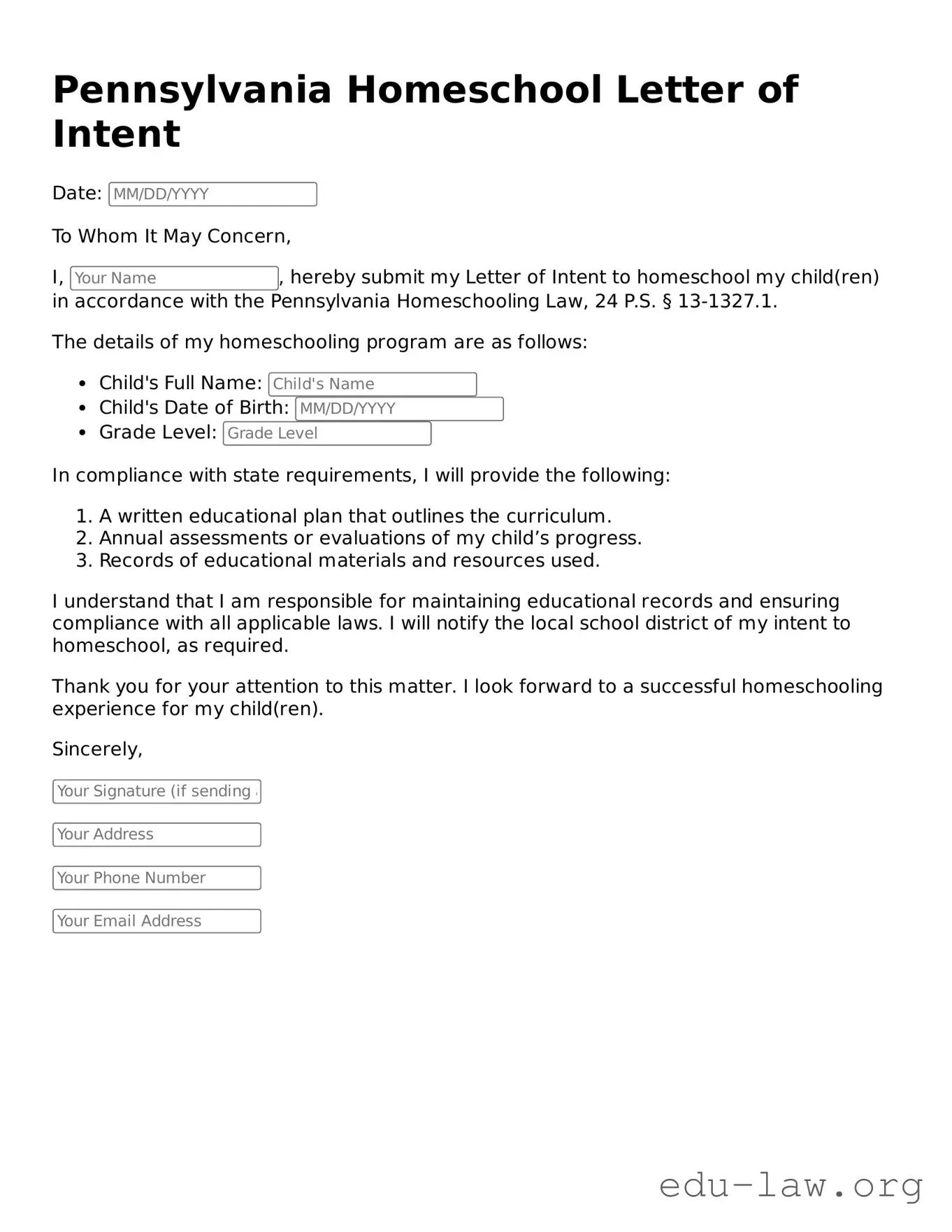
In Pennsylvania, families who choose to homeschool their children must navigate a specific set of requirements, one of which is the submission of a Homeschool Letter of Intent. This essential document serves as a formal notification to the local school district that a parent or guardian intends to educate their child at home. The form typically includes vital information such as the names and ages of the children being homeschooled, the educational objectives, and the curriculum that will be used. Additionally, it outlines the responsibilities of the parents in providing a comprehensive education that meets state standards. By completing this form, parents not only fulfill a legal obligation but also affirm their commitment to creating a tailored learning environment that aligns with their family's values and educational philosophy. Understanding the nuances of this form is crucial for those embarking on the homeschooling journey, as it sets the foundation for a successful educational experience outside the traditional classroom setting.
Pennsylvania Homeschool Letter of Intent
Date:
To Whom It May Concern,
I, , hereby submit my Letter of Intent to homeschool my child(ren) in accordance with the Pennsylvania Homeschooling Law, 24 P.S. § 13-1327.1.
The details of my homeschooling program are as follows:
In compliance with state requirements, I will provide the following:
I understand that I am responsible for maintaining educational records and ensuring compliance with all applicable laws. I will notify the local school district of my intent to homeschool, as required.
Thank you for your attention to this matter. I look forward to a successful homeschooling experience for my child(ren).
Sincerely,
| Fact Name | Description |
|---|---|
| Purpose | The Pennsylvania Homeschool Letter of Intent form notifies the local school district of a parent's decision to homeschool their child. |
| Governing Law | This form is governed by the Pennsylvania School Code, specifically under 24 P.S. § 13-1327.1. |
| Submission Deadline | The form must be submitted to the local school district by August 1st or within 30 days of beginning homeschooling. |
| Required Information | The form requires basic information such as the child's name, age, and the educational plan being followed. |
| Annual Review | Parents must provide an annual evaluation of the child's progress to the school district after submitting the form. |
| Record Keeping | It is essential for parents to keep a copy of the Letter of Intent for their records, as it serves as proof of compliance. |
After completing the Pennsylvania Homeschool Letter of Intent form, you will submit it to your local school district. They will review your submission and may reach out for any additional information. It is important to ensure that all information is accurate and complete to avoid delays in the process.
What is the Pennsylvania Homeschool Letter of Intent?
The Pennsylvania Homeschool Letter of Intent is a formal document that parents or guardians must submit to the local school district when they decide to educate their children at home. This letter serves as a notification of the intent to homeschool and outlines the educational plan for the child. It is a crucial first step in establishing a homeschooling program in Pennsylvania.
When must I submit the Letter of Intent?
The Letter of Intent must be submitted to the local school district by the beginning of the school year or within 30 days of the child beginning to be homeschooled. If a child is transferring from a public or private school to homeschooling, the letter should be submitted promptly to ensure compliance with state regulations.
What information should be included in the Letter of Intent?
The Letter of Intent should include the child’s name, age, and grade level, as well as the name of the parent or guardian. It should also indicate the educational plan, including the curriculum being used and the subjects that will be taught. While there is no specific format required, clarity and completeness are essential to avoid misunderstandings with the school district.
Is there a specific format for the Letter of Intent?
No specific format is mandated by the state, but it is recommended to keep the letter clear and concise. A simple, straightforward letter that includes all necessary information will suffice. Many families choose to use templates available online to ensure they cover all required details.
Do I need to provide additional documentation with the Letter of Intent?
Typically, the Letter of Intent does not require additional documentation at the time of submission. However, parents should be prepared to provide proof of educational progress and curriculum details during the annual evaluation process, which is a separate requirement in Pennsylvania homeschooling law.
What happens after I submit the Letter of Intent?
What if I change my mind about homeschooling?
If you decide to discontinue homeschooling, you are not required to submit any formal notification. However, it is advisable to inform the local school district, especially if the child will be enrolling in a public or private school. This helps ensure a smooth transition and compliance with any necessary enrollment procedures.
Are there any consequences for not submitting the Letter of Intent?
Failure to submit the Letter of Intent may lead to complications, such as the school district considering the child truant. This can result in legal ramifications, including the potential for fines or other penalties. Therefore, it is crucial to adhere to the state’s requirements to avoid any issues with the local education authorities.
Can I amend the Letter of Intent after submission?
If there are changes to the educational plan or if you wish to update any information, it is advisable to submit an amended Letter of Intent. While not strictly required, doing so can help maintain clear communication with the school district and ensure that all information is current and accurate.
Not providing complete information. It's essential to fill out all required fields. Leaving any section blank can lead to delays or rejection of the form.
Failing to include the correct name of the child. Make sure the child's name matches their official documents. Inaccurate names can cause confusion.
Omitting the date of birth. This detail is crucial for identification. Ensure the date is correct and formatted properly.
Not signing the form. A signature is necessary to validate the intent to homeschool. Double-check that you have signed before submitting.
When families decide to homeschool in Pennsylvania, they often need to complete several forms and documents alongside the Homeschool Letter of Intent. These additional documents help ensure compliance with state regulations and provide a clear educational framework. Here’s a brief overview of the most commonly used forms.
By preparing these documents alongside the Homeschool Letter of Intent, families can create a structured and compliant homeschooling experience. Each form plays a vital role in ensuring that the educational needs of the child are met while adhering to Pennsylvania's homeschooling laws.
The Pennsylvania Homeschool Letter of Intent form shares similarities with the Notice of Intent to Homeschool form used in other states. Both documents serve as official notifications to the relevant educational authorities that a parent or guardian intends to educate their child at home. They typically require basic information about the student, the parent, and the educational approach planned for the year. Just as in Pennsylvania, many states require this notice to be submitted before the school year begins, ensuring that the educational system is aware of students who will not be attending traditional public or private schools.
Another document that resembles the Homeschool Letter of Intent is the Individualized Education Program (IEP). While an IEP is specifically designed for students with special needs, both documents outline a tailored educational approach. The IEP details specific goals, accommodations, and services that a child will receive, similar to how the Homeschool Letter of Intent may outline the curriculum and educational philosophy. Both documents are critical in ensuring that the educational needs of the child are met, albeit in different contexts.
The Affidavit of Homeschooling is another document that is often associated with the Homeschool Letter of Intent. This affidavit is a sworn statement provided by parents, affirming their commitment to homeschool their children. Like the Letter of Intent, it typically includes information about the child and the educational plan. In some states, submitting an affidavit may be a requirement following the submission of the Letter of Intent, reinforcing the legal basis for homeschooling.
In addition, the Enrollment Withdrawal Form is similar in purpose to the Homeschool Letter of Intent. When parents decide to homeschool, they often need to formally withdraw their child from a public or private school. This form notifies the school of the withdrawal and provides a clear record of the transition from traditional education to homeschooling. Both documents serve to establish the educational status of the child, ensuring that there is no confusion regarding their schooling situation.
Lastly, the Curriculum Plan is akin to the Homeschool Letter of Intent in that it outlines the educational path a family intends to take for their child. This plan details the subjects to be taught, the materials to be used, and the methods of instruction. While the Letter of Intent serves as a notification to authorities, the Curriculum Plan acts as a guide for parents, helping them stay organized and focused on their educational goals. Both documents emphasize the importance of planning in the homeschooling process.
When filling out the Pennsylvania Homeschool Letter of Intent form, it is crucial to follow certain guidelines to ensure a smooth process. Here are five things you should and shouldn't do:
By adhering to these guidelines, you can help ensure that your homeschooling journey starts off on the right foot.
Many people have misunderstandings about the Pennsylvania Homeschool Letter of Intent form. Here are ten common misconceptions, along with clarifications to help you better understand the process.
This is not true. Homeschooling is legal in Pennsylvania as long as you follow the state's guidelines.
Actually, it is required. Parents must submit this form to formally notify the school district of their intent to homeschool.
While the form should include certain information, it does not have to follow a strict format. Clarity and completeness are what matter most.
This is a misconception. You only need to register your child for homeschooling after you submit the Letter of Intent.
In Pennsylvania, parents do not need to hold a teaching degree to homeschool their children. They simply need to meet state requirements.
This is false. Many school districts allow homeschooled students to participate in extracurricular activities.
Once you submit the Letter of Intent, you do not need to resubmit it unless you change your homeschooling status or your child's educational program.
There are deadlines. Typically, you should submit the form at least a few weeks before you start homeschooling.
Homeschooling is for any family that feels it is the right choice for their child, regardless of their background or beliefs.
This is incorrect. Families can transition back to public school if they choose, following the district's policies.
Understanding these misconceptions can help you navigate the homeschooling process in Pennsylvania more effectively. Always check with your local school district for the most current information and guidance.
When considering homeschooling in Pennsylvania, filling out the Homeschool Letter of Intent form is an important step. Here are some key takeaways to keep in mind:
By following these key points, you can ensure a smoother transition into the homeschooling environment in Pennsylvania.