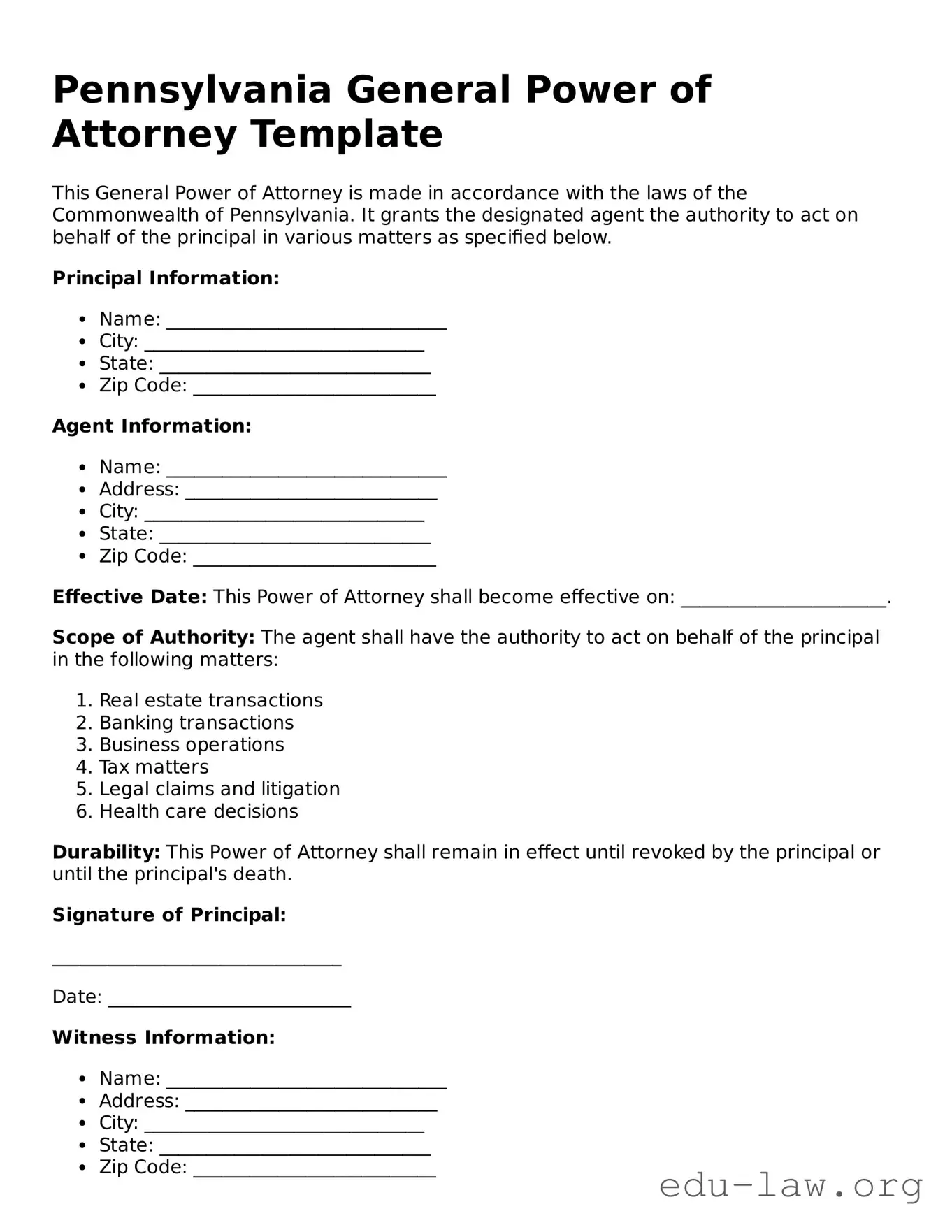
The Pennsylvania General Power of Attorney form serves as a vital legal document that allows an individual, known as the principal, to appoint another person, referred to as the agent or attorney-in-fact, to make decisions on their behalf. This form grants the agent broad authority to handle a variety of financial and legal matters, including managing bank accounts, signing checks, and making investment decisions. It is essential for individuals to understand that the powers granted can be customized to fit specific needs, whether they are limited to certain transactions or encompass a wider range of responsibilities. The General Power of Attorney can be effective immediately or set to activate upon the principal's incapacitation, ensuring that their affairs are managed seamlessly. Additionally, the form requires the signatures of both the principal and the agent, along with a witness or notary acknowledgment, to ensure its validity. Understanding these components is crucial for anyone considering this important legal tool, as it facilitates the smooth handling of personal and financial matters in times of need.
Pennsylvania General Power of Attorney Template
This General Power of Attorney is made in accordance with the laws of the Commonwealth of Pennsylvania. It grants the designated agent the authority to act on behalf of the principal in various matters as specified below.
Principal Information:
Agent Information:
Effective Date: This Power of Attorney shall become effective on: ______________________.
Scope of Authority: The agent shall have the authority to act on behalf of the principal in the following matters:
Durability: This Power of Attorney shall remain in effect until revoked by the principal or until the principal's death.
Signature of Principal:
_______________________________
Date: __________________________
Witness Information:
Signature of Witness:
_______________________________
Date: __________________________
Notarization:
State of Pennsylvania, County of _______________
Subscribed and sworn to before me this ______ day of __________, 20__.
_______________________________
Notary Public
My commission expires: ________________
| Fact Name | Description |
|---|---|
| Definition | A General Power of Attorney allows an individual to appoint someone else to manage their financial and legal affairs. |
| Governing Law | The Pennsylvania General Power of Attorney is governed by Title 20, Chapter 56 of the Pennsylvania Consolidated Statutes. |
| Agent Authority | The appointed agent can perform a wide range of tasks, such as handling bank transactions, managing real estate, and filing taxes. |
| Durability | A General Power of Attorney can be made durable, meaning it remains in effect even if the principal becomes incapacitated. |
| Revocation | The principal can revoke the power of attorney at any time, as long as they are mentally competent. |
| Execution Requirements | The form must be signed by the principal and witnessed by two individuals or notarized to be valid. |
| Limitations | Some actions, like making healthcare decisions, typically require a separate document, such as a Health Care Power of Attorney. |
| Accessibility | The form is available through various legal resources and can often be downloaded from state websites. |
After obtaining the Pennsylvania General Power of Attorney form, you will need to complete it carefully to ensure it reflects your intentions. The next steps will guide you through the process of filling out the form accurately.
Once you have filled out the form, it is important to communicate with your agent about their responsibilities and ensure they understand your wishes.
What is a General Power of Attorney in Pennsylvania?
A General Power of Attorney (GPOA) in Pennsylvania is a legal document that allows one person, known as the "principal," to grant another person, referred to as the "agent" or "attorney-in-fact," the authority to act on their behalf. This authority can encompass a wide range of decisions, including financial matters, property management, and other personal affairs. The GPOA can be tailored to meet specific needs, making it a versatile tool for individuals seeking to ensure their interests are managed when they are unable to do so themselves.
When does a General Power of Attorney become effective?
A General Power of Attorney can be effective immediately upon signing or can be set to activate at a later date or upon the occurrence of a specific event, such as the principal becoming incapacitated. This flexibility allows individuals to choose the timing that best suits their circumstances. It is essential to clearly state when the powers granted to the agent will commence to avoid any confusion later on.
Can I revoke a General Power of Attorney in Pennsylvania?
Yes, a General Power of Attorney can be revoked at any time by the principal, as long as they are mentally competent to do so. To revoke the GPOA, the principal should create a written document stating their intention to revoke the authority granted to the agent. It is advisable to notify the agent and any institutions or individuals that were relying on the original GPOA to ensure that the revocation is respected and acknowledged.
What responsibilities does an agent have under a General Power of Attorney?
The agent has a fiduciary duty to act in the best interests of the principal. This means the agent must make decisions that benefit the principal and manage their affairs with care and loyalty. The agent should keep accurate records of all transactions and decisions made on behalf of the principal. Transparency is key, as the agent may be required to provide reports or account for their actions if requested by the principal or their family members.
Is it necessary to have a lawyer to create a General Power of Attorney in Pennsylvania?
While it is not legally required to have a lawyer to create a General Power of Attorney in Pennsylvania, consulting with one can be beneficial. A legal professional can provide guidance on the specific powers to include, ensure that the document complies with state laws, and help address any unique circumstances. However, many individuals successfully create a GPOA on their own using available templates and resources, as long as they fully understand the implications of the powers they are granting.
Not specifying the powers granted: One common mistake is failing to clearly outline the specific powers being granted to the agent. It's important to detail what decisions the agent can make on your behalf.
Choosing the wrong agent: Selecting someone who may not act in your best interest can lead to complications. It’s crucial to choose a trustworthy person who understands your wishes.
Forgetting to date the document: A power of attorney form should always be dated. Without a date, it may be questioned or deemed invalid.
Not signing in front of a notary: Many states, including Pennsylvania, require the document to be notarized. Skipping this step can render the document ineffective.
Overlooking alternate agents: If your primary agent is unable to serve, having an alternate agent is wise. Failing to name one can create uncertainty about who should act on your behalf.
Neglecting to review the document periodically: Life circumstances change. Regularly reviewing and updating your power of attorney ensures it reflects your current wishes and needs.
A Pennsylvania General Power of Attorney form allows one person to grant another the authority to act on their behalf in various matters. While this form is crucial for establishing a power of attorney, several other documents often accompany it to ensure comprehensive legal coverage and clarity in decision-making. Below is a list of common forms and documents that may be used alongside the General Power of Attorney in Pennsylvania.
These documents work together to create a comprehensive framework for managing personal, financial, and medical decisions. It is important to consider each one carefully to ensure that your wishes are clearly communicated and legally recognized.
The Pennsylvania General Power of Attorney form is similar to the Durable Power of Attorney. Both documents allow an individual to appoint someone else to make decisions on their behalf. The key difference lies in durability; a Durable Power of Attorney remains effective even if the principal becomes incapacitated, while a standard General Power of Attorney may not. This means that if you want your chosen agent to act for you during times when you can’t, the Durable option is the way to go.
Another document that shares similarities is the Healthcare Power of Attorney. This form specifically focuses on medical decisions. Like the General Power of Attorney, it allows you to designate someone to make choices for you. However, the Healthcare Power of Attorney is limited to health-related matters, ensuring your agent can make decisions about your medical care when you are unable to do so.
The Living Will is also comparable, though it serves a different purpose. A Living Will outlines your wishes regarding end-of-life medical treatment. While the General Power of Attorney allows someone to make decisions for you, a Living Will communicates your preferences directly to healthcare providers. Both documents work together to ensure your wishes are respected when you cannot voice them yourself.
The Financial Power of Attorney is another related document. This form specifically grants authority over financial matters. Like the General Power of Attorney, it allows someone to manage your finances, pay bills, and handle investments. The main distinction is that the Financial Power of Attorney is tailored exclusively for financial decisions, while the General Power of Attorney can cover a broader range of responsibilities.
A Revocable Living Trust is also similar in that it allows for the management of assets. This document enables you to place your assets in a trust, which can be managed by a trustee. While a General Power of Attorney allows someone to act on your behalf, a Revocable Living Trust can help avoid probate and streamline the transfer of assets upon your passing. Both documents can work in tandem to provide comprehensive management of your affairs.
The Medical Proxy is another document that functions similarly to the Healthcare Power of Attorney. It allows you to designate someone to make healthcare decisions if you are unable to do so. While the Healthcare Power of Attorney can cover a wide range of medical decisions, a Medical Proxy is often more focused on specific medical situations. Both ensure that someone you trust will advocate for your health when you cannot.
The Advance Directive combines elements of both the Living Will and Healthcare Power of Attorney. This document provides instructions for medical care and appoints an agent to make decisions if you become incapacitated. Like the General Power of Attorney, it empowers someone to act on your behalf, but it is specifically tailored to healthcare situations, ensuring that your medical preferences are clear and respected.
Lastly, the Special Power of Attorney is a more limited version of the General Power of Attorney. This document allows you to grant specific powers to someone, such as selling a property or handling a particular financial transaction. Unlike the General Power of Attorney, which can cover a wide array of decisions, the Special Power of Attorney is focused on specific tasks, making it a useful tool for particular situations.
When filling out the Pennsylvania General Power of Attorney form, it is important to follow certain guidelines to ensure the document is valid and meets your needs. Below are ten recommendations, divided into things you should do and things you should avoid.
Things You Should Do:
Things You Shouldn't Do:
Understanding the Pennsylvania General Power of Attorney form is essential for anyone considering its use. However, several misconceptions exist regarding this legal document. Below is a list of common misunderstandings and clarifications for each.
This is not entirely accurate. While a General Power of Attorney often includes financial authority, it can also grant powers related to health care and other personal matters.
In reality, the powers granted to an agent can be limited by the principal. The principal has the ability to specify what the agent can and cannot do.
This is misleading. A General Power of Attorney can be revoked at any time by the principal, as long as they are mentally competent to do so.
This is not true. An agent can be any trusted individual, such as a family member or friend, as long as they are willing to take on the responsibility.
These terms are not interchangeable. A Durable Power of Attorney remains effective even if the principal becomes incapacitated, while a General Power of Attorney may not.
In Pennsylvania, a General Power of Attorney must be signed in front of a notary public to be legally valid.
This is a misconception. Agents have a fiduciary duty to act in the best interest of the principal and can be held accountable for any misuse of power.
This is incorrect. A will only takes effect after death, while a General Power of Attorney is used during the principal's lifetime for various decisions.
Filling out and using the Pennsylvania General Power of Attorney form is an important step in managing your financial and legal affairs. Here are some key takeaways to keep in mind: