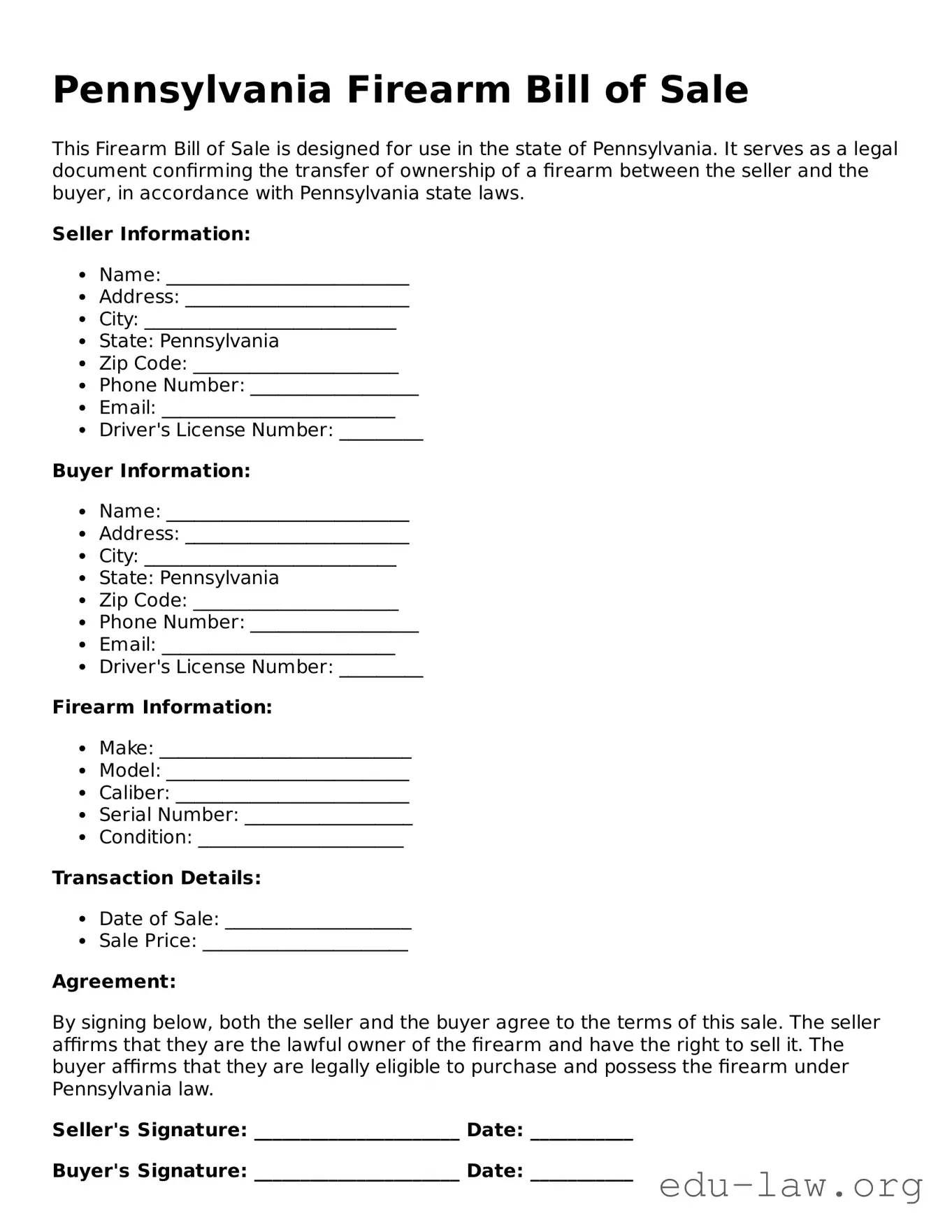
The Pennsylvania Firearm Bill of Sale form serves as a crucial document in the private sale of firearms within the state. This form is designed to provide a written record of the transaction between the buyer and the seller, ensuring both parties have a clear understanding of the terms involved. Key elements typically included in the form are the names and addresses of both the buyer and seller, a detailed description of the firearm being sold, and the sale price. Additionally, the form may require the seller to affirm that they are legally allowed to sell the firearm and that the buyer is legally permitted to purchase it. This documentation not only helps in maintaining transparency but also serves to protect both parties in the event of future disputes. Furthermore, while the form itself does not require notarization, having it signed in the presence of a witness can add an extra layer of credibility to the transaction. Understanding the importance of this form is essential for anyone engaging in the sale or purchase of firearms in Pennsylvania.
Pennsylvania Firearm Bill of Sale
This Firearm Bill of Sale is designed for use in the state of Pennsylvania. It serves as a legal document confirming the transfer of ownership of a firearm between the seller and the buyer, in accordance with Pennsylvania state laws.
Seller Information:
Buyer Information:
Firearm Information:
Transaction Details:
Agreement:
By signing below, both the seller and the buyer agree to the terms of this sale. The seller affirms that they are the lawful owner of the firearm and have the right to sell it. The buyer affirms that they are legally eligible to purchase and possess the firearm under Pennsylvania law.
Seller's Signature: ______________________ Date: ___________
Buyer's Signature: ______________________ Date: ___________
This document should be kept by both parties for their records. It is advisable to consult with a legal professional if there are any questions regarding the sale of firearms.
| Fact Name | Details |
|---|---|
| Purpose | The Pennsylvania Firearm Bill of Sale form is used to document the transfer of ownership of a firearm between private parties. |
| Governing Law | The transfer of firearms in Pennsylvania is governed by Title 18, Chapter 61 of the Pennsylvania Consolidated Statutes. |
| Requirements | Both the buyer and seller must be residents of Pennsylvania and comply with federal and state laws regarding firearm transactions. |
| Record Keeping | It is advisable for both parties to retain a copy of the completed Bill of Sale for their records, although it is not legally required. |
Filling out the Pennsylvania Firearm Bill of Sale form is a straightforward process that requires attention to detail. After completing the form, it is essential to keep a copy for your records. This documentation can be helpful for both the buyer and seller in the event of future inquiries or transactions.
What is a Firearm Bill of Sale in Pennsylvania?
A Firearm Bill of Sale is a legal document used to record the sale or transfer of a firearm between two parties. In Pennsylvania, this document serves as proof of the transaction and includes details such as the buyer and seller's names, addresses, the firearm's description, and the date of sale. While not legally required for private sales, having a bill of sale can help protect both parties in case of future disputes or legal issues.
Is a Firearm Bill of Sale required in Pennsylvania?
In Pennsylvania, a Firearm Bill of Sale is not mandatory for private sales of firearms. However, it is highly recommended. Having a written record can provide legal protection and clarity for both the buyer and seller. It helps establish ownership and can be useful if questions arise about the firearm's history or if it is involved in a crime.
What information should be included in a Firearm Bill of Sale?
A comprehensive Firearm Bill of Sale should include several key pieces of information. This includes the full names and addresses of both the buyer and seller, the date of the transaction, a detailed description of the firearm (including make, model, caliber, and serial number), and the sale price. Both parties should sign and date the document to validate the transaction.
Do I need to have the Firearm Bill of Sale notarized?
No, notarization is not required for a Firearm Bill of Sale in Pennsylvania. However, having the document notarized can add an extra layer of authenticity and security. It may also be helpful if the transaction is ever questioned or if there are disputes regarding the sale.
Can I use a Firearm Bill of Sale from another state?
While you can use a Firearm Bill of Sale from another state, it is advisable to ensure that it meets Pennsylvania's requirements. Each state may have different laws regarding firearm sales, so it’s best to use a form specifically designed for Pennsylvania. This ensures that all necessary information is included and helps avoid any potential legal issues.
Incomplete Information: Failing to fill out all required fields can lead to delays or issues with the sale. Ensure that both the seller and buyer provide their full names, addresses, and signatures.
Incorrect Dates: Entering the wrong date can cause confusion. Double-check that the date of the transaction is accurate.
Missing Signatures: Both parties must sign the form. Without signatures, the document is not valid, and the sale may not be legally recognized.
Omitting Firearm Details: Not including specific details about the firearm, such as make, model, and serial number, can lead to complications. Be thorough in describing the firearm being sold.
Not Keeping a Copy: Failing to keep a copy of the completed form for personal records can create problems later. It’s important to have documentation of the sale.
Ignoring Local Laws: Not being aware of local regulations regarding firearm sales can result in legal issues. Always check state and local laws before completing the sale.
The Pennsylvania Firearm Bill of Sale form is an important document for anyone involved in the sale or transfer of firearms in Pennsylvania. However, there are other forms and documents that are often used in conjunction with this bill of sale to ensure compliance with state laws and to provide additional information regarding the transaction. Below is a list of five commonly used documents.
Using these documents alongside the Pennsylvania Firearm Bill of Sale can help ensure a smooth and legally compliant transaction. It is always advisable to keep copies of all forms for personal records and to consult with a legal professional if there are any questions about the process.
The Pennsylvania Firearm Bill of Sale form shares similarities with a Vehicle Bill of Sale. Both documents serve as proof of transfer of ownership. In the case of a vehicle, this form includes details such as the vehicle identification number (VIN), make, model, and year, along with the seller's and buyer's information. Like the firearm bill of sale, it must be signed by both parties to validate the transaction. This ensures that the buyer has legal ownership and the seller is released from liability regarding the vehicle.
Another document akin to the Firearm Bill of Sale is the Boat Bill of Sale. This form is used when transferring ownership of a boat. It captures essential details such as the boat's hull identification number, make, model, and year. Similar to the firearm bill of sale, it requires signatures from both the seller and buyer. This document serves as a legal record of the transaction, providing proof of ownership for the buyer and protecting the seller from future claims.
The Personal Property Bill of Sale is also comparable. This document is used for the sale of various personal items, including electronics, furniture, or collectibles. It contains a description of the item, its condition, and the purchase price. Both the personal property bill of sale and the firearm bill of sale require signatures from both parties, ensuring that the transaction is documented and legally binding.
A Lease Agreement can be seen as similar in its role of documenting a transfer of rights. While it does not transfer ownership, it grants the tenant the right to use the property for a specified time. Both documents involve the parties' information, terms of the agreement, and signatures. They serve as legal evidence of the transaction, protecting the rights of both the landlord and tenant.
The Real Estate Purchase Agreement is another related document. It outlines the terms and conditions for the sale of real estate. Like the firearm bill of sale, it includes details about the parties involved, the property being sold, and the purchase price. Both documents require signatures to finalize the agreement, ensuring that both buyer and seller are committed to the transaction.
The Gift Receipt is similar in that it documents the transfer of ownership without a monetary exchange. This form is often used when someone gives a gift, such as a firearm. It includes the item description, the giver's and recipient's information, and a statement of the gift. Both the gift receipt and the firearm bill of sale serve as proof of ownership transfer, although one is a sale and the other is a gift.
Lastly, the Business Sale Agreement can be compared to the Firearm Bill of Sale. This document outlines the terms of selling a business, including assets like inventory, equipment, and intellectual property. It includes details about the buyer and seller, the purchase price, and the terms of the sale. Both agreements require signatures to be legally binding, ensuring that both parties understand and agree to the terms of the transfer.
When filling out the Pennsylvania Firearm Bill of Sale form, it is important to follow certain guidelines to ensure accuracy and compliance. Here are four things you should and shouldn't do:
Understanding the Pennsylvania Firearm Bill of Sale form can be challenging due to various misconceptions. Here are ten common misunderstandings and clarifications regarding this important document:
Many believe that a bill of sale is mandatory for every firearm transaction. However, in Pennsylvania, it is not legally required for private sales, though it is highly recommended for record-keeping purposes.
Some think that the bill of sale registers the firearm with the state. In reality, Pennsylvania does not have a firearm registration system. The bill of sale is simply a record of the transaction.
While private sales are permissible, sellers must still comply with federal and state laws regarding the sale of firearms, including ensuring the buyer is legally eligible to own a firearm.
There is a misconception that the bill of sale needs to be notarized. Notarization is not a requirement in Pennsylvania, although it may add an extra layer of authenticity.
Some people think there is a specific format that must be followed. While there are key elements that should be included, such as the buyer and seller's information and firearm details, the format is flexible.
This is incorrect. Any individual can create a bill of sale for a private firearm sale, not just licensed dealers. It’s a straightforward document that can be drafted by anyone involved in the transaction.
Even if the buyer possesses a permit to carry a firearm, having a bill of sale is still advisable. It provides proof of the transaction and can protect both parties in case of future disputes.
Some believe that the bill of sale applies to all firearms equally. While it is generally used for handguns and rifles, certain laws may apply differently to other types of firearms, such as automatic weapons.
This is a misunderstanding. A bill of sale can also be used for gifting a firearm. Documenting the transfer, even if no money changes hands, is a good practice.
Some people think that once the bill of sale is signed, it cannot be altered. In fact, if both parties agree, they can amend the document as needed, provided it reflects the truth of the transaction.
By clearing up these misconceptions, individuals can better understand the importance and function of the Pennsylvania Firearm Bill of Sale form.
When filling out and using the Pennsylvania Firearm Bill of Sale form, there are several important points to keep in mind.
Following these guidelines can help ensure a smooth transaction when buying or selling a firearm in Pennsylvania.