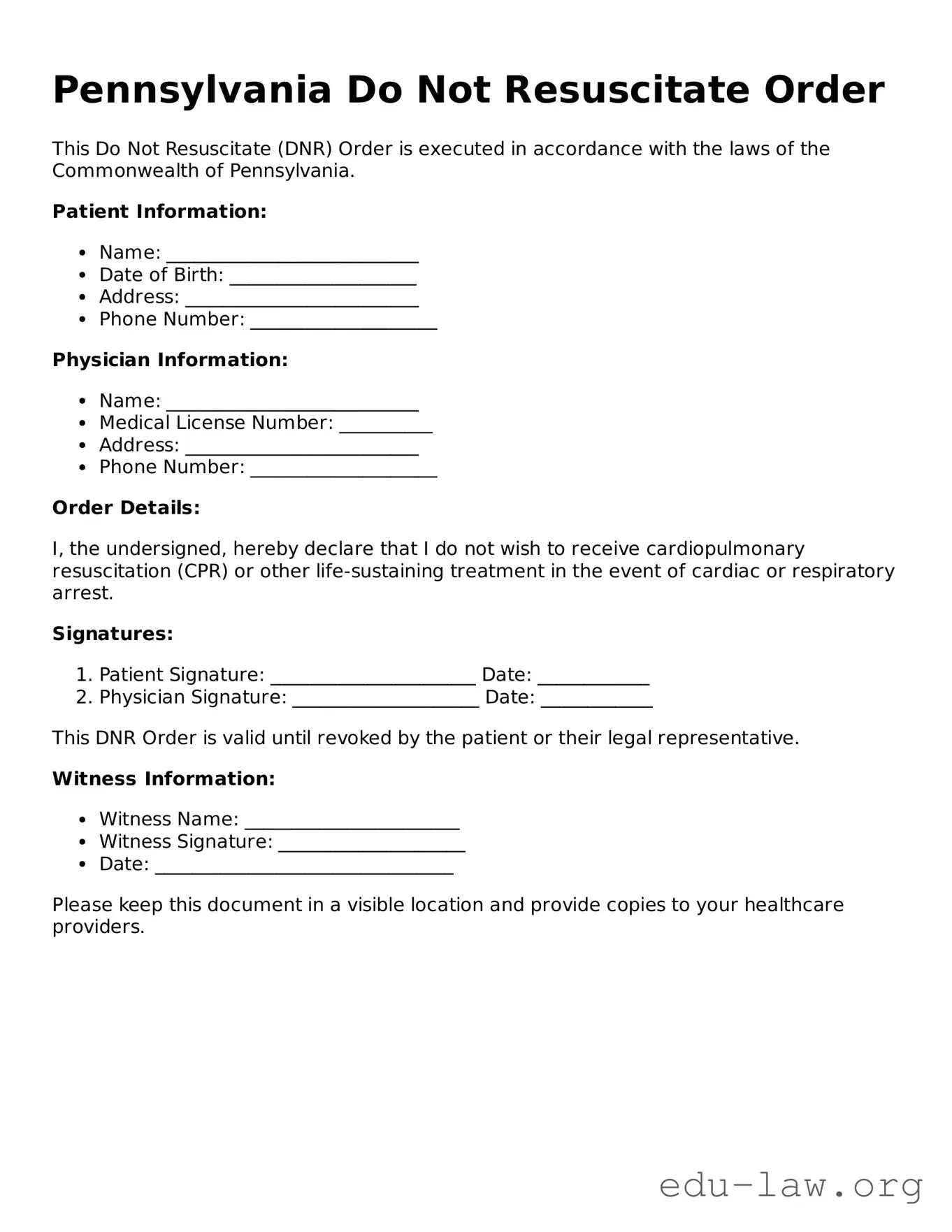
In Pennsylvania, the Do Not Resuscitate (DNR) Order form serves as a crucial document for individuals who wish to express their preferences regarding medical treatment in the event of a life-threatening situation. This form allows patients to communicate their desire not to receive cardiopulmonary resuscitation (CPR) or other life-sustaining measures if their heart stops beating or they stop breathing. Understanding the DNR Order is essential for both patients and their families, as it ensures that medical professionals respect the wishes of the individual regarding end-of-life care. The form must be completed and signed by a qualified physician, and it should be readily available in case of an emergency. Additionally, it’s important to note that the DNR Order can be revoked at any time, providing individuals with the flexibility to change their minds as circumstances evolve. By taking the time to understand and complete this form, patients can have peace of mind knowing their healthcare preferences will be honored when it matters most.
Pennsylvania Do Not Resuscitate Order
This Do Not Resuscitate (DNR) Order is executed in accordance with the laws of the Commonwealth of Pennsylvania.
Patient Information:
Physician Information:
Order Details:
I, the undersigned, hereby declare that I do not wish to receive cardiopulmonary resuscitation (CPR) or other life-sustaining treatment in the event of cardiac or respiratory arrest.
Signatures:
This DNR Order is valid until revoked by the patient or their legal representative.
Witness Information:
Please keep this document in a visible location and provide copies to your healthcare providers.
| Fact Name | Description |
|---|---|
| Purpose | The Pennsylvania Do Not Resuscitate (DNR) Order form allows individuals to refuse resuscitation efforts in the event of cardiac or respiratory arrest. |
| Governing Law | This form is governed by the Pennsylvania Consolidated Statutes, Title 20, Chapter 54, which outlines the legal framework for advance directives. |
| Eligibility | Any adult who is capable of making their own medical decisions can complete a DNR order. This includes individuals with terminal illnesses or those who wish to avoid aggressive medical interventions. |
| Implementation | The DNR order must be signed by the patient and a physician. It should be presented to medical personnel to ensure that the patient's wishes are respected in emergencies. |
Filling out the Pennsylvania Do Not Resuscitate (DNR) Order form is an important step in expressing your healthcare preferences. After completing the form, you will need to ensure it is signed and dated appropriately. This document will guide your medical team in understanding your wishes regarding resuscitation efforts in case of a medical emergency.
What is a Do Not Resuscitate (DNR) Order in Pennsylvania?
A Do Not Resuscitate Order is a legal document that allows a person to refuse cardiopulmonary resuscitation (CPR) and other life-saving measures in the event of cardiac or respiratory arrest. In Pennsylvania, this order is recognized by healthcare providers and is intended to honor the wishes of individuals regarding end-of-life care.
Who can complete a DNR Order in Pennsylvania?
In Pennsylvania, a DNR Order can be completed by an adult who is capable of making their own healthcare decisions. If a person is unable to make decisions, a legally authorized representative, such as a healthcare proxy or power of attorney, may complete the order on their behalf.
How do I obtain a DNR Order form in Pennsylvania?
The DNR Order form can be obtained from various sources, including healthcare providers, hospitals, or the Pennsylvania Department of Health website. It is essential to use the official state form to ensure that it is legally valid and recognized by medical personnel.
What information is required on the DNR Order form?
The DNR Order form requires essential information, including the patient's name, date of birth, and a clear statement indicating the desire for a DNR. Additionally, the form must be signed by the patient or their authorized representative and a physician to be valid.
Is a DNR Order valid outside of a hospital setting?
Yes, a DNR Order is valid in both hospital and out-of-hospital settings in Pennsylvania. However, it is crucial to ensure that the order is clearly visible and accessible to emergency medical personnel. Carrying a copy of the order or wearing a medical alert bracelet can help communicate your wishes effectively.
Can a DNR Order be revoked?
Yes, a DNR Order can be revoked at any time by the patient or their authorized representative. To revoke the order, simply notify your healthcare provider and remove any copies of the DNR from your medical records. It is also advisable to communicate your decision to family members and caregivers.
What should I do if I change my mind about my DNR Order?
If you change your mind about your DNR Order, you must inform your healthcare provider and revoke the order as described above. It is also important to ensure that new healthcare directives reflect your current wishes regarding resuscitation and end-of-life care.
Where should I keep my DNR Order form?
Keep your DNR Order form in a place that is easily accessible, such as your medical records, a safe at home, or with a trusted family member. Inform your healthcare provider and family members about its location to ensure that it can be quickly retrieved in an emergency.
Inaccurate Information: Individuals often provide incorrect personal details, such as name, date of birth, or medical record number. This can lead to confusion and hinder the effectiveness of the order when it is needed.
Not Signing the Form: A common mistake is failing to sign the Do Not Resuscitate Order. Without a signature, the document may not be considered valid, rendering the wishes of the individual unenforceable.
Missing Witness Signatures: In Pennsylvania, the form requires the signatures of two witnesses or a notary. Neglecting to include these signatures can invalidate the order, which can have serious implications during a medical emergency.
Ambiguous Language: Some individuals use vague or unclear language when describing their wishes. This ambiguity can lead to misinterpretation by healthcare providers, potentially resulting in unwanted medical interventions.
Failure to Update the Form: Circumstances may change over time, such as a shift in health status or personal preferences. Not revisiting and updating the Do Not Resuscitate Order can lead to outdated directives that do not reflect current wishes.
The Pennsylvania Do Not Resuscitate (DNR) Order form is an important document for individuals who wish to express their preferences regarding resuscitation efforts in medical emergencies. It is often accompanied by other forms and documents that help ensure a person's healthcare wishes are respected. Below is a list of related documents that may be used alongside the DNR Order.
These documents work together to create a comprehensive plan that reflects an individual's healthcare wishes. Understanding each form's purpose can help ensure that preferences are honored and respected during critical medical situations.
The Pennsylvania Do Not Resuscitate (DNR) Order form shares similarities with the Advance Directive. An Advance Directive allows individuals to outline their preferences for medical treatment in case they become unable to communicate those wishes. Like the DNR, it ensures that healthcare providers respect the patient’s desires regarding life-sustaining treatments. Both documents serve to guide medical decisions, emphasizing the importance of patient autonomy in end-of-life care.
Another document comparable to the DNR is the Living Will. A Living Will is a legal document that specifies the types of medical treatment a person wishes to receive or avoid in situations where they are terminally ill or incapacitated. Similar to the DNR, it focuses on the patient’s preferences regarding life support and resuscitation efforts, providing clarity to healthcare providers and family members during critical moments.
The Healthcare Power of Attorney (POA) is also akin to the DNR Order. This document designates a trusted person to make healthcare decisions on behalf of the individual if they are unable to do so. While the DNR specifically addresses resuscitation efforts, the Healthcare POA can cover a broader range of medical decisions, ensuring that the patient's overall healthcare wishes are honored.
The Physician Orders for Life-Sustaining Treatment (POLST) form is another document similar to the DNR. POLST is a medical order that translates a patient’s wishes regarding life-sustaining treatments into actionable medical orders. While the DNR focuses solely on resuscitation, POLST encompasses a wider scope of treatment preferences, making it a comprehensive tool for end-of-life care planning.
The Do Not Intubate (DNI) order is closely related to the DNR. A DNI order specifically instructs medical personnel not to perform intubation if a patient experiences respiratory failure. Both documents reflect a patient’s wishes about aggressive medical interventions, but the DNI focuses more on breathing support rather than cardiac resuscitation.
The Comfort Care Order is another document that aligns with the principles of the DNR. This order emphasizes the provision of comfort and symptom management rather than curative treatment. It is intended for patients who are at the end of life and wish to avoid invasive procedures, similar to the goals of a DNR in prioritizing quality of life over aggressive interventions.
The Medical Order for Scope of Treatment (MOST) is similar to the DNR in that it outlines a patient's preferences regarding various medical interventions. MOST is often used in specific healthcare settings, such as nursing homes, to ensure that medical staff understand the patient's wishes about resuscitation and other life-sustaining measures, paralleling the intent of the DNR.
The End-of-Life Care Plan can also be compared to the DNR. This plan typically includes a variety of documents, including a DNR, and outlines the patient’s overall goals for care as they approach the end of life. It provides a comprehensive approach to ensure that all aspects of the patient’s wishes are documented and respected by healthcare providers.
Lastly, the Declaration of a Living Will is another document that mirrors the DNR. This declaration allows individuals to express their wishes regarding medical treatment in the event they become unable to communicate. Like the DNR, it serves to guide healthcare providers in making decisions that align with the patient’s values and preferences during critical health situations.
When filling out the Pennsylvania Do Not Resuscitate (DNR) Order form, it is crucial to approach the process with care and attention to detail. Here are some important dos and don'ts to consider:
By following these guidelines, individuals can ensure that their preferences regarding resuscitation are clearly communicated and respected in medical situations.
Understanding the Pennsylvania Do Not Resuscitate (DNR) Order form is crucial for individuals and families making end-of-life decisions. Here are nine common misconceptions about this important document.
This is incorrect. A DNR specifically addresses the use of cardiopulmonary resuscitation (CPR) in the event of cardiac or respiratory arrest. Other medical treatments and interventions may still be provided.
This misconception overlooks the fact that anyone can have a DNR order, regardless of their health status. Individuals may choose a DNR for various personal reasons.
A DNR order is valid in various healthcare settings, including nursing homes, emergency medical services, and at home. It is not limited to hospitals.
This is false. Individuals can revoke a DNR order at any time, as long as they are mentally competent to do so. Communication of this revocation to healthcare providers is essential.
This is misleading. A DNR only applies to resuscitation efforts. Patients with a DNR are still entitled to receive comprehensive medical care and support.
While both documents relate to end-of-life decisions, they serve different purposes. A living will outlines a person's wishes regarding medical treatment, while a DNR specifically addresses resuscitation efforts.
This assumption can lead to confusion. It is vital to ensure that all healthcare providers are aware of the DNR order and its specifics to avoid any misunderstandings.
This belief is often rooted in fear. A DNR reflects a personal choice about the type of medical interventions one wishes to receive, not a desire to end life.
This is incorrect. A DNR can be updated or changed as circumstances or personal wishes evolve. Regular discussions with healthcare providers can help ensure that the order remains aligned with the individual's values.
When considering the Pennsylvania Do Not Resuscitate (DNR) Order form, it's essential to understand its implications and proper usage. Here are key takeaways to guide you:
Understanding these key points will help ensure that your wishes regarding medical treatment are respected and followed. It is always best to approach this sensitive topic thoughtfully and with care.