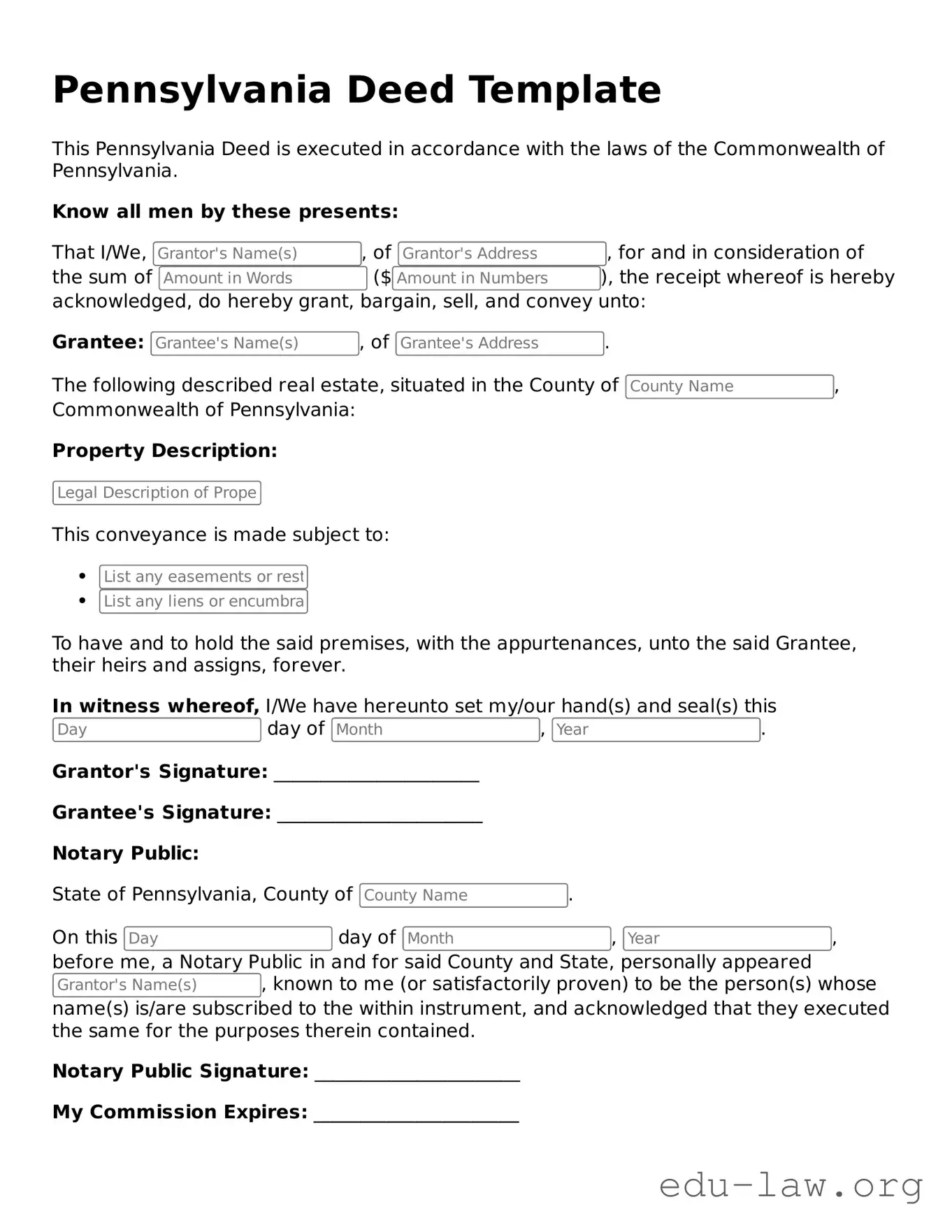
In Pennsylvania, the deed form serves as a crucial document in real estate transactions, playing a vital role in the transfer of property ownership. This form outlines essential details such as the names of the parties involved, a clear description of the property being transferred, and the consideration, or payment, exchanged for the property. It is important to note that the deed must be signed by the grantor, the individual or entity transferring the property, and typically requires notarization to ensure its validity. Additionally, the form may specify any conditions or restrictions associated with the property, which can impact future use or ownership. The Pennsylvania deed form comes in various types, including warranty deeds, quitclaim deeds, and special purpose deeds, each serving distinct purposes depending on the nature of the transaction. Understanding these components is essential for anyone involved in buying or selling real estate in the state, as a properly executed deed not only facilitates a smooth transfer but also protects the rights of all parties involved.
Pennsylvania Deed Template
This Pennsylvania Deed is executed in accordance with the laws of the Commonwealth of Pennsylvania.
Know all men by these presents:
That I/We, , of , for and in consideration of the sum of ($), the receipt whereof is hereby acknowledged, do hereby grant, bargain, sell, and convey unto:
Grantee: , of .
The following described real estate, situated in the County of , Commonwealth of Pennsylvania:
Property Description:
This conveyance is made subject to:
To have and to hold the said premises, with the appurtenances, unto the said Grantee, their heirs and assigns, forever.
In witness whereof, I/We have hereunto set my/our hand(s) and seal(s) this day of , .
Grantor's Signature: ______________________
Grantee's Signature: ______________________
Notary Public:
State of Pennsylvania, County of .
On this day of , , before me, a Notary Public in and for said County and State, personally appeared , known to me (or satisfactorily proven) to be the person(s) whose name(s) is/are subscribed to the within instrument, and acknowledged that they executed the same for the purposes therein contained.
Notary Public Signature: ______________________
My Commission Expires: ______________________
| Fact Name | Details |
|---|---|
| Governing Law | The Pennsylvania Deed form is governed by Title 21 of the Pennsylvania Consolidated Statutes. |
| Types of Deeds | Pennsylvania recognizes several types of deeds, including warranty deeds, quitclaim deeds, and special purpose deeds. |
| Required Signatures | All parties involved in the transfer of property must sign the deed for it to be valid. |
| Notarization | A notary public must witness the signatures on the deed to ensure its authenticity. |
| Recording | To protect ownership rights, the deed must be recorded in the county where the property is located. |
| Property Description | The deed must include a legal description of the property being transferred. |
| Consideration | The deed should state the consideration, or payment, made for the property, although it can be nominal. |
| Transfer Tax | Pennsylvania imposes a realty transfer tax on property transactions, which must be paid at the time of recording. |
| Exemptions | Certain transfers, such as those between family members, may be exempt from transfer tax. |
| Legal Capacity | All parties must have the legal capacity to enter into a contract, meaning they must be of sound mind and of legal age. |
Once you have the Pennsylvania Deed form in hand, you are ready to begin the process of transferring property ownership. This form requires careful attention to detail to ensure that all necessary information is accurately provided. Follow these steps to complete the form correctly.
Completing the Pennsylvania Deed form accurately is essential for a smooth property transfer. After filing, the deed will be recorded, making the transfer official and public. Keep a copy of the filed deed for your records, as it serves as proof of ownership.
What is a Pennsylvania Deed form?
A Pennsylvania Deed form is a legal document used to transfer ownership of real estate in the state of Pennsylvania. It serves as evidence of the transfer and contains essential details such as the names of the parties involved, a description of the property, and the terms of the transfer. There are different types of deeds, including warranty deeds and quitclaim deeds, each serving distinct purposes based on the nature of the transaction.
What information is required to complete a Pennsylvania Deed form?
To properly complete a Pennsylvania Deed form, several key pieces of information must be included. This includes the full names and addresses of both the grantor (the person transferring the property) and the grantee (the person receiving the property). A legal description of the property is also necessary, which identifies the exact location and boundaries. Additionally, the deed should specify the type of deed being used and may require the inclusion of any relevant consideration, such as the purchase price.
How do I file a Pennsylvania Deed form?
Filing a Pennsylvania Deed form involves several steps. First, the completed deed must be signed by the grantor in the presence of a notary public. After notarization, the deed should be recorded at the local county recorder of deeds office where the property is located. This recording process is crucial, as it provides public notice of the transfer and protects the rights of the new owner. There may also be associated fees for recording the deed, which vary by county.
Are there any taxes associated with transferring property in Pennsylvania?
Yes, transferring property in Pennsylvania typically incurs certain taxes. The most common is the Realty Transfer Tax, which is assessed on the sale price of the property. The rate may vary by municipality, and it is often split between the buyer and seller unless otherwise agreed upon. Additionally, if the property is being transferred as a gift or inheritance, different tax rules may apply, so it is advisable to consult with a tax professional or attorney to understand the implications.
Can I create my own Pennsylvania Deed form?
While it is possible to create your own Pennsylvania Deed form, it is generally recommended to use a standardized form or consult with a legal professional. This ensures that all necessary elements are included and that the deed complies with state laws. Using a standardized form can also help prevent potential legal issues that may arise from improper wording or missing information. If you choose to draft your own deed, careful attention to detail is essential to avoid complications in the future.
Not including all required information. Make sure to fill in every section completely. Missing details can delay the processing of the deed.
Using incorrect names. Ensure that the names of all parties involved are spelled correctly and match their identification documents.
Forgetting to sign the form. A deed must be signed by the grantor. Without a signature, the deed is not valid.
Neglecting to have the deed notarized. Most deeds require notarization to be legally binding. Make sure to have a notary public present during the signing.
Failing to check local regulations. Different counties may have specific requirements for deed forms. Always verify that you are following local rules.
When transferring property in Pennsylvania, the Deed form is a crucial document. However, several other forms and documents often accompany it to ensure a smooth transaction. Understanding these documents can help streamline the process and clarify responsibilities for all parties involved.
In summary, various forms and documents play a vital role in the property transfer process in Pennsylvania. Familiarity with these documents can empower both buyers and sellers, ensuring that they are well-prepared for a successful transaction.
The Pennsylvania Deed form is similar to a Quitclaim Deed. Both documents are used to transfer property ownership, but they differ in the level of assurance provided. A Quitclaim Deed transfers whatever interest the seller has in the property without guaranteeing that the title is clear. This means that if there are any liens or claims against the property, the buyer may be responsible for them. In contrast, the Pennsylvania Deed can offer more assurances about the title, depending on its specific type.
Another document that shares similarities is the Warranty Deed. This deed provides a stronger guarantee than a Quitclaim Deed. It assures the buyer that the seller holds a clear title to the property and has the right to sell it. If any issues arise after the sale, the seller is responsible for resolving them. Like the Pennsylvania Deed, the Warranty Deed is a formal way to transfer ownership, but it comes with additional protections for the buyer.
The Bargain and Sale Deed is also comparable to the Pennsylvania Deed. This type of deed implies that the seller has the right to sell the property but does not guarantee a clear title. It is often used in foreclosure sales or by executors of estates. While it conveys ownership, it offers less protection than a Warranty Deed. Buyers using this type of deed should conduct thorough title searches to ensure they are aware of any potential issues.
A Special Purpose Deed is another document that is similar. This type of deed is used for specific transactions, such as transferring property between family members or in divorce settlements. Like the Pennsylvania Deed, it formalizes the transfer of ownership. However, it may not always include the same level of title assurance. The context of the transfer often dictates the type of deed used.
The Trustee's Deed is also relevant. This document is used when a trustee sells property held in a trust. It transfers ownership from the trust to a buyer. While it is similar to the Pennsylvania Deed in that it conveys ownership, the Trustee's Deed may come with specific limitations or conditions based on the trust agreement. Buyers should understand these nuances before proceeding.
A Leasehold Deed can also be seen as similar in some respects. While primarily used for leasing property, it can outline the terms under which the leasehold interest can be transferred. This document formalizes the agreement between the lessor and lessee. Like the Pennsylvania Deed, it serves to clarify ownership rights, but it does so in the context of leasing rather than outright ownership transfer.
Finally, a Bill of Sale can be considered similar when dealing with personal property. While the Pennsylvania Deed pertains to real estate, a Bill of Sale is used to transfer ownership of personal property, such as vehicles or equipment. Both documents serve the purpose of formalizing a transfer of ownership, ensuring that the transaction is recognized legally. The main difference lies in the type of property being transferred.
When filling out the Pennsylvania Deed form, there are important guidelines to follow to ensure accuracy and compliance. Here are five things you should do and five things you should avoid.
Things You Should Do:
Things You Shouldn't Do:
Understanding the Pennsylvania Deed form is crucial for anyone involved in real estate transactions in the state. However, several misconceptions can lead to confusion. Here are seven common misconceptions:
Being aware of these misconceptions can help individuals navigate the process of property transfer more effectively. It’s always advisable to consult with a legal expert when dealing with real estate transactions.
Filling out and using the Pennsylvania Deed form requires careful attention to detail. Here are some key takeaways to keep in mind:
By following these key points, you can navigate the process of filling out and using the Pennsylvania Deed form more effectively.