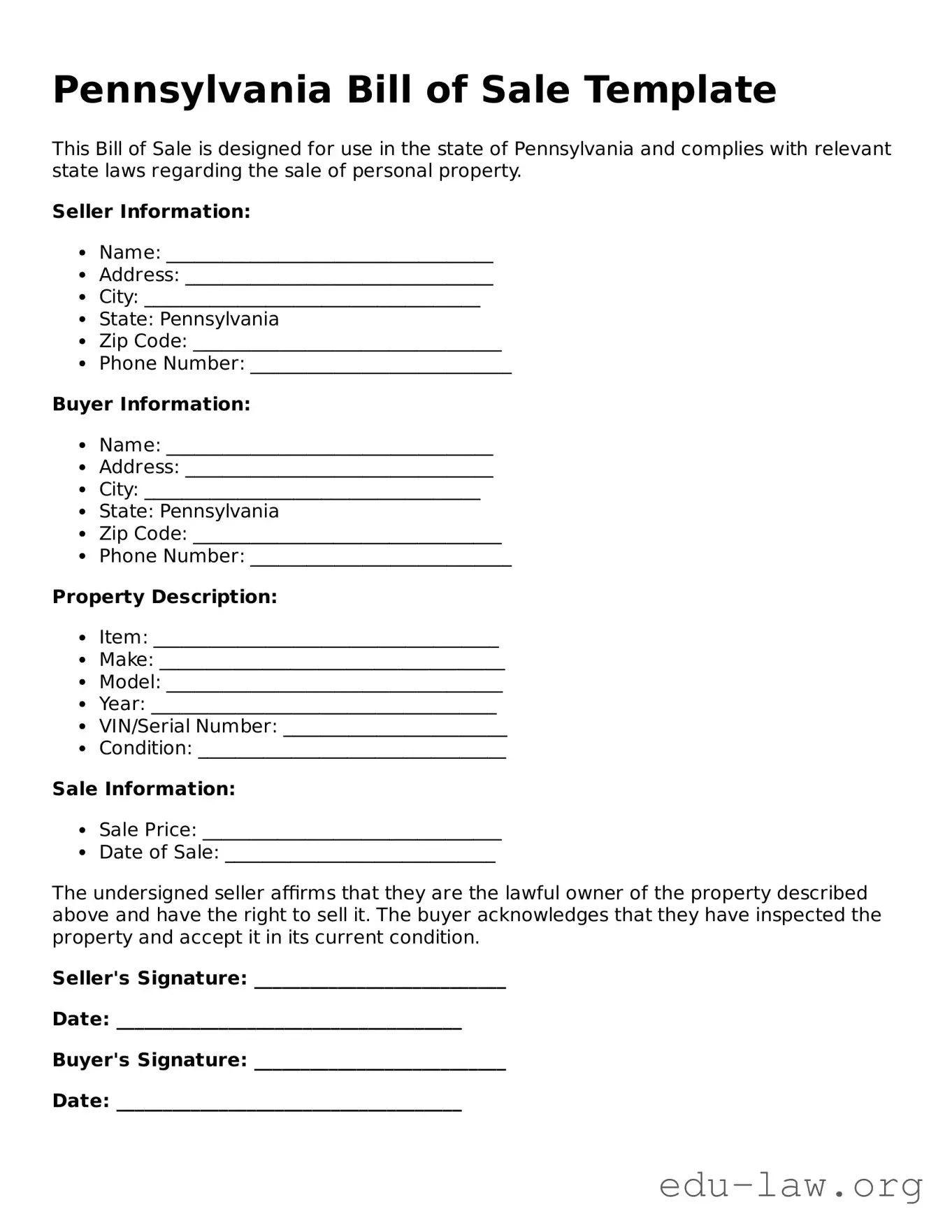
The Pennsylvania Bill of Sale form serves as a crucial document in the process of transferring ownership of personal property from one individual to another. This form is particularly important for transactions involving vehicles, boats, and other valuable items, as it provides both parties with a record of the sale. Essential details included in the form are the names and addresses of the buyer and seller, a description of the item being sold, and the sale price. Additionally, the form may include information about any warranties or guarantees, which can protect the buyer in case of defects or issues with the item. By documenting the transaction, the Bill of Sale not only helps prevent disputes but also serves as proof of ownership, which can be vital for registration or insurance purposes. Understanding how to properly complete and utilize this form can simplify the buying and selling process, making it a valuable tool for residents of Pennsylvania.
Pennsylvania Bill of Sale Template
This Bill of Sale is designed for use in the state of Pennsylvania and complies with relevant state laws regarding the sale of personal property.
Seller Information:
Buyer Information:
Property Description:
Sale Information:
The undersigned seller affirms that they are the lawful owner of the property described above and have the right to sell it. The buyer acknowledges that they have inspected the property and accept it in its current condition.
Seller's Signature: ___________________________
Date: _____________________________________
Buyer's Signature: ___________________________
Date: _____________________________________
| Fact Name | Description |
|---|---|
| Definition | A Pennsylvania Bill of Sale is a legal document that transfers ownership of personal property from one party to another. |
| Governing Law | The Bill of Sale is governed by Pennsylvania's Uniform Commercial Code (UCC) and state property laws. |
| Types of Property | This form can be used for various types of personal property, including vehicles, equipment, and furniture. |
| Notarization | While notarization is not required, it is recommended for added legal protection and verification. |
| Buyer and Seller Information | The form must include the full names and addresses of both the buyer and the seller. |
| Property Description | A detailed description of the property being sold is essential, including make, model, and serial number if applicable. |
| Purchase Price | The document must clearly state the purchase price agreed upon by both parties. |
| As-Is Clause | Many sellers include an "as-is" clause, indicating that the buyer accepts the property in its current condition. |
| Legal Recourse | If disputes arise, the Bill of Sale can serve as evidence in court regarding the terms of the sale. |
| Record Keeping | Both parties should keep a signed copy of the Bill of Sale for their records, as it may be needed for future reference. |
After gathering the necessary information, you can begin filling out the Pennsylvania Bill of Sale form. This document is essential for recording the sale of personal property, ensuring that both the buyer and seller have a clear understanding of the transaction.
Once the form is completed, it’s important to keep a copy for your records. The buyer should also receive a copy for their reference. This helps ensure that both parties have proof of the transaction.
What is a Pennsylvania Bill of Sale?
A Pennsylvania Bill of Sale is a legal document that records the transfer of ownership of personal property from one person to another. This document serves as proof of the transaction and includes important details about the item being sold, the buyer, and the seller. It is commonly used for vehicles, boats, and other valuable items. Having a Bill of Sale can help protect both parties in case of disputes or questions about ownership in the future.
What information is needed to complete a Bill of Sale?
To complete a Bill of Sale in Pennsylvania, you will need to provide specific information. This includes the names and addresses of both the buyer and the seller, a description of the item being sold (such as make, model, year, and VIN for vehicles), the sale price, and the date of the transaction. It is also helpful to include any warranties or conditions of the sale, if applicable.
Is a Bill of Sale required in Pennsylvania?
While a Bill of Sale is not legally required for all transactions in Pennsylvania, it is highly recommended. For certain items, such as vehicles, a Bill of Sale may be necessary for registration and titling purposes. Having this document can provide clarity and protect both parties, making it easier to resolve any issues that may arise later.
Do I need to have the Bill of Sale notarized?
In Pennsylvania, notarization of a Bill of Sale is not required for most transactions. However, having the document notarized can add an extra layer of security and validation. It can be especially beneficial for high-value items or when dealing with unfamiliar parties. Notarization helps confirm the identities of the buyer and seller and ensures that both parties agree to the terms outlined in the document.
What should I do with the Bill of Sale after it is completed?
Once the Bill of Sale is completed and signed by both parties, it is important to keep a copy for your records. The buyer should retain their copy as proof of ownership. If the item sold is a vehicle, the Bill of Sale may need to be submitted to the Pennsylvania Department of Transportation when applying for title and registration. Always store the document in a safe place, as it may be needed for future reference.
Not including the correct date of the sale. The date should reflect when the transaction took place.
Failing to provide complete buyer and seller information. Both parties' names and addresses must be included.
Omitting a detailed description of the item being sold. This should include make, model, year, and any identifying numbers.
Not indicating the purchase price clearly. The amount should be stated in both numerical and written form.
Forgetting to sign the document. Both the buyer and seller must sign the Bill of Sale to make it valid.
Using incorrect or outdated forms. Always ensure you are using the latest version of the Pennsylvania Bill of Sale form.
Not keeping a copy of the completed form. It is important to retain a copy for personal records.
Ignoring state-specific requirements. Some transactions may require additional documentation or disclosures.
The Pennsylvania Bill of Sale form serves as a crucial document in the transfer of ownership for various types of property, such as vehicles, personal items, or real estate. However, it is often accompanied by other forms and documents that help to ensure a smooth transaction. Below is a list of additional documents that are frequently used alongside the Bill of Sale in Pennsylvania.
Understanding these additional documents can facilitate a more efficient and secure transaction process. Each document plays a specific role in protecting the rights and responsibilities of both the buyer and the seller, ensuring that the transfer of ownership is legally sound.
The Pennsylvania Bill of Sale form is similar to the Vehicle Bill of Sale, which is specifically designed for the transfer of ownership of motor vehicles. This document includes details such as the vehicle identification number (VIN), make, model, and year of the vehicle, along with the seller and buyer's information. Both documents serve as proof of the transaction, ensuring that the buyer has legal ownership and that the seller is released from any future liabilities related to the vehicle.
Another document that resembles the Pennsylvania Bill of Sale is the General Bill of Sale. This document can be used for various types of personal property transactions, including furniture, electronics, and other goods. Like the Pennsylvania Bill of Sale, it includes essential details such as the description of the item, the sale price, and the names of the buyer and seller. Both documents help establish a clear record of the sale and protect the interests of both parties involved.
The Personal Property Bill of Sale is also similar, as it serves to document the sale of tangible personal property. This document is more specific in terms of the items being sold, often detailing serial numbers or unique identifiers. Both the Personal Property Bill of Sale and the Pennsylvania Bill of Sale provide a legal framework for the transaction, ensuring that the buyer receives ownership rights and the seller is acknowledged for the sale.
The Boat Bill of Sale is another related document, tailored for the sale of boats and watercraft. This form includes information such as the hull identification number, make, model, and year of the boat. Both the Boat Bill of Sale and the Pennsylvania Bill of Sale function to facilitate the transfer of ownership and protect the rights of both the buyer and seller, ensuring that all necessary details are documented.
Similar to the Pennsylvania Bill of Sale is the Firearm Bill of Sale, which is used for the sale of firearms. This document includes specific details about the firearm, such as the make, model, and serial number, along with the buyer and seller's information. Both documents emphasize the importance of proper documentation in the sale process, ensuring that ownership is clearly transferred and that legal requirements are met.
The Lease Agreement can also be compared to the Pennsylvania Bill of Sale in terms of documenting a transaction. While a Lease Agreement pertains to the rental of property rather than a sale, both documents outline the terms of the agreement and the responsibilities of each party. They serve as legal proof of the transaction, providing clarity on what is being exchanged and the conditions surrounding that exchange.
The Warranty Deed is another document that shares similarities with the Pennsylvania Bill of Sale, particularly in real estate transactions. A Warranty Deed transfers ownership of real property and guarantees that the seller has the right to sell the property. While the Pennsylvania Bill of Sale is more focused on personal property, both documents serve as formal agreements that establish ownership and protect the interests of the parties involved.
The Assignment of Contract is also akin to the Pennsylvania Bill of Sale, as it involves the transfer of rights from one party to another. This document is often used in real estate or business transactions. Both documents outline the specifics of the transaction and ensure that all parties are aware of their rights and responsibilities, providing legal backing to the transfer process.
Lastly, the Promissory Note can be compared to the Pennsylvania Bill of Sale in that both involve a financial transaction. A Promissory Note outlines the terms of a loan, including the amount borrowed and the repayment schedule. While the Pennsylvania Bill of Sale documents the sale of an item, both documents are essential in establishing clear terms and conditions, protecting the interests of the parties involved in the transaction.
When filling out the Pennsylvania Bill of Sale form, it is crucial to ensure that all information is accurate and complete. Here are some essential dos and don’ts to keep in mind:
By following these guidelines, you can help ensure that your Bill of Sale is properly filled out and legally binding. Taking these steps can prevent potential issues down the road.
Many individuals hold misconceptions about the Pennsylvania Bill of Sale form. Understanding these misconceptions can help clarify the purpose and function of this important document. Below are some common misunderstandings:
While the Bill of Sale is often associated with vehicle transactions, it is also applicable to the sale of personal property, such as furniture, electronics, and equipment.
In Pennsylvania, a properly completed Bill of Sale can serve as a legally binding contract, provided both parties agree to the terms and conditions outlined in the document.
Different types of transactions may require specific information. A Bill of Sale for a vehicle will differ from one for personal property, reflecting the unique details of each sale.
While notarization is not always required, having a Bill of Sale notarized can provide additional legal protection and help verify the identities of the parties involved.
Although changes to a Bill of Sale should be made carefully, it is possible to amend the document if both parties agree to the modifications and sign the amended version.
In reality, the Bill of Sale protects both the buyer and the seller by documenting the transaction and providing proof of ownership transfer.
When dealing with the Pennsylvania Bill of Sale form, understanding its components and proper usage is essential for both buyers and sellers. Here are some key takeaways to keep in mind:
By keeping these key points in mind, individuals can navigate the process of completing and utilizing the Pennsylvania Bill of Sale form more effectively, ensuring a smoother transaction experience.