In the realm of legal proceedings, ensuring that all parties are properly notified is crucial for the integrity of the judicial process. The Pennsylvania Affidavit of Service form plays a vital role in this respect. This document serves as a formal declaration that an individual has been served with legal papers, such as a summons or complaint, in accordance with state laws. It outlines key details, including the identity of the person served, the method of service used, and the date and time of service. By providing a clear record of these essential elements, the affidavit helps to establish that due process has been followed. Furthermore, it is typically signed by the individual who performed the service, adding an extra layer of authenticity. Understanding the nuances of this form is important for anyone involved in legal actions within Pennsylvania, as it not only facilitates communication between parties but also upholds the standards of legal protocol.
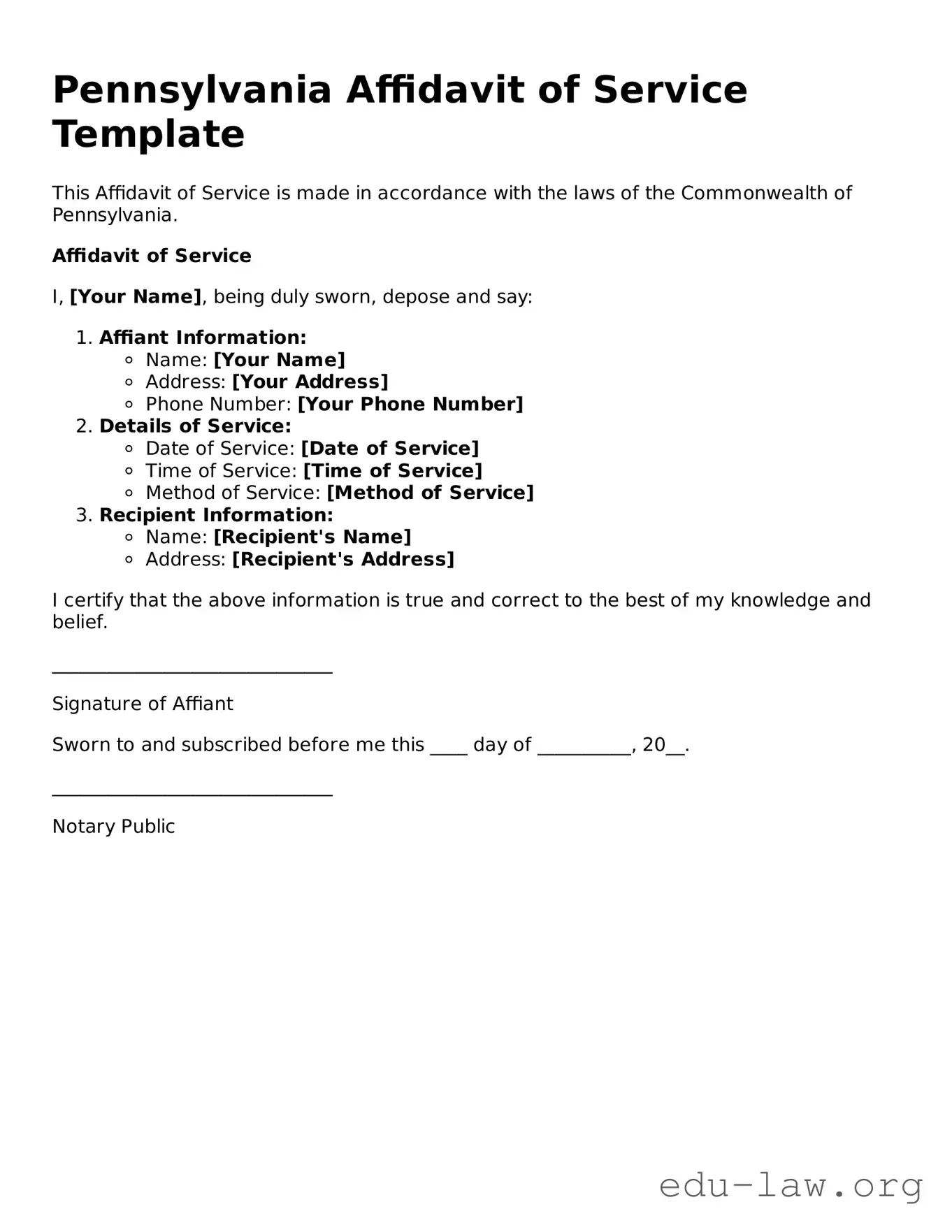
Pennsylvania Affidavit of Service Template
This Affidavit of Service is made in accordance with the laws of the Commonwealth of Pennsylvania.
Affidavit of Service
I, [Your Name], being duly sworn, depose and say:
I certify that the above information is true and correct to the best of my knowledge and belief.
______________________________
Signature of Affiant
Sworn to and subscribed before me this ____ day of __________, 20__.
______________________________
Notary Public
| Fact Name | Description |
|---|---|
| Definition | The Pennsylvania Affidavit of Service is a legal document used to confirm that legal papers have been delivered to the appropriate parties. |
| Governing Law | This form is governed by the Pennsylvania Rules of Civil Procedure, specifically Rule 402. |
| Purpose | The purpose of the affidavit is to provide proof that a defendant or other interested party has been properly notified of legal actions. |
| Who Can Serve | Anyone over the age of 18 who is not a party to the case can serve the documents and complete the affidavit. |
| Required Information | The affidavit must include details such as the date of service, the method of service, and the name of the person served. |
| Filing | After completing the affidavit, it must be filed with the court to officially document the service of process. |
| Notarization | The affidavit typically requires notarization to confirm the authenticity of the signature and the details provided. |
| Consequences of Non-Compliance | If the affidavit is not properly completed or filed, it may result in delays or dismissal of the case. |
| Types of Service | Service can be accomplished through personal delivery, certified mail, or by other means as allowed by law. |
| Deadline | There are specific deadlines for serving documents, which can vary based on the type of case and the court's rules. |
Once you have the Pennsylvania Affidavit of Service form ready, it’s time to fill it out accurately. This form is essential for confirming that legal documents were delivered properly. Follow these steps carefully to ensure that you complete the form correctly.
After filling out the form, you will need to file it with the appropriate court. Ensure that you keep a copy for your records. This will help you maintain a clear record of the service performed.
What is a Pennsylvania Affidavit of Service?
The Pennsylvania Affidavit of Service is a legal document that confirms that a particular legal document, such as a summons or complaint, has been delivered to the intended recipient. This form serves as proof that the recipient has been properly notified of the legal action being taken against them. It is essential in ensuring that all parties are aware of the proceedings, which is a fundamental aspect of due process in the legal system.
Who can complete the Affidavit of Service?
Typically, the Affidavit of Service can be completed by anyone who is not a party to the case and is at least 18 years old. This could be a friend, family member, or a professional process server. The person serving the documents must provide accurate details about how and when the documents were delivered, as this information is critical for the affidavit's validity.
What information is required on the Affidavit of Service?
The Affidavit of Service requires specific information to be valid. This includes the name and address of the person being served, the date and time of service, and the method of delivery (such as personal delivery or mail). Additionally, the individual completing the affidavit must sign it, affirming that the information provided is true and accurate. This ensures accountability and integrity in the service process.
What happens after the Affidavit of Service is completed?
Once the Affidavit of Service is completed and signed, it should be filed with the court where the case is pending. This filing serves as official documentation that the recipient has been properly notified of the legal action. It is crucial to keep a copy of the affidavit for personal records. If the affidavit is not filed, or if it contains inaccuracies, it may lead to complications in the case, including potential delays or dismissals.
Not including the correct case number. This number is essential for identifying the specific case related to the service.
Failing to provide accurate details about the person served. It's important to include their full name and address.
Using the wrong method of service. The affidavit must reflect how the documents were delivered, whether by mail, in person, or through another method.
Neglecting to sign the affidavit. A signature is required to validate the document and confirm that the information provided is true.
Not dating the affidavit. Including the date of service is crucial for tracking timelines and deadlines in legal proceedings.
Leaving out the name of the person who served the documents. This person's identity should be clearly stated to ensure accountability.
Failing to provide a detailed description of how service was executed. This includes noting the time and place of service.
Overlooking local rules or requirements. Each jurisdiction may have specific rules regarding affidavits, and it’s important to follow them closely.
The Pennsylvania Affidavit of Service form is an important document used to confirm that legal papers have been delivered to the appropriate parties. However, it is often used in conjunction with several other forms and documents that facilitate various legal processes. Below is a list of related documents commonly utilized in Pennsylvania legal proceedings.
Understanding these related forms can help individuals navigate the legal process more effectively. Each document plays a critical role in ensuring that legal proceedings are conducted fairly and transparently.
The Affidavit of Service in Pennsylvania shares similarities with the Proof of Service document commonly used in various jurisdictions. Both documents serve the purpose of confirming that legal documents have been delivered to the intended recipient. While the Affidavit of Service is specific to Pennsylvania, the Proof of Service can be found in many states, detailing who served the documents, when, and how. This ensures that the court has a clear record of service, which is essential for the legal process to proceed smoothly.
Another related document is the Certificate of Service, often used in civil litigation. Like the Affidavit of Service, this certificate verifies that a party has served all relevant documents to other parties involved in a case. The Certificate of Service typically accompanies filed documents, affirming that all required parties received copies. This helps maintain transparency and ensures that all parties are informed about the proceedings, similar to the objectives of the Affidavit of Service.
The Return of Service document also parallels the Affidavit of Service in its function. It is generally used by process servers to provide evidence that they have successfully delivered legal documents. This document includes details such as the date and time of service, the method of delivery, and the recipient's information. Both the Return of Service and the Affidavit of Service aim to establish a formal record of service, which is crucial for the court's acknowledgment of due process.
Lastly, the Summons and Complaint package often includes a section that resembles the Affidavit of Service. When a plaintiff files a lawsuit, they must serve the defendant with a Summons and Complaint, and proof of this service must be documented. This documentation can take the form of an Affidavit of Service or a similar proof, ensuring that the defendant is aware of the legal action against them. Both documents serve to uphold the principle of fair notice in legal proceedings.
When filling out the Pennsylvania Affidavit of Service form, it is important to follow certain guidelines to ensure accuracy and compliance. Below is a list of things you should and shouldn't do:
Misconceptions about the Pennsylvania Affidavit of Service form can lead to confusion regarding its purpose and use. Below are seven common misconceptions along with clarifications.
Understanding these misconceptions can help individuals navigate the legal process more effectively and ensure compliance with Pennsylvania's legal requirements.
The Pennsylvania Affidavit of Service form is an important document used to confirm that legal documents have been properly served to the intended recipient. Here are some key takeaways regarding its completion and usage:
By following these guidelines, individuals can ensure that they properly fill out and utilize the Pennsylvania Affidavit of Service form, facilitating a smoother legal process.