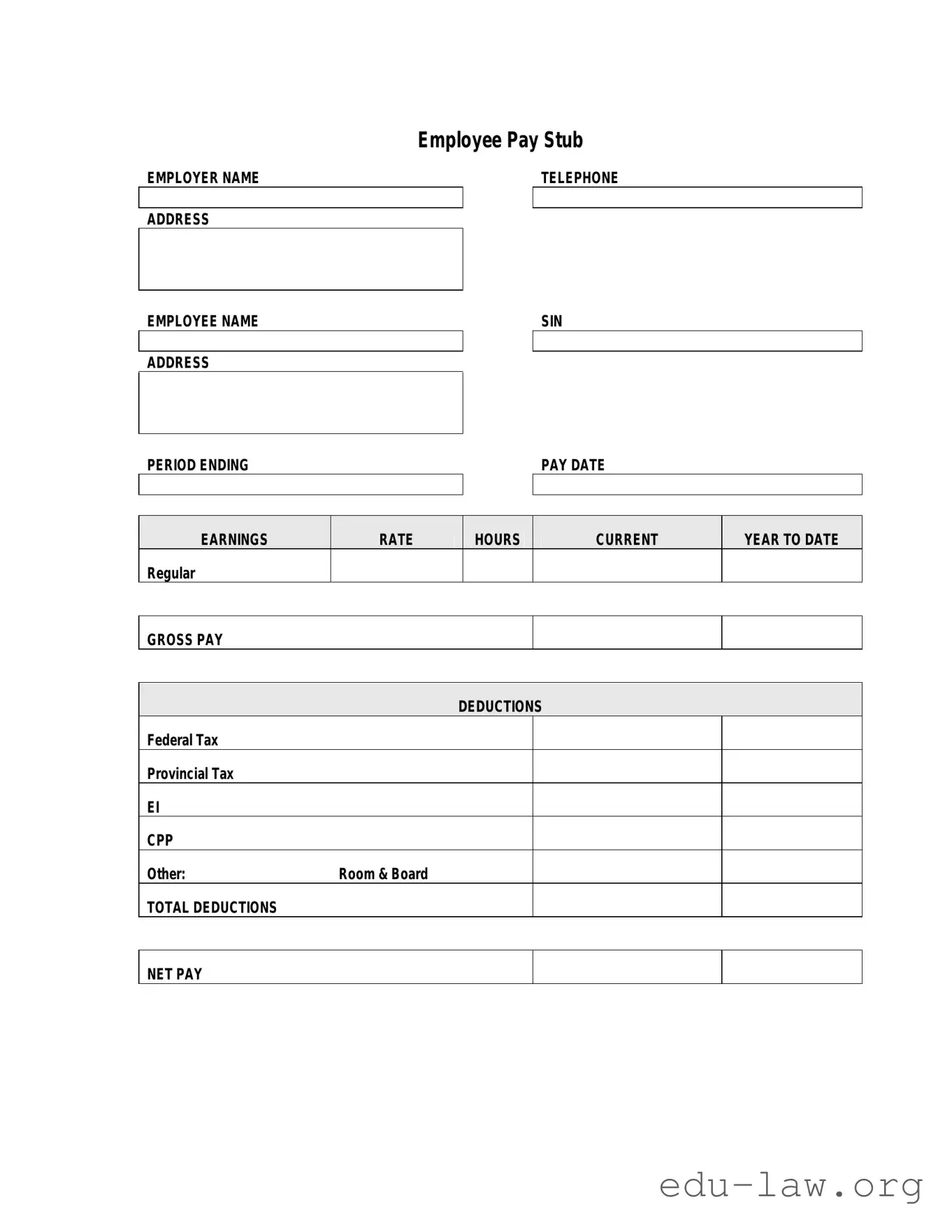
The Pay Stub form serves as a crucial document for employees and employers alike, providing a detailed summary of an employee's earnings for a specific pay period. This form typically includes vital information such as gross wages, deductions, and net pay, ensuring transparency in the payroll process. Employees can find details regarding their hourly rate or salary, overtime compensation, and any bonuses or commissions earned during the pay period. Additionally, the Pay Stub form outlines deductions for taxes, health insurance, retirement contributions, and other withholdings, offering a clear view of how much money is taken from an employee's earnings. Understanding this document is essential for employees to verify their compensation and ensure that all deductions are accurate. Employers, on the other hand, utilize the Pay Stub to maintain compliance with labor laws and to provide employees with a record of their earnings, which can be helpful for personal financial management or when applying for loans. Overall, the Pay Stub form plays a significant role in the employer-employee relationship, fostering trust and clarity in financial matters.

Employee Pay Stub
EMPLOYER NAME |
|
TELEPHONE |
|
|
|
ADDRESS
EMPLOYEE NAME |
|
SIN |
|
|
|
ADDRESS
PERIOD ENDING |
|
|
PAY DATE |
|
|
|
|
|
|
|
|
|
|
|
EARNINGS |
RATE |
HOURS |
CURRENT |
YEAR TO DATE |
Regular |
|
|
|
|
GROSS PAY
DEDUCTIONS
Federal Tax
Provincial Tax
EI
CPP
Other:Room & Board
TOTAL DEDUCTIONS
NET PAY
| Fact Name | Description |
|---|---|
| Definition | A pay stub is a document provided by an employer that outlines an employee's earnings and deductions for a specific pay period. |
| Components | Typically includes gross pay, net pay, taxes withheld, and other deductions such as health insurance or retirement contributions. |
| Frequency | Pay stubs are usually issued with each paycheck, whether weekly, bi-weekly, or monthly. |
| State Requirements | Some states have specific laws governing the information that must be included on pay stubs. For example, California requires itemized deductions. |
| Access | Employees have the right to access their pay stubs, whether in paper form or electronically, depending on the employer's policy. |
| Record Keeping | It is advisable for employees to keep their pay stubs for at least a year for tax purposes and personal record-keeping. |
| Tax Implications | Pay stubs provide essential information for tax reporting, including total earnings and withholdings for the year. |
| Discrepancies | If there are discrepancies on a pay stub, employees should promptly discuss them with their employer or HR department. |
| Legal Protections | Employees are protected under various federal and state laws that require accurate reporting of wages and deductions. |
Filling out the Pay Stub form is an essential step in documenting your earnings and deductions accurately. Completing this form ensures that you have a clear record of your income, which can be useful for various purposes, such as tax filing or loan applications. Follow these steps to fill out the form correctly.
What is a Pay Stub?
A pay stub is a document provided by an employer that outlines an employee's earnings for a specific pay period. It typically includes details such as gross pay, deductions, and net pay. Pay stubs serve as a record of income and can be useful for budgeting, applying for loans, or verifying employment.
What information is included on a Pay Stub?
A pay stub usually contains the following information: the employee's name, the pay period dates, gross earnings, deductions (such as taxes and benefits), and net pay. Some pay stubs may also show year-to-date totals for earnings and deductions, which helps employees track their financial progress throughout the year.
How can I obtain my Pay Stub?
Why is it important to keep my Pay Stubs?
Keeping your pay stubs is essential for several reasons. They provide proof of income, which can be necessary when applying for loans or renting a property. Additionally, pay stubs help you monitor your earnings and deductions, ensuring that your pay is accurate. If discrepancies arise, having your pay stubs on hand can assist in resolving any issues with your employer.
What should I do if I notice an error on my Pay Stub?
If you find an error on your pay stub, it is crucial to address it promptly. Begin by reviewing the details carefully to confirm the mistake. Then, contact your HR department or payroll administrator to report the issue. Provide any necessary documentation to support your claim. Most employers will investigate and correct errors as needed.
Are there any legal requirements for providing Pay Stubs?
Not double-checking personal information. Many people forget to verify their name, address, and Social Security number. This can lead to serious issues later.
Ignoring the pay period dates. It’s crucial to ensure the dates reflect the correct time frame for the hours worked. Mistakes here can affect pay calculations.
Failing to report all hours worked. Some individuals forget to include overtime or additional hours. This can result in underpayment.
Misunderstanding deductions. Many don’t fully grasp what deductions are taken out. It’s important to review these to understand your take-home pay.
Overlooking tax information. People often neglect to check if the correct tax withholdings are applied. Incorrect withholdings can lead to tax issues later.
Not keeping a copy of the pay stub. It’s easy to forget to save a copy for personal records. Keeping track can help if discrepancies arise.
Assuming all information is correct. Many assume the employer has entered everything accurately. Always review the details before submitting.
Rushing through the form. Filling out the form quickly can lead to careless mistakes. Taking your time can prevent errors.
The Pay Stub form is a crucial document for both employees and employers, providing detailed information about earnings and deductions. Alongside the Pay Stub, several other forms and documents are commonly used in payroll and employment processes. Each serves a specific purpose and helps maintain transparency and compliance in financial matters.
Understanding these documents is vital for both employees and employers. They facilitate clear communication regarding earnings, deductions, and benefits, fostering a trustworthy workplace environment.
The W-2 form is a document that employers provide to employees at the end of each tax year. It summarizes an employee's total earnings and the taxes withheld throughout the year. Like a pay stub, the W-2 shows gross income, federal income tax withheld, and other deductions. Both documents serve as important records for employees to understand their earnings and tax obligations.
The paycheck is another document closely related to the pay stub. It is the actual payment received by an employee for their work. While a pay stub provides a breakdown of earnings and deductions for a specific pay period, the paycheck is the tangible representation of that payment. Employees often refer to both to verify their earnings and ensure accurate compensation.
The direct deposit statement is similar to a pay stub in that it provides details about an employee's earnings and deductions. This statement is issued when an employee's paycheck is directly deposited into their bank account. It includes information such as the amount deposited and any deductions taken, allowing employees to track their income without needing a physical paycheck.
The 1099 form is used for independent contractors and freelancers, providing a summary of income received from a client. Similar to a pay stub, the 1099 shows the total amount earned during the year. Both documents are essential for reporting income to the IRS, but the 1099 is specifically for non-employees, while the pay stub is for employees.
The earnings statement is a document that provides a detailed account of an employee's earnings for a specific pay period. It includes information on gross pay, net pay, and deductions, much like a pay stub. However, an earnings statement may be issued more frequently than a pay stub, often on a weekly or bi-weekly basis, allowing employees to monitor their earnings more closely.
The payroll summary report is a document that summarizes the payroll expenses for a specific period. It provides an overview of total wages, taxes withheld, and deductions for all employees. Similar to a pay stub, it helps employers track payroll expenses and ensures that all employees are compensated correctly. Employees may not receive this document directly, but it is essential for payroll management.
The labor distribution report is another document that outlines how labor costs are allocated across different departments or projects within an organization. Like a pay stub, it provides insight into employee compensation, but it focuses on the distribution of labor costs rather than individual earnings. This report helps employers analyze labor expenses and make informed budgeting decisions.
When filling out the Pay Stub form, attention to detail is crucial. Here’s a helpful list of things to do and avoid to ensure accuracy and compliance.
Following these guidelines will help ensure that your Pay Stub form is completed correctly and efficiently.
Understanding pay stubs is essential for both employees and employers. However, many people hold misconceptions about what a pay stub really represents. Here are five common misunderstandings:
This is not true. Pay stubs are provided to all employees, regardless of whether they are hourly or salaried. They serve as a record of earnings and deductions for everyone.
While pay stubs do provide information about earnings, they are not the same as tax forms like W-2s. Pay stubs show the amount earned during a specific pay period, while tax forms summarize earnings for the entire year.
Not all deductions are required. While some, like federal and state taxes, are mandatory, others, such as contributions to retirement plans or health insurance, may be optional depending on the employee's choices.
Employers should also pay attention to pay stubs. They help ensure that payroll is processed accurately and can serve as documentation in case of disputes regarding wages.
While they may seem complicated at first glance, pay stubs are designed to provide clear information. With a little guidance, anyone can learn to read and interpret the information presented.
By dispelling these misconceptions, employees and employers can better understand the importance of pay stubs in the workplace.
When filling out and using the Pay Stub form, keep these key takeaways in mind:
Understanding these points will help ensure that the Pay Stub form is filled out correctly and used effectively.