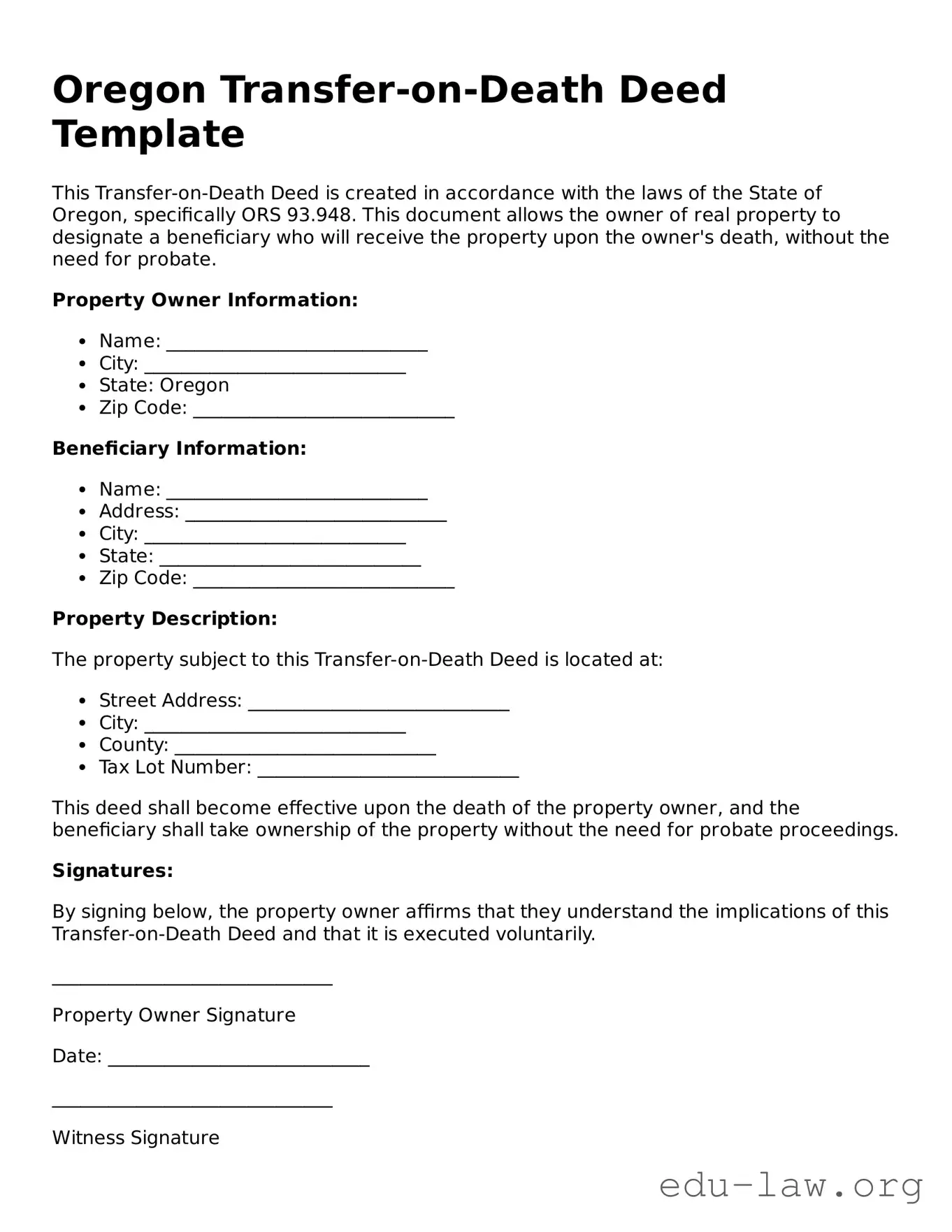
The Oregon Transfer-on-Death Deed form is a valuable tool for property owners looking to simplify the transfer of real estate upon their passing. This legal document allows individuals to designate a beneficiary who will automatically inherit their property without the need for probate. By completing this form, property owners can ensure that their assets are passed on according to their wishes, providing peace of mind for both themselves and their loved ones. The form requires specific information, including the names of the property owner and the beneficiary, as well as a legal description of the property. It must be signed and recorded with the county clerk to be effective. This straightforward process can help avoid complications and delays during estate settlement, making it an attractive option for many. Understanding the nuances of the Transfer-on-Death Deed can empower property owners to make informed decisions about their estate planning.
Oregon Transfer-on-Death Deed Template
This Transfer-on-Death Deed is created in accordance with the laws of the State of Oregon, specifically ORS 93.948. This document allows the owner of real property to designate a beneficiary who will receive the property upon the owner's death, without the need for probate.
Property Owner Information:
Beneficiary Information:
Property Description:
The property subject to this Transfer-on-Death Deed is located at:
This deed shall become effective upon the death of the property owner, and the beneficiary shall take ownership of the property without the need for probate proceedings.
Signatures:
By signing below, the property owner affirms that they understand the implications of this Transfer-on-Death Deed and that it is executed voluntarily.
______________________________
Property Owner Signature
Date: ____________________________
______________________________
Witness Signature
Date: ____________________________
______________________________
Notary Public Signature
Date: ____________________________
My Commission Expires: ____________________________
| Fact Name | Details |
|---|---|
| Definition | The Oregon Transfer-on-Death Deed allows property owners to transfer real estate to beneficiaries upon their death without going through probate. |
| Governing Law | The deed is governed by Oregon Revised Statutes, specifically ORS 93.948 to ORS 93.979. |
| Eligibility | Any individual who owns real property in Oregon can create a Transfer-on-Death Deed. |
| Revocation | The deed can be revoked at any time by the property owner through a written document. |
| Beneficiary Designation | Property owners can designate multiple beneficiaries and specify their shares in the deed. |
| Recording Requirement | The Transfer-on-Death Deed must be recorded with the county recorder's office to be effective. |
Once you have the Oregon Transfer-on-Death Deed form in hand, you’re ready to start the process. This deed allows you to designate a beneficiary who will receive your property upon your passing, without going through probate. Follow these steps to complete the form accurately.
After filing, keep a copy of the recorded deed for your records. This ensures that your wishes regarding property transfer are clear and legally recognized. It’s a good idea to inform your beneficiary about the deed and where they can find it when the time comes.
What is a Transfer-on-Death Deed in Oregon?
A Transfer-on-Death Deed (TODD) is a legal document that allows property owners in Oregon to transfer their real estate to designated beneficiaries upon their death. This deed does not take effect until the owner passes away, meaning the property remains under the owner's control during their lifetime. It provides a straightforward way to transfer property without the need for probate, making the process simpler for the beneficiaries.
Who can use a Transfer-on-Death Deed?
Any property owner in Oregon can use a Transfer-on-Death Deed, as long as they are of sound mind and at least 18 years old. This deed can be used for various types of real estate, including residential homes, commercial properties, and vacant land. However, it is important to note that the property must be solely owned by the individual creating the deed, and joint ownership situations may require additional considerations.
How do I create a Transfer-on-Death Deed?
To create a Transfer-on-Death Deed in Oregon, you must fill out the appropriate form, which includes details about the property and the beneficiaries. The form must be signed and notarized. After that, it must be recorded with the county clerk in the county where the property is located. It is advisable to keep a copy of the recorded deed for your records and to inform the beneficiaries about the deed's existence.
Can I revoke a Transfer-on-Death Deed?
Yes, you can revoke a Transfer-on-Death Deed at any time during your lifetime. To do this, you must create a new deed that explicitly states the revocation or record a formal revocation document with the county clerk. Additionally, if you sell or otherwise transfer the property, the original TODD becomes void. Always ensure that any changes are properly documented to avoid confusion later.
What happens if a beneficiary predeceases me?
If a beneficiary named in your Transfer-on-Death Deed passes away before you do, the transfer of property will typically go to that beneficiary's heirs, unless the deed specifies otherwise. It is wise to consider alternate beneficiaries in your deed to ensure that your property is transferred according to your wishes, even if the primary beneficiary is no longer living.
Is there a cost associated with filing a Transfer-on-Death Deed?
Yes, there are costs associated with filing a Transfer-on-Death Deed in Oregon. While creating the deed itself may not involve significant expenses, you will need to pay a recording fee when you file the deed with the county clerk. The fee varies by county, so it is best to check with your local office for the exact amount. Additionally, if you seek legal assistance in preparing the deed, there may be additional fees for those services.
Not Including All Required Information: When filling out the Oregon Transfer-on-Death Deed form, it's crucial to provide complete and accurate details. Missing information, such as the full names of the property owners or the legal description of the property, can lead to complications later on.
Failing to Sign and Date the Form: It's important to remember that the deed must be signed and dated by the property owner. Without a signature and date, the form may be considered invalid, which can create issues for the intended beneficiaries.
Not Notarizing the Document: In Oregon, the Transfer-on-Death Deed must be notarized. Skipping this step can render the deed ineffective. Make sure to have a notary public witness the signing of the document.
Neglecting to Record the Deed: After completing the form, it must be recorded with the county clerk's office. Failing to do so means the deed may not be recognized, and the property may not transfer as intended upon the owner's death.
The Oregon Transfer-on-Death Deed form allows property owners to designate a beneficiary who will inherit the property upon the owner's death, bypassing the probate process. While this form is essential for ensuring a smooth transfer of property, several other documents are often used in conjunction with it to clarify intentions, provide legal authority, or facilitate the transfer process. Below is a list of these commonly associated forms and documents.
Each of these documents plays a crucial role in estate planning and property transfer. By utilizing them alongside the Oregon Transfer-on-Death Deed form, individuals can create a more organized and efficient process for transferring their assets to their chosen beneficiaries.
The Oregon Transfer-on-Death Deed allows an individual to transfer real property to a beneficiary upon their death without going through probate. This document is similar to a Last Will and Testament, which also designates beneficiaries for assets. However, while a will takes effect only after the individual’s death and must go through the probate process, a Transfer-on-Death Deed allows for an immediate transfer of property upon death, bypassing probate entirely.
Another similar document is a Revocable Living Trust. Like the Transfer-on-Death Deed, a living trust allows for the transfer of assets outside of probate. In a living trust, the individual places their assets into the trust during their lifetime, which can then be managed by a trustee. Upon death, the assets in the trust are distributed according to the terms of the trust, similar to how a Transfer-on-Death Deed transfers property directly to the designated beneficiary.
A Joint Tenancy Agreement also shares similarities with the Transfer-on-Death Deed. In a joint tenancy, two or more individuals hold property together, and when one owner passes away, their share automatically transfers to the surviving owner(s). This automatic transfer is akin to the Transfer-on-Death Deed, which facilitates the transfer of property to a beneficiary without the need for probate.
The Beneficiary Designation form used for bank accounts or retirement accounts is another document that operates similarly. Individuals can designate beneficiaries for these accounts, allowing for direct transfer upon their death. Like the Transfer-on-Death Deed, this method avoids probate and ensures that the assets go directly to the named beneficiary.
A Payable-on-Death (POD) designation is similar as well. This designation allows individuals to name beneficiaries for bank accounts. Upon the account holder's death, the funds are transferred directly to the beneficiary without going through probate. This process mirrors the function of a Transfer-on-Death Deed in ensuring a seamless transfer of assets.
A Life Estate Deed can also be compared to the Transfer-on-Death Deed. With a life estate deed, the property owner retains the right to live in or use the property during their lifetime, while designating a remainder beneficiary who will receive the property after their death. This arrangement allows for a transfer of property outside of probate, similar to the Transfer-on-Death Deed.
A Family Limited Partnership (FLP) may also resemble the Transfer-on-Death Deed in terms of asset transfer. In an FLP, family members can contribute assets to the partnership, which can then be managed and transferred according to the partnership agreement. This structure allows for the transfer of ownership without going through probate, akin to the Transfer-on-Death Deed.
A Declaration of Trust is another document that can be likened to the Transfer-on-Death Deed. This document establishes a trust that can hold property, allowing for the transfer of assets to beneficiaries upon the death of the trustor. Like the Transfer-on-Death Deed, a Declaration of Trust can facilitate the transfer of property outside of probate.
Finally, a Transfer-on-Death Account (TOD Account) is similar to the Transfer-on-Death Deed. This type of account allows the account holder to designate a beneficiary who will receive the account's assets upon the account holder's death. The transfer occurs automatically, avoiding probate, much like the process outlined in a Transfer-on-Death Deed.
When filling out the Oregon Transfer-on-Death Deed form, it's important to follow specific guidelines to ensure the document is completed correctly. Here are some dos and don'ts to keep in mind:
By adhering to these guidelines, you can help ensure that your Transfer-on-Death Deed is processed smoothly and effectively.
Transfer-on-Death Deeds (TODDs) in Oregon have become increasingly popular for estate planning. However, several misconceptions exist regarding their use and functionality. Below is a list of six common misconceptions about the Oregon Transfer-on-Death Deed form, along with explanations to clarify these misunderstandings.
This is incorrect. A Transfer-on-Death Deed allows property to be transferred to a designated beneficiary upon the death of the owner, but it does not transfer ownership until the owner passes away.
Not all property qualifies for a Transfer-on-Death Deed. Generally, real property can be transferred, but personal property, such as vehicles or bank accounts, may require different methods for transfer.
While a Transfer-on-Death Deed can help avoid probate for the transferred property, it does not eliminate the need for probate for other assets or debts the deceased may have had.
This is a misconception. Beneficiaries named in a TODD cannot access or control the property until the owner has passed away, despite being designated to receive it.
This is false. The owner can revoke or change the TODD at any time before their death, as long as they follow the proper legal procedures for revocation.
This is misleading. The validity of a Transfer-on-Death Deed depends on proper execution according to state laws, including necessary signatures and recording requirements. Each deed must be tailored to meet specific legal standards.
Understanding these misconceptions can help individuals make informed decisions regarding estate planning and the use of Transfer-on-Death Deeds in Oregon.
When considering the Oregon Transfer-on-Death Deed, keep these key points in mind: