The Oregon Small Estate Affidavit is a valuable tool designed to simplify the process of transferring assets when a loved one passes away, particularly when the estate is relatively small. This form allows individuals, often heirs or beneficiaries, to bypass the lengthy and often costly probate process, provided that the total value of the estate does not exceed a certain threshold. By utilizing this affidavit, individuals can assert their rights to the decedent's property, including bank accounts, personal belongings, and other assets, without the need for court intervention. The form requires essential information such as the decedent's details, a list of assets, and the names of the individuals entitled to inherit. Additionally, it must be signed under penalty of perjury, ensuring that the information provided is accurate and truthful. Understanding the requirements and implications of the Small Estate Affidavit can significantly ease the burden during a difficult time, allowing families to focus on healing rather than navigating complex legal processes.
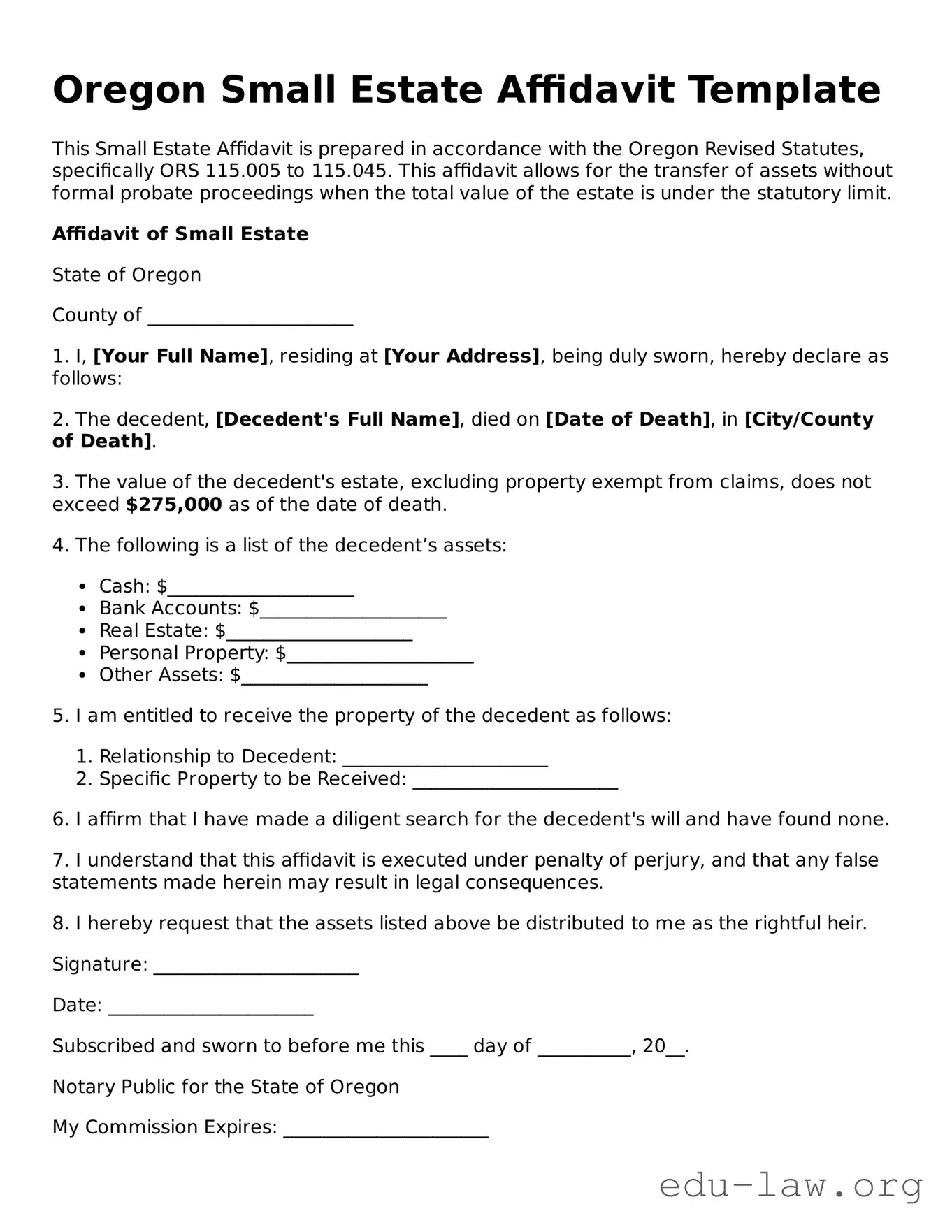
Oregon Small Estate Affidavit Template
This Small Estate Affidavit is prepared in accordance with the Oregon Revised Statutes, specifically ORS 115.005 to 115.045. This affidavit allows for the transfer of assets without formal probate proceedings when the total value of the estate is under the statutory limit.
Affidavit of Small Estate
State of Oregon
County of ______________________
1. I, [Your Full Name], residing at [Your Address], being duly sworn, hereby declare as follows:
2. The decedent, [Decedent's Full Name], died on [Date of Death], in [City/County of Death].
3. The value of the decedent's estate, excluding property exempt from claims, does not exceed $275,000 as of the date of death.
4. The following is a list of the decedent’s assets:
5. I am entitled to receive the property of the decedent as follows:
6. I affirm that I have made a diligent search for the decedent's will and have found none.
7. I understand that this affidavit is executed under penalty of perjury, and that any false statements made herein may result in legal consequences.
8. I hereby request that the assets listed above be distributed to me as the rightful heir.
Signature: ______________________
Date: ______________________
Subscribed and sworn to before me this ____ day of __________, 20__.
Notary Public for the State of Oregon
My Commission Expires: ______________________
| Fact Name | Description |
|---|---|
| Purpose | The Oregon Small Estate Affidavit allows individuals to claim assets of a deceased person without going through probate if the total value is under a certain threshold. |
| Threshold Amount | As of 2023, the total value of the estate must not exceed $275,000 for the Small Estate Affidavit to be applicable. |
| Eligibility | Only certain individuals, such as a surviving spouse, domestic partner, or adult child, can file the affidavit. |
| Governing Law | The Small Estate Affidavit is governed by Oregon Revised Statutes (ORS) 114.505 to 114.560. |
| Filing Process | The affidavit must be completed, signed, and submitted to the appropriate financial institutions or asset holders to claim the deceased's assets. |
After obtaining the Oregon Small Estate Affidavit form, it is essential to gather all necessary information and documents before proceeding. This form allows individuals to claim a decedent's assets without going through formal probate. Follow the steps below to accurately fill out the form.
Once the form is completed and notarized, it can be submitted to the appropriate financial institutions or agencies to claim the decedent's assets.
What is the Oregon Small Estate Affidavit form?
The Oregon Small Estate Affidavit is a legal document that allows individuals to claim assets of a deceased person without going through the lengthy probate process. This form is typically used when the total value of the deceased's assets is below a certain threshold, which, as of 2023, is $275,000. By using this affidavit, heirs or beneficiaries can transfer ownership of property or financial accounts directly, simplifying the process of settling an estate.
Who is eligible to use the Small Estate Affidavit in Oregon?
Eligibility to use the Small Estate Affidavit is generally limited to individuals who are either the surviving spouse, children, or other close relatives of the deceased. Additionally, the estate must meet the value threshold mentioned earlier. If the deceased had a will, the affidavit can still be used, but the heirs must be the ones named in the will. It's important to note that certain types of assets, such as real estate or assets held in a trust, may not qualify for this process.
How do I complete and file the Small Estate Affidavit?
To complete the Small Estate Affidavit, you will need to fill out the form accurately, providing necessary information such as the deceased's details, the names of the heirs, and a list of assets. Once completed, the affidavit must be signed in front of a notary public. After notarization, you can file the affidavit with the appropriate financial institutions or entities that hold the deceased's assets. It’s advisable to keep copies for your records and to provide copies to any relevant parties, such as banks or insurance companies.
What happens after I file the Small Estate Affidavit?
Once the Small Estate Affidavit is filed, the institutions holding the deceased's assets will review the document. If everything is in order, they will release the assets to the rightful heirs as outlined in the affidavit. This process can vary in duration depending on the institution's policies and procedures. If any disputes arise regarding the distribution of assets, it may lead to complications, and legal advice might be necessary to resolve such issues. Overall, this form streamlines the transition of assets, allowing heirs to access what they are entitled to in a more efficient manner.
Failing to provide accurate information about the deceased. It is crucial to include the full name, date of death, and any other identifying details. Inaccurate information can lead to delays or complications.
Not listing all assets. The affidavit requires a complete inventory of the deceased’s assets. Omitting any property or accounts can jeopardize the validity of the affidavit.
Neglecting to sign the affidavit. All parties involved must sign the document. Without the necessary signatures, the affidavit will not be accepted.
Overlooking the requirement for notarization. The affidavit must be notarized to confirm the identity of the signers. Missing this step can result in the affidavit being rejected.
When navigating the process of settling a small estate in Oregon, several key documents often accompany the Oregon Small Estate Affidavit. These documents help streamline the transfer of assets and ensure that all legal requirements are met. Below is a list of commonly used forms and documents that may be needed.
Collecting these documents can simplify the process of settling a small estate in Oregon. Being organized and prepared will help ensure that everything proceeds smoothly and efficiently.
The Oregon Small Estate Affidavit is similar to the Affidavit of Heirship. This document is used to establish the heirs of a deceased person when there is no will. Like the Small Estate Affidavit, it simplifies the process of transferring property without going through probate. Both documents require information about the deceased and their heirs, making it easier for families to manage estate matters without lengthy legal proceedings.
Another similar document is the Will. A Will outlines how a person's assets should be distributed after their death. While a Small Estate Affidavit is used when the estate is below a certain value, a Will can apply to larger estates. Both documents serve to clarify the deceased's wishes and help ensure that assets are passed on to the intended beneficiaries.
The Transfer on Death Deed (TOD) is also comparable. This deed allows individuals to transfer real estate to beneficiaries upon their death without going through probate. Like the Small Estate Affidavit, it simplifies the transfer process. Both documents require the owner’s intent to pass on property, ensuring that the designated beneficiaries receive the asset directly.
The Petition for Probate is another document that shares similarities. This petition is filed to initiate the probate process, which is necessary for larger estates. In contrast, the Small Estate Affidavit allows for a quicker resolution without formal probate. Both documents involve the court and aim to settle the deceased's affairs, but the Small Estate Affidavit is designed for simpler cases.
The Affidavit for Collection of Personal Property is also relevant. This document allows individuals to collect personal property of a deceased person without going through probate. Like the Small Estate Affidavit, it is intended for smaller estates. Both documents require a declaration of the relationship to the deceased and help streamline the process of asset collection.
The Declaration of Informal Probate is another similar document. This declaration is used in some states to handle estates informally, without the full probate process. While the Small Estate Affidavit is specific to smaller estates, both documents aim to simplify the transfer of assets and reduce the burden on families during a difficult time.
The Small Estate Affidavit is also comparable to the Affidavit of Title. This document is used to confirm ownership of property when transferring it after someone’s death. Both documents help facilitate the transfer process and avoid the complexities of probate. They provide a straightforward way to establish ownership and ensure that the right individuals receive the assets.
The Certificate of Trust is another document that can serve a similar purpose. This certificate verifies the existence of a trust and outlines its terms. While the Small Estate Affidavit deals directly with estates, both documents can help in transferring assets without going through probate. They offer a means to clarify the intentions of the deceased regarding their assets.
Lastly, the Living Trust is worth mentioning. A Living Trust allows individuals to manage their assets during their lifetime and designate beneficiaries for after their death. Similar to the Small Estate Affidavit, it avoids probate for the assets held within the trust. Both documents provide a way to ensure that property is distributed according to the deceased's wishes without the lengthy probate process.
When filling out the Oregon Small Estate Affidavit form, it is important to follow certain guidelines to ensure the process goes smoothly. Below is a list of things you should and shouldn't do.
By following these guidelines, you can help ensure that your Small Estate Affidavit is completed correctly and efficiently.
Misconceptions about the Oregon Small Estate Affidavit can lead to confusion and delays in settling an estate. Here are ten common misunderstandings:
Understanding these misconceptions can help streamline the estate settlement process in Oregon.
Filling out and using the Oregon Small Estate Affidavit form can be a straightforward process if you understand the key points. Here are some essential takeaways to keep in mind:
Understanding these key points can make the process of using the Oregon Small Estate Affidavit much smoother for you and your family.