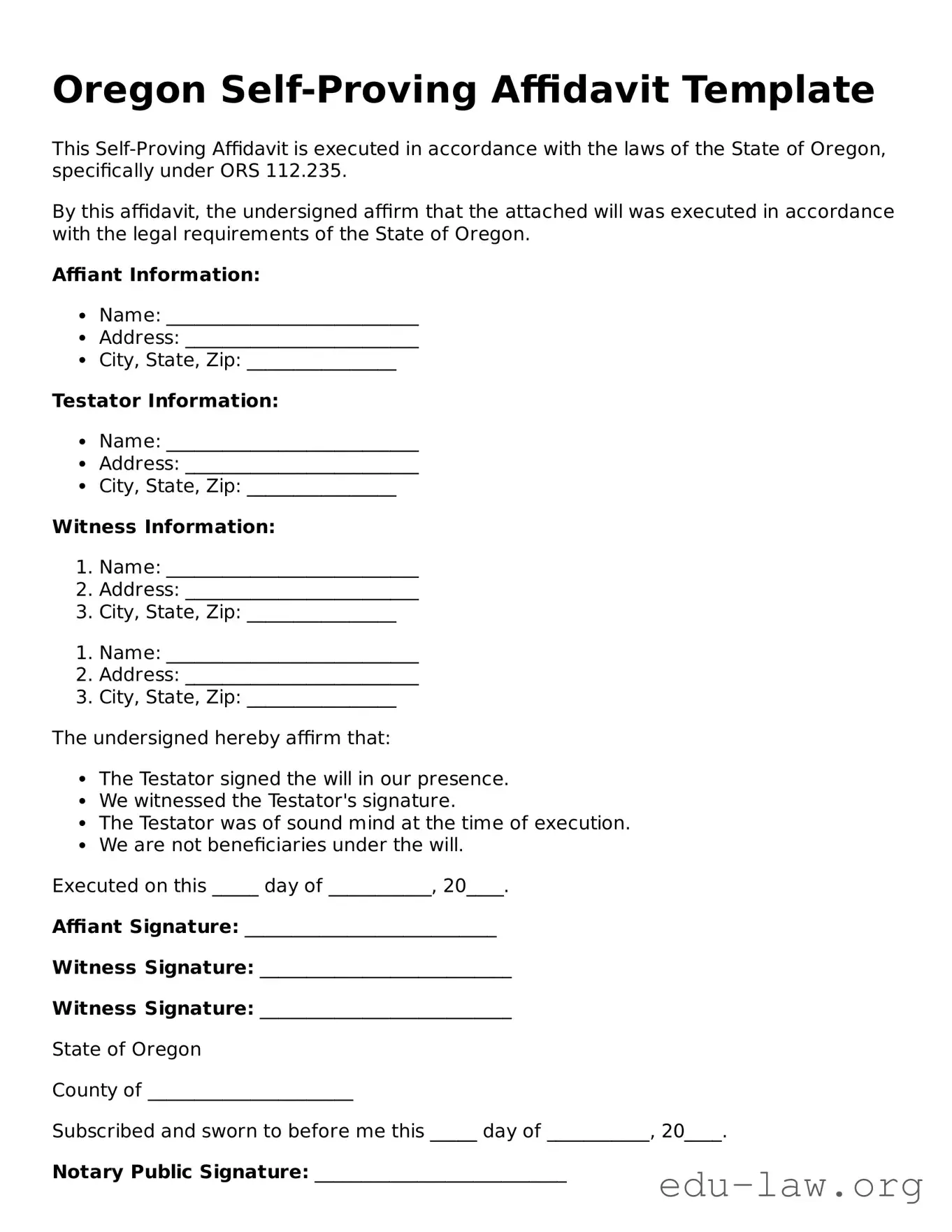
In the realm of estate planning and probate law, the Oregon Self-Proving Affidavit form serves as a crucial tool for individuals seeking to streamline the validation of their wills. This form allows testators to declare that their wills were executed in accordance with state laws, thereby reducing the need for witnesses to testify in court about the will's authenticity. By incorporating the self-proving affidavit into the estate planning process, individuals can facilitate a smoother probate process, potentially saving time and resources for their heirs. The form requires the signatures of the testator and witnesses, along with a notary public's acknowledgment, which adds an extra layer of verification. Furthermore, the use of this affidavit can help to minimize disputes among beneficiaries, as it provides clear evidence of the testator's intentions. Understanding the intricacies of the Oregon Self-Proving Affidavit is essential for anyone looking to ensure that their final wishes are honored and executed efficiently.
Oregon Self-Proving Affidavit Template
This Self-Proving Affidavit is executed in accordance with the laws of the State of Oregon, specifically under ORS 112.235.
By this affidavit, the undersigned affirm that the attached will was executed in accordance with the legal requirements of the State of Oregon.
Affiant Information:
Testator Information:
Witness Information:
The undersigned hereby affirm that:
Executed on this _____ day of ___________, 20____.
Affiant Signature: ___________________________
Witness Signature: ___________________________
Witness Signature: ___________________________
State of Oregon
County of ______________________
Subscribed and sworn to before me this _____ day of ___________, 20____.
Notary Public Signature: ___________________________
My Commission Expires: ___________________________
| Fact Name | Description |
|---|---|
| Purpose | The Oregon Self-Proving Affidavit form allows a will to be validated without the need for witness testimony during probate. |
| Governing Law | This form is governed by Oregon Revised Statutes, specifically ORS 112.235. |
| Signature Requirement | The form must be signed by the testator and two witnesses in the presence of each other. |
| Notarization | A notary public must acknowledge the signatures on the affidavit to ensure its validity. |
| Use in Probate | By submitting the Self-Proving Affidavit, the will can be admitted to probate without the witnesses appearing in court. |
| Revocation | Executing a new will or a formal revocation of the prior will can invalidate the Self-Proving Affidavit. |
| Accessibility | The form is available online through the Oregon Secretary of State's website and can be downloaded for use. |
After gathering the necessary information, you will be ready to fill out the Oregon Self-Proving Affidavit form. This form requires specific details about the testators and witnesses involved in the will. Ensure that all information is accurate and complete before proceeding to the next steps.
Once the form is filled out completely, it is advisable to keep it with the will and provide copies to the relevant parties. This will help ensure that the will is recognized as valid when needed.
What is a Self-Proving Affidavit in Oregon?
A Self-Proving Affidavit is a legal document that allows a will to be validated without requiring the witnesses to testify in court. In Oregon, this affidavit is typically attached to a will, making it easier for the probate process to proceed smoothly. It essentially serves as a declaration that the will was properly signed and witnessed according to state laws.
Who can create a Self-Proving Affidavit?
Any individual who is of sound mind and at least 18 years old can create a Self-Proving Affidavit. This usually includes the testator (the person making the will) and the witnesses who observed the signing of the will. It’s important that all parties involved understand the document and its implications.
What information is included in a Self-Proving Affidavit?
A Self-Proving Affidavit typically includes the names and addresses of the testator and the witnesses, a statement affirming that the will was signed in their presence, and an acknowledgment that they understand the will's contents. The document is usually signed in front of a notary public, who also adds their signature and seal.
Is a Self-Proving Affidavit required in Oregon?
No, a Self-Proving Affidavit is not legally required in Oregon. However, having one can significantly simplify the probate process. Without it, witnesses may need to be called to testify about the will, which can delay proceedings and create additional complications.
How does a Self-Proving Affidavit affect the probate process?
By including a Self-Proving Affidavit with a will, the probate process can be expedited. Courts can accept the will as valid without needing to summon witnesses. This can save time and reduce stress for the executor and beneficiaries, allowing for a smoother transition of assets.
Can a Self-Proving Affidavit be revoked?
A Self-Proving Affidavit itself cannot be revoked; however, it can be rendered invalid if the will it accompanies is revoked. If a new will is created, it should include a new Self-Proving Affidavit to ensure that it meets the same standards for validation.
How can I obtain a Self-Proving Affidavit form in Oregon?
Self-Proving Affidavit forms can often be found online through legal resources or state websites. Many legal document services also offer customizable templates. It’s advisable to ensure that any form you use complies with Oregon state laws to avoid potential issues during probate.
Not Signing in the Presence of a Notary: One common mistake is failing to sign the affidavit in front of a notary public. This step is crucial for the affidavit to be considered valid.
Incorrect Notary Information: Sometimes, people overlook filling out the notary's information correctly. Ensure the notary's name, commission number, and expiration date are accurate.
Missing Witness Signatures: The affidavit requires signatures from witnesses. Forgetting to include these signatures can invalidate the document.
Inaccurate Date: People often forget to write the date of signing. An incorrect or missing date can lead to confusion about when the affidavit was executed.
Using the Wrong Form: Some individuals mistakenly use an outdated or incorrect version of the form. Always check that you have the latest version of the Oregon Self-Proving Affidavit.
Not Providing Complete Information: Leaving out essential details, such as names or addresses, can lead to issues later. Ensure all fields are filled out completely.
Failing to Review the Document: Skimming through the affidavit before submitting it can result in overlooked errors. Take the time to review everything carefully.
Not Keeping Copies: After completing the affidavit, some forget to make copies. Always keep a copy for your records and provide one to your attorney or executor.
The Oregon Self-Proving Affidavit form is an important document that can streamline the probate process by allowing a will to be accepted without the need for witnesses to testify. However, several other forms and documents are often used in conjunction with it. Below is a list of these documents, each serving a specific purpose in estate planning and management.
Each of these documents plays a crucial role in ensuring that an individual’s wishes are honored and that their estate is managed effectively. It is advisable to consider these forms carefully when planning your estate to ensure a smooth transition for your loved ones.
The Oregon Self-Proving Affidavit is similar to a standard will in that both documents serve to clarify the intentions of a person regarding their estate after their death. A will outlines how a person's assets should be distributed, while a self-proving affidavit serves as evidence that the will was executed properly. This affidavit can simplify the probate process, as it eliminates the need for witnesses to testify about the will’s validity, making it easier for the court to accept the will as genuine.
Another document comparable to the Oregon Self-Proving Affidavit is a living trust. A living trust allows individuals to manage their assets during their lifetime and dictate how those assets will be distributed upon their death. Like the self-proving affidavit, a living trust can help avoid probate, allowing for a smoother transition of assets without court involvement. Both documents aim to ensure that a person’s wishes are honored while minimizing legal complexities.
The power of attorney is another document that shares similarities with the self-proving affidavit. A power of attorney designates someone to make financial or medical decisions on behalf of another person. While the self-proving affidavit deals with a person's wishes after death, the power of attorney addresses decisions made while the person is still alive but unable to act for themselves. Both documents require careful consideration and proper execution to be effective.
A healthcare directive, or living will, also bears resemblance to the self-proving affidavit. This document outlines a person’s medical preferences in case they become incapacitated. Like the self-proving affidavit, it ensures that a person's wishes are respected and followed, reducing the potential for disputes among family members or medical providers. Both documents empower individuals to take control of their decisions, whether in life or after death.
The affidavit of heirship is another document that can be compared to the Oregon Self-Proving Affidavit. This document is used to establish the heirs of a deceased person's estate when there is no will. While the self-proving affidavit affirms the validity of a will, the affidavit of heirship serves to clarify who inherits the estate. Both documents play crucial roles in the estate planning process, helping to avoid confusion and disputes among potential heirs.
Another similar document is a codicil, which is an amendment to an existing will. A codicil allows individuals to make changes or updates to their will without having to create an entirely new document. Just like the self-proving affidavit, a codicil must be executed properly to be valid. Both documents require the same level of attention to detail and legal formality to ensure that a person's wishes are accurately reflected.
The estate plan itself is a broader document that encompasses various components, including wills, trusts, and affidavits. An estate plan outlines how a person's assets will be managed and distributed after their death. The self-proving affidavit fits within this larger framework, providing a streamlined way to validate a will. Both documents work together to ensure that a person's wishes are clearly communicated and legally enforceable.
Another document that shares similarities is a disclaimer of interest. This document allows an heir to refuse their inheritance, which can be beneficial in certain situations, such as tax implications. While the self-proving affidavit affirms a will's validity, a disclaimer can alter the distribution of assets as outlined in that will. Both documents can impact how an estate is settled, providing options for heirs in different circumstances.
Lastly, a spousal consent form can be likened to the self-proving affidavit. This document is often used in community property states to ensure that one spouse has the other’s permission to make decisions regarding shared assets. Similar to the self-proving affidavit, a spousal consent form aims to prevent disputes by clearly establishing consent and understanding between parties. Both documents emphasize the importance of communication and agreement in estate planning.
When filling out the Oregon Self-Proving Affidavit form, it is important to follow certain guidelines to ensure the process goes smoothly. Here are six things you should and shouldn't do:
Misconceptions about the Oregon Self-Proving Affidavit form can lead to confusion and potential issues in the estate planning process. Here are eight common misunderstandings:
Understanding these misconceptions can help ensure that the estate planning process is carried out correctly and efficiently.
The Oregon Self-Proving Affidavit is an important legal document that can simplify the probate process for a will. Below are key takeaways regarding its use and completion.