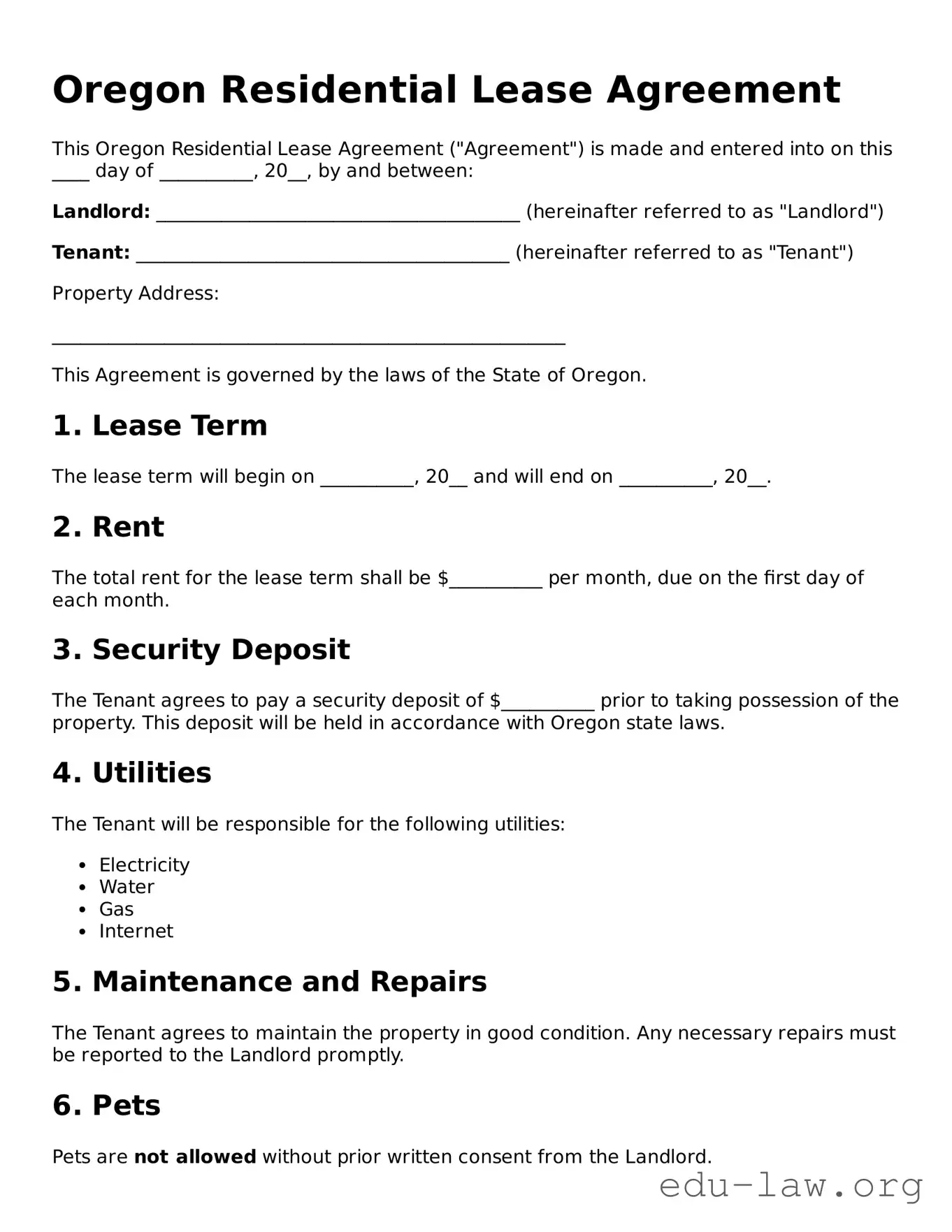
The Oregon Residential Lease Agreement form serves as a vital tool for both landlords and tenants, establishing clear expectations and responsibilities for all parties involved in a rental arrangement. This document outlines essential details such as the rental property’s address, the duration of the lease, and the monthly rent amount. It also specifies the security deposit requirements, which protect the landlord’s interests while ensuring tenants understand their financial obligations. Important provisions regarding maintenance responsibilities, utilities, and rules about pets are included to promote a harmonious living environment. Additionally, the agreement addresses the process for handling late payments, lease termination, and the consequences of breaking the lease, thereby minimizing potential disputes. By clearly delineating the rights and duties of each party, the Oregon Residential Lease Agreement fosters transparency and helps create a positive rental experience.
Oregon Residential Lease Agreement
This Oregon Residential Lease Agreement ("Agreement") is made and entered into on this ____ day of __________, 20__, by and between:
Landlord: _______________________________________ (hereinafter referred to as "Landlord")
Tenant: ________________________________________ (hereinafter referred to as "Tenant")
Property Address:
_______________________________________________________
This Agreement is governed by the laws of the State of Oregon.
1. Lease Term
The lease term will begin on __________, 20__ and will end on __________, 20__.
2. Rent
The total rent for the lease term shall be $__________ per month, due on the first day of each month.
3. Security Deposit
The Tenant agrees to pay a security deposit of $__________ prior to taking possession of the property. This deposit will be held in accordance with Oregon state laws.
4. Utilities
The Tenant will be responsible for the following utilities:
5. Maintenance and Repairs
The Tenant agrees to maintain the property in good condition. Any necessary repairs must be reported to the Landlord promptly.
6. Pets
Pets are not allowed without prior written consent from the Landlord.
7. Termination
Either party may terminate this Agreement by providing a written notice of at least 30 days prior to the intended termination date.
8. Governing Law
This Agreement shall be governed by and construed in accordance with the laws of the State of Oregon.
9. Signatures
By signing below, both parties agree to the terms of this Agreement.
Landlord Signature: _____________________________ Date: ____________
Tenant Signature: ______________________________ Date: ____________
| Fact Name | Details |
|---|---|
| Governing Law | The Oregon Residential Lease Agreement is governed by Oregon state law, specifically the Oregon Revised Statutes (ORS) Chapter 90. |
| Parties Involved | The agreement is between the landlord and the tenant, clearly identifying each party's rights and responsibilities. |
| Duration of Lease | The lease can be for a fixed term or a month-to-month basis, depending on the agreement between the parties. |
| Security Deposit | Oregon law limits the security deposit to one month's rent, and it must be returned within 31 days after the lease ends. |
| Rent Payment | The lease should specify the amount of rent, the due date, and acceptable payment methods. |
| Maintenance Responsibilities | The agreement outlines the responsibilities of both the landlord and tenant regarding property maintenance and repairs. |
| Termination Notice | For month-to-month leases, either party must provide at least 30 days' written notice to terminate the agreement. |
| Discrimination Protections | The lease must comply with fair housing laws, prohibiting discrimination based on race, color, religion, sex, national origin, disability, or familial status. |
Completing the Oregon Residential Lease Agreement form is an important step in establishing a rental relationship. This document outlines the terms and conditions of the lease, ensuring both parties are on the same page. Follow these steps to fill out the form accurately.
Once the form is completed, both parties should retain a copy for their records. This ensures that everyone has access to the agreed-upon terms throughout the duration of the lease.
What is an Oregon Residential Lease Agreement?
An Oregon Residential Lease Agreement is a legal document that outlines the terms and conditions under which a landlord rents property to a tenant. This agreement typically includes details such as the rental amount, duration of the lease, security deposit requirements, and the responsibilities of both parties. It serves to protect the rights of both landlords and tenants by clearly defining expectations and obligations.
What are the key components of the Oregon Residential Lease Agreement?
The key components of this agreement generally include the names of the landlord and tenant, the property address, the lease term (fixed-term or month-to-month), rental payment details, security deposit information, and maintenance responsibilities. Additionally, it may cover rules regarding pets, smoking, and other property use regulations. It is essential that both parties review these components carefully before signing.
How long does a typical lease last in Oregon?
In Oregon, leases can vary in duration. A typical fixed-term lease lasts for one year, but it can also be shorter or longer, depending on the agreement between the landlord and tenant. Month-to-month leases are also common, allowing for more flexibility. However, it is important to note that even month-to-month leases require proper notice for termination, usually 30 days.
Can a landlord increase rent during the lease term?
Generally, landlords cannot increase rent during the term of a fixed-term lease unless the lease specifically allows for it. For month-to-month leases, landlords can raise the rent, but they must provide proper written notice, typically 30 days in Oregon. It is crucial for tenants to understand their lease terms regarding rent increases to avoid any surprises.
What should I do if I need to terminate my lease early?
If you need to terminate your lease early, first review the lease agreement for any early termination clauses. Many leases include specific conditions under which a tenant can break the lease without penalty. If no such clause exists, you may still be responsible for paying rent until the lease ends or until the landlord finds a new tenant. Communicating with your landlord is essential; they may be willing to negotiate an early termination agreement.
Failing to provide accurate tenant information. It is crucial that all tenants' names and contact details are correctly listed. Any discrepancies can lead to confusion or disputes.
Not including the lease term. The agreement should specify the start and end dates of the lease. Omitting this information can create uncertainty regarding the duration of tenancy.
Neglecting to document the rental amount. Clearly stating the monthly rent and due date is essential. Without this, tenants may misunderstand their payment obligations.
Overlooking the security deposit details. The lease should outline the amount of the security deposit, the conditions for its return, and any deductions that may apply.
Failing to specify maintenance responsibilities. It is important to clarify who is responsible for repairs and maintenance. This can help prevent disputes later on.
Ignoring the pet policy. If pets are allowed, the lease should detail any restrictions or additional fees. This prevents misunderstandings between landlords and tenants.
Not including any rules regarding alterations to the property. Tenants should be informed about what changes they can make, if any, to avoid potential issues.
Leaving out the notice period for termination. The lease should specify how much notice is required from either party to terminate the agreement. This protects both landlords and tenants.
Failing to include the consequences of late payments. The lease should state any late fees or penalties that may be incurred if rent is not paid on time.
Not having all parties sign the agreement. Every adult tenant must sign the lease to ensure that all parties are legally bound by its terms. Missing signatures can render the lease unenforceable.
When entering into a rental agreement in Oregon, several additional forms and documents are often utilized alongside the Oregon Residential Lease Agreement. These documents help clarify the terms of the lease, outline responsibilities, and protect the rights of both the landlord and the tenant. Below is a list of commonly used forms that can be beneficial in the leasing process.
Using these forms and documents alongside the Oregon Residential Lease Agreement can enhance communication between landlords and tenants. They ensure that both parties understand their rights and obligations, creating a smoother rental experience.
The Oregon Rental Agreement is similar to the standard Residential Lease Agreement found in many states. Both documents outline the terms and conditions under which a tenant agrees to rent a property from a landlord. They typically cover essential elements such as rent amount, payment due dates, security deposits, and maintenance responsibilities. While the specifics may vary by state, the fundamental purpose remains the same: to protect the rights of both parties and ensure clarity in the rental relationship.
Another document that resembles the Oregon Residential Lease Agreement is the Month-to-Month Rental Agreement. This type of agreement provides flexibility for both landlords and tenants, allowing either party to terminate the lease with a short notice period. Much like the standard lease, it includes details about rent, utilities, and property maintenance, but it also emphasizes the temporary nature of the rental arrangement. This is ideal for those who may not want to commit to a long-term lease.
The Sublease Agreement is yet another document that shares similarities with the Oregon Residential Lease Agreement. This agreement allows a tenant to rent out their leased space to another individual, known as the subtenant. It mirrors the original lease in many ways, including stipulations about rent, duration, and property use. However, it also includes specific clauses that address the responsibilities of both the original tenant and the subtenant, ensuring that the original lease terms are upheld.
A Lease Addendum is also akin to the Oregon Residential Lease Agreement. This document serves as an attachment or modification to the original lease, adding specific terms or conditions that were not included in the initial agreement. For instance, it may detail pet policies or additional fees. While it functions as a supplement, it is equally important in clarifying the rights and obligations of both parties, similar to the main lease document.
Finally, the Commercial Lease Agreement is comparable to the Oregon Residential Lease Agreement, though it is tailored for business properties. Both documents outline the terms of rental, including duration, payment terms, and maintenance obligations. However, a Commercial Lease Agreement often includes additional clauses related to business operations, zoning laws, and modifications to the property. Both types of leases aim to protect the interests of the landlord and tenant while ensuring a clear understanding of the rental arrangement.
When filling out the Oregon Residential Lease Agreement form, it is essential to approach the process with care and attention to detail. Here are six important considerations to keep in mind:
By adhering to these guidelines, you can navigate the lease agreement process more effectively, fostering a positive landlord-tenant relationship from the outset.
Understanding the Oregon Residential Lease Agreement form is crucial for both landlords and tenants. However, several misconceptions can lead to confusion. Here are seven common misunderstandings:
Many people think that lease agreements are interchangeable. In reality, each state has specific laws that govern lease agreements, and Oregon has its own unique requirements.
Some believe that a verbal agreement is enough to create a binding lease. However, written agreements provide clarity and legal protection for both parties.
It's a common belief that landlords can modify lease terms whenever they wish. In fact, changes typically require mutual consent and may need to be documented in writing.
There is a misconception that security deposits are always kept by landlords. In Oregon, tenants may be entitled to a refund, depending on the condition of the property at the end of the lease.
Some tenants think they can stop paying rent if they encounter issues with the property. However, withholding rent is only permissible under specific circumstances outlined in Oregon law.
Many assume that all leases last for a year. In reality, lease agreements can be for various durations, including month-to-month arrangements.
It is a misconception that landlords have unrestricted access to rental properties. Oregon law requires landlords to provide notice before entering a tenant's home, except in emergencies.
Being aware of these misconceptions can help both landlords and tenants navigate their rights and responsibilities more effectively.
When dealing with the Oregon Residential Lease Agreement form, it’s important to understand a few key aspects to ensure a smooth process. Here are some essential takeaways:
By keeping these points in mind, both landlords and tenants can navigate the Oregon Residential Lease Agreement with confidence and clarity.