The Oregon Quitclaim Deed form serves as an essential tool for individuals looking to transfer property ownership in a straightforward manner. Unlike other types of deeds, a quitclaim deed does not guarantee that the property title is free of claims or encumbrances. Instead, it allows the current owner, known as the grantor, to relinquish any interest they may have in the property to another party, called the grantee. This form is particularly useful in situations such as transferring property between family members, resolving disputes, or clearing up title issues. It is important to note that while a quitclaim deed can expedite the transfer process, it does not provide the same level of protection as warranty deeds, which offer assurances about the property's title. Completing the Oregon Quitclaim Deed requires specific information, including the names of the parties involved, a legal description of the property, and the signatures of the grantor. Additionally, the form must be notarized and recorded with the county clerk to ensure that the transfer is legally recognized. Understanding the nuances of this form can help facilitate smooth property transactions and protect the interests of all parties involved.
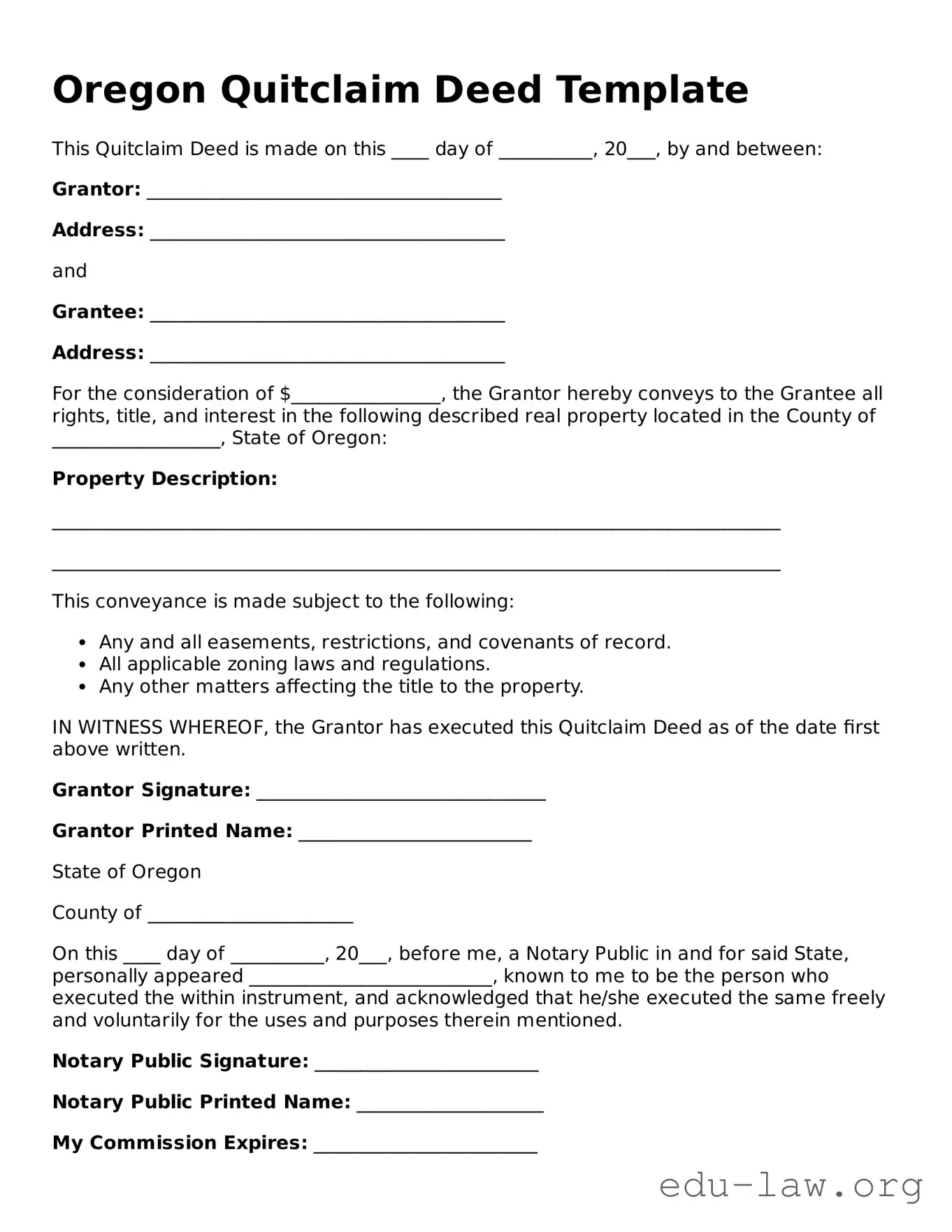
Oregon Quitclaim Deed Template
This Quitclaim Deed is made on this ____ day of __________, 20___, by and between:
Grantor: ______________________________________
Address: ______________________________________
and
Grantee: ______________________________________
Address: ______________________________________
For the consideration of $________________, the Grantor hereby conveys to the Grantee all rights, title, and interest in the following described real property located in the County of __________________, State of Oregon:
Property Description:
______________________________________________________________________________
______________________________________________________________________________
This conveyance is made subject to the following:
IN WITNESS WHEREOF, the Grantor has executed this Quitclaim Deed as of the date first above written.
Grantor Signature: _______________________________
Grantor Printed Name: _________________________
State of Oregon
County of ______________________
On this ____ day of __________, 20___, before me, a Notary Public in and for said State, personally appeared __________________________, known to me to be the person who executed the within instrument, and acknowledged that he/she executed the same freely and voluntarily for the uses and purposes therein mentioned.
Notary Public Signature: ________________________
Notary Public Printed Name: ____________________
My Commission Expires: ________________________
| Fact Name | Details |
|---|---|
| Definition | A Quitclaim Deed is a legal document used to transfer ownership of real estate from one party to another without making any warranties about the title. |
| Usage | This form is often used in situations where property is transferred between family members, or in divorce settlements. |
| Governing Law | The Oregon Quitclaim Deed is governed by the Oregon Revised Statutes, specifically ORS 93.860. |
| Filing Requirements | After completion, the Quitclaim Deed must be filed with the county clerk in the county where the property is located. |
After obtaining the Oregon Quitclaim Deed form, you will need to complete it accurately to ensure proper transfer of property rights. Once filled out, the form must be signed and notarized before being recorded with the county clerk's office.
What is a Quitclaim Deed in Oregon?
A Quitclaim Deed is a legal document used to transfer ownership of real property from one person to another without any warranties or guarantees. This means that the person transferring the property, known as the grantor, does not assure the recipient, or grantee, that the title is clear or free of any claims. In Oregon, this type of deed is commonly used among family members or in situations where the parties involved trust each other. It is a straightforward way to convey property rights, but it is essential to understand the implications of such a transfer.
How do I complete an Oregon Quitclaim Deed?
Completing a Quitclaim Deed in Oregon involves several steps. First, you will need to obtain the appropriate form, which can typically be found online or at your local county clerk’s office. Next, you must fill out the form with accurate information, including the names of the grantor and grantee, the legal description of the property, and the date of the transfer. After the form is completed, it should be signed by the grantor in the presence of a notary public. Finally, the deed must be recorded at the county recorder's office where the property is located to ensure the transfer is legally recognized.
Are there any fees associated with filing a Quitclaim Deed in Oregon?
Yes, there are fees associated with filing a Quitclaim Deed in Oregon. The recording fees vary by county, so it is advisable to check with your local county recorder’s office for the exact amount. Additionally, if you seek assistance in preparing the deed, there may be costs involved in hiring a legal document preparer or using online services. It is essential to factor in these expenses when planning your property transfer.
Can a Quitclaim Deed be revoked in Oregon?
Once a Quitclaim Deed is executed and recorded, it generally cannot be revoked. The transfer of property rights is considered final. However, if there are extenuating circumstances, such as fraud or duress during the signing process, it may be possible to challenge the deed in court. It is crucial to understand the permanence of this type of deed before proceeding with the transfer, as it can have lasting implications on property ownership.
Do I need an attorney to prepare a Quitclaim Deed in Oregon?
While it is not legally required to have an attorney prepare a Quitclaim Deed in Oregon, seeking legal advice can be beneficial, especially if the property transfer involves complex issues or disputes. An attorney can provide guidance on the implications of the deed, help ensure that all necessary information is included, and address any concerns you may have. If you feel confident in handling the process yourself, you can also utilize resources available online or at your local county clerk's office to complete the deed.
Not including the correct names of all parties involved. Make sure to list the full names of both the grantor (the person transferring the property) and the grantee (the person receiving the property).
Failing to provide a complete property description. The property must be clearly identified, including details like the address and parcel number.
Neglecting to sign the deed. Both the grantor and any required witnesses must sign the document for it to be valid.
Forgetting to have the deed notarized. A notary public must witness the signatures to ensure authenticity.
Leaving out the date of the transaction. It's important to include the date when the transfer takes place.
Using incorrect legal terminology. While the Quitclaim Deed form is straightforward, using terms that are not clear can lead to confusion.
Not checking for outstanding liens or claims on the property. It’s wise to ensure there are no legal issues attached to the property before transferring ownership.
Failing to record the deed after signing. Once completed, the deed should be filed with the appropriate county office to make the transfer official.
Not keeping copies of the completed deed. Always retain a copy for your records in case you need to reference it in the future.
When transferring property in Oregon, a Quitclaim Deed is a crucial document. However, there are several other forms and documents that often accompany it to ensure a smooth and legally sound transaction. Below is a list of these important documents, each serving a specific purpose in the property transfer process.
Understanding these documents can help you navigate the property transfer process more confidently. Each plays a vital role in ensuring that the transaction is completed legally and that both parties are protected.
A warranty deed is one of the most common forms of property transfer documents, similar to a quitclaim deed in that it conveys ownership of real estate. However, a warranty deed provides a guarantee that the seller holds clear title to the property and has the right to sell it. This means that if any issues arise regarding the title, the seller is responsible for resolving them. In contrast, a quitclaim deed offers no such guarantees, making it a more straightforward but riskier option for buyers who may not know the full history of the property.
A special warranty deed is another document that shares similarities with a quitclaim deed. Like a quitclaim deed, it transfers property without providing a full guarantee of the title. However, the special warranty deed does include a limited warranty, meaning the seller only guarantees that they have not caused any title issues during their ownership. This makes it a middle ground between a quitclaim deed and a warranty deed, offering some level of protection while still being less comprehensive than a full warranty deed.
A bargain and sale deed is also akin to a quitclaim deed, as it transfers property without a warranty of clear title. This type of deed implies that the seller has ownership of the property and the right to sell it, but it does not guarantee that the title is free of liens or other claims. Buyers should be cautious when using a bargain and sale deed, as they may inherit hidden issues related to the property’s title, similar to what they might face with a quitclaim deed.
A grant deed is another document that bears resemblance to a quitclaim deed. It transfers ownership of real estate and includes certain implied warranties, such as the assurance that the seller has not transferred the property to anyone else and that the property is free from undisclosed encumbrances. While it offers more protection than a quitclaim deed, it does not guarantee against all potential title defects, making it essential for buyers to conduct thorough due diligence.
A deed of trust is somewhat different but still related to the realm of property transactions. While a quitclaim deed transfers ownership, a deed of trust is used to secure a loan with real estate as collateral. In this case, the property is held by a third party (the trustee) until the borrower pays off the loan. Although it serves a different purpose, both documents are essential in real estate transactions and can significantly impact ownership rights.
Finally, a leasehold deed can be compared to a quitclaim deed in that it conveys an interest in real estate, but it does so temporarily. A leasehold deed grants the lessee the right to use and occupy the property for a specified period. Unlike a quitclaim deed, which transfers ownership, a leasehold deed maintains the lessor's ownership rights. This distinction is crucial for understanding the nature of the rights being transferred and the duration of those rights.
When filling out the Oregon Quitclaim Deed form, it is essential to approach the process with care and attention. Here are six important dos and don'ts to consider:
By following these guidelines, you can help ensure a smooth process when completing the Oregon Quitclaim Deed form.
This is not entirely accurate. A quitclaim deed transfers whatever interest the grantor has in the property, but it does not guarantee that the grantor actually owns the property. If the grantor has no interest, the recipient receives nothing.
While quitclaim deeds are often used to transfer property between spouses during a divorce, they can be used in various situations. For instance, they are also common in family transfers, estate settlements, or when individuals want to clear up title issues.
This is misleading. A quitclaim deed does not resolve any existing liens, mortgages, or other claims against the property. The new owner may still face legal challenges if there are unresolved title issues.
This is incorrect. A warranty deed provides a guarantee that the grantor holds clear title to the property and has the right to sell it. In contrast, a quitclaim deed offers no such assurances. It simply conveys whatever interest the grantor may have.
Filling out and using the Oregon Quitclaim Deed form requires attention to detail and an understanding of its implications. Here are key takeaways to consider:
Understanding these aspects can facilitate a smoother transaction and help avoid potential disputes or complications in the future.