When couples in Oregon decide to tie the knot, they often consider a prenuptial agreement as a way to protect their individual assets and clarify financial responsibilities. This important legal document outlines how property and debts will be handled in the event of a divorce or separation. It can address various aspects, including the division of assets acquired during the marriage, spousal support, and even the handling of debts. By discussing these topics before marriage, couples can foster open communication and set clear expectations. The Oregon Prenuptial Agreement form serves as a structured template to help partners articulate their wishes and ensure that both parties are on the same page. While it might not be the most romantic topic, a well-crafted prenuptial agreement can provide peace of mind and help avoid potential conflicts down the road.
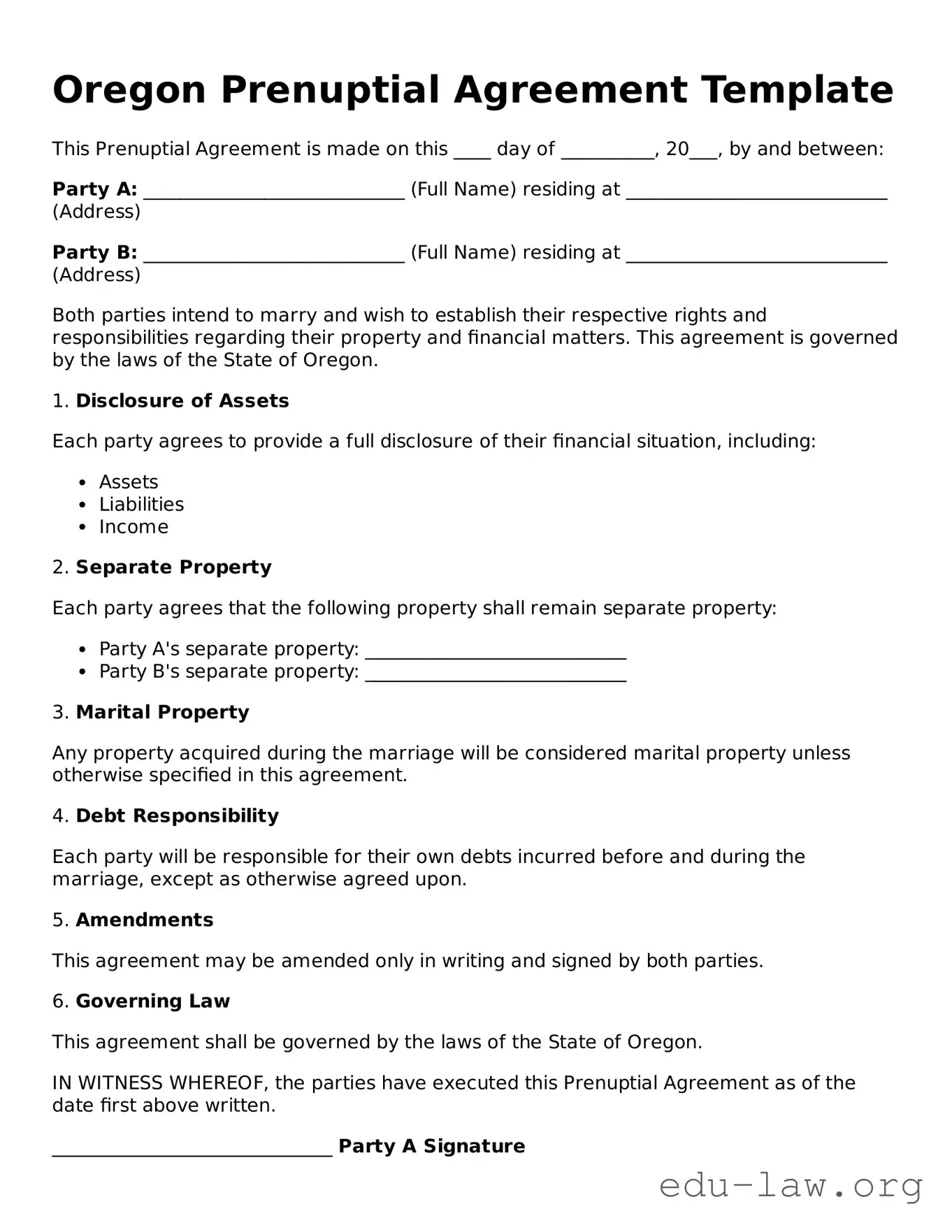
Oregon Prenuptial Agreement Template
This Prenuptial Agreement is made on this ____ day of __________, 20___, by and between:
Party A: ____________________________ (Full Name) residing at ____________________________ (Address)
Party B: ____________________________ (Full Name) residing at ____________________________ (Address)
Both parties intend to marry and wish to establish their respective rights and responsibilities regarding their property and financial matters. This agreement is governed by the laws of the State of Oregon.
1. Disclosure of Assets
Each party agrees to provide a full disclosure of their financial situation, including:
2. Separate Property
Each party agrees that the following property shall remain separate property:
3. Marital Property
Any property acquired during the marriage will be considered marital property unless otherwise specified in this agreement.
4. Debt Responsibility
Each party will be responsible for their own debts incurred before and during the marriage, except as otherwise agreed upon.
5. Amendments
This agreement may be amended only in writing and signed by both parties.
6. Governing Law
This agreement shall be governed by the laws of the State of Oregon.
IN WITNESS WHEREOF, the parties have executed this Prenuptial Agreement as of the date first above written.
______________________________ Party A Signature
______________________________ Party B Signature
______________________________ Date
______________________________ Date
| Fact Name | Description |
|---|---|
| Definition | An Oregon prenuptial agreement is a legal document created by two individuals before they marry, outlining the division of assets and responsibilities in the event of divorce or separation. |
| Governing Law | The Oregon Uniform Premarital Agreement Act governs prenuptial agreements in Oregon, specifically ORS 108.700 to 108.740. |
| Purpose | The main purpose of a prenuptial agreement is to protect individual assets and clarify financial rights and obligations. |
| Enforceability | For a prenuptial agreement to be enforceable in Oregon, it must be in writing and signed by both parties. |
| Full Disclosure | Both parties must fully disclose their financial situations, including assets and debts, to ensure fairness. |
| Legal Representation | It is highly recommended that each party seeks independent legal counsel before signing the agreement to ensure understanding and fairness. |
| Modification | A prenuptial agreement can be modified or revoked after marriage if both parties agree in writing. |
| Limitations | Oregon law does not allow prenuptial agreements to dictate child custody or child support arrangements. |
| Timing | It is advisable to create and sign the prenuptial agreement well in advance of the wedding to avoid claims of coercion. |
| Common Misconceptions | Many believe prenuptial agreements are only for the wealthy; however, they can be beneficial for anyone entering a marriage with existing assets or debts. |
Filling out the Oregon Prenuptial Agreement form is a straightforward process. It’s important to provide accurate information to ensure that the agreement reflects your intentions. Follow these steps to complete the form correctly.
Once you have completed the form, review it carefully. Make sure all information is accurate and both parties agree to the terms. Keep a copy for your records and provide one to your partner. This document will serve as a reference in the future.
What is a prenuptial agreement in Oregon?
A prenuptial agreement, often called a prenup, is a legal contract created by two individuals before they get married. In Oregon, this agreement outlines how assets and debts will be divided in the event of a divorce or separation. It can also address issues like spousal support. By having a prenup, couples can protect their individual interests and clarify financial expectations, which can help reduce conflicts later on.
Why should I consider a prenuptial agreement?
Many couples find that a prenuptial agreement provides peace of mind. It allows both partners to discuss financial matters openly, which can strengthen their relationship. Additionally, if one or both partners have significant assets, business interests, or children from previous relationships, a prenup can help ensure that those assets are protected. It’s a proactive step that can save time, stress, and money in the long run.
What should be included in a prenuptial agreement?
While every prenuptial agreement is unique, common elements include the identification of each partner’s assets and debts, how property will be divided in the event of a divorce, and whether spousal support will be paid. Couples may also choose to include provisions for financial responsibilities during the marriage. It’s important to tailor the agreement to fit your specific situation and future goals.
Is a prenuptial agreement enforceable in Oregon?
Yes, prenuptial agreements are generally enforceable in Oregon as long as they meet certain legal requirements. Both parties must fully disclose their financial situations, and the agreement must be signed voluntarily without any coercion. Additionally, it should be fair and reasonable at the time of signing. If these conditions are met, the court is likely to uphold the agreement in the event of a dispute.
Can I modify a prenuptial agreement after marriage?
Yes, a prenuptial agreement can be modified after marriage, but both partners must agree to the changes. This is typically done through a written amendment to the original agreement. It’s important to ensure that any modifications comply with Oregon law and are executed properly to maintain their enforceability.
Do I need a lawyer to create a prenuptial agreement in Oregon?
While it’s not legally required to have a lawyer draft a prenuptial agreement, it is highly recommended. A lawyer can help ensure that the agreement complies with Oregon laws, is fair to both parties, and addresses all necessary issues. Having legal representation can also provide peace of mind, knowing that your rights and interests are protected.
Failing to disclose all assets and debts. Transparency is crucial in a prenuptial agreement. When individuals do not fully disclose their financial situations, it can lead to disputes later.
Not considering future financial changes. Many people overlook the potential for future income changes or asset acquisitions. A prenuptial agreement should account for these possibilities to remain relevant over time.
Using vague language. Clarity is essential. When terms are ambiguous, it can create confusion and lead to legal challenges. Specificity helps ensure that both parties understand their rights and obligations.
Neglecting to have independent legal counsel. Each party should have their own attorney review the agreement. Without independent legal advice, individuals may not fully understand the implications of the agreement.
Rushing the process. Taking the time to carefully consider the terms and implications of a prenuptial agreement is vital. Rushed decisions can result in agreements that do not adequately protect either party.
When preparing a prenuptial agreement in Oregon, several additional forms and documents may be beneficial. These documents can help clarify terms, outline financial responsibilities, and protect both parties' interests. Below is a list of commonly used forms that accompany a prenuptial agreement.
These documents play a significant role in ensuring that both parties are protected and that their wishes are clearly outlined. Consulting with a qualified professional can help in understanding the importance and implications of each document.
A cohabitation agreement is similar to a prenuptial agreement in that it outlines the rights and responsibilities of partners living together without being married. This document addresses issues such as property ownership, financial obligations, and the division of assets in the event of a separation. Both agreements aim to provide clarity and security for the parties involved, helping to prevent disputes that may arise in the future.
A postnuptial agreement serves a similar purpose to a prenuptial agreement but is created after the marriage has taken place. Like a prenuptial agreement, it details how assets and debts will be handled in the event of divorce or separation. This document can be particularly useful for couples who wish to modify their financial arrangements or clarify their intentions regarding property acquired during the marriage.
A separation agreement is another document akin to a prenuptial agreement, as it outlines the terms under which a couple will separate. This document can cover child custody, support, and the division of assets. While a prenuptial agreement is created before marriage, a separation agreement is typically drafted when a couple decides to live apart, making it essential for addressing immediate concerns and future arrangements.
An estate planning document, such as a will or trust, shares similarities with a prenuptial agreement in that both deal with the distribution of assets. While a prenuptial agreement focuses on assets during the marriage and potential divorce, estate planning documents address how an individual's assets will be managed and distributed after death. Both types of documents aim to provide clarity and protect the interests of the parties involved.
A financial disclosure statement can also be compared to a prenuptial agreement. This document requires both parties to disclose their financial situations, including assets, debts, and income. By ensuring transparency, it helps couples make informed decisions about their financial future together. Both documents emphasize the importance of understanding each partner's financial standing before entering into a legally binding agreement.
When considering a prenuptial agreement in Oregon, it is essential to approach the process thoughtfully. Below are five important do's and don'ts to keep in mind while filling out the form.
These guidelines can help ensure that the prenuptial agreement serves its intended purpose and fosters a sense of trust between partners.
When it comes to prenuptial agreements in Oregon, there are several misconceptions that can lead to confusion and misunderstandings. Here are eight common myths, along with clarifications to help set the record straight.
This is a common myth. Prenuptial agreements can benefit couples of all income levels. They provide clarity and protection for both parties, regardless of financial status.
While they do outline how assets will be divided in the event of a divorce, prenuptial agreements can also address issues like debt management and financial responsibilities during marriage.
In Oregon, prenuptial agreements are legally enforceable as long as they meet certain requirements, such as being in writing and signed by both parties.
This is false. Couples can modify their prenuptial agreements at any time, provided both parties agree to the changes and the modifications are documented properly.
Many view them as practical tools for financial planning rather than expressions of distrust. They can foster open communication about finances, which is essential in a healthy relationship.
Each party should have their own legal representation to ensure that their interests are adequately protected. This helps avoid potential conflicts of interest.
While they are commonly associated with marriage, similar agreements can be created for domestic partnerships, providing similar protections and clarity.
While they can involve legal language and considerations, working with an experienced attorney can simplify the process. Couples can tailor the agreement to meet their specific needs.
Understanding these misconceptions can help couples make informed decisions about prenuptial agreements and their financial future together.
When considering a prenuptial agreement in Oregon, it's important to understand the process and implications. Here are some key takeaways to keep in mind:
Understanding these aspects can help ensure that the prenuptial agreement serves its intended purpose and protects both parties' interests.