The Oregon Power of Attorney for a Child form is a crucial legal document that allows a parent or legal guardian to designate another adult to make decisions on behalf of their child. This form is particularly important in situations where a parent may be temporarily unavailable due to work, travel, or other obligations. It grants the designated individual the authority to handle various responsibilities, including healthcare decisions, educational matters, and general welfare. By using this form, parents can ensure that their child's needs are met in their absence, providing peace of mind during times of uncertainty. The document must be completed in accordance with Oregon state laws, ensuring that it is both valid and enforceable. It is essential for parents to understand the scope of authority they are granting and to choose a trusted individual who will act in the best interests of the child. This form can serve as a safeguard, allowing for continuity of care and support, thus fostering a stable environment for the child during the parent's temporary absence.
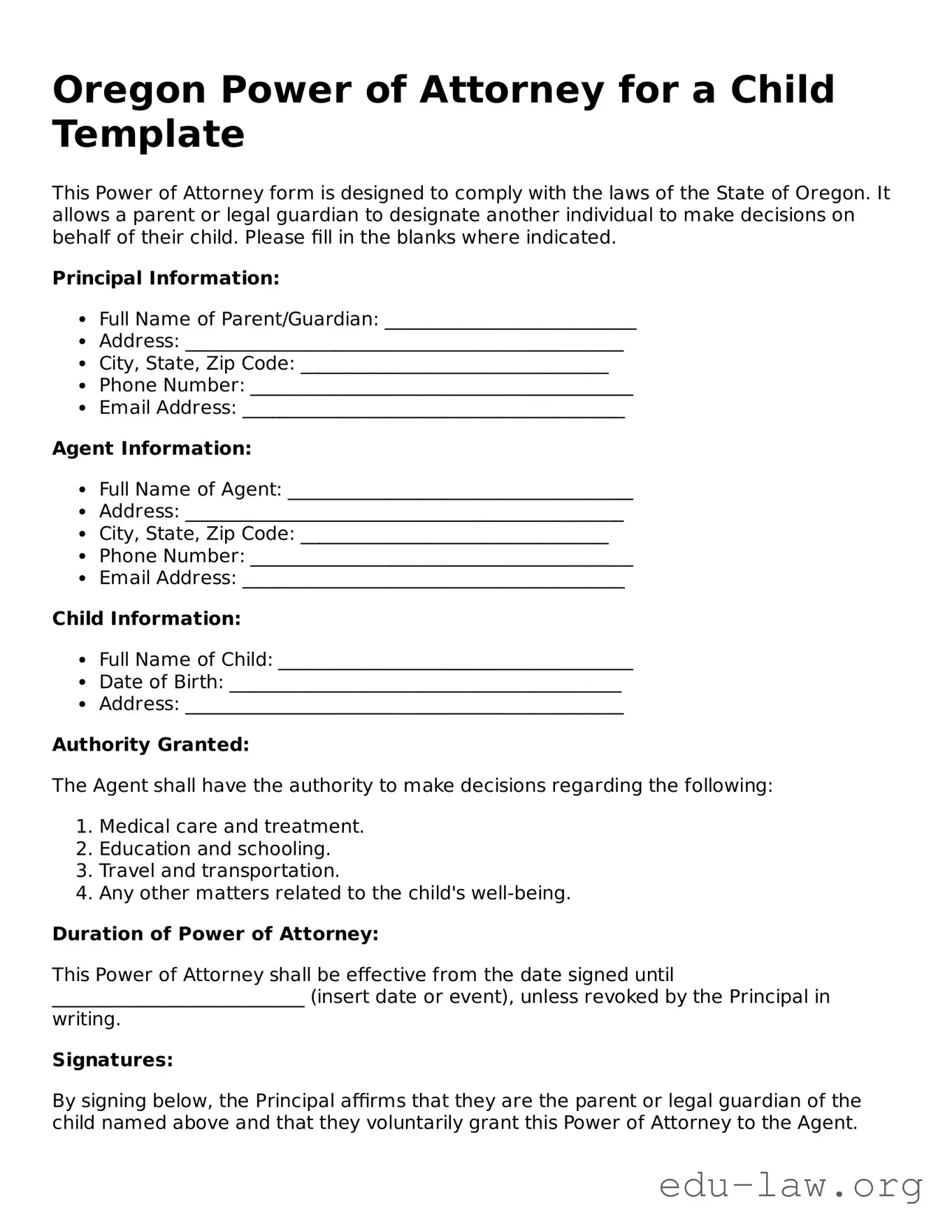
Oregon Power of Attorney for a Child Template
This Power of Attorney form is designed to comply with the laws of the State of Oregon. It allows a parent or legal guardian to designate another individual to make decisions on behalf of their child. Please fill in the blanks where indicated.
Principal Information:
Agent Information:
Child Information:
Authority Granted:
The Agent shall have the authority to make decisions regarding the following:
Duration of Power of Attorney:
This Power of Attorney shall be effective from the date signed until ___________________________ (insert date or event), unless revoked by the Principal in writing.
Signatures:
By signing below, the Principal affirms that they are the parent or legal guardian of the child named above and that they voluntarily grant this Power of Attorney to the Agent.
_____________________________
Signature of Parent/Guardian
Date: ________________________
_____________________________
Signature of Agent
Date: ________________________
Witnesses:
1. __________________________
Signature of Witness
Date: ________________________
2. __________________________
Signature of Witness
Date: ________________________
Notary Public:
State of Oregon
County of ____________________
Subscribed and sworn to before me this ____ day of __________, 20__.
_____________________________
Notary Public Signature
My Commission Expires: ____________
| Fact Name | Description |
|---|---|
| Purpose | The Oregon Power of Attorney for a Child form allows a parent or guardian to appoint someone else to make decisions for their child. |
| Governing Law | This form is governed by Oregon Revised Statutes (ORS) 126.036. |
| Duration | The authority granted can be temporary or indefinite, depending on the parent's choice. |
| Limitations | It does not grant the agent the ability to make decisions regarding the child's education or medical care unless specified. |
| Agent Requirements | The agent must be at least 18 years old and capable of making responsible decisions. |
| Revocation | The parent can revoke the power of attorney at any time, as long as they provide written notice. |
| Signature Requirement | The form must be signed by the parent or guardian and may require notarization for validity. |
| Child's Information | The form requires the child's full name, date of birth, and other identifying details. |
Filling out the Oregon Power of Attorney for a Child form is straightforward. After completing the form, you will need to ensure that it is signed and notarized to make it legally binding. Keep a copy for your records and provide one to the designated agent.
What is a Power of Attorney for a Child in Oregon?
A Power of Attorney for a Child in Oregon is a legal document that allows a parent or legal guardian to appoint another adult to make decisions on behalf of their child. This can include decisions related to education, healthcare, and general welfare. It is often used when parents are temporarily unable to care for their child due to travel, illness, or other circumstances.
Who can serve as an agent under this Power of Attorney?
The agent, or the person appointed to act on behalf of the child, must be an adult. This can be a relative, family friend, or any trusted individual. It is essential that the parent or guardian feels confident in the agent's ability to make decisions in the best interest of the child.
How long is the Power of Attorney for a Child valid?
The Power of Attorney for a Child remains valid until the specified expiration date, if one is included in the document. If no expiration date is mentioned, it generally remains in effect until the parent or guardian revokes it or until the child reaches the age of majority, which is 18 years old in Oregon.
Can the Power of Attorney be revoked?
Yes, the Power of Attorney can be revoked at any time by the parent or legal guardian. This can be done by providing a written notice to the agent and any relevant parties. It is advisable to keep a copy of the revocation for personal records.
What responsibilities does the agent have?
The agent has the responsibility to act in the best interest of the child. This includes making decisions regarding education, healthcare, and general welfare. The agent must also keep the parent or guardian informed about significant decisions and events concerning the child.
Is the Power of Attorney for a Child required to be notarized?
While notarization is not strictly required for the Power of Attorney for a Child to be valid in Oregon, it is highly recommended. Having the document notarized can help prevent disputes and ensure that it is recognized by schools, medical facilities, and other entities.
Can a Power of Attorney for a Child be used for medical decisions?
Yes, a Power of Attorney for a Child can grant the agent the authority to make medical decisions on behalf of the child. However, it is important to specify this authority clearly in the document. Parents should also consider whether a separate medical power of attorney is needed for more complex situations.
What should be included in the Power of Attorney for a Child form?
The form should include the names of the parent or guardian, the child, and the agent. It should specify the powers granted to the agent, any limitations on those powers, and the duration of the Power of Attorney. Clear language helps avoid confusion about the agent's authority.
Are there any limitations on the powers granted to the agent?
Yes, parents or guardians can place limitations on the powers granted to the agent. For instance, they may specify that the agent cannot make certain medical decisions or cannot enroll the child in a particular school. Clearly outlining these limitations in the document is crucial.
Where can I obtain a Power of Attorney for a Child form in Oregon?
Power of Attorney for a Child forms can often be found online through legal websites, state government resources, or local legal aid organizations. It is advisable to use a form that complies with Oregon law to ensure its validity.
Not including the full names of both the child and the agent. Ensure that all names are spelled correctly and include middle names if applicable.
Failing to specify the duration of the power of attorney. Clearly state how long the agent will have authority over the child.
Leaving out important contact information. Provide current addresses and phone numbers for both the parent and the agent.
Not signing the document in front of a notary. A signature without notarization may render the form invalid.
Using outdated forms. Always use the most current version of the Oregon Power of Attorney for a Child form.
Neglecting to check state-specific requirements. Each state may have different rules regarding power of attorney for minors.
Not including alternate agents. If the primary agent cannot serve, an alternate should be named.
Failing to review the document for accuracy. Double-check all information before submitting the form.
Not providing a clear description of the powers granted. Specify what decisions the agent can make on behalf of the child.
Overlooking the need for witnesses. Some situations may require additional witnesses beyond notarization.
When preparing a Power of Attorney for a Child in Oregon, it is often beneficial to have additional forms and documents ready. These documents can help clarify responsibilities and ensure that the child’s needs are met during the time the power of attorney is in effect. Below is a list of commonly used forms and documents that may accompany the Oregon Power of Attorney for a Child.
Having these documents organized and accessible can greatly assist in the smooth transition of care for the child. Each form plays a vital role in ensuring that the child's best interests are prioritized and that the designated agent is fully prepared to meet their needs.
The Oregon Power of Attorney for a Child form shares similarities with the General Power of Attorney. Both documents allow an individual to appoint someone else to make decisions on their behalf. However, the General Power of Attorney can cover a wide range of matters, including financial and legal decisions, while the Power of Attorney for a Child specifically focuses on the care and welfare of a minor. This targeted approach ensures that the appointed person can make decisions related to the child's education, health care, and daily needs.
Another document that parallels the Oregon Power of Attorney for a Child is the Medical Power of Attorney. This form allows a person to designate someone to make medical decisions for them if they become unable to do so. Like the Power of Attorney for a Child, it emphasizes the importance of having a trusted individual in charge of health-related decisions. However, the Medical Power of Attorney is typically used for adults, whereas the Oregon form is tailored for the needs of minors.
The Child Custody Agreement is also similar in that it outlines the responsibilities and rights regarding the care of a child. Both documents focus on the welfare of a minor, but the Child Custody Agreement is often established during divorce or separation proceedings. It details where the child will live and how decisions will be made, while the Oregon Power of Attorney for a Child is more about temporary delegation of authority for specific situations.
In addition, the Guardianship Agreement shares common ground with the Oregon Power of Attorney for a Child. A Guardianship Agreement is a legal arrangement that grants an individual the authority to care for a child, usually in more permanent situations. The Power of Attorney for a Child is typically more temporary and can be revoked at any time, providing flexibility for parents who may need short-term assistance.
The Authorization for Release of Medical Records is another document that resembles the Oregon Power of Attorney for a Child. Both forms enable designated individuals to access important information related to a child's health. While the Power of Attorney allows for broader decision-making authority, the Authorization for Release is more focused on obtaining medical records and information necessary for care.
The Child Care Agreement also shares similarities with the Oregon Power of Attorney for a Child. This document outlines the terms under which a caregiver will look after a child. It can include details about daily routines, discipline, and educational responsibilities. While both documents prioritize the child's well-being, the Child Care Agreement is often more informal and may not carry the same legal weight as a Power of Attorney.
The Temporary Custody Agreement is another relevant document. This form allows a parent to give temporary custody of their child to another person, often in emergency situations. Like the Oregon Power of Attorney for a Child, it is designed to ensure that a child is cared for when a parent cannot be present. However, the Temporary Custody Agreement is usually more formal and may involve court approval, whereas the Power of Attorney can be executed without court intervention.
The Consent for Treatment form is also similar in purpose. This document allows a parent or guardian to authorize medical treatment for a child. While the Power of Attorney for a Child provides broader decision-making authority, the Consent for Treatment is specifically aimed at health care situations. Both documents ensure that a child receives necessary care when parents are unavailable.
Lastly, the Affidavit of Guardianship can be compared to the Oregon Power of Attorney for a Child. This affidavit is often used to establish a legal relationship between a caregiver and a child, particularly in situations where a parent is unable to care for the child. While the Affidavit may provide a more permanent solution, the Power of Attorney allows for a more flexible and temporary arrangement, catering to specific needs as they arise.
When filling out the Oregon Power of Attorney for a Child form, it's important to approach the task with care. Here are some guidelines to help you navigate the process smoothly.
Following these dos and don’ts can help ensure that the form is completed correctly and serves its intended purpose. Always consider consulting with a legal professional if you have questions or concerns.
There are several misconceptions regarding the Oregon Power of Attorney for a Child form. Understanding these misconceptions can help clarify the purpose and use of this legal document.
While it can be used in emergencies, the Power of Attorney for a Child form serves broader purposes, such as allowing a designated adult to make decisions regarding the child's care and welfare when parents are unavailable.
The Power of Attorney for a Child is not a permanent arrangement. It can be revoked at any time by the parent or guardian who created it.
While parents typically create the form, legal guardians or other authorized individuals may also establish a Power of Attorney for a Child under certain circumstances.
This form does not transfer custody. It allows the designated adult to make specific decisions regarding the child's care, but parental rights remain intact.
Although it is often used for travel purposes, the form is applicable in various situations where a child needs care from another adult, such as during a temporary absence from the parents.
Notarization is not a requirement for this form in Oregon, although it may be beneficial to have it notarized for added legal assurance.
The Power of Attorney for a Child is limited to specific areas, such as medical care and educational decisions. It does not cover all aspects of a child's life.
Guardianship is a more formal legal arrangement that involves court approval. The Power of Attorney for a Child is less formal and does not require court intervention.
Filling out the Oregon Power of Attorney for a Child form can be straightforward if you keep a few key points in mind. Here are some important takeaways:
By following these guidelines, you can ensure that the Power of Attorney for a Child form serves its intended purpose effectively.