When starting a business in Oregon, having a clear understanding of the Oregon Operating Agreement form is crucial for any Limited Liability Company (LLC). This document serves as a foundational blueprint for how your LLC will operate, outlining the rights and responsibilities of its members. It covers essential aspects such as management structure, profit distribution, and procedures for adding or removing members. Additionally, the agreement addresses what happens in the event of a member's departure or the dissolution of the company. By establishing these guidelines, you not only protect your business interests but also foster transparency and cooperation among members. Failing to create an Operating Agreement can lead to misunderstandings and disputes down the line, making it vital to prioritize this step as part of your business formation process. Understanding the intricacies of this form can save you time, money, and potential legal headaches in the future.
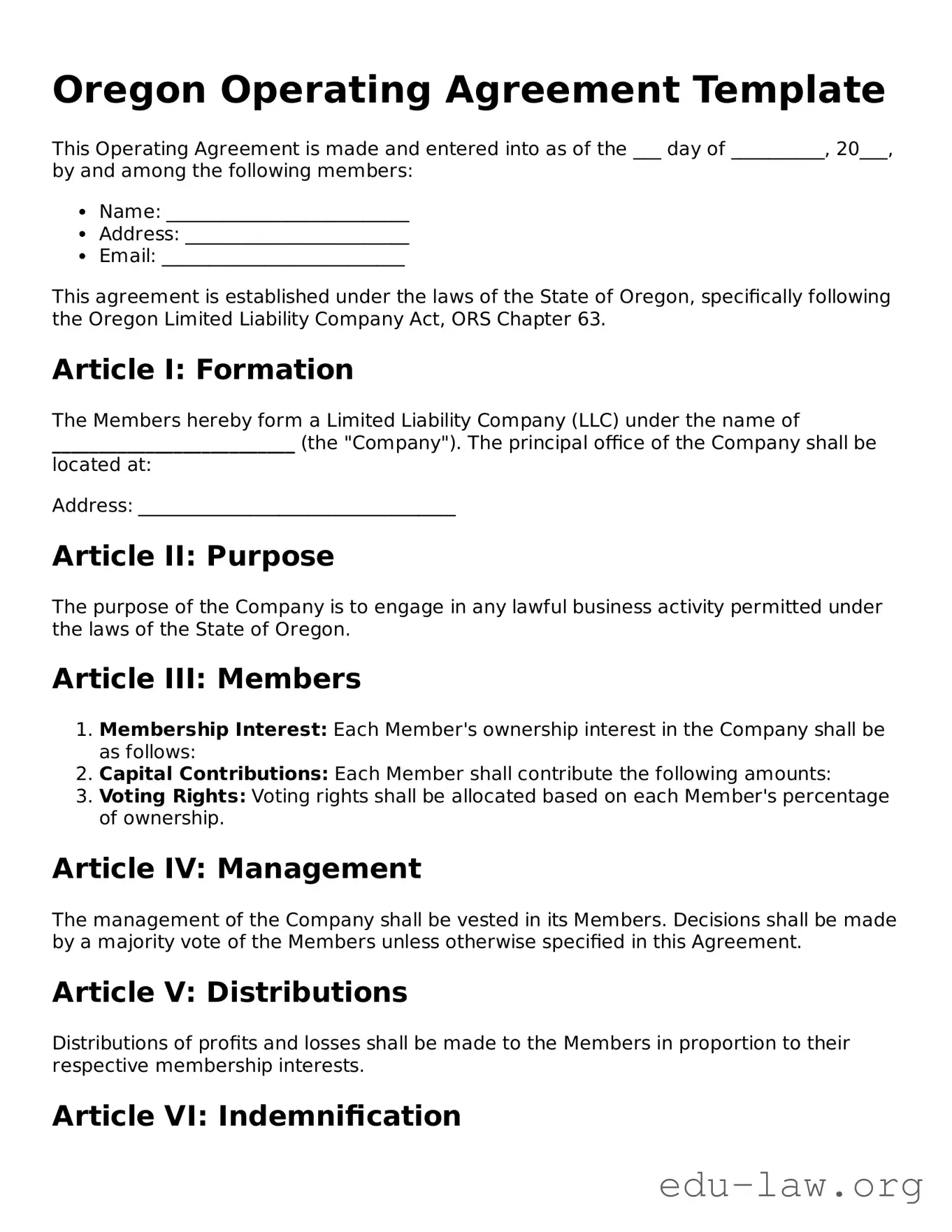
Oregon Operating Agreement Template
This Operating Agreement is made and entered into as of the ___ day of __________, 20___, by and among the following members:
This agreement is established under the laws of the State of Oregon, specifically following the Oregon Limited Liability Company Act, ORS Chapter 63.
Article I: Formation
The Members hereby form a Limited Liability Company (LLC) under the name of __________________________ (the "Company"). The principal office of the Company shall be located at:
Address: __________________________________
Article II: Purpose
The purpose of the Company is to engage in any lawful business activity permitted under the laws of the State of Oregon.
Article III: Members
Article IV: Management
The management of the Company shall be vested in its Members. Decisions shall be made by a majority vote of the Members unless otherwise specified in this Agreement.
Article V: Distributions
Distributions of profits and losses shall be made to the Members in proportion to their respective membership interests.
Article VI: Indemnification
The Company shall indemnify any Member or Manager against expenses and liabilities incurred in connection with the Company to the fullest extent permitted by Oregon law.
Article VII: Amendments
This Operating Agreement may be amended only by a written agreement signed by all Members.
Article VIII: Miscellaneous
This Agreement constitutes the entire agreement among the Members. Any prior agreements or understandings, whether written or oral, are hereby superseded.
IN WITNESS WHEREOF, the Members have executed this Operating Agreement as of the date first above written.
| Fact Name | Description |
|---|---|
| Governing Law | The Oregon Operating Agreement is governed by Oregon state law, specifically the Oregon Limited Liability Company Act. |
| Purpose | This form outlines the management structure and operational procedures for a limited liability company (LLC) in Oregon. |
| Members' Rights | The agreement defines the rights and responsibilities of the members of the LLC, including voting rights and profit distribution. |
| Flexibility | Oregon allows LLCs to customize their operating agreements to fit their specific needs, offering flexibility in management and operations. |
| Not Mandatory | While it is highly recommended, an operating agreement is not legally required to form an LLC in Oregon. |
| Amendments | The operating agreement can be amended as needed, provided that the process for amendments is clearly outlined within the document itself. |
| Dispute Resolution | Many operating agreements include provisions for dispute resolution, such as mediation or arbitration, to handle conflicts among members. |
After obtaining the Oregon Operating Agreement form, it is essential to complete it accurately to ensure compliance with state regulations. This form will require specific information about your business and its members. Follow the steps outlined below to fill out the form correctly.
What is an Oregon Operating Agreement?
An Oregon Operating Agreement is a legal document that outlines the management structure and operational procedures of a limited liability company (LLC) in Oregon. This agreement serves as the foundation for how the LLC will operate, detailing the roles and responsibilities of its members, how profits and losses will be distributed, and the process for making decisions. It helps prevent misunderstandings among members and provides a clear roadmap for the business's operations.
Is an Operating Agreement required in Oregon?
No, an Operating Agreement is not legally required in Oregon. However, having one is highly recommended. While the state does not mandate it, an Operating Agreement can protect your interests and clarify the management of the LLC. Without it, state default rules will apply, which may not align with your specific business needs.
Who should create the Operating Agreement?
What should be included in the Operating Agreement?
Can the Operating Agreement be amended?
Incomplete Information: Failing to provide all required details can lead to delays or rejection. Ensure every section is filled out accurately.
Incorrect Member Names: Listing members with incorrect names or spellings can create confusion. Double-check the names against official documents.
Missing Signatures: Not signing the agreement or having all necessary members sign can invalidate the document. Each member's signature is essential.
Ignoring State Requirements: Each state has specific requirements for operating agreements. Be aware of Oregon's regulations to ensure compliance.
Vague Terms: Using ambiguous language can lead to misunderstandings. Clearly define roles, responsibilities, and processes within the agreement.
Not Updating the Agreement: Failing to revise the agreement after changes in membership or business structure can result in outdated information. Regular updates are necessary.
Overlooking Financial Contributions: Not specifying each member's financial contributions can lead to disputes later. Clearly outline each member's investment.
Neglecting to Include a Dissolution Clause: Omitting a clause for how to dissolve the business can complicate matters if the need arises. Plan for all scenarios.
Failing to Seek Legal Advice: Skipping professional guidance can result in significant errors. Consulting with a legal expert can help avoid common pitfalls.
When forming a limited liability company (LLC) in Oregon, it is essential to have a variety of supporting documents to ensure compliance with state regulations and to outline the operational structure of the business. Below is a list of commonly used forms and documents that often accompany the Oregon Operating Agreement.
Having these documents in place not only helps in the smooth operation of the LLC but also provides clarity and structure. Each document plays a vital role in ensuring that the business runs efficiently and in compliance with applicable laws. It is advisable to consult with a professional to ensure that all necessary documents are completed accurately and filed appropriately.
The Oregon Operating Agreement is similar to the Limited Liability Company (LLC) formation documents found in many states. Like the Operating Agreement, these documents outline the structure and management of the LLC. They typically include information about ownership percentages, member responsibilities, and procedures for decision-making. While the specifics can vary from state to state, the core purpose remains the same: to provide a clear framework for how the business will operate and how members will interact with one another.
Another document that shares similarities with the Oregon Operating Agreement is the Partnership Agreement. This document is used by partnerships to define the roles and responsibilities of each partner. Much like an Operating Agreement, it details how profits and losses will be shared, how decisions are made, and what happens if a partner wants to leave the partnership. Both agreements serve to minimize misunderstandings and disputes among the parties involved.
The Corporate Bylaws document is also comparable to the Oregon Operating Agreement. Bylaws govern the internal management of a corporation, outlining the roles of directors and officers, the process for holding meetings, and how corporate decisions are made. While the Operating Agreement is specific to LLCs, both documents serve to establish a structured governance framework that helps ensure smooth operations and compliance with applicable laws.
Shareholder Agreements bear resemblance to the Oregon Operating Agreement as well. These agreements are used by corporations to outline the rights and obligations of shareholders. They often include provisions for the transfer of shares, voting rights, and how disputes among shareholders will be resolved. Like an Operating Agreement, a Shareholder Agreement aims to provide clarity and prevent conflicts among the parties involved.
The Joint Venture Agreement is another document that parallels the Oregon Operating Agreement. This agreement is used when two or more parties come together for a specific business purpose. It outlines the terms of the collaboration, including how profits will be shared, the roles of each party, and how decisions will be made. Both agreements emphasize the importance of clear communication and defined roles to facilitate successful business operations.
Lastly, the Non-Disclosure Agreement (NDA) can be seen as a related document, although its focus is different. An NDA protects confidential information shared between parties, ensuring that sensitive business information remains private. While it does not govern the structure of a business like the Oregon Operating Agreement, it is often used in conjunction with such agreements to safeguard the interests of the parties involved, particularly in collaborative ventures.
When filling out the Oregon Operating Agreement form, it’s important to keep a few key points in mind. Here are some things you should and shouldn't do:
Many people have misunderstandings about the Oregon Operating Agreement form. Here are eight common misconceptions, along with clarifications to help you understand this important document better.
Understanding these misconceptions can help you better navigate the requirements and benefits of an Oregon Operating Agreement.
When filling out and using the Oregon Operating Agreement form, it is important to understand several key aspects to ensure compliance and clarity for all members involved. Here are some essential takeaways:
By paying attention to these key points, members can create a comprehensive Operating Agreement that serves as a valuable tool for their LLC.