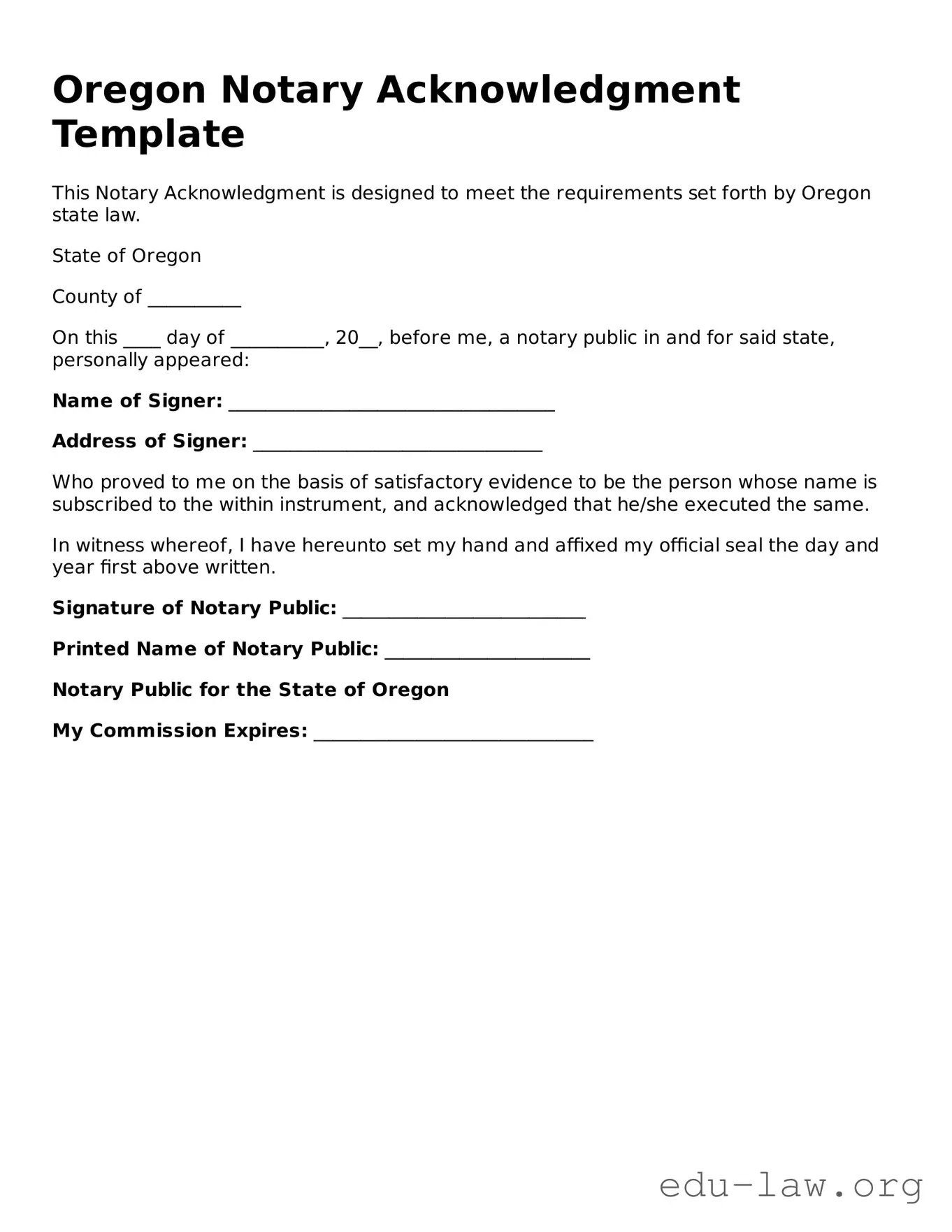
The Oregon Notary Acknowledgement form serves a crucial role in the legal landscape, providing a reliable method for verifying the authenticity of signatures on various documents. This form is often used in real estate transactions, legal filings, and other important agreements, ensuring that the signatory willingly and knowingly executed the document in question. By requiring the presence of a notary public, the form helps to prevent fraud and protect the interests of all parties involved. Key components of the form include the notary's signature, seal, and the date of the acknowledgment, which collectively confirm that the signatory was properly identified and understood the implications of their signature. Additionally, the form includes space for the signatory's name and details about the document being acknowledged, making it a vital tool for establishing legal validity. Understanding how to properly complete and utilize this form can significantly enhance the integrity of important transactions in Oregon.
Oregon Notary Acknowledgment Template
This Notary Acknowledgment is designed to meet the requirements set forth by Oregon state law.
State of Oregon
County of __________
On this ____ day of __________, 20__, before me, a notary public in and for said state, personally appeared:
Name of Signer: ___________________________________
Address of Signer: _______________________________
Who proved to me on the basis of satisfactory evidence to be the person whose name is subscribed to the within instrument, and acknowledged that he/she executed the same.
In witness whereof, I have hereunto set my hand and affixed my official seal the day and year first above written.
Signature of Notary Public: __________________________
Printed Name of Notary Public: ______________________
Notary Public for the State of Oregon
My Commission Expires: ______________________________
| Fact Name | Description |
|---|---|
| Purpose | The Oregon Notary Acknowledgment form is used to verify the identity of the signer and confirm that they signed the document willingly. |
| Governing Law | The form is governed by Oregon Revised Statutes (ORS) 194.010 to 194.400, which outline the powers and duties of notaries public in Oregon. |
| Signature Requirement | The signer must be present before the notary public at the time of signing the document. |
| Identification | The notary must verify the identity of the signer using a government-issued photo ID or other acceptable forms of identification. |
| Form Structure | The form typically includes spaces for the notary's signature, seal, and the date of the acknowledgment. |
| Use Cases | This form is commonly used for real estate transactions, legal documents, and various agreements requiring notarization. |
| Record Keeping | Notaries are required to keep a record of each acknowledgment performed, including details about the document and the signer. |
| Expiration | Notarial acts in Oregon do not expire; however, the notary's commission must be renewed periodically as required by law. |
Once you have the Oregon Notary Acknowledgement form in hand, you will need to complete it accurately to ensure it meets all necessary requirements. After filling out the form, it will be ready for submission or use as needed.
What is the purpose of the Oregon Notary Acknowledgement form?
The Oregon Notary Acknowledgement form serves as a legal document that verifies the identity of individuals signing a document. It confirms that the signer appeared before the notary public, who then acknowledges their signature. This process adds a layer of authenticity and can be crucial for various legal transactions, such as real estate deals or the execution of wills.
Who can act as a notary public in Oregon?
In Oregon, a notary public must be at least 18 years old, a resident of the state, and able to read and write English. They must also complete a training course and pass a test. Once appointed, notaries are authorized to perform notarial acts, including acknowledgments, oaths, and affirmations, within the state.
What information is required on the Oregon Notary Acknowledgement form?
The form typically requires the name of the signer, the date of the acknowledgment, and the notary’s signature and seal. It also includes a statement indicating that the signer personally appeared before the notary and acknowledged their signature on the document. This information helps ensure that the notarial act is valid and legally binding.
Is the Oregon Notary Acknowledgement form necessary for all documents?
No, not all documents require a notary acknowledgment. However, certain legal documents, such as property deeds or powers of attorney, often do. It is essential to check the specific requirements for the type of document you are dealing with. If in doubt, consulting with a legal professional can provide clarity on whether notarization is needed.
How can I find a notary public in Oregon?
Finding a notary public in Oregon is relatively straightforward. Many banks, law offices, and public libraries offer notary services. Additionally, you can search online for local notaries or use directories that list certified notaries. Always ensure that the notary you choose is currently active and authorized to perform notarial acts in the state.
Not including the signer's name correctly. It's crucial to ensure the name matches the one on the identification.
Failing to provide the date of the acknowledgment. This is essential for legal validity.
Using an incorrect notary seal. Ensure the seal is current and meets state requirements.
Not identifying the type of document being acknowledged. This information is necessary for clarity.
Forgetting to sign the form. The notary must sign to validate the acknowledgment.
Leaving the venue section blank. This should indicate where the acknowledgment took place.
Not confirming the identity of the signer. A valid ID must be presented to ensure authenticity.
Overlooking the witness requirements, if applicable. Some documents may require a witness present during the acknowledgment.
When engaging in various legal and financial transactions in Oregon, the Notary Acknowledgment form plays a crucial role. However, it is often accompanied by several other important documents that help facilitate these processes. Below is a list of commonly used forms and documents that work in conjunction with the Oregon Notary Acknowledgment form.
Understanding these documents and their functions can greatly enhance your ability to navigate legal transactions in Oregon. Each form serves a unique purpose, and when used alongside the Notary Acknowledgment, they contribute to a more secure and organized legal process.
The Oregon Notary Acknowledgment form shares similarities with the Affidavit. Both documents serve to affirm the truthfulness of statements made. An affidavit is a written statement confirmed by oath or affirmation, typically used as evidence in court. Like the notary acknowledgment, it requires the signature of the individual making the statement and the verification of a notary public, ensuring that the document is legally binding and credible.
Another document akin to the Oregon Notary Acknowledgment is the Power of Attorney (POA). A POA grants someone the authority to act on another's behalf in legal or financial matters. Similar to the notary acknowledgment, it must be signed by the principal and notarized to confirm that the principal willingly granted this authority. This process safeguards against fraud and ensures that the principal’s intentions are clear and documented.
The Deed is also comparable to the Oregon Notary Acknowledgment. A deed is a legal document that transfers property ownership from one person to another. For a deed to be valid, it typically requires notarization. The notary’s role is to verify the identities of the parties involved and confirm that they signed the deed willingly, similar to the acknowledgment process in the notary form.
Next, consider the Mortgage Document. Like the notary acknowledgment, this document requires notarization to be legally enforceable. A mortgage outlines the terms of a loan secured by real property. The notary’s verification of signatures ensures that all parties understand and agree to the terms, providing an additional layer of security and legitimacy to the transaction.
The Last Will and Testament also bears resemblance to the Oregon Notary Acknowledgment. A will outlines an individual's wishes regarding the distribution of their assets after death. While not always required, having a will notarized can add an extra layer of validation. The notary ensures that the testator signed the document voluntarily and that they were of sound mind, similar to the purpose of the acknowledgment form.
The Living Trust is another document that parallels the Oregon Notary Acknowledgment. A living trust allows individuals to manage their assets during their lifetime and dictate the distribution after their death. While not always required, notarizing the trust document can help affirm its validity. The notary’s role is to confirm the identities of the individuals involved and their intentions, much like the acknowledgment process.
Lastly, the Certification of Trust is similar to the Oregon Notary Acknowledgment. This document provides evidence of the existence of a trust and outlines its terms without revealing the entire trust document. Notarization helps to verify the authenticity of the certification. Just as with the acknowledgment form, the notary confirms the identities of the signatories and ensures that the certification is executed correctly.
When filling out the Oregon Notary Acknowledgement form, it is important to follow specific guidelines to ensure the document is valid. Here is a list of things you should and shouldn't do:
Many people have misunderstandings about the Oregon Notary Acknowledgement form. Clearing up these misconceptions can help individuals navigate notary services more effectively. Here are eight common misconceptions:
Understanding these misconceptions can help individuals make informed decisions when seeking notary services in Oregon.
When filling out and using the Oregon Notary Acknowledgement form, it is important to consider the following key takeaways:
Following these guidelines will help ensure that the Oregon Notary Acknowledgement form is used correctly and effectively.