In the world of business, protecting sensitive information is crucial. The Oregon Non-disclosure Agreement (NDA) form serves as a valuable tool for individuals and companies looking to safeguard their proprietary data. This form outlines the terms under which confidential information can be shared and establishes the responsibilities of both parties involved. By signing the NDA, parties agree to keep certain information private, preventing unauthorized disclosure. It covers key elements such as the definition of confidential information, the duration of the agreement, and the consequences of breaching the contract. Whether you’re a startup seeking to protect your innovative ideas or an established business entering a partnership, understanding the Oregon NDA is essential for maintaining trust and integrity in your professional relationships.
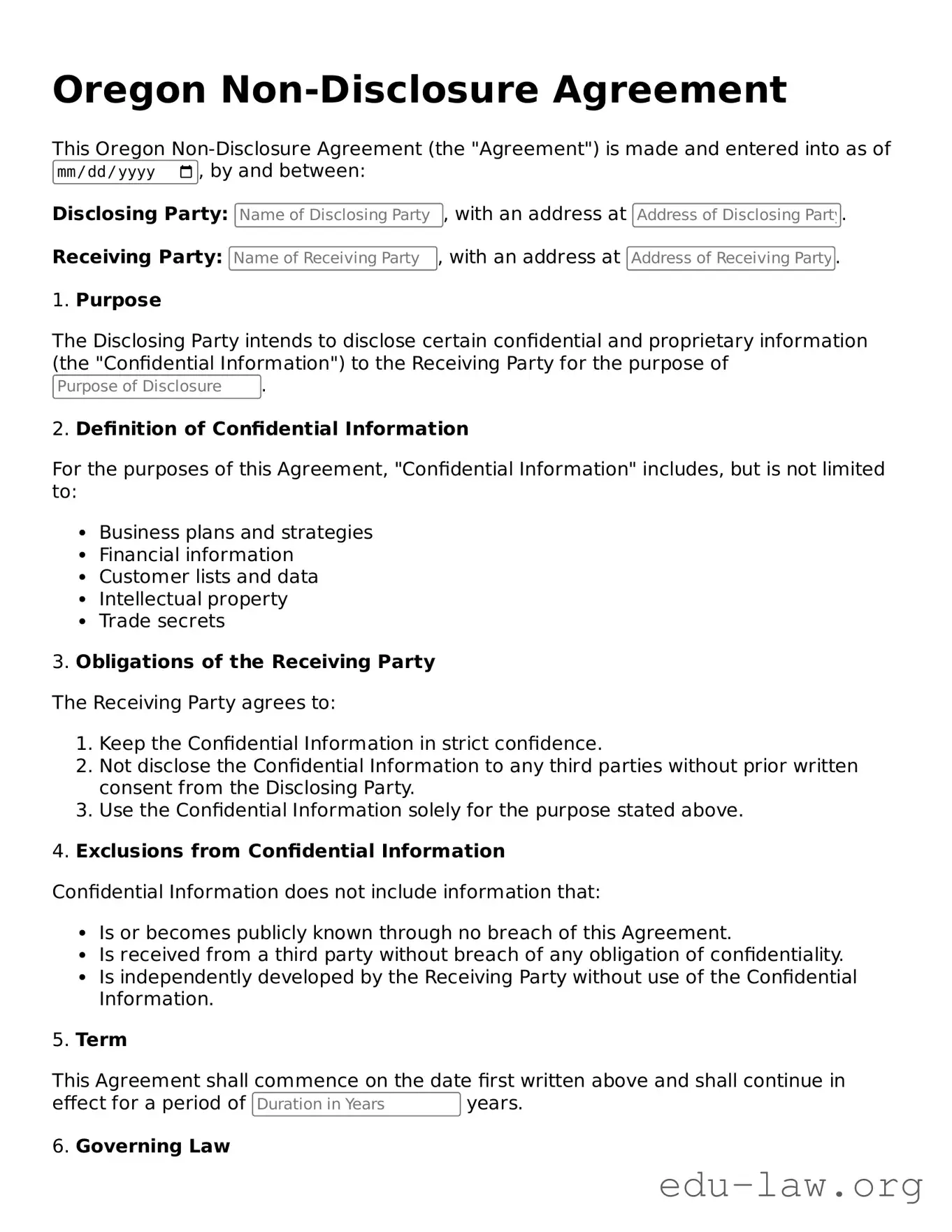
Oregon Non-Disclosure Agreement
This Oregon Non-Disclosure Agreement (the "Agreement") is made and entered into as of , by and between:
Disclosing Party: , with an address at .
Receiving Party: , with an address at .
1. Purpose
The Disclosing Party intends to disclose certain confidential and proprietary information (the "Confidential Information") to the Receiving Party for the purpose of .
2. Definition of Confidential Information
For the purposes of this Agreement, "Confidential Information" includes, but is not limited to:
3. Obligations of the Receiving Party
The Receiving Party agrees to:
4. Exclusions from Confidential Information
Confidential Information does not include information that:
5. Term
This Agreement shall commence on the date first written above and shall continue in effect for a period of years.
6. Governing Law
This Agreement shall be governed by and construed in accordance with the laws of the State of Oregon.
7. Entire Agreement
This Agreement constitutes the entire understanding between the parties regarding the subject matter hereof and supersedes all prior discussions and agreements.
IN WITNESS WHEREOF, the parties have executed this Non-Disclosure Agreement as of the date first above written.
Disclosing Party Signature: ________________________
Date: ________________________
Receiving Party Signature: ________________________
Date: ________________________
| Fact Name | Description |
|---|---|
| Purpose | The Oregon Non-disclosure Agreement (NDA) protects confidential information shared between parties. |
| Governing Law | The NDA is governed by the laws of the State of Oregon. |
| Parties Involved | Typically, the NDA involves a disclosing party and a receiving party. |
| Duration | The duration of confidentiality is usually specified, often lasting several years. |
| Permitted Disclosures | Some disclosures may be allowed, such as those required by law or court order. |
| Return of Information | Upon termination, parties may be required to return or destroy confidential materials. |
| Remedies for Breach | In case of a breach, the injured party may seek legal remedies, including injunctions. |
| Signature Requirement | Both parties must sign the NDA for it to be legally binding. |
Completing the Oregon Non-disclosure Agreement form is a straightforward process. After filling out the form, it will be necessary to review the information for accuracy and ensure that all required signatures are obtained before proceeding with any confidential discussions.
What is a Non-disclosure Agreement (NDA) in Oregon?
A Non-disclosure Agreement, commonly known as an NDA, is a legally binding contract designed to protect confidential information shared between parties. In Oregon, this agreement ensures that sensitive information, such as trade secrets or proprietary data, remains private and is not disclosed to unauthorized individuals or entities.
Who typically uses an NDA in Oregon?
NDAs are frequently utilized by businesses, entrepreneurs, and individuals who are entering into partnerships, collaborations, or employment relationships. Any party that needs to share confidential information while protecting their interests may find an NDA beneficial.
What types of information can be protected by an NDA?
Generally, an NDA can protect a wide range of information. This includes, but is not limited to, business plans, customer lists, financial data, marketing strategies, and any other proprietary information that could give a competitive advantage if disclosed. It is essential to clearly define what constitutes confidential information within the agreement.
Are there different types of NDAs?
Yes, there are two primary types of NDAs: unilateral and mutual. A unilateral NDA involves one party disclosing confidential information to another party, while a mutual NDA involves both parties sharing confidential information with each other. The choice between the two depends on the nature of the relationship and the information being exchanged.
How long does the confidentiality obligation last under an NDA?
The duration of confidentiality obligations can vary. Typically, NDAs specify a time frame during which the information must remain confidential, often ranging from one to five years. However, some information, such as trade secrets, may be protected indefinitely, as long as it remains confidential and provides economic value.
What happens if someone breaches an NDA?
If a party breaches the NDA, the non-breaching party may have legal grounds to pursue remedies. These remedies could include seeking monetary damages, injunctions to prevent further disclosure, or even specific performance, which requires the breaching party to comply with the terms of the agreement. The specific consequences depend on the terms outlined in the NDA and applicable state laws.
Can an NDA be modified or terminated?
Yes, an NDA can be modified or terminated if both parties agree to the changes in writing. It is crucial to document any amendments to ensure clarity and enforceability. Additionally, an NDA may automatically terminate under certain conditions, such as the expiration of the specified time period or the mutual agreement of the parties involved.
Is it necessary to have a lawyer review an NDA?
While it is not mandatory to have a lawyer review an NDA, it is highly advisable. Legal professionals can provide valuable insights into the terms of the agreement, ensuring that it adequately protects your interests and complies with Oregon laws. Their expertise can help prevent potential disputes in the future.
Where can I find an NDA template for use in Oregon?
Many resources are available online for obtaining NDA templates specific to Oregon. However, it is important to choose a template that aligns with your specific needs and circumstances. Customizing the agreement to reflect the unique aspects of your situation is crucial for ensuring its effectiveness and enforceability.
Not reading the entire agreement carefully. Many individuals rush through the document, missing important clauses that could affect their rights and obligations.
Failing to identify all parties involved. It is crucial to list everyone who will be bound by the agreement, including any affiliates or employees.
Using vague language. Clarity is key. People often write ambiguous terms that can lead to misunderstandings later on.
Neglecting to specify the duration of confidentiality. The agreement should clearly state how long the information must remain confidential.
Overlooking the definition of confidential information. Without a clear definition, it becomes difficult to enforce the agreement.
Not including exceptions to confidentiality. It’s important to outline situations where disclosure is permissible, such as legal requirements.
Forgetting to sign and date the document. An unsigned agreement may not hold up legally, so it is essential to ensure all parties have completed this step.
When entering into a Non-disclosure Agreement (NDA) in Oregon, several other forms and documents may be relevant to ensure comprehensive protection of confidential information. Here’s a list of commonly used documents that often accompany an NDA:
Understanding these documents can help you navigate the complexities of confidentiality in business relationships. Each plays a unique role in protecting sensitive information and ensuring that all parties are on the same page regarding their obligations.
The Confidentiality Agreement is closely related to the Oregon Non-disclosure Agreement (NDA). Both documents serve the primary purpose of protecting sensitive information shared between parties. In a Confidentiality Agreement, the emphasis is often on the obligation to keep certain information private, which aligns with the core intent of an NDA. These agreements may be used in various contexts, including business negotiations and employment relationships, ensuring that proprietary information remains secure.
The Proprietary Information Agreement (PIA) shares similarities with the Oregon NDA in that it specifically addresses the handling of proprietary information. While an NDA can cover a broader range of confidential information, a PIA typically focuses on trade secrets and intellectual property. Both documents require the receiving party to refrain from disclosing the information without consent, thus safeguarding the interests of the disclosing party.
A Mutual Non-disclosure Agreement (MNDA) is another document that parallels the Oregon NDA. Unlike a one-sided NDA, an MNDA involves both parties agreeing to protect each other's confidential information. This type of agreement is particularly useful in joint ventures or partnerships, where both parties may need to share sensitive data. The mutual aspect fosters trust and encourages open communication while ensuring that both sides are held to the same standards of confidentiality.
The Non-circumvention Agreement is similar to the Oregon NDA in that it seeks to protect the interests of one party from being undermined by another. While NDAs focus primarily on confidentiality, non-circumvention agreements specifically prevent one party from bypassing the other to engage in business directly with a third party. This type of agreement is particularly common in business dealings involving brokers or agents, where trust and transparency are essential.
The Non-disclosure and Non-solicitation Agreement combines elements of both an NDA and a non-solicitation clause. This document not only protects confidential information but also restricts one party from soliciting clients or employees of the other party for a specified period. By incorporating both confidentiality and non-solicitation provisions, this agreement helps to maintain business integrity and protect valuable relationships.
The Data Use Agreement (DUA) is another document that aligns with the Oregon NDA, particularly in contexts involving research or data sharing. A DUA specifies how data can be used, shared, and protected, ensuring that both parties understand their responsibilities regarding sensitive information. While the Oregon NDA focuses on confidentiality, a DUA often includes specific terms related to data management and compliance with applicable regulations.
The Licensing Agreement is similar in that it may include confidentiality clauses to protect proprietary information shared between the licensor and licensee. While the primary focus of a licensing agreement is to grant permission to use intellectual property, it often necessitates the protection of sensitive information that may be disclosed during the licensing process. Both agreements emphasize the importance of safeguarding intellectual property rights.
Lastly, the Settlement Agreement can also bear similarities to the Oregon NDA, especially when parties agree to keep the terms of the settlement confidential. In such cases, the settlement may involve sensitive information that both parties wish to protect from public disclosure. Like an NDA, a Settlement Agreement outlines the obligations of the parties regarding confidentiality, thereby ensuring that the terms remain private and secure.
When filling out the Oregon Non-disclosure Agreement form, there are certain best practices to follow. Here is a list of things you should and shouldn't do:
Understanding the Oregon Non-disclosure Agreement (NDA) form is crucial for protecting sensitive information. However, several misconceptions exist. Here are nine common misunderstandings:
This is not true. NDAs can benefit businesses of all sizes, including startups and individual contractors. They help protect valuable information regardless of the company's size.
Each NDA can be tailored to fit specific needs. The terms and conditions can vary significantly based on the nature of the information being protected.
While NDAs restrict sharing confidential information, they do not prevent all communication. You can still discuss non-confidential matters or information that is already public.
Not all NDAs are enforceable. Courts may not uphold agreements that are overly broad or unreasonable in scope. It’s essential to ensure the NDA is fair and clear.
NDAs typically have a specified duration. After this period, the obligations to keep information confidential may expire, depending on the agreement's terms.
In many cases, both parties should sign the NDA to ensure mutual protection. This establishes a clear understanding of confidentiality obligations for everyone involved.
NDAs can protect oral information as well. If sensitive information is shared verbally, it can still be covered under the NDA if specified in the agreement.
Even in trusted relationships, an NDA is important. It provides legal protection and clarity, reducing the risk of misunderstandings about what can be shared.
While you can draft an NDA on your own, seeking legal advice is wise. A lawyer can help ensure that the NDA is properly constructed and enforceable.
Being aware of these misconceptions can help you make informed decisions when dealing with Non-disclosure Agreements in Oregon.
When dealing with sensitive information in Oregon, a Non-disclosure Agreement (NDA) is a crucial tool. Here are some key takeaways to keep in mind when filling out and using the Oregon NDA form:
Filling out the Oregon Non-disclosure Agreement form with care can help safeguard your valuable information and foster trust in professional relationships.