In the competitive landscape of Oregon's job market, businesses often seek ways to protect their interests, and one common method is through the use of non-compete agreements. These agreements serve as legal contracts between employers and employees, outlining the terms under which an employee may be restricted from working for competitors or starting a similar business after leaving their current position. The Oregon Non-compete Agreement form is designed to ensure that these restrictions are reasonable and enforceable under state law. Key aspects of this form include specifying the duration of the non-compete period, defining the geographic area covered, and detailing the nature of the work that is restricted. Additionally, the form must comply with Oregon's specific regulations, which mandate that non-compete clauses are only enforceable if they are entered into at the time of employment or during a promotion, and if the employee earns a certain minimum salary. Understanding these elements is crucial for both employers looking to safeguard their business interests and employees who want to know their rights and obligations. By carefully considering the terms outlined in the Oregon Non-compete Agreement form, both parties can navigate the complexities of employment law while fostering a fair working environment.
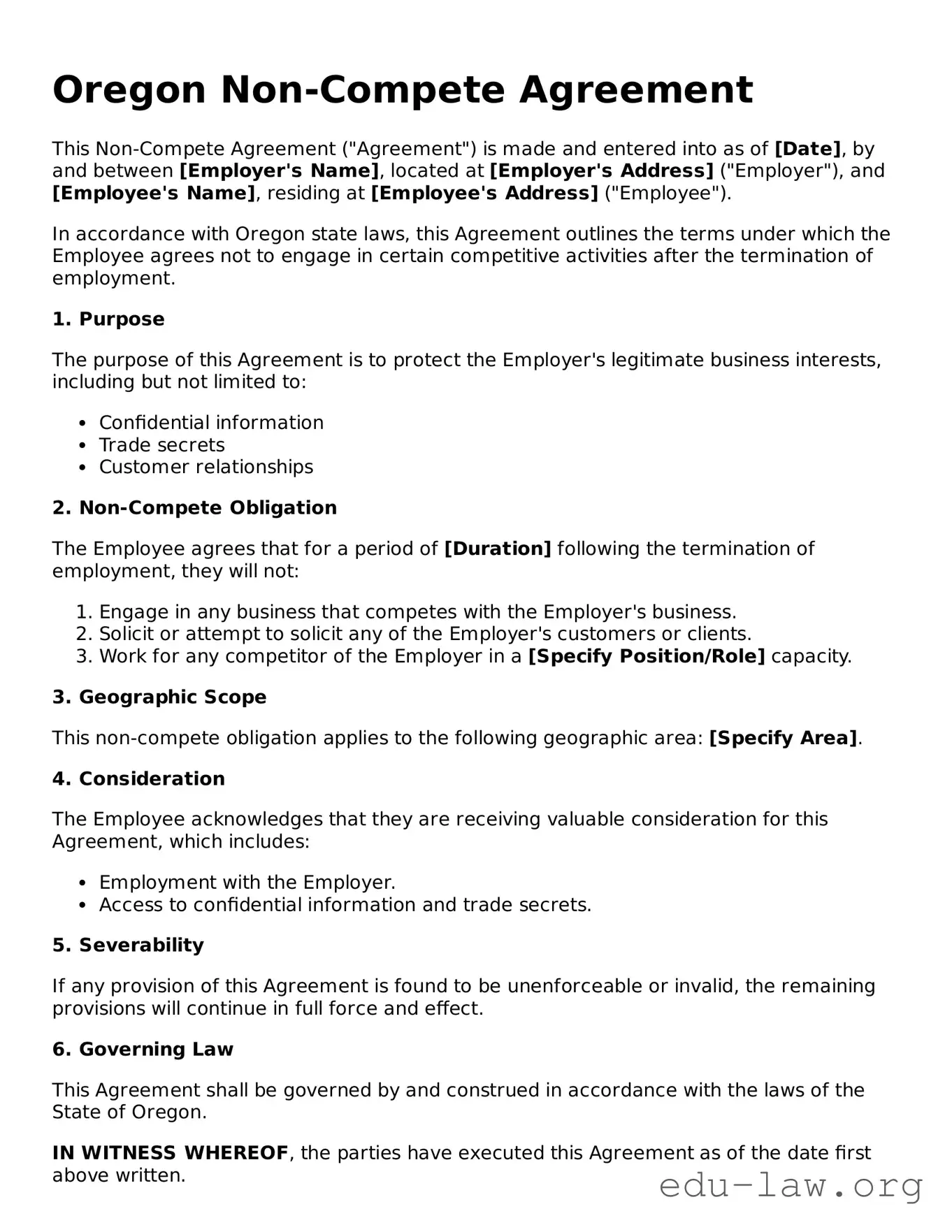
Oregon Non-Compete Agreement
This Non-Compete Agreement ("Agreement") is made and entered into as of [Date], by and between [Employer's Name], located at [Employer's Address] ("Employer"), and [Employee's Name], residing at [Employee's Address] ("Employee").
In accordance with Oregon state laws, this Agreement outlines the terms under which the Employee agrees not to engage in certain competitive activities after the termination of employment.
1. Purpose
The purpose of this Agreement is to protect the Employer's legitimate business interests, including but not limited to:
2. Non-Compete Obligation
The Employee agrees that for a period of [Duration] following the termination of employment, they will not:
3. Geographic Scope
This non-compete obligation applies to the following geographic area: [Specify Area].
4. Consideration
The Employee acknowledges that they are receiving valuable consideration for this Agreement, which includes:
5. Severability
If any provision of this Agreement is found to be unenforceable or invalid, the remaining provisions will continue in full force and effect.
6. Governing Law
This Agreement shall be governed by and construed in accordance with the laws of the State of Oregon.
IN WITNESS WHEREOF, the parties have executed this Agreement as of the date first above written.
Employer: ___________________________
Employee: ___________________________
Date: ___________________________
| Fact Name | Description |
|---|---|
| Governing Law | The Oregon Non-compete Agreement is governed by Oregon Revised Statutes (ORS) 653.295. |
| Duration Limit | Non-compete agreements in Oregon cannot exceed 18 months in duration. |
| Geographic Scope | The agreement must specify a reasonable geographic area where the restrictions apply. |
| Consideration Requirement | There must be adequate consideration provided to the employee, such as a job offer or promotion. |
| Employee Eligibility | Non-compete agreements are only enforceable against employees who earn a salary of at least $100,000 annually. |
| Disclosure Requirement | Employers must provide a copy of the non-compete agreement to the employee at least two weeks before the employee starts work. |
| Enforceability | Oregon courts may void or modify a non-compete agreement if it is deemed overly broad or unreasonable. |
| Exceptions | Non-compete agreements do not apply to certain professions, including those in the medical field and independent contractors. |
Completing the Oregon Non-compete Agreement form requires careful attention to detail. After filling out the form, it will be necessary to review the information for accuracy and ensure that all required signatures are obtained. This process helps establish clear expectations between parties involved.
After completing these steps, both parties should retain a copy of the signed agreement for their records. This ensures that everyone involved has access to the terms outlined in the document.
What is a Non-compete Agreement in Oregon?
A Non-compete Agreement is a legal contract between an employer and an employee that restricts the employee from working for competitors or starting a competing business for a specified period after leaving the company. In Oregon, these agreements must meet specific criteria to be enforceable, including being reasonable in duration and geographic scope.
Are Non-compete Agreements enforceable in Oregon?
Yes, Non-compete Agreements can be enforceable in Oregon, but they must adhere to state laws. For instance, they cannot exceed 18 months in duration and must be necessary to protect the employer's legitimate business interests. If the agreement fails to meet these requirements, it may be deemed invalid by a court.
What are the limitations of a Non-compete Agreement in Oregon?
Oregon law places several limitations on Non-compete Agreements. They cannot be used for employees who earn less than a specific income threshold. Additionally, the agreement must be signed at the time of employment or during a promotion, and it must be clear and understandable. Overly broad or vague terms may render the agreement unenforceable.
How long can a Non-compete Agreement last in Oregon?
In Oregon, a Non-compete Agreement can last for a maximum of 18 months after the employee leaves the company. This time frame is designed to balance the interests of the employer in protecting their business while allowing employees the freedom to seek new opportunities.
What should I consider before signing a Non-compete Agreement?
Before signing a Non-compete Agreement, carefully evaluate the terms. Consider the duration, geographic scope, and how it may impact your future employment opportunities. It may be beneficial to seek legal advice to understand your rights and the potential consequences of the agreement.
Can I negotiate the terms of a Non-compete Agreement?
Yes, you can negotiate the terms of a Non-compete Agreement. Employers may be open to modifications, especially if the initial terms seem overly restrictive. Discuss your concerns with your employer and seek a mutually agreeable solution that protects both parties' interests.
What should I do if I believe my Non-compete Agreement is unfair?
If you believe your Non-compete Agreement is unfair or overly restrictive, consider discussing your concerns with your employer. If that does not lead to a satisfactory resolution, consult with a legal professional who specializes in employment law. They can provide guidance on your options and help you determine the best course of action.
Not Understanding the Terms: Many individuals fail to fully grasp the terms of the agreement. It’s crucial to comprehend what a non-compete agreement entails and how it may affect future employment opportunities.
Ignoring State Laws: Each state has different laws governing non-compete agreements. Individuals often overlook the specific regulations in Oregon, which can lead to unenforceable agreements.
Overly Broad Language: Using vague or overly broad terms can render the agreement ineffective. It's important to be specific about the scope, duration, and geographical area of the non-compete.
Failure to Specify Consideration: A non-compete agreement must include something of value exchanged between the employer and employee. Not outlining this consideration can lead to legal issues.
Not Seeking Legal Advice: Many people fill out the form without consulting a legal professional. This oversight can result in misunderstandings or unintended consequences.
Neglecting to Review Before Signing: Rushing through the signing process often leads to missed details. Taking the time to review the document carefully is essential.
Assuming All Non-competes are the Same: Each non-compete agreement is unique. Assuming that one agreement applies to all situations can lead to complications.
Not Considering Future Employment: People often forget to think about how the agreement may limit their job prospects in the future. Understanding the long-term implications is vital.
Ignoring the Termination Clause: The termination conditions of the agreement can be just as important as the non-compete terms. Failing to review this clause can lead to unexpected challenges.
When entering into a Non-compete Agreement in Oregon, several other forms and documents may be relevant to ensure clarity and legal compliance. These documents can help outline the terms of employment, protect intellectual property, and establish mutual understanding between the employer and employee. Below is a list of commonly used forms alongside the Non-compete Agreement.
Utilizing these documents in conjunction with the Oregon Non-compete Agreement can help create a comprehensive framework for the employment relationship. Each form serves a specific purpose and contributes to a clearer understanding of rights and responsibilities for both parties involved.
The Oregon Non-compete Agreement is similar to the Non-disclosure Agreement (NDA). Both documents aim to protect sensitive information and business interests. An NDA focuses on preventing the sharing of confidential information, while a non-compete agreement restricts an employee's ability to work with competitors after leaving a company. Both require clear definitions of what constitutes confidential information and the scope of the restrictions imposed on the employee.
Another document akin to the Oregon Non-compete Agreement is the Non-solicitation Agreement. This agreement prevents an employee from soliciting clients or employees from their former employer after leaving. Like the non-compete, it protects the company's relationships and assets. However, it specifically targets client and employee interactions rather than outright employment with competitors.
The Confidentiality Agreement shares similarities with the Oregon Non-compete Agreement as well. Both documents are designed to safeguard a company's proprietary information. While the non-compete restricts employment opportunities, the confidentiality agreement focuses on preventing the disclosure of sensitive information. They can complement each other to provide comprehensive protection for a business.
The Employment Agreement can also resemble the Oregon Non-compete Agreement. This document outlines the terms of employment, including job responsibilities, compensation, and any restrictions on future employment. While an employment agreement may include a non-compete clause, it serves a broader purpose by establishing the overall relationship between the employer and employee.
The Proprietary Information Agreement is another document that parallels the Oregon Non-compete Agreement. This agreement protects a company's proprietary information and trade secrets. While the non-compete restricts future employment, the proprietary information agreement emphasizes the importance of maintaining confidentiality regarding specific business information. Both serve to protect the company's interests, albeit in different ways.
The Release of Claims Agreement can also be compared to the Oregon Non-compete Agreement. This document is often signed when an employee leaves a company, waiving the right to pursue legal claims against the employer. While it does not restrict future employment directly, it can include non-compete clauses as part of the overall separation agreement, ensuring that the employee cannot compete with the employer after departure.
The Separation Agreement may bear similarities to the Oregon Non-compete Agreement as well. This document outlines the terms of an employee's departure from a company, often including severance pay and other benefits. It may also contain non-compete provisions to prevent the employee from joining competitors. Both agreements address the end of the employment relationship but with different focuses.
Lastly, the Independent Contractor Agreement can be likened to the Oregon Non-compete Agreement. This document outlines the terms under which a contractor provides services to a company. It may include non-compete clauses to prevent the contractor from working with competing businesses during or after the contract period. Both agreements protect the interests of the business and limit competition in the marketplace.
When filling out the Oregon Non-compete Agreement form, it's important to follow certain guidelines. Here are ten things you should and shouldn't do:
Understanding the Oregon Non-compete Agreement can be challenging due to several misconceptions. Here are five common misunderstandings:
Many people believe that all non-compete agreements hold up in court. However, Oregon law has specific requirements that must be met for these agreements to be valid. If they do not comply, they may be deemed unenforceable.
This is not true. In Oregon, non-compete agreements can only be enforced against employees who earn a certain salary threshold. Workers below this threshold are generally not bound by such agreements.
While a non-compete agreement may restrict employment opportunities for a certain period, it does not permanently prevent an individual from working in their field. The restrictions typically have a defined duration.
These two types of agreements serve different purposes. A non-compete agreement restricts where and how an employee can work after leaving a job, while a non-disclosure agreement protects confidential information from being shared.
In Oregon, there are specific regulations regarding when and how non-compete agreements can be implemented. For example, they must be provided to the employee in writing and signed before the start of employment.
When it comes to filling out and using the Oregon Non-compete Agreement form, understanding the essential elements can make a significant difference. Here are some key takeaways:
By keeping these points in mind, you can navigate the complexities of non-compete agreements in Oregon more effectively.