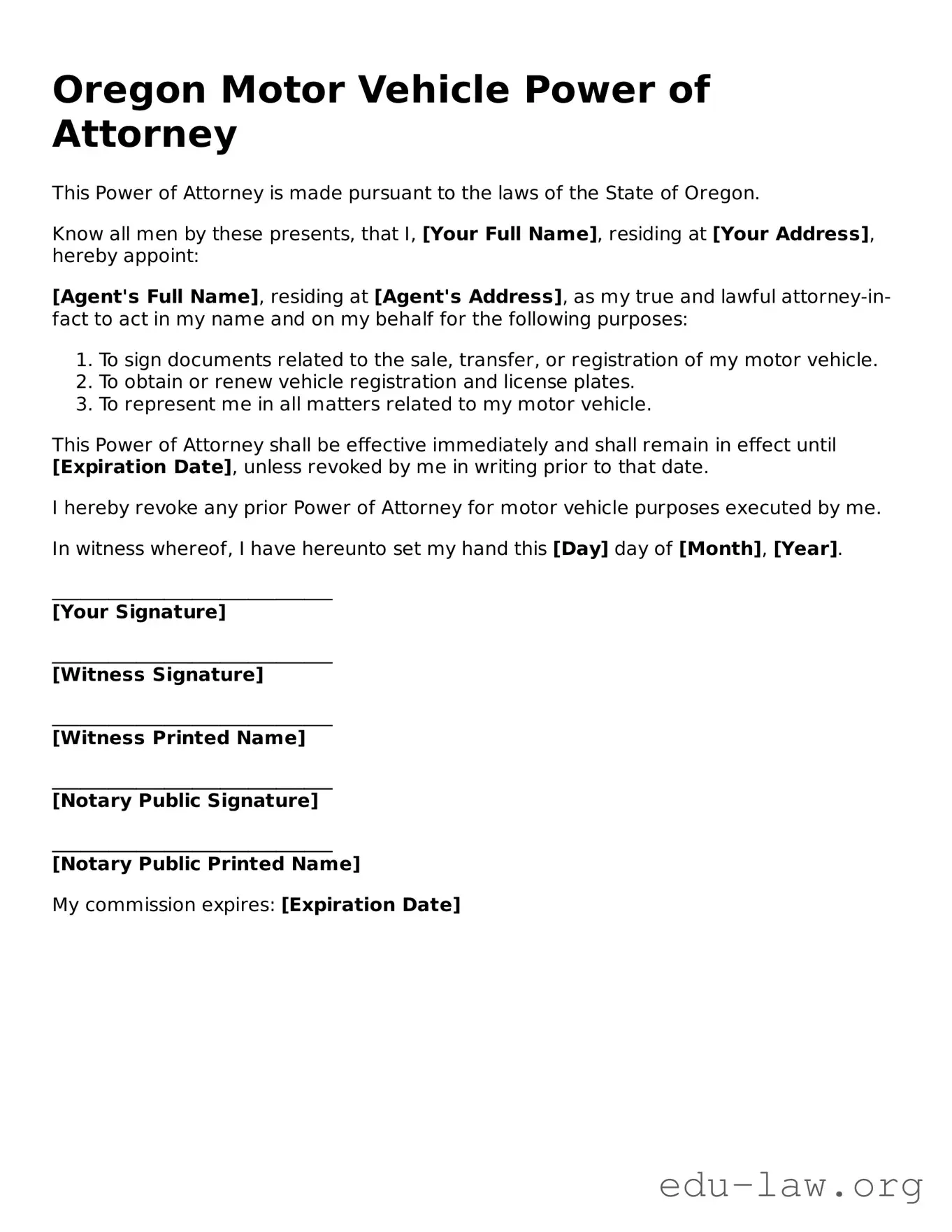
The Oregon Motor Vehicle Power of Attorney form serves as a crucial document for individuals who need to delegate authority regarding their motor vehicle transactions. This form allows one person, known as the principal, to appoint another person, referred to as the agent, to act on their behalf in matters related to vehicle registration, title transfers, and other motor vehicle-related activities. By utilizing this form, the principal can ensure that their interests are represented, especially when they are unable to attend to these matters personally due to various reasons such as being out of state or having health constraints. The form typically requires the signatures of both the principal and the agent, along with a description of the specific powers granted. It is important to complete the form accurately to avoid any complications in the future. Understanding the nuances of this document can help individuals navigate the complexities of motor vehicle ownership and transactions in Oregon more effectively.
Oregon Motor Vehicle Power of Attorney
This Power of Attorney is made pursuant to the laws of the State of Oregon.
Know all men by these presents, that I, [Your Full Name], residing at [Your Address], hereby appoint:
[Agent's Full Name], residing at [Agent's Address], as my true and lawful attorney-in-fact to act in my name and on my behalf for the following purposes:
This Power of Attorney shall be effective immediately and shall remain in effect until [Expiration Date], unless revoked by me in writing prior to that date.
I hereby revoke any prior Power of Attorney for motor vehicle purposes executed by me.
In witness whereof, I have hereunto set my hand this [Day] day of [Month], [Year].
______________________________
[Your Signature]
______________________________
[Witness Signature]
______________________________
[Witness Printed Name]
______________________________
[Notary Public Signature]
______________________________
[Notary Public Printed Name]
My commission expires: [Expiration Date]
| Fact Name | Description |
|---|---|
| Purpose | The Oregon Motor Vehicle Power of Attorney form allows an individual to authorize another person to act on their behalf regarding motor vehicle transactions. |
| Governing Law | This form is governed by the Oregon Revised Statutes, specifically ORS 802.045. |
| Authorization Scope | The form can cover various transactions, including title transfers, registration, and other motor vehicle-related matters. |
| Principal and Agent | The individual granting authority is known as the principal, while the person receiving authority is called the agent. |
| Signature Requirement | The principal must sign the form to make it valid. Witnesses or notarization may be required in certain situations. |
| Duration | The power of attorney remains in effect until the principal revokes it or until a specified expiration date, if included. |
| Revocation | The principal has the right to revoke the power of attorney at any time, as long as they do so in writing. |
| Use by Dealers | Car dealerships often use this form to facilitate vehicle sales and transfers on behalf of the buyer or seller. |
| Legal Age | The principal must be at least 18 years old to execute the power of attorney for motor vehicle transactions. |
| Form Availability | The Oregon Motor Vehicle Power of Attorney form is available online through the Oregon Department of Transportation's website. |
Filling out the Oregon Motor Vehicle Power of Attorney form is straightforward. After completing the form, it is important to ensure that it is signed and dated properly. This will allow the designated person to act on your behalf regarding motor vehicle matters.
What is the Oregon Motor Vehicle Power of Attorney form?
The Oregon Motor Vehicle Power of Attorney form is a legal document that allows an individual, known as the principal, to authorize another person, called the agent, to act on their behalf regarding motor vehicle transactions. This can include tasks such as transferring ownership, registering a vehicle, or obtaining a title.
Who can serve as an agent under this form?
Any adult individual can serve as an agent, provided they have the legal capacity to act on behalf of the principal. This may include family members, friends, or professionals, such as attorneys or auto dealers. It is important for the principal to choose someone they trust, as the agent will have significant authority regarding the principal's motor vehicle matters.
How is the form completed?
The form must be filled out with specific information, including the names and addresses of both the principal and the agent, as well as details about the vehicle in question, such as the make, model, and VIN (Vehicle Identification Number). After completing the form, the principal must sign it in the presence of a notary public to ensure its validity.
Does the Oregon Motor Vehicle Power of Attorney need to be notarized?
Yes, the form must be notarized to be legally binding. The principal must sign the document in front of a notary public, who will then affix their seal. This step helps to verify the identity of the principal and confirms that they are signing the document voluntarily.
Can the Power of Attorney be revoked?
Yes, the principal can revoke the Power of Attorney at any time, as long as they are of sound mind. To do so, the principal should provide written notice to the agent and any relevant parties, such as the Department of Motor Vehicles. It is advisable to use a formal revocation form to ensure clarity and legality.
Is there a specific time frame for which the Power of Attorney is valid?
The Oregon Motor Vehicle Power of Attorney does not have a set expiration date unless specified by the principal. However, it is prudent for the principal to indicate a time frame or specific conditions under which the Power of Attorney will remain in effect. This helps to avoid any confusion regarding the authority granted to the agent.
What are the limitations of the Power of Attorney?
The Power of Attorney grants the agent authority specifically related to motor vehicle transactions. However, it does not allow the agent to make decisions about other areas of the principal's life, such as financial matters or health care. The principal should ensure that the scope of authority is clearly defined in the document.
Can more than one agent be appointed?
Yes, a principal can appoint multiple agents to act jointly or severally. If agents are appointed to act jointly, they must make decisions together. If appointed to act severally, each agent can act independently. The principal should clearly specify their intentions in the Power of Attorney form to avoid any potential conflicts.
Where can I obtain the Oregon Motor Vehicle Power of Attorney form?
The Oregon Motor Vehicle Power of Attorney form can be obtained from the Oregon Department of Transportation's website or at local DMV offices. Additionally, legal service providers may offer templates for this form. It is important to ensure that the most current version of the form is used to comply with state requirements.
Failing to include the correct name of the principal. It is essential to ensure that the full legal name matches the identification documents.
Not specifying the powers granted. The form should clearly outline what authority is being given to the agent.
Omitting the date of signing. A date is necessary to validate the document and establish when the authority begins.
Neglecting to sign the form. The principal’s signature is crucial for the document to be legally binding.
Failing to provide the agent’s complete information. This includes the agent’s name and address, which must be accurate.
Using incorrect or outdated forms. Always ensure that the most current version of the form is used to avoid complications.
Not having the form notarized when required. Some situations may necessitate notarization for the document to be accepted.
Overlooking the need for witnesses. Depending on the circumstances, having witnesses may be necessary to validate the form.
When dealing with motor vehicle transactions in Oregon, individuals often utilize various forms and documents alongside the Oregon Motor Vehicle Power of Attorney form. Each of these documents serves a specific purpose and can facilitate the process of transferring ownership or managing vehicle-related matters.
Utilizing these documents in conjunction with the Oregon Motor Vehicle Power of Attorney form can streamline various vehicle-related transactions, ensuring that all necessary information is documented and legal requirements are met.
The Oregon Motor Vehicle Power of Attorney form shares similarities with the General Power of Attorney document. Both forms grant authority to an individual, known as the agent or attorney-in-fact, to act on behalf of another person, referred to as the principal. In the case of the General Power of Attorney, the agent may handle a wide range of financial and legal matters, not just those related to motor vehicles. This flexibility allows the principal to delegate various responsibilities, ensuring that their interests are managed effectively in multiple areas of life.
Another document akin to the Oregon Motor Vehicle Power of Attorney is the Limited Power of Attorney. While the Motor Vehicle Power of Attorney specifically pertains to vehicle-related transactions, the Limited Power of Attorney allows the principal to specify particular tasks or decisions for the agent to handle. For instance, if someone needs assistance with real estate transactions or medical decisions, a Limited Power of Attorney can be tailored to those specific needs, just as the Motor Vehicle Power of Attorney is tailored for vehicle matters.
The Vehicle Title Transfer form also bears resemblance to the Oregon Motor Vehicle Power of Attorney. Both documents are used in the context of vehicle ownership and transactions. The Vehicle Title Transfer form is essential when ownership of a vehicle changes hands, as it officially records the new owner's information. In contrast, the Motor Vehicle Power of Attorney allows someone to act on behalf of the owner to facilitate that transfer, making it easier for the agent to complete the necessary paperwork without the owner's physical presence.
Lastly, the Authorization to Release Information form is similar in that it allows one person to grant another the right to access specific information. While the Oregon Motor Vehicle Power of Attorney empowers an agent to perform actions related to vehicle ownership, the Authorization to Release Information form permits the sharing of personal data, such as driving records or vehicle history. This can be particularly useful in situations where an agent needs to gather information to support the transactions they are authorized to carry out.
When filling out the Oregon Motor Vehicle Power of Attorney form, it's essential to follow specific guidelines to ensure accuracy and compliance. Here are seven things you should and shouldn't do:
By adhering to these guidelines, you can help ensure that your Power of Attorney form is processed smoothly and effectively.
There are several misconceptions surrounding the Oregon Motor Vehicle Power of Attorney form. Understanding these can help clarify its purpose and usage. Here are eight common misconceptions:
Many believe this form is solely for selling vehicles. In reality, it can be used for various purposes, including registering a vehicle, transferring title, and even obtaining a duplicate title.
While legal advice can be helpful, it is not necessary to have a lawyer complete the form. Individuals can fill it out themselves as long as they follow the guidelines.
Some think that notarization is a requirement. However, the Oregon Motor Vehicle Power of Attorney does not need to be notarized to be valid.
This form does not expire unless specifically stated in the document. As long as the authority granted is not revoked, it remains effective.
Another misconception is that only individuals can use this form. In fact, businesses and organizations can also designate someone to act on their behalf.
Some believe that multiple signatures are necessary for validity. In most cases, only the principal's signature is required.
While legal documents can seem complex, the Oregon Motor Vehicle Power of Attorney form is straightforward. Clear instructions are provided to guide users through the process.
This form is specifically for motor vehicles registered in Oregon. Using it for vehicles registered in other states may not be valid.
By addressing these misconceptions, individuals can better navigate the process of using the Oregon Motor Vehicle Power of Attorney form effectively.
Filling out and using the Oregon Motor Vehicle Power of Attorney form can seem daunting, but understanding its key aspects can simplify the process. Here are some important takeaways to keep in mind:
By following these guidelines, individuals can effectively navigate the process of using the Oregon Motor Vehicle Power of Attorney form.