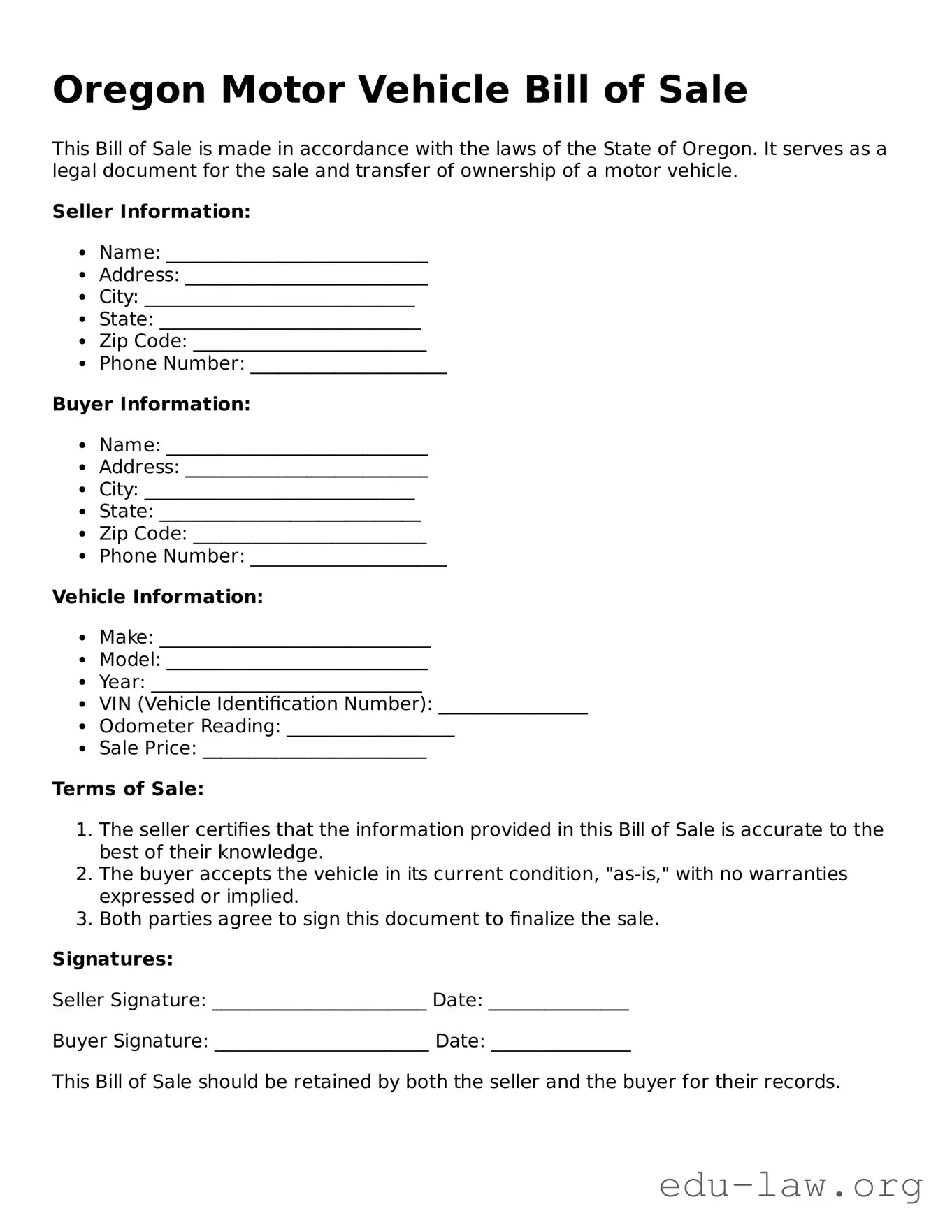
The Oregon Motor Vehicle Bill of Sale form serves as a crucial document in the transfer of ownership for vehicles within the state. This form captures essential details, including the names and addresses of both the buyer and seller, as well as the vehicle's identification number (VIN), make, model, and year. It also specifies the purchase price, ensuring that both parties agree on the financial terms of the transaction. In addition, the form may include information about any liens on the vehicle, which is vital for the buyer to understand their potential obligations. The document must be signed by both the buyer and seller, providing a clear record of the transaction and protecting the interests of both parties involved. By facilitating a transparent exchange, the Oregon Motor Vehicle Bill of Sale form plays an integral role in the vehicle sales process, ensuring compliance with state regulations and offering peace of mind to both buyers and sellers.
Oregon Motor Vehicle Bill of Sale
This Bill of Sale is made in accordance with the laws of the State of Oregon. It serves as a legal document for the sale and transfer of ownership of a motor vehicle.
Seller Information:
Buyer Information:
Vehicle Information:
Terms of Sale:
Signatures:
Seller Signature: _______________________ Date: _______________
Buyer Signature: _______________________ Date: _______________
This Bill of Sale should be retained by both the seller and the buyer for their records.
| Fact Name | Description |
|---|---|
| Purpose | The Oregon Motor Vehicle Bill of Sale form serves as a legal document to record the sale of a vehicle between a buyer and a seller. |
| Governing Law | The form is governed by the Oregon Revised Statutes, specifically ORS 803.095, which outlines the requirements for vehicle transfers. |
| Required Information | The form must include details such as the vehicle's make, model, year, Vehicle Identification Number (VIN), and the sale price. |
| Signatures | Both the buyer and the seller must sign the Bill of Sale to validate the transaction. |
| Notarization | While notarization is not required, it is recommended to enhance the document's credibility. |
| Tax Implications | The Bill of Sale may be required for tax purposes, as it provides proof of the transaction amount for the buyer. |
| Transfer of Ownership | The form is essential for transferring ownership and must be presented to the Oregon Department of Transportation for title transfer. |
| Record Keeping | Both parties should retain a copy of the Bill of Sale for their records, as it serves as proof of the transaction. |
Filling out the Oregon Motor Vehicle Bill of Sale form is an important step in the process of transferring ownership of a vehicle. After completing the form, both the buyer and seller will have a record of the transaction, which can be useful for future reference or legal purposes.
What is a Motor Vehicle Bill of Sale in Oregon?
A Motor Vehicle Bill of Sale is a legal document that records the transfer of ownership of a vehicle from one party to another in Oregon. This form serves as proof of the transaction and includes essential details about the vehicle, such as its make, model, year, and Vehicle Identification Number (VIN), as well as information about the buyer and seller.
Is a Bill of Sale required for vehicle sales in Oregon?
While a Bill of Sale is not legally required for every vehicle sale in Oregon, it is highly recommended. Having this document can protect both the buyer and seller by providing a clear record of the transaction. It can also be useful for registering the vehicle with the Department of Motor Vehicles (DMV) or in case of disputes.
What information should be included in the Bill of Sale?
The Bill of Sale should include the following information: the names and addresses of both the buyer and seller, the vehicle's make, model, year, VIN, the sale price, and the date of the transaction. Additionally, it can include any terms of the sale, such as whether the vehicle is sold "as is" or if any warranties are provided.
Can I create my own Bill of Sale?
Yes, you can create your own Bill of Sale as long as it includes all the necessary information. However, using a standardized form can help ensure that you don’t miss any critical details. Various templates are available online, or you can obtain one from the DMV or other legal resources.
Do I need to have the Bill of Sale notarized?
Notarization is not required for a Bill of Sale in Oregon. However, having the document notarized can add an extra layer of security and legitimacy, especially if you are dealing with a large transaction. It can help verify the identities of both parties involved.
What should I do with the Bill of Sale after the sale?
After the sale is completed, both the buyer and seller should keep a copy of the Bill of Sale for their records. The buyer will need it for vehicle registration and title transfer at the DMV. The seller may also want to keep it in case any issues arise later regarding the sale.
How does a Bill of Sale affect vehicle registration?
The Bill of Sale is a crucial document when registering a vehicle in Oregon. It provides proof of ownership, which is necessary for the DMV to issue a new title and registration. Without it, the registration process may be delayed or denied.
What if the vehicle has a lien on it?
If the vehicle has a lien, it’s essential to disclose this information in the Bill of Sale. The seller should ensure that the lien is satisfied before completing the sale. Buyers should be cautious and verify that the lien has been cleared to avoid any legal complications in the future.
Failing to provide accurate vehicle information. This includes the VIN (Vehicle Identification Number), make, model, and year. Inaccuracies can lead to issues with registration.
Not including the correct sale price. The amount should reflect the actual transaction. Underreporting can raise red flags with tax authorities.
Omitting the date of the sale. This detail is crucial for establishing the timeline of ownership and is often required for legal purposes.
Neglecting to sign the document. Both the buyer and seller must sign the bill of sale to validate the transaction.
Forgetting to include odometer reading. This information is important for both parties and can impact the vehicle’s value and condition.
Using incorrect or outdated forms. Always ensure that the most current version of the Oregon Motor Vehicle Bill of Sale form is being used.
Not providing identification details. Including the driver's license numbers or ID numbers of both parties can help prevent future disputes.
Failing to keep a copy of the bill of sale. Both the buyer and seller should retain a copy for their records, which can be important for future reference.
Not understanding the legal implications. Buyers and sellers should be aware that the bill of sale is a legally binding document, and misrepresentation can lead to legal consequences.
The Oregon Motor Vehicle Bill of Sale is an essential document for anyone buying or selling a vehicle in Oregon. It serves as proof of the transaction and outlines important details about the vehicle and the parties involved. Along with this form, several other documents may be necessary or beneficial during the process of transferring vehicle ownership. Below is a list of commonly used forms and documents.
Having the appropriate documents ready can streamline the vehicle buying or selling process in Oregon. Each of these forms plays a role in ensuring a smooth and legally compliant transaction. It is advisable to review all requirements before proceeding with the sale or purchase of a vehicle.
The Oregon Motor Vehicle Bill of Sale is similar to the general Bill of Sale, which is a document used to transfer ownership of personal property from one party to another. Like the Oregon form, a general Bill of Sale typically includes details about the buyer and seller, a description of the item being sold, and the sale price. Both documents serve as proof of transaction and can be useful for tax purposes or future disputes regarding ownership.
Another document that shares similarities is the Vehicle Title. This legal document establishes ownership of a vehicle and is often required for registration purposes. While the Vehicle Title provides official proof of ownership, the Bill of Sale complements it by detailing the terms of the sale. Together, these documents ensure a smooth transfer of ownership and protect both parties involved in the transaction.
The Purchase Agreement for a vehicle is also akin to the Oregon Motor Vehicle Bill of Sale. This document outlines the terms and conditions of the sale, including payment arrangements, warranties, and any contingencies. Like the Bill of Sale, the Purchase Agreement serves as a record of the transaction, but it typically contains more detailed information about the buyer's and seller's obligations.
A Lease Agreement can be compared to the Bill of Sale in that both documents involve the transfer of rights related to a vehicle. While a Bill of Sale indicates a complete transfer of ownership, a Lease Agreement allows one party to use the vehicle while the other retains ownership. Both documents include essential details such as the parties involved and the terms of the agreement, but they serve different purposes in the realm of vehicle transactions.
The Odometer Disclosure Statement is another document similar to the Oregon Motor Vehicle Bill of Sale. This form is often required when selling a vehicle and provides a record of the vehicle's mileage at the time of sale. Both documents aim to protect buyers by ensuring transparency regarding the vehicle's condition and history, helping to prevent fraud or misrepresentation.
In some instances, a Gift Declaration may be used in lieu of a Bill of Sale when a vehicle is given as a gift. This document outlines the transfer of ownership without a monetary exchange. Like the Bill of Sale, a Gift Declaration includes the names of the donor and recipient, as well as a description of the vehicle. Both documents help establish clear ownership and can be important for tax considerations.
The Affidavit of Ownership is another document that can serve a similar purpose. When a vehicle is acquired without a traditional sale, such as through inheritance or a lost title, this affidavit can be used to declare ownership. Like the Bill of Sale, it provides a formal declaration of ownership, although it may require additional documentation to support the claim.
In the realm of vehicle transactions, a Release of Liability form is also relevant. This document protects the seller from future claims related to the vehicle after the sale has been completed. While the Bill of Sale confirms the transfer of ownership, the Release of Liability serves to inform the state and other parties that the seller is no longer responsible for the vehicle, ensuring both parties are clear about their rights and responsibilities.
Lastly, a Vehicle Registration Application shares similarities with the Oregon Motor Vehicle Bill of Sale. While the Bill of Sale documents the sale, the Registration Application is necessary for the new owner to register the vehicle in their name. Both forms require information about the vehicle and its new owner, ensuring that the transaction is officially recognized by the state.
When filling out the Oregon Motor Vehicle Bill of Sale form, it is essential to follow specific guidelines to ensure the process goes smoothly. Here are some important dos and don'ts to keep in mind.
By following these guidelines, you can help ensure that the transfer of ownership is clear and legally binding. This will protect both the buyer and the seller in the transaction.
The Oregon Motor Vehicle Bill of Sale form is an important document for the transfer of vehicle ownership. However, several misconceptions exist regarding its use and requirements. Here are six common misconceptions:
Understanding these misconceptions can help facilitate smoother vehicle transactions and ensure compliance with Oregon's regulations.
When completing the Oregon Motor Vehicle Bill of Sale form, it is essential to understand its importance and the necessary steps involved. Here are some key takeaways:
By following these guidelines, you can ensure a smooth transaction and proper documentation of the vehicle sale.