In the state of Oregon, the Living Will form serves as a crucial tool for individuals wishing to outline their healthcare preferences in the event they become unable to communicate their wishes. This legal document empowers individuals to express their desires regarding life-sustaining treatment, ensuring that their values and choices are respected during critical moments. By detailing specific instructions about medical interventions, such as resuscitation efforts or the use of feeding tubes, the Living Will provides clarity for healthcare providers and loved ones alike. Additionally, it allows individuals to designate a healthcare representative, someone who can make decisions on their behalf if they are incapacitated. Understanding the intricacies of this form is essential, as it not only addresses personal wishes but also alleviates the burden on family members during emotionally challenging times. With this form, Oregonians can take proactive steps to ensure their healthcare aligns with their personal beliefs and values, fostering peace of mind for themselves and their families.
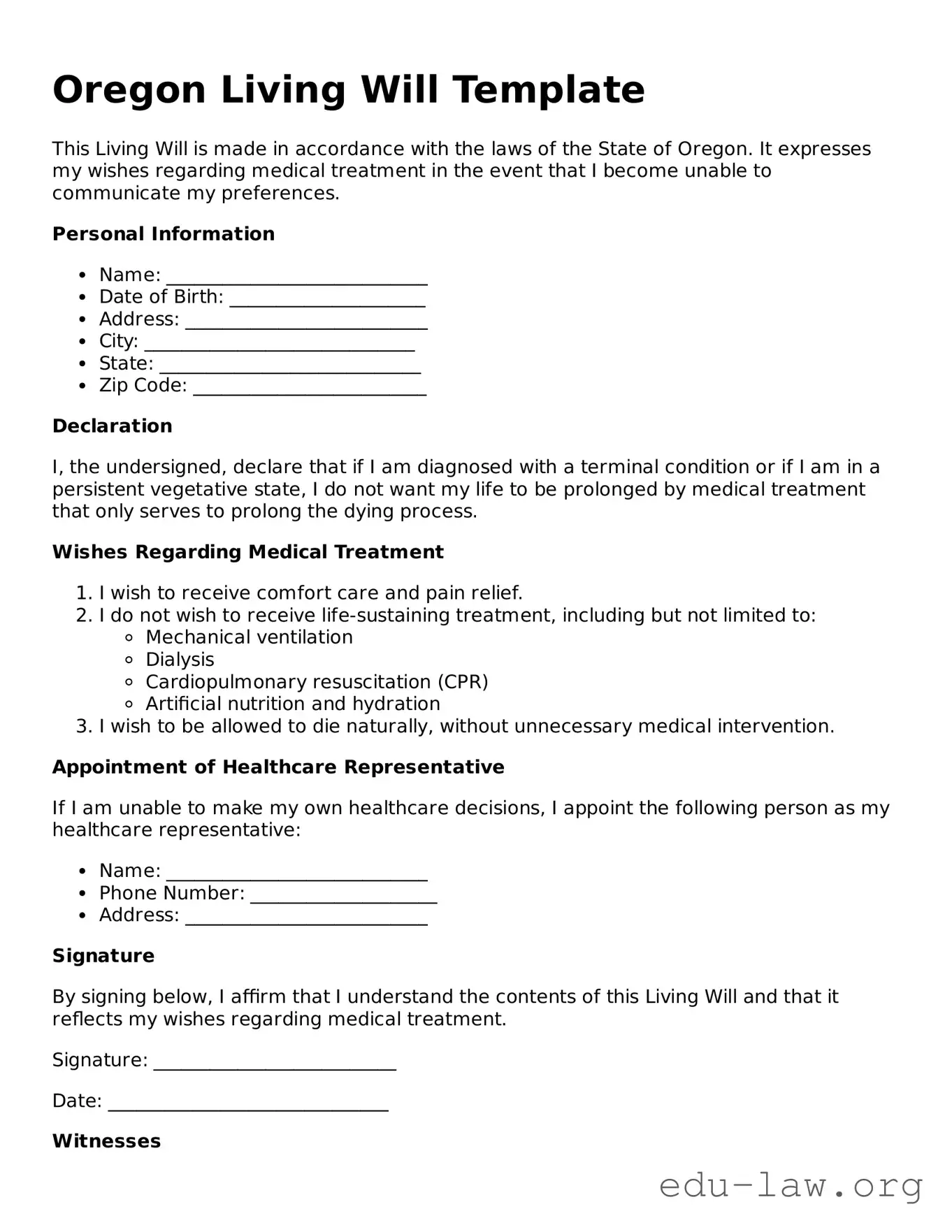
Oregon Living Will Template
This Living Will is made in accordance with the laws of the State of Oregon. It expresses my wishes regarding medical treatment in the event that I become unable to communicate my preferences.
Personal Information
Declaration
I, the undersigned, declare that if I am diagnosed with a terminal condition or if I am in a persistent vegetative state, I do not want my life to be prolonged by medical treatment that only serves to prolong the dying process.
Wishes Regarding Medical Treatment
Appointment of Healthcare Representative
If I am unable to make my own healthcare decisions, I appoint the following person as my healthcare representative:
Signature
By signing below, I affirm that I understand the contents of this Living Will and that it reflects my wishes regarding medical treatment.
Signature: __________________________
Date: ______________________________
Witnesses
This document must be signed in the presence of two witnesses who are not related to me and who will not inherit from me.
| Fact Name | Description |
|---|---|
| Governing Law | The Oregon Living Will form is governed by Oregon Revised Statutes (ORS) 127.531 to 127.541. |
| Purpose | This form allows individuals to express their wishes regarding medical treatment in case they become unable to communicate. |
| Eligibility | Any adult resident of Oregon can complete a Living Will. |
| Signature Requirement | The form must be signed by the individual and witnessed by two adults who are not related to the individual. |
| Witness Restrictions | Witnesses cannot be beneficiaries of the individual's estate or employees of the individual's healthcare provider. |
| Revocation | An individual can revoke their Living Will at any time, either verbally or in writing. |
| Healthcare Proxy | A Living Will does not appoint a healthcare proxy; a separate document is needed for that purpose. |
| Storage | It is recommended to keep the Living Will in a safe but accessible place and provide copies to family members and healthcare providers. |
| Legal Assistance | While legal assistance is not required, it can be beneficial to ensure that the form accurately reflects the individual's wishes. |
Filling out the Oregon Living Will form is a straightforward process that allows individuals to express their wishes regarding medical treatment in case they become unable to communicate those wishes themselves. After completing the form, you will need to ensure it is signed and witnessed properly to be legally valid.
What is a Living Will in Oregon?
A Living Will is a legal document that allows individuals to outline their preferences for medical treatment in the event they become unable to communicate their wishes. In Oregon, this document typically addresses end-of-life care and can specify whether a person wants to receive life-sustaining treatments, such as resuscitation or mechanical ventilation, if they are terminally ill or in a persistent vegetative state. It serves to ensure that a person's healthcare decisions are honored according to their values and desires.
How do I create a Living Will in Oregon?
To create a Living Will in Oregon, you can use a standardized form provided by the state or draft your own document, ensuring it meets legal requirements. The form must be signed by you and witnessed by two individuals who are not related to you and who do not stand to benefit from your estate. Alternatively, you may choose to have your Living Will notarized. It is advisable to discuss your wishes with your healthcare provider and family members to ensure everyone understands your intentions.
Can I change or revoke my Living Will?
Yes, you can change or revoke your Living Will at any time, as long as you are mentally competent. To revoke it, you can simply destroy the document or create a new Living Will that explicitly states your updated wishes. It is important to inform your healthcare provider and family members about any changes to ensure they are aware of your current preferences. Keeping a copy of the updated document in a safe place and providing copies to relevant parties can help avoid confusion.
Is a Living Will the same as a Durable Power of Attorney for Healthcare?
No, a Living Will and a Durable Power of Attorney for Healthcare are not the same, although they both relate to healthcare decisions. A Living Will specifically outlines your wishes regarding medical treatment, while a Durable Power of Attorney for Healthcare designates an individual to make healthcare decisions on your behalf if you are unable to do so. It is possible to have both documents in place, ensuring that your preferences are communicated and that someone you trust can advocate for you in medical situations.
Not clearly stating their wishes. Individuals often fail to articulate their preferences regarding medical treatment, leading to confusion for healthcare providers.
Forgetting to date the document. A missing date can create issues regarding the validity of the Living Will, especially if multiple versions exist.
Neglecting to sign the form. Without a signature, the document is not legally binding, rendering it ineffective in a medical situation.
Not having witnesses present. Oregon law requires at least two witnesses to sign the form. Failing to do so can invalidate the document.
Using outdated forms. It is important to ensure that the most current version of the Oregon Living Will form is used to comply with current laws.
Overlooking the need for periodic reviews. Individuals should regularly review and update their Living Will to reflect any changes in their health status or personal wishes.
Assuming family members will know their wishes. Communication is essential. Without discussing their preferences, family members may be uncertain about what actions to take.
A Living Will is an important document that outlines your preferences for medical treatment in case you become unable to communicate your wishes. Along with the Oregon Living Will form, there are several other documents that can help ensure your healthcare preferences are honored. Here are four commonly used forms and documents:
Using these documents in conjunction with the Oregon Living Will form can help ensure that your healthcare preferences are clearly communicated and respected. It is advisable to review and update these documents periodically to reflect any changes in your wishes or circumstances.
The Oregon Living Will form is similar to the Advance Directive for Health Care, which allows individuals to specify their healthcare preferences in advance. This document empowers people to make decisions about their medical treatment if they become unable to communicate those wishes. Like the Living Will, the Advance Directive can outline preferences for life-sustaining treatments and appoint a healthcare representative to make decisions on behalf of the individual.
Another comparable document is the Durable Power of Attorney for Health Care. This legal instrument enables individuals to designate someone they trust to make healthcare decisions for them when they are incapacitated. Similar to the Living Will, it ensures that a person’s medical preferences are respected, but it places more emphasis on appointing a trusted person to advocate for those wishes in various situations.
The Do Not Resuscitate (DNR) Order is also akin to the Oregon Living Will. A DNR specifically instructs medical personnel not to perform CPR if a patient’s heart stops or they stop breathing. While a Living Will covers a broader range of medical decisions, a DNR focuses solely on the choice to avoid resuscitation efforts, making it a critical component of end-of-life planning.
The Physician Orders for Life-Sustaining Treatment (POLST) is another document with similarities. POLST translates a patient’s treatment preferences into actionable medical orders. Unlike the Living Will, which is often broader and more general, POLST provides specific instructions for emergency medical personnel, ensuring that a patient’s wishes are followed in critical situations.
The Health Care Proxy is a document that allows individuals to appoint someone to make healthcare decisions on their behalf. This is similar to the Durable Power of Attorney for Health Care but may not necessarily include specific treatment preferences. Both documents aim to ensure that a person’s healthcare choices are honored when they cannot speak for themselves.
The Five Wishes document combines aspects of a Living Will and a healthcare proxy. It allows individuals to express their medical, personal, emotional, and spiritual wishes in a comprehensive manner. This document not only addresses medical treatment preferences but also covers how individuals want to be treated and what they wish their loved ones to know, making it a holistic approach to end-of-life planning.
The Advance Care Plan is similar in that it encourages individuals to discuss their healthcare preferences with family and healthcare providers. It serves as a guide for making decisions that align with a person’s values and wishes. While it may not be a legally binding document like a Living Will, it plays a crucial role in ensuring that loved ones understand a person’s desires regarding medical treatment.
The Medical Power of Attorney is another document that shares similarities with the Living Will. This legal document grants a designated individual the authority to make medical decisions on behalf of someone else. While the Living Will outlines specific treatment preferences, the Medical Power of Attorney focuses on granting decision-making power to a trusted person, ensuring that healthcare choices are made in line with the individual’s values.
Finally, the End-of-Life Care Plan is a document that addresses preferences for care during the final stages of life. It encompasses a wide range of considerations, including pain management, emotional support, and spiritual care. While the Living Will primarily focuses on medical treatment preferences, the End-of-Life Care Plan takes a more comprehensive approach to ensure that all aspects of a person’s experience are honored as they approach the end of life.
When filling out the Oregon Living Will form, it is crucial to be thorough and precise. Here are some key points to consider:
Taking these steps can help ensure that your wishes are respected in the event of a medical emergency.
Understanding the Oregon Living Will form is crucial for making informed decisions about end-of-life care. However, several misconceptions can lead to confusion. Here’s a breakdown of ten common misunderstandings:
By dispelling these misconceptions, individuals can better navigate their options and ensure their healthcare preferences are honored. Understanding the nuances of the Oregon Living Will form is a vital step in preparing for the future.
Filling out a Living Will in Oregon is an important step in ensuring your healthcare wishes are respected. Here are some key takeaways to keep in mind:
Taking the time to fill out a Living Will can provide peace of mind for you and your loved ones. It empowers you to make decisions about your own healthcare, even when you cannot speak for yourself.