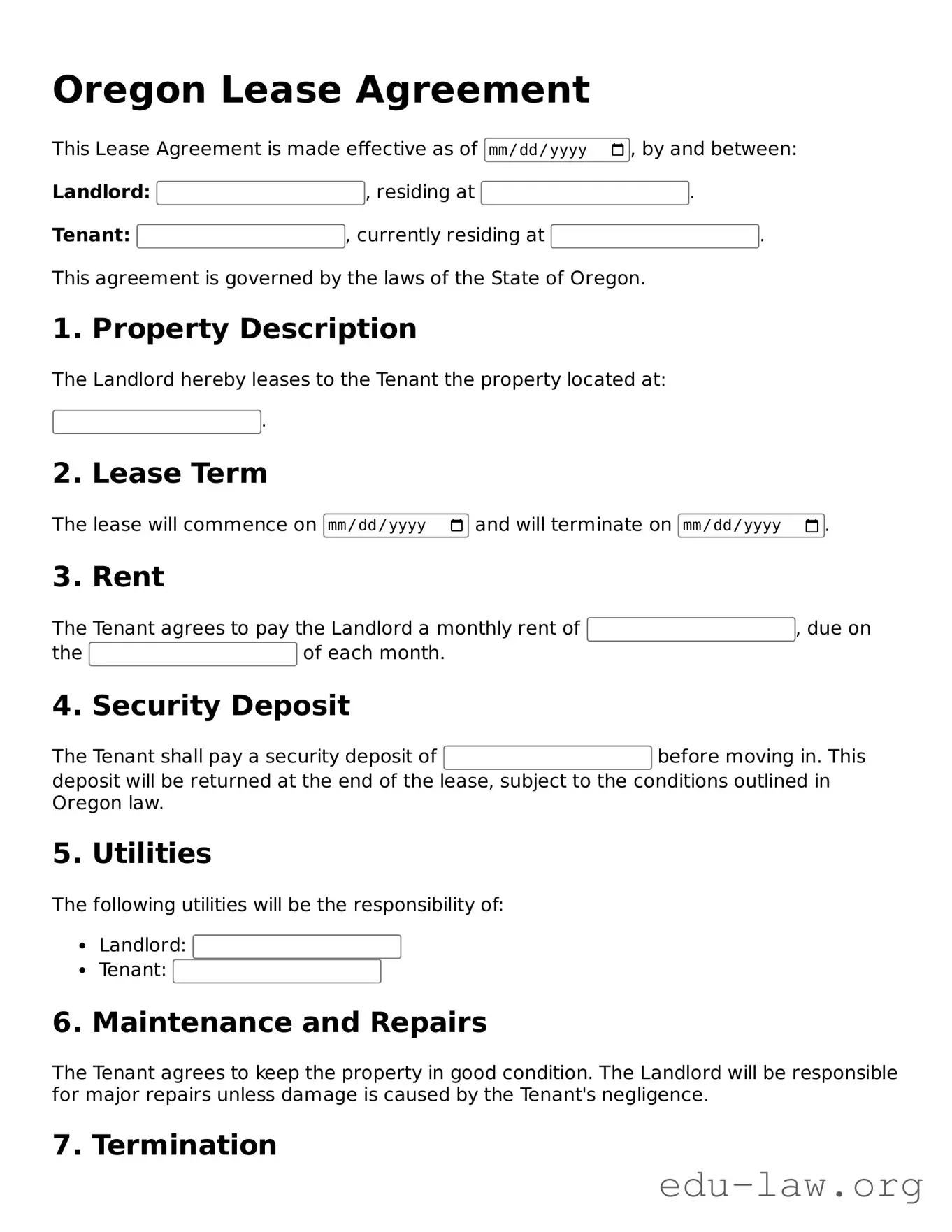
The Oregon Lease Agreement form serves as a crucial document in the rental process, outlining the rights and responsibilities of both landlords and tenants. This form typically includes essential details such as the names of the parties involved, the rental property address, and the duration of the lease. Additionally, it specifies the amount of rent due, payment methods, and any security deposit requirements. Important terms regarding maintenance responsibilities, rules for pets, and conditions for terminating the lease are also clearly articulated. By establishing these parameters, the form aims to foster a transparent and respectful relationship between landlords and tenants, ensuring that both parties understand their obligations. It is vital for individuals entering into a rental agreement in Oregon to carefully review this document to avoid potential disputes and to promote a harmonious living environment.
Oregon Lease Agreement
This Lease Agreement is made effective as of , by and between:
Landlord: , residing at .
Tenant: , currently residing at .
This agreement is governed by the laws of the State of Oregon.
1. Property Description
The Landlord hereby leases to the Tenant the property located at:
.
2. Lease Term
The lease will commence on and will terminate on .
3. Rent
The Tenant agrees to pay the Landlord a monthly rent of , due on the of each month.
4. Security Deposit
The Tenant shall pay a security deposit of before moving in. This deposit will be returned at the end of the lease, subject to the conditions outlined in Oregon law.
5. Utilities
The following utilities will be the responsibility of:
6. Maintenance and Repairs
The Tenant agrees to keep the property in good condition. The Landlord will be responsible for major repairs unless damage is caused by the Tenant's negligence.
7. Termination
Either party may terminate this lease by providing written notice at least days in advance.
8. Governing Law
This Agreement shall be governed by and construed in accordance with the laws of the State of Oregon.
9. Signatures
By signing below, both parties agree to the terms outlined in this Lease Agreement.
__________________________
Landlord Signature
__________________________
Tenant Signature
Date:
| Fact Name | Description |
|---|---|
| Governing Law | The Oregon Lease Agreement is governed by the Oregon Revised Statutes, specifically ORS Chapter 91. |
| Types of Leases | This form can be used for various types of residential leases, including month-to-month and fixed-term leases. |
| Security Deposit | Oregon law limits the amount a landlord can charge for a security deposit to no more than one month's rent. |
| Notice Requirements | Landlords must provide written notice for rent increases and lease termination, adhering to state-mandated timelines. |
| Tenant Rights | Tenants in Oregon have specific rights regarding habitability, privacy, and protection against retaliation. |
Filling out the Oregon Lease Agreement form is an important step in establishing the terms of a rental arrangement. By completing this form accurately, both landlords and tenants can ensure that their rights and responsibilities are clearly defined.
After completing the form, keep a copy for your records. It’s advisable for both parties to review the signed agreement together to confirm that all details are accurate and understood.
What is an Oregon Lease Agreement form?
An Oregon Lease Agreement form is a legal document that outlines the terms and conditions between a landlord and a tenant for renting residential or commercial property in Oregon. It specifies details such as the rental amount, duration of the lease, and responsibilities of both parties.
What should be included in an Oregon Lease Agreement?
The agreement should include the names of the landlord and tenant, property address, lease term, rent amount, payment due dates, security deposit details, maintenance responsibilities, and any rules or restrictions. It may also cover procedures for terminating the lease and handling disputes.
Is a written lease required in Oregon?
While oral leases can be valid, a written lease is highly recommended. A written document provides clarity and serves as evidence of the agreed-upon terms, which can protect both parties in case of disputes.
How long can a lease last in Oregon?
Leases in Oregon can vary in length. They can be short-term (month-to-month) or long-term (typically one year or more). The duration should be clearly stated in the lease agreement.
What happens if a tenant wants to break the lease early?
If a tenant wishes to break the lease early, they may be responsible for paying rent until a new tenant is found or until the lease term ends, depending on the lease terms. It is advisable to communicate with the landlord to discuss options and potential penalties.
Can landlords increase rent during a lease term?
Generally, landlords cannot increase rent during a fixed-term lease unless the lease specifically allows for it. For month-to-month leases, landlords must provide written notice of the rent increase, typically 30 days in advance.
What is a security deposit, and how is it handled in Oregon?
A security deposit is a sum of money collected by the landlord to cover potential damages or unpaid rent. In Oregon, the maximum security deposit is typically one month's rent. The landlord must return the deposit within 31 days after the tenant moves out, minus any lawful deductions.
Are there any specific laws governing lease agreements in Oregon?
Yes, Oregon has specific laws that govern lease agreements. These include regulations on security deposits, rent increases, eviction procedures, and tenant rights. It is important for both landlords and tenants to be aware of these laws to ensure compliance.
What should tenants do if they have a dispute with their landlord?
If a tenant has a dispute with their landlord, they should first attempt to resolve the issue through direct communication. If that fails, tenants can seek mediation or legal assistance. Documenting all communications and keeping records of the lease agreement can be beneficial.
Incomplete Information: Many people forget to fill in all required fields. Missing names, addresses, or dates can lead to confusion later on.
Incorrect Dates: It's crucial to enter the correct start and end dates for the lease. Mistakes here can cause issues with tenancy.
Omitting Signatures: Both the landlord and tenant must sign the agreement. Without signatures, the lease is not valid.
Ignoring Terms and Conditions: Some overlook important terms, such as pet policies or maintenance responsibilities. Understanding these details is essential.
Not Reviewing Rent Amount: Double-check the rent amount and payment due date. Errors can lead to financial misunderstandings.
Neglecting to Include Contact Information: Always provide up-to-date contact details. This helps in communication between landlord and tenant.
Forgetting to Specify Utilities: Clarify which utilities are included in the rent. This prevents disputes over bills later.
Failing to Understand the Renewal Terms: Read the renewal options carefully. Knowing how to proceed at the end of the lease term is important.
When entering into a rental agreement in Oregon, several additional forms and documents may be necessary to ensure a clear understanding between landlords and tenants. These documents help outline responsibilities, rights, and procedures related to the rental property. Below is a list of commonly used forms that often accompany the Oregon Lease Agreement.
These documents collectively contribute to a transparent and organized rental process. They protect the interests of both landlords and tenants, fostering a respectful and responsible rental relationship.
The Oregon Lease Agreement form shares similarities with the Rental Agreement form, which outlines the terms under which a tenant rents property from a landlord. Both documents specify the duration of the rental period, the amount of rent due, and the responsibilities of both parties regarding maintenance and repairs. While a lease typically covers a longer term, such as one year, a rental agreement may be more flexible, often used for shorter-term arrangements. Both documents serve to protect the rights of tenants and landlords, ensuring that expectations are clearly communicated and legally enforceable.
Another document akin to the Oregon Lease Agreement is the Commercial Lease Agreement. This type of lease is specifically designed for renting business properties. Like residential leases, commercial leases detail the rental terms, including payment schedules and maintenance responsibilities. However, they often include additional clauses tailored to business needs, such as zoning regulations and permitted use of the property. Both agreements aim to create a legally binding relationship that clarifies the obligations of each party, though the focus and terms may differ significantly based on the type of property involved.
The Sublease Agreement also bears resemblance to the Oregon Lease Agreement. A sublease occurs when a tenant rents out their leased property to another party, known as the subtenant. This document outlines the terms under which the subtenant can occupy the property, including rent payments and the duration of the sublease. While the original lease agreement remains in effect between the landlord and the primary tenant, the sublease provides an additional layer of detail regarding the relationship between the primary tenant and the subtenant. Both documents are essential for ensuring that all parties understand their rights and obligations.
Lastly, the Lease Termination Agreement is another document that complements the Oregon Lease Agreement. This document is used when either party decides to end the lease before its natural expiration. It outlines the conditions under which the lease can be terminated, including notice periods and any penalties for early termination. Similar to a lease agreement, the termination agreement seeks to protect the interests of both the landlord and tenant, ensuring that the process of ending the rental relationship is clear and legally binding. By detailing the steps for termination, both parties can avoid potential disputes and misunderstandings.
When filling out the Oregon Lease Agreement form, attention to detail is crucial. Here are some important dos and don’ts to keep in mind:
By following these guidelines, you can help ensure that your lease agreement is completed correctly and effectively protects your rights as a tenant or landlord.
Misconceptions about the Oregon Lease Agreement form can lead to confusion for both landlords and tenants. Understanding these misconceptions is crucial for effective communication and compliance with the law. Below are nine common misconceptions clarified:
While both documents serve to outline the terms of a rental arrangement, a lease agreement typically covers a longer duration, often a year, whereas a rental agreement may be month-to-month.
Although it is highly recommended for clarity and legal protection, oral leases for a term of less than one year can be enforceable under Oregon law.
Landlords must adhere to state laws regarding what can and cannot be included in a lease agreement. Certain clauses, such as those that discriminate against protected classes, are illegal.
Amendments can be made to a lease agreement if both parties agree to the changes and document them in writing.
Oregon law places specific limits on security deposits, including how much can be charged and the timeline for returning the deposit after the lease ends.
Landlords must provide reasonable notice, typically 24 hours, before entering a tenant's unit, except in emergencies.
Tenants retain rights throughout the lease term, including the right to a habitable living environment and protection against unlawful eviction.
While there are standard forms, lease agreements can vary significantly based on local laws and individual landlord preferences.
Tenants also have the right to terminate a lease under certain circumstances, such as constructive eviction or breach of lease terms by the landlord.
Filling out and using the Oregon Lease Agreement form requires attention to detail and understanding of the rights and responsibilities of both landlords and tenants. Here are some key takeaways: